


Your sourdough starter is a mixture of yeasts and suitable bacteria that co-exist to leaven and flavor bread dough. I’ve been maintaining my starter for over ten years now, regularly feeding it twice a day, every day, and the process is so familiar I don’t even think about it anymore. But it’s nothing mystical or magical, my sourdough starter is a culture I give nourishment (flour and water), and in return, it happily does work for me without even realizing it. But many uncertainties can arise along with its maintenance, and this frequently asked sourdough starter questions post is here to help.
I’ve been compiling this list of starter questions for almost as long as this website has been around. Each time I receive an email or comment asking a question about what I do in a particular situation, I’ve saved it and added the most commonly asked questions below.
If you’ve arrived here before you have a starter, it might be worthwhile to have a read-through to internalize some of these questions and answers. Then head to my guide to creating a sourdough starter and get started.

How Do I Create a Sourdough Starter?
I’ve written a detailed post with pictures and clear instructions on creating a sourdough starter in 7 easy steps.
Do I Have To Use Whole-Grain Rye Flour For A Sourdough Starter?
I call for whole-grain rye flour when creating a starter because the additional nutrients in rye flour help speed up the process. You can certainly use whole wheat flour or even white (sifted) flour if you’d like, but I find rye flour to be the most effective flour at the beginning. If you don’t have rye flour, then whole wheat works!
I Think My Sourdough Starter Died. Is it Dead?
It’s normal to see a lapse of activity at some point when first creating a sourdough starter—this is normal. The initial proliferation of action at the beginning of creating a starter is from a different type of bacteria in your mixture that will eventually be replaced by the kind we are looking for (lactic acid bacteria). Keep feeding, and discarding, as I outline in my creation guide. Eventually, your mixture will slowly become more and more acidic (low pH), killing off other bacteria and allowing the beneficial yeasts and bacteria we are looking for to take hold.
I’ve Been Following Your Starter Creation Guide, But Nothing is Happening. What’s Wrong?
The most common problem I see people face is low temperatures: it’s easier to create your starter if you keep it warmer. Cold temperatures (below 70°F/21°C) will slow the process down significantly, whereas warmer temperatures (around 76-82°F/24-26°C) will speed it up. Try to find a warm spot in your kitchen to keep your starter, or use more lukewarm water for feeding. For more information on starter and dough temperatures, see my post on the importance of dough temperature.

Should I Cover My Sourdough Starter Jar?
I like to keep mine covered loosely to keep anything from falling inside the jar and the starter from drying out. The lid does not have to be airtight. I loosely place a glass lid on top (my favorite sourdough starter jars have a glass lid that rests on top), but it’s not sealed shut.
When Is My Sourdough Starter Ready?
Once you see predictable signs of fermentation (rise, bubbles, a transformation in aroma from sweet to sour, etc.) each day, it should be strong enough for baking. When creating a starter from scratch, you might see a spur of activity at the beginning of the process, but you want consistent signs of fermentation day after day before it’s strong enough to use for leavening. Typically, when creating a new starter, this is after 5-8 days.
Do I Have to Make a Levain?
It’s always an option to use your starter instead of making a levain. But, for most recipes, I prefer making a levain so I can control the flour going into the levain, the ripening timeline, and when I use it to mix into a dough—all of this without having to adjust my continually maintained sourdough starter.
For example, I might make a levain with all white flour and use it before being overly ripe for my cinnamon rolls. This will help to ensure the end rolls will not have an overly sour flavor.
What Kind of Container Is Best For a Sourdough Starter?
You can use just about anything. I like to use clear glass containers to observe the sides and bottom, and these Weck jars are my favorite. They have a glass lid that rests on top just in case too much pressure builds up inside the jar from fermentation. Canning glass jars are also a perfect choice.
How Often Should I Clean My Sourdough Starter Jar?
Use the same jar daily and keep it as clean as possible. During a feeding, discard part of your starter per usual and then scrape down as much residual starter as possible, reincorporating it back into the mixture. Then wipe the top and sides of the jar with a towel to remove any remaining liquid. If you can get the top half reasonably clean, that’s good enough. The bottom half of the jar will most likely be covered when your starter rises during the day, anyway.
What Water is Best For a Sourdough Starter?
Regular drinking water from the tap is just fine. Fill up a large container and let it sit on the counter overnight before using it to allow any chlorine in your tap water to dissipate.
What Can I Do With Sourdough Starter Discard?
Cook or bake with it! You can use leftover starter into banana bread, waffles, pancakes, tea cakes, muffins, pizza, cookies, and so on. If you want to use less flour overall, check out my guide to maintaining a smaller sourdough starter. Aside from using sourdough discard in other foods, I will almost always compost any leftovers, only using the trash as a last resort.

Can I Refrigerate My Sourdough Starter?
You can absolutely store your starter in the fridge, especially for vacation. To prepare for the fridge, I will wait until the starter needs a refreshment, discard all but 20g of ripe starter, and then refresh it with 100g flour and 80g water (I like the culture to be a bit on the stiff/dry side). After refreshing, let it sit on the counter for 1 hour, then toss it into the fridge. I will usually use the same Weck jars for this, and the cover will be loosely placed on top so nothing can fall in, but excess gasses can escape.
When I want to bake again, I will remove my starter from the fridge, let it ferment on the counter for a few hours, and then feed it as I would normally. I will do this a few days before I plan to bake to get the culture back up to strength.
See my post on storing a sourdough starter for tips on keeping it in the fridge or other methods for longer periods over two to three weeks.
Why Doesn’t The Sourdough Starter Float Test Work?
The float test is a good general indicator for when a starter or levain has significant fermentation, but I find it is not 100% reliable in testing for when a starter is ready for use. It can lead to false positives, but, as I discuss below, when your starter makeup is not with a majority of white flour at a moderate to high hydration, it will also rarely float, even if your starter is ripe. Instead of using the float test, I look for signs of strong fermentation and ripeness.
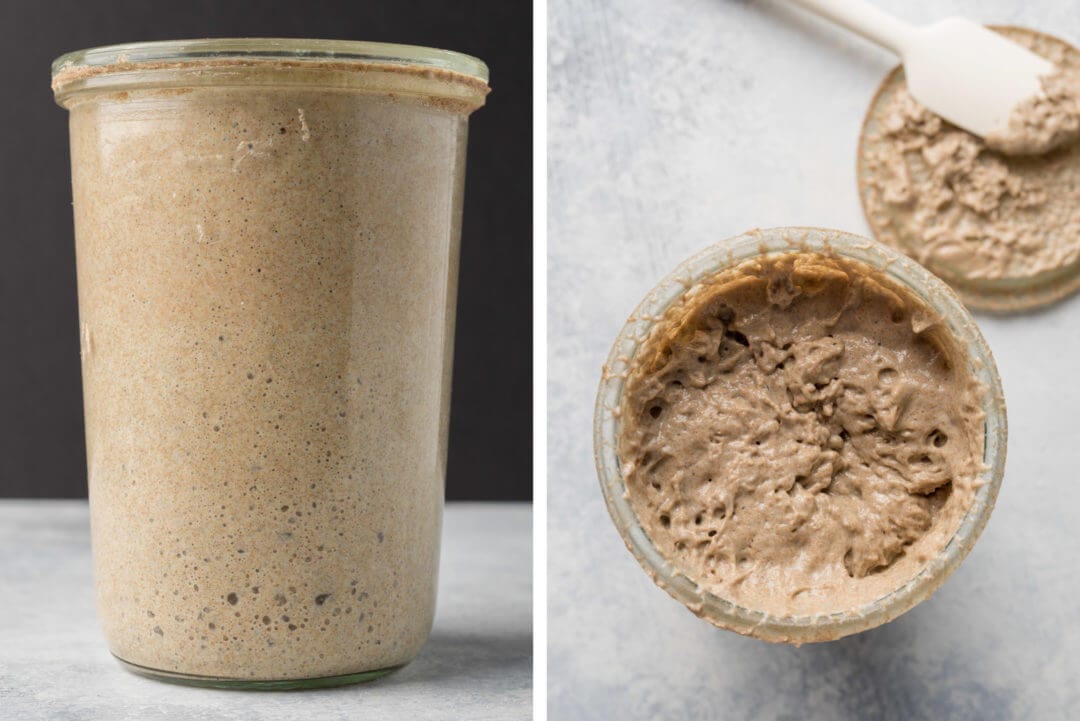
Why Isn’t My Sourdough Starter Strong?
If you’ve just created your starter, give it time to ripen. With consistent, predictable refreshments, you will “train” your starter into strength, and it will display the same signs of strong fermentation each day. Temperature is also incredibly important here: keeping your starter relatively warm (I prefer 76-80°F/24-26°C) will encourage increased activity.
Why Does My Sourdough Starter Take Forever To Ripen?
Several factors play into the fermentation vigor of your starter, and the most important one is temperature. Try to find a warm spot in your kitchen to keep your starter, or use more lukewarm water to feed it. Shoot for 76°F – 80°F (24-26°C) ambient temperature for increased fermentation activity. Maintaining a stable temperature is important, and if there’s one thing I like to focus on with my starter, it’s temperature.
Flour selection also plays into the fermentation activity; the more whole grains you use to refresh, the higher the fermentation rate in your culture.
And, of course, the amount of ripe starter you carry over from feeding to feeding plays a significant role. The larger the percentage, the faster your newly refreshed culture will ripen.
All of these variables can be tweaked to speed up, or slow down, the time it takes for your starter to ripen and need a refreshment. My preferred method for changing my starter’s ripening timeline is to adjust the amount of starter I leave in the jar for each refreshment (the carryover). If it’s summertime, I will usually carry over a smaller percentage of ripe starter (15% or so) at each refreshment to slow things down so I can maintain my twice-a-day refreshment schedule. If it’s winter and temperatures are lower, I’ll carry over an increased amount of ripe starter (25% or so) into my next refreshment.
How Often Should I Feed My Sourdough Starter?
This question is very temperature and flour-dependent. If the ambient temperature in your kitchen is on the warmer side, 75-80°F (23-26°C), then you’ll find your starter ferments much faster than if it were cooler (less than 75°F/23°C). Likewise, you’ll see higher fermentation rates if you use a large percentage of whole grains in your refreshment.
I prefer to feed my starter twice daily to keep it healthy and ready to bake at any moment. But then again, I bake very, very frequently. If temperatures are not overly high, I recommend a single daily feeding. If your starter falls significantly in its jar, looks broken down and loose, and smells like harsh vinegar or paint, try using a smaller percentage of ripe starter at each feeding. You can also find a cooler spot in your kitchen or use colder water to feed.
For example, in the summer (typically 75-78°F/23-26°C in my kitchen), I feed my starter twice a day, but even then, I have to reduce my ripe starter carryover percentage. Instead of my usual 20-25% in the winter, I drop it down to 10-15% and find a shaded, cool spot in my kitchen to slow things down. For more information on this, including pictures, see my post on maintaining your sourdough starter.
How Can I Feed My Sourdough Starter On Workdays?
For a very in-depth discussion on how to maintain your starter in the fridge during the week and use it to bake on the weekend, head over to my Weekend Baking Schedule guide! Additionally, see the previous question for what “tools” you can utilize to speed up or slow down your starter’s fermentation rate.
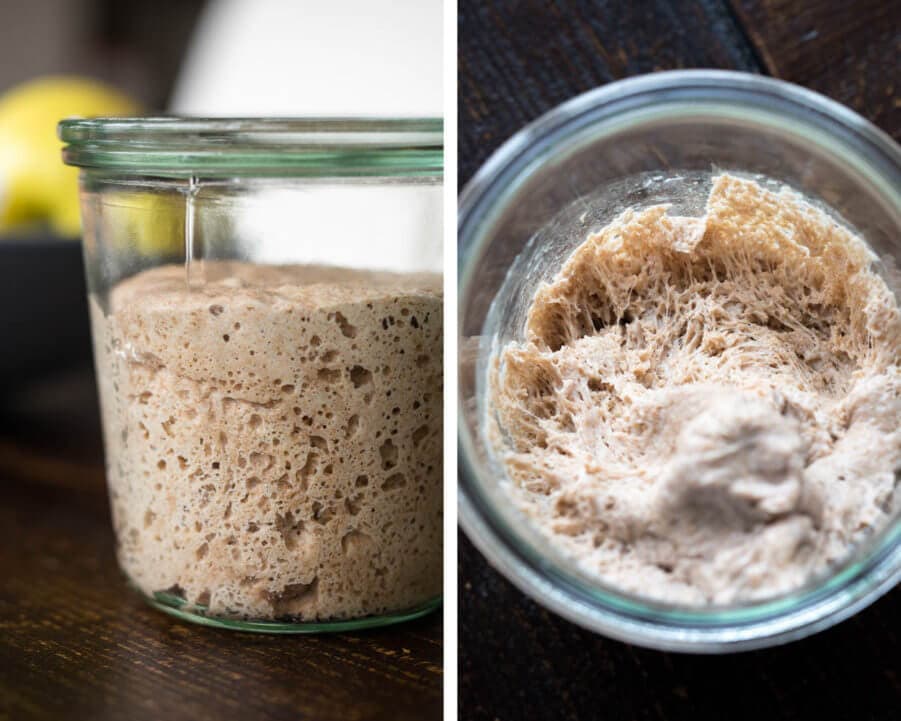
What Hydration is Best For a Sourdough Starter?
Of course. When it’s significantly hot and dry here in the summer, and the flour seems to need more water, I’ll increase my hydration to 105% or higher as required. You can adjust the amount of water you use at each refreshment so the mixture displays the desired viscosity. As the humidity level in your environment changes, adjust the hydration up and down by 5% to compensate.
My Starter Has Clear Liquid On Top, Should I Throw It Out?
You can either discard this liquid (or “hooch,” as it’s commonly called) or stir it back into the culture. I typically stir it all in together. This can be a sign you’re not feeding your starter often enough.
How Does Altitude Affect My Sourdough Starter?
You might see increased fermentation activity at high elevations. See my baking at high altitude guide for more tips.
What’s Next?
If you’re having issues with your sourdough starter and haven’t found help above, post at our member community for help!
For more starter-related things, look at my ultimate guide to sourdough starters for help and advice with feedings, maintenance temperatures, long-term storage, and much more.
Happy baking!


516 Comments
Hi all, I’ve just started my sourdough adventure with a starter gifted from my daughter. My question (which I couldn’t find an answer for in the FAQs so apologies if it’s been asked and answered) is how to keep the discarded starter to cook with on weekends? Do I just keep it in a jar, adding to it after each feed and leave then it on the bench or fridge? I’m in Sydney, Australia and we’re just starting to get into cooler weather. Thanks so much in advance!
I store discards in the largest canning jar (64oz) I have. I just keep it in the refrigerator and use some as needed. It seems to do OK on its own, and ends up being a good back up. If it starts to die out, I either feed it some flour or just end up throwing it out, depending on my plans for using it.
Hello Maurizio. I have enjoyed your site after it was shared by a friend and been inspired to try my hand at bread baking as we all continue to hibernate due to COVID-19. My first attempt to create a starter was hampered on day 2 when a family member had accidentally pre-heated the oven, forgetting the starter was quietly resting inside. As for my second starter, I saw bubbles and significant rise/fall on by day 2, but since then — I am now on day 7 — hardly any activity at all other than 1-2 bubbles. It has been quite cool and rainy here over the last week or so and since the first incident, I have not kept the starter in the oven but a warm room (however, I have been lucky if the room hits 72 degrees F). Perhaps a bigger issue, however, I just realized last evening that I had been feeding 125 g water at every feeding (obviously I cannot read directions properly!). I reduced the amount of water down yesterday per your instructions for day 5-6 to 115 g, and for day 7 (this morning) I reduced down to 100 g. Can you tell me if my starter is ok (will survive), or do I need to start over? Thank you for your advice, angela
Hi Maurizio! I’m on day 7 of my starter. It is 100% whole rye, I feed it in ratio 1:1:1 and it is rising, honestly, like a maniac. I switched to two feeds on about day 5, but since then feeding it every 12 hours seems to be too little, because by the time I feed it again it has sunk quite a bit and smells WAY too acidic. I’ve adjusted water temperature (colder) and moved it to a cooler spot in the house, but the starter doesn’t seem fazed and just keeps on going. I did feed it 3 times in the last 24hours, which definitely improved the smell, but that seems like a lot of work and wastage if I keep that up. Do you have a suggestion for what I could try so that I don’t have to feed it more than twice a day? Thanks so much for all your amazing posts and advice!
I’m new to this as well. From his notes;
“the extra nutrients in whole rye flour help speed up the process. After your starter is rising and falling predictably, you can change over to any flour combination you’d like throughout a few feedings.”
You may try reducing the amount of rye in your starter and or using a 1:5:5 feed ratio. I was using 1:1:1 without success. After reading this article I’m switching to 1:5:5.
Hi – Thanks so much for all this help and guidance! I’m on day four of starting my starter. It had lots of activity in day two, nothing in day 3, and on day three and this morning (day 4) It had a very weird smell, almost like warm, spoiled yogurt or cheese. I’ve read this is a bad sign, but am wondering if it can be saved or needs to be scrapped. I went ahead and gave it a feed this morning and plan to do a second feed these evening per your instructions to start two daily feeds on day 4. Should i keep feeding or just start over?
Hello! Great article, thank you for posting it. My starter is a slow riser, it’s pretty cold here at the moment. It’s about two weeks old and rising every 18-24 hours (room temp), which means I have ended up feeding it at the top of it’s peak (currently feeding once per day). Is that ok, do you recommend feeding the starter at its peak or waiting until it’s dropped a little bit? Thank you!
I am honestly a very forgetful person, and work in the service industry, so I often have unpredictable hours. How much flexibility is there on this. If I’m regularly a few hours late or early on a feeding, or semi regularly miss a feeding, will it be an issue long term?
Absolutely not a problem at all. A few hours — heck, even a whole day — will be ok. Our cultures are a very resilient thing, they’ll spring back and keep going under some of the most intense conditions, and a few hours isn’t a problem 🙂
When hooch develops, should you feed it then or wait until the normal feeding time ?
Thanks in advance !
Usually that’s a sign it needed a refreshment a little earlier. You can wait and it would be ok, but I’d likely give it a refreshment!
Hi Maurizio,
I’ve been baking with your weekday sourdough recipe and have had some success. I have two questions I can’t seem to work out.
1. Following the weekday levain recipe, I keep getting less than 165g by the end of the 10 hours. 5-10grams short. Is this a big issue? I’ve made loaves fine but I assume there’s probably textural issues etc.?
2. You mentioned in one of your articles that you feed your levain twice a day so it is ready whenever you need to bake. Since i’ve been baking more now I keep my starter outside at room temp and feed at 9AM and 9PM. If I was to feed it again at 9PM, can I use the starter right away at 11PM to build my levain for the next day at 9AM?
Thank you for your time! Love the website.
Glad to hear that, Oliver! Answers:
1. It’s ok if it’s a little short, that happens (some loss to the jar, spatula, etc.).
2. Yes, when you’d normally refresh your starter is a good time to use that mature starter to make a levain.
Happy baking and thank you!
Hi, I get a thin brownish crust on my starter which is fermenting very well. Do I peel and discard it or just stir it in at each feeding? Thanks
Hey, Bryan! I like to keep a lid loosely on top of my jar to prevent air from getting into the jar which can cause that crust to form (make sure it’s loose so any gasses built up during fermentation can escape!). You could peel it off, that’s likely what I would do. Hope that helps and happy baking!
Thanks Maurizio…..I will give it a go!
There is a layer of water at then bottom of my starter. Do i drain it? Add more flour less water? Today is day 4 since making starter from scratch. It passed float test this am. What do you think?
You could drain it or mix it in, either way will be fine. I’d give it a stir midway between refreshments to avoid separation.
I started my starter today but almost 9 hours later there’s no rise. It is a little bit cold in my house, would moving it to a warmer spot salvage it or should I just start over from scratch?
Definitely don’t throw it out, you’ve just begun! Give it some time, several days are needed at the very least. Yes, a warm spot (78-80F) would be helpful!
Thanks! It’s day 3 and it finally started seeing activity. However I started to put the jar in a water bath of 80 degrees after I feed it. Will the warm spot requirement be needed once the starter is mature enough?
Once it’s established it’ll work just fine and just about any temperature (68-85F or so) 🙂
My starter is on day 6! Doing a good job of rising and falling (I think or maybe just wishful thinking!). Half of my starter turned dark brown on the side that was warmer. Did my starter die? Still bubbling, and smells alive… Hoping that the different color is due to varied temperature.
It’s likely just fine. I’d adjust the jar so it’s not so close to the heating element and give it a normal refreshment and continue from there. Should be just fine!
Thank you! Making bread is incredibly cathartic for me and my family! Planning to make pancakes this weekend with my leftover starter!
Hi, thank you for the great site and information! How can I use my normal yogurt maker to proof my starter?
You’re welcome, Nuno! I don’t have any experience with yogurt makers, but if you’re able to set it around 78-80°F consistent temperature, that’s how I’d go about using it — set the temperature and then keep your jar inside 🙂
It’s not tall enough to close the lid, hence the question. It’s only 12cm high…
Gotcha. Well, closing the lid would help most but you could always just place it inside at a warm temp to raise the temperature of your starter, just be careful it’s not too hot especially if your jar is near the heating element. You could also perhaps invert a bowl to cover the top of the maker with jar inside? Just a few ideas!
hi, i’ve tried following your sourdough starter guide! i’m using 100% AP flour, and i live in the tropics so it’s like 85F in my house. it’s day 3, the starter showed a lot of initial activity on day 1 and 2 but the activity died off on day 3, where hooch started appearing 4 hours after feeding. i fed it again after another 8 hours but hooch has once again appeared. is this normal? and if not what do i do? 🙂
It’s very common to see a dip in activity like this by day 3 — stick with the schedule! If you see this hooch, you can stir the starter halfway (or after 4-6 hours) between refreshments. This happens more often in very warm and humid climates. Eventually, you’ll likely have to feed sooner or leave less mature starter in the jar at each refreshment to lengthen that refreshment interval (but don’t worry about this for now, not until your starter is rising and falling predictably!).
I started a rye starter about 10 days ago, 80 gr rye flour and 80 ml water. Then everyday fed the 80 gr of starter w 80 gr flour + 80 ml of water, meaning I have a 100% hydration, is that correct? It’s my first time doing this so I am sooo confused.
In the first days I didn’t have much action, but in the last 5 days has double in size or even more. But I didn’t see it falling at all these days. The rise is constant, no fall. Yet it doesn’t flow. Should I just try to bake? Any bread recipe you can recommend? Thank you
Yes, that’s 100% hydration (80g water / 80g flour == 100%). That’s ok if it doesn’t fall as long as you’re seeing a strong rise and signs of fermentation (sour smell, bubbles, etc.). If you see this consistent activity every day it should be good to go!
I have a nice robust starter but only about 100g that I feed 2x a day. When & how do you recommend I increase this so that I can use it in your recipes that usually require 200+g? Should I increase gradually over several days?
Hey, Sue! You can increase it in one build if you’d like, just add more of each (keeping the same percentages of everything) ingredient to cover the desired quantity. Usually, though, I find making a separate, dedicated levain the best way to scale things up — many of my recipes here call for a levain for this reason. Either way will work, though!
May I know if the starter only rise and fall once in the 12 hour feeding or it will rise and fall more than once like 2x or 3x?
There are many factors contributing to a starter’s rise and fall, including: flour type, hydration, and temperature. If you’re not stirring it during this time it should only rise to a peak and fall once (it might do 2x, 3x, or even less than 2x). If you stir your starter down it will usually rise back up above the previous level assuming there’s plenty of “food” left and the flour isn’t broken down excessively. I hope that answers your question!
Hi Maurizio, I just started baking with a starter that a friend passed along to me. As I’m usually baking tiny loaves (~ 250 g), it seems like a hassle to make a separate levain (only to discard most of it again). If I were to use the starter directly into the final mix, do I simply substitute it 1 : 1 for the levain? At what stage should the starter be used? Thanks for your help, your blog is aaamazing!
Hey, Charmaine. Yes, that’s right. As I mentioned above, your starter and levain really are the same thing — just use your starter 1:1 when a levain is called for. Be sure to use your starter according to the description for when it’s supposed to be used, but generally I use mine when it’s mature and just about to, or just has, fallen in the jar. Normally this would be when you give it a refreshment.
Hope that helps!
That’s a really great suggestion, Tom. I’m adding this to my list of things to work on and will add it to this post when I get there. In fact, it’s a common question I get, so it’ll help to address that here. I should note that the hydration percentage — the number itself — is quite subjective to the flour you’re using (e.g. 100% rye flour vs 100% apw — much different even if both at 100% hydration!). Nonetheless, this would be great to have here. Thanks again!
Hey I have a pre civil war starter. I was just wondering if that is bullshit, it’s obviously not the same bacteria today as then. Not to mention it being moved around the US multiple times as I know it, collecting yeasts everywhere. Probably only the strongest culture survived. Haven’t found any info on this.
I don’t put a lot of stock in saying super old starters are something special, but it’s very possible there are strains of bacteria/yeast in the mixture that have been picked up over time which may be harder to find these days. However, typically a starter will begin to adapt to the local climate, feeding routine, and largest contributor: the flour you use to feed. It’s an evolving microbiome of bacteria and yeast that are constantly competing for survival, like you said, the strongest survive.
Great FAQ, but I have a question I couldn’t find the answer to anywhere on the web. I usually feed my starter in the evening and start making the levain in the morning. This time after I woke up in the morning, I check on it and it seems not as bubbly as usually. There are only bubbles in the bottom half. How do I tell if the starter is still in the process of rising or has already fallen? Thank you!
Does it cool off overnight? It might be getting cooler in your kitchen than you think, slowing things down. Regardless, look for signs the top level of the starter has fallen in the jar: you’ll see visible streaks on the side of the jar indicating it’s fallen some measure. You can also inspect the top of the starter, there should be lots of bubbles on top with areas that look like they might be receding a bit.
Another test you can do: let it sit out one day in the morning and check in on it ever 15-20 minutes. When you see it start to fall (don’t touch it or you’ll cause it to fall by moving it) it’ll be a good judge for about when it does so.
Hope that helps!
Hi Maurizio, I have my starter for 9 days now with whole wheat flour and all purpose flour, I feed it every 24 hours, and yes it rises, but never doubled in size, not even close, but my starter passed the float test. By the way, I live in tropical country around 27ºC. so my question is, is my starter ready to use although it is not doubled? and if not, then what can I do for it to double in size?
Yes, that sounds just fine. It doesn’t have to double, it may never do this depending on the hydration of the mixture, the flour you’re using, etc. As long as you’re seeing consistent rise and fall each day, which is sounds like you are, then you’re good to go!
What do you call the jar in your pictures? Thanks
It’s a Weck canning jar, I have them listed on my tools page!
Maurizio- quick question- we keep our home on the cooler side- around 65*F. My family wouldn’t love it if they were all sweating so I could make a sourdough starter. Because of this, my starter is 4 days old, today, and not giving me any bubbles. I’m using 50g unbleached AP and 50 grams stone milled whole wheat and 100g water. I make the water warm but nothing is really happening. It’s moist but not bubbling. I’m new to this so maybe I’m being impatient? But my real question is, is there anything I can do to keep my starter warm without having to roast everyone out?
Thanks so much for any advice!
Jackie Woodward
Feeing with warm water is great, keep up with that. Additionally, you could use your microwave: put your jar in there alongside a bowl of just-boiled water to keep the microwave nice and warm inside. If the door is kept shut it’ll keep warm for quite a while. You can also do this with your oven (just be sure no one uses either!). Other than that, keep at it, sometimes it does take a little extra time, especially if your house is cooler.
Thank you so much! I also read more of your articles and am purchasing a home proofer!
Used rye flour and the microwave as you suggested. Great results! My starter finally rose (5 days after starting it). It’s fallen today, but I have great hopes for it now. Thank you..
Myra
Maurizio, great website, thanks for putting all this content together.
I’m following your steps into making a Starter. It’s almost 24h since the beginning and the mixture shows some liquid (water?) at the bottom of the container. I came here to the FAQ and haven’t found anything related (except to liquid on top), is it normal? Should I mix all together to prepare the first feed?
Thanks again!
Edit: last night it was a bit cool and I used the oven with light on technique, good tip. I’m using 100% whole rye flour, as per your guide, but I doubt it is dark rye.
Rodrigo — that’s likely just fine. I would mix it together and keep going. It’s ok if it’s not 100% whole rye, even sifted rye should work pretty well (although whole is much better). Keep at it!
Hi There, I haven’t found these questions or answers anywhere so hoping you can help.
1. Tartine’s leaven calls for only 1 tablespoon of starter with 200g water/200g/four – this seems like a big difference, what’s up here?
2. if I want to bake more than 2 loaves, how do I go about scaling up my leaven so that I have enough… can i just do 2tbsp starter plus double the flour?
Thank you!
Hey, Ben. Answers:
1) Just a difference in their approach/recipe. I’ve always found their levain recipe a little less than what I used to use.
2) The beauty of using Baker’s Math is it helps answer your question exactly: scale things up using percentages instead of quantities (check out my Beginner’s Sourdough post for more on baker’s percentages). But yes, if you’re looking to simply double the recipe, just double the levain to suit, this is like scaling everything up proportionately.
Hope that helps!
Hi Maurizio, I have just started a whole wheat baby starter last weekend, and it’s striving nicely (the smell is fantastic, I can’t help myself from keep sniffing that sweet-sour floral). I have read that it’s better to start baking sourdough with white bread flour since the failure rate is lower? I’m wondering if I could build a levain with my whole wheat starter and 80%+ white bread four? Or I need to slowly transform my whole wheat starter to a white bread four starter before my first bake? I’m afraid to use white bread four for feedings because I can’t find a local mill in my area and all the store-bought flour doesn’t label them as unbleached. I found some unbleached artisan bread four online but they are really expensive ($7 per 680g). I want to save these for making my real bread, instead of wasting them in the feeding cycles. So can I ask what are your thoughts about this? I would really appreciate your help! And thanks for putting up such a wonderful site! It’s very educational for us newbies!
Hey, Yudi! Sorry for the delay. I’d say you do not have to bake with white bread flour if you don’t want to, it’s all up to you. In fact, I think you’ll do just fine using the flour you have local (which is better, anyway, in my opinion). White bread flour does tend to be “easier” to bake with, but don’t let this stop you. Let me know how it goes with your local flour!
Hi Maurizio, it has gone great! It’s been a month since I made my starter and I have baked some really yummy sourdough sandwich breads! My family love them and they ask me to bake every weekend LOL. The local flour has been working well for me. I managed to find a high quality bread flour that has 14% protein at a little more than $1 per kilo. It’s really nice but it’s bleached flour. Is it okay to feed my starter with bleached flour? I wanna make the starter 50/50 white and whole wheat, but I really don’t wanna kill the little yeasties. May I politely ask if you have any experience with bleached flour in starters? Have a good day!
Glad to hear things are going well! Trust me, once everyone knows you’re baking bread, you’ll be baking more and more and more… It’s a good thing. It’s probably ok to feed with bleached flour, but I’d personally not go with that flour. I don’t have any experience in using bleached flour because I’ve never used it here in my kitchen.
After about 2 weeks I went to feed my starter and a swarm of fruit flies flew out of the jar so I discarded it, assuming that was the correct thing to do. Right? The starter was in a wide mouth canning jar with cheese cloth and a canning ring. Will a pickle pipe, a silicone seal with a tiny escape port for CO2, be a better or worse option? In addition, I started with organic spelt flour and filtered well water, we were having lovely not weather then a rapid temperature drop. My kitchen went from 76 to 66 overnight and seemed to stop the starter. It was slowly coming back when invaded by fruit flies. What went wrong?
I wouldn’t say anything went wrong at all, those pesky flies just got in and made a new home. Sorry to hear that! I keep my jar covered with a glass lid that doesn’t allow any air, or anything else, into the jar (it’s not needed) but will allow pressure to escape if necessary by bumping the lid up. Perhaps try to keep it covered with something that won’t allow flies in, your cheese cloth might not have been fine enough to keep them out. If you want to use cloth, you could try doubling it up and use a band to keep it in place. I hope this helps!
Hey there!
First of all – your website is by far the best thing to ever happen to my bread baking journey, and there isn’t a close second.
I’m having a problem, though…Twice within the last year my starter has gone from being great and active to starting to smell like eggs – bordering on rotten eggs. I use 100% whole grain hard white from central milling. The first starter to go bad was 100% hydration, so the second time around I tried going with a stiff starter, but now, 6 months later, it’s happened again. I clean all my containers in the dishwasher before use, I try to keep temp consistent…I’m not sure what else to do. It could be the fresh-milled flour I’ve been using, but I hope it’s not because it’s soooo much cheaper for me than buying flour would be.
Thanks!!!
Thanks for that, I happy to help and appreciate the kind words! This same thing happens to me, actually, and I’ve never had an issue with this over the long run. I notice this happens most significantly when I feed my starter 100% whole grains (especially freshly milled) and when the hydration is more on the stiff side (60% hydration or so, but I’ve also seen it at higher hydration levels, too).
I’ve heard offhand from other bakers who actually say this is a good thing as it indicates your starter is comprised mostly of heterofermentive bacteria (which is what we want). However, I don’t have any hard data on this, all I can say for sure is that my starter almost always smells like this and performs very well, and has done so for many years now.
Sorry I don’t have a better answer than this!
That’s a great answer and thank you! I actually got it back to a normal sourdough smell (for me at least) by starving the poor little guy for a couple days hoping that the good bacteria that can be so resilient would outlast what I at least thought at the time was the bad bacteria.
Now that you’re telling me that could be a good sign, I won’t bother with this in the future and just keep on baking.
But anyways, after letting it fast a couple of days, we’ll say, I fed it twice a day with 1/2 milled white wheat and 1/2 milled rye and it’s happier than ever:)
Glad to hear this, Michael!
Hi Maurizio, I hope you have a moment to comment on the following thought concept.
I have a functioning active starter that I feed once a day with 100g organic wholewheat and 100g water to 50g of retained starter. When I build a levain I take 50g starter and add 100g organic wholewheat and 100g water and generally use 200g of that to make my straight bread dough. As the levain i am making is the same as the starter when fed why do I need a levain why not just use the required amount of starter directly in my dough as really by adding the starter to the water and flour of my bread dough i am just creating a large levain. I see no gain by making a small levain to add to what is essentially a large levain called my bread dough.
Also as I sometimes feed my starter in the morning and sometimes in the evening and always get the same rise in the starter with just a slight difference in maturing time (10-12hrs) using a mature or collapsed starter to make my levain or bread dough only requires an adjustment in fermenting time. The starter organisms don’t care I think how much food they have to feed on and will just keep multiplying and feeding until all the food is consumed. So I suppose I am saying a ripe bread dough is really just a very large levain with salt!
Sorry for the long winded question:)
Maurizio, since posting the above question I have found a partial answer in Hammelman’s Bread 2nd edition on page 148. Of course he is commenting for commercial baking and building large dough mixes so to some extent his explanation doesn’t apply to those of us building dough for say two 800g loaves. He does use a practice favoured by some of using all the starter to build the levain then recovering a small amount for ongoing use before adding the levain to the dough mix. Works ok as long as you remember to save a bit😙😙
Hey, Leslie! Sorry for the delay. Yes, you’re right about that: assuming your levain is/would be made from the same flour as your starter, they’re really the same thing. You don’t have to make a specific levain for a bake if you have enough starter to cover the preferment requirements of the recipe.
Usually I make a levain to scale up the quantity of preferment, especially when I’m doing large bakes and my starter just wouldn’t cover the requirement. The other reason I might is if I need to modify the levain in some way, perhaps with a different flour, hydration, or time to maturity.
I hope that helps and yes, be sure to keep a part of your starter if you use it directly 🙂
Hi Maurizio, Really loving your site! I originally started my starter with King Arthur Flour whole wheat and then fed with KAF All Purpose. Stuck with that for two weeks and while I had bubbles (top only) I had essentially no rising and naively gave up and started over. Still before finding your site I started over the same way (probably the definition of crazy expecting a different outcome). Once I found your site I switched to feeding that second starter with 50% KAF AP + 50% Bobs Red Mill Organic Dark Rye. With this mix I immediately got nice bubbling and doubling within 3-4 hours and stuck with that for a couple days. Problem is I have to order the rye online and it’s expensive vs AP. I really want to use AP over the long term. I still got good bubbling and doubling in that 3-4 hour timeframe over the next two days when I decreased rye to 25%, but when I went to 100% AP the next day it once again pooped out, with minimal bubbling and next to no rise for two days. At this point my starter is 3 weeks old so that was disappointing. If I want to use straight AP what would you suggest? My thought is to maybe stick with 25% rye for x number of days, then 10% for x number of days, 5% for x number of days and then finally try all AP again. Does that make sense to you or would you do something different, even start over with rye from the get go? If my more gradual weaning idea does make sense how many days would you make sure you were getting good bubbling and doubling before decreasing to the next lower percent rye? And how much carryover starter would you use with 100g total flour….50g with 100g water or 75g with 125 water? Thank you in advance Maurizio!
Thank you, glad to hear that! I’d say, yes, a gradual weaning off of rye will work quite well. In the long run you can certainly switch to using 100% AP flour, but only do this once you have a starter rising and falling each day predictably. Rye is great to help get things going, and once they do, then change to whatever flour blend you like.
As far as carryover, I change this based on the season. When it’s very warm I might only carry over 10g or so (once your starter is strong). When it’s cooler in the winter, I usually carryover more, perhaps 20-30g. Have a look at my sourdough starter maintenance routine post for ideas on this!
Thank you, glad to hear that! I’d say, yes, a gradual weaning off of rye will work quite well. In the long run you can certainly switch to using 100% AP flour, but only do this once you have a starter rising and falling each day predictably. Rye is great to help get things going, and once they do, then change to whatever flour blend you like.
As far as carryover, I change this based on the season. When it’s very warm I might only carry over 10g or so (once your starter is strong). When it’s cooler in the winter, I usually carryover more, perhaps 20-30g. Have a look at my sourdough starter maintenance routine post for ideas on this!
Thanks so much Maurizio! So when you say only do this once you have a starter rising and falling each day predictably…how many days would you want to see predictable rising and falling? More than 2-3 days?
Yes, that rising and falling reliably each day is a good indicator your starter is strong enough and established. It’s hard to say exactly how long this takes as there are many variables, but generally it’s 7-10 days.
Ok, thanks again! 🙂
Hello,
I have been following your recipes and they are fantastic! thank you!
I have a question regarding dutch ovens. I have quite a large one, not sure what size it is, but definitely a lot bigger than the combi cooker you suggest in your “my baking tools” section. I know my dough will flatten out if I place it in it, because it won’t touch the sides. So my question is whether this is a problem? I foresee that it might flatten out too much before the crust hardens enough to keep it intact. Would it be advisable to make one big dough instead of splitting them, becaus of the size of the dutch oven? Or is there a method to keeping the shape of the dough in the too big Dutch oven?
Sorry if this question has been asked before, thank you so much again! keep up the good work. 🙂
Liam
Glad to hear that, Liam! This shouldn’t be a problem at all as long as your dough is strong enough to hold shape in the Dutch oven (DO). If you think about it, when you bake just on a baking stone you don’t have any sides at all: it’s the dough’s strength that keeps it from spreading immediately when it’s baked. If your dough spreads when you put it in the oven it’s either that the dough is over proofed or it wasn’t strong enough (not shaped tightly enough or simply it needed more dough development).
I hope that helps!
I have been enjoying your blog, and read all the questions and answers. I still have a question, though: My starter started out with rye flour and I have since switched to an unbleached all purpose white flour, and the starter seems to love it, but I have never seen hooch, except for one time: I switched from using filtered water to distilled water that I cooked potaotes in, kept some of the potato water and added more distilled water to it, and used that…it loved it and I saw a little hooch, once, and then nothng… Should I switch back to rye until I do? The starter is about 3 months old and still smells as sweet as day one. I have tried everything else and cannot get it to produce hooch. I even switched to using New Zealand Artesian water bottled at the source (from Trader Joe’s) in case chlorine or flouride were the problem. It has never been refrigerated and is still good, makes okay bread but no sourdough flavor.
In my experience it’s actually good that you’re not seeing hooch — this typically indicates your starter has fermented a little past when it needed a feeding and that liquid has started to come up to the top. Typically I’ll see this in my own starter when left in the fridge too long or if I don’t feed it for a while (which admittely almost never happens 🙂). So yeah, I’d say it’s a good thing you’re not seeing hooch!
Thanks, but everyone says it is the hooch that gives sourdough the sour flavor, and mine has ZERO sour flavor. I cannot get it to sour up no matter what I do. Even long ferment time in the fridge does nothing.
~Kermit
You can change it to whatever flour you’d like.
I don’t use the rubber seal.