


Your sourdough starter is a mixture of yeasts and suitable bacteria that co-exist to leaven and flavor bread dough. I’ve been maintaining my starter for over ten years now, regularly feeding it twice a day, every day, and the process is so familiar I don’t even think about it anymore. But it’s nothing mystical or magical, my sourdough starter is a culture I give nourishment (flour and water), and in return, it happily does work for me without even realizing it. But many uncertainties can arise along with its maintenance, and this frequently asked sourdough starter questions post is here to help.
I’ve been compiling this list of starter questions for almost as long as this website has been around. Each time I receive an email or comment asking a question about what I do in a particular situation, I’ve saved it and added the most commonly asked questions below.
If you’ve arrived here before you have a starter, it might be worthwhile to have a read-through to internalize some of these questions and answers. Then head to my guide to creating a sourdough starter and get started.

How Do I Create a Sourdough Starter?
I’ve written a detailed post with pictures and clear instructions on creating a sourdough starter in 7 easy steps.
Do I Have To Use Whole-Grain Rye Flour For A Sourdough Starter?
I call for whole-grain rye flour when creating a starter because the additional nutrients in rye flour help speed up the process. You can certainly use whole wheat flour or even white (sifted) flour if you’d like, but I find rye flour to be the most effective flour at the beginning. If you don’t have rye flour, then whole wheat works!
I Think My Sourdough Starter Died. Is it Dead?
It’s normal to see a lapse of activity at some point when first creating a sourdough starter—this is normal. The initial proliferation of action at the beginning of creating a starter is from a different type of bacteria in your mixture that will eventually be replaced by the kind we are looking for (lactic acid bacteria). Keep feeding, and discarding, as I outline in my creation guide. Eventually, your mixture will slowly become more and more acidic (low pH), killing off other bacteria and allowing the beneficial yeasts and bacteria we are looking for to take hold.
I’ve Been Following Your Starter Creation Guide, But Nothing is Happening. What’s Wrong?
The most common problem I see people face is low temperatures: it’s easier to create your starter if you keep it warmer. Cold temperatures (below 70°F/21°C) will slow the process down significantly, whereas warmer temperatures (around 76-82°F/24-26°C) will speed it up. Try to find a warm spot in your kitchen to keep your starter, or use more lukewarm water for feeding. For more information on starter and dough temperatures, see my post on the importance of dough temperature.

Should I Cover My Sourdough Starter Jar?
I like to keep mine covered loosely to keep anything from falling inside the jar and the starter from drying out. The lid does not have to be airtight. I loosely place a glass lid on top (my favorite sourdough starter jars have a glass lid that rests on top), but it’s not sealed shut.
When Is My Sourdough Starter Ready?
Once you see predictable signs of fermentation (rise, bubbles, a transformation in aroma from sweet to sour, etc.) each day, it should be strong enough for baking. When creating a starter from scratch, you might see a spur of activity at the beginning of the process, but you want consistent signs of fermentation day after day before it’s strong enough to use for leavening. Typically, when creating a new starter, this is after 5-8 days.
Do I Have to Make a Levain?
It’s always an option to use your starter instead of making a levain. But, for most recipes, I prefer making a levain so I can control the flour going into the levain, the ripening timeline, and when I use it to mix into a dough—all of this without having to adjust my continually maintained sourdough starter.
For example, I might make a levain with all white flour and use it before being overly ripe for my cinnamon rolls. This will help to ensure the end rolls will not have an overly sour flavor.
What Kind of Container Is Best For a Sourdough Starter?
You can use just about anything. I like to use clear glass containers to observe the sides and bottom, and these Weck jars are my favorite. They have a glass lid that rests on top just in case too much pressure builds up inside the jar from fermentation. Canning glass jars are also a perfect choice.
How Often Should I Clean My Sourdough Starter Jar?
Use the same jar daily and keep it as clean as possible. During a feeding, discard part of your starter per usual and then scrape down as much residual starter as possible, reincorporating it back into the mixture. Then wipe the top and sides of the jar with a towel to remove any remaining liquid. If you can get the top half reasonably clean, that’s good enough. The bottom half of the jar will most likely be covered when your starter rises during the day, anyway.
What Water is Best For a Sourdough Starter?
Regular drinking water from the tap is just fine. Fill up a large container and let it sit on the counter overnight before using it to allow any chlorine in your tap water to dissipate.
What Can I Do With Sourdough Starter Discard?
Cook or bake with it! You can use leftover starter into banana bread, waffles, pancakes, tea cakes, muffins, pizza, cookies, and so on. If you want to use less flour overall, check out my guide to maintaining a smaller sourdough starter. Aside from using sourdough discard in other foods, I will almost always compost any leftovers, only using the trash as a last resort.

Can I Refrigerate My Sourdough Starter?
You can absolutely store your starter in the fridge, especially for vacation. To prepare for the fridge, I will wait until the starter needs a refreshment, discard all but 20g of ripe starter, and then refresh it with 100g flour and 80g water (I like the culture to be a bit on the stiff/dry side). After refreshing, let it sit on the counter for 1 hour, then toss it into the fridge. I will usually use the same Weck jars for this, and the cover will be loosely placed on top so nothing can fall in, but excess gasses can escape.
When I want to bake again, I will remove my starter from the fridge, let it ferment on the counter for a few hours, and then feed it as I would normally. I will do this a few days before I plan to bake to get the culture back up to strength.
See my post on storing a sourdough starter for tips on keeping it in the fridge or other methods for longer periods over two to three weeks.
Why Doesn’t The Sourdough Starter Float Test Work?
The float test is a good general indicator for when a starter or levain has significant fermentation, but I find it is not 100% reliable in testing for when a starter is ready for use. It can lead to false positives, but, as I discuss below, when your starter makeup is not with a majority of white flour at a moderate to high hydration, it will also rarely float, even if your starter is ripe. Instead of using the float test, I look for signs of strong fermentation and ripeness.
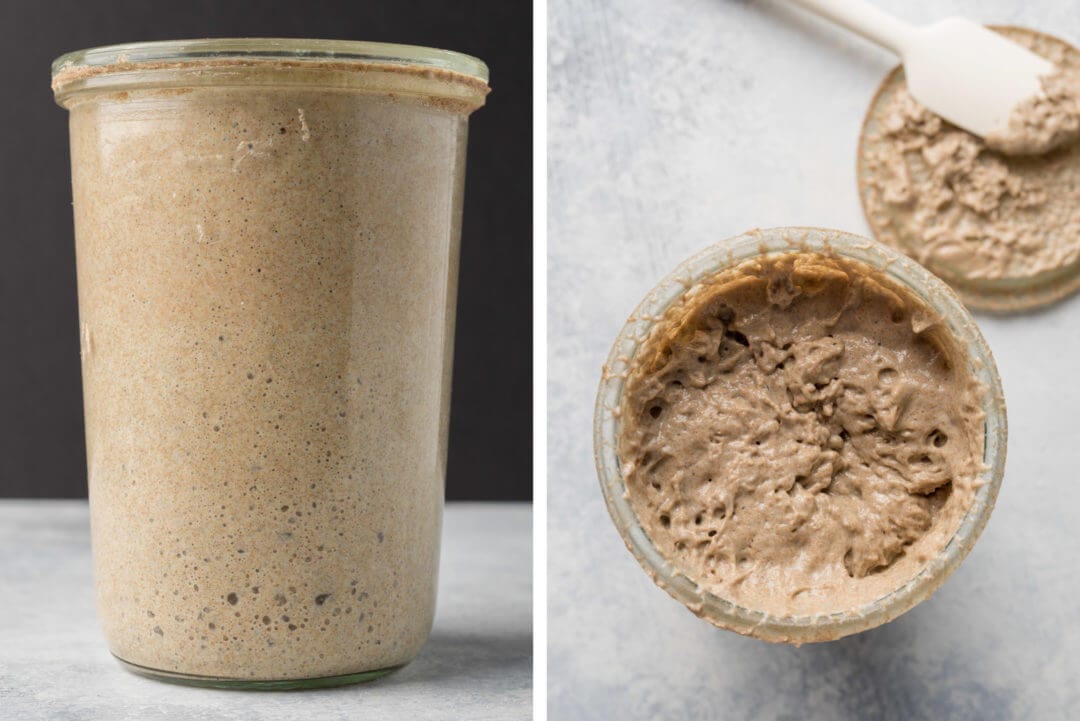
Why Isn’t My Sourdough Starter Strong?
If you’ve just created your starter, give it time to ripen. With consistent, predictable refreshments, you will “train” your starter into strength, and it will display the same signs of strong fermentation each day. Temperature is also incredibly important here: keeping your starter relatively warm (I prefer 76-80°F/24-26°C) will encourage increased activity.
Why Does My Sourdough Starter Take Forever To Ripen?
Several factors play into the fermentation vigor of your starter, and the most important one is temperature. Try to find a warm spot in your kitchen to keep your starter, or use more lukewarm water to feed it. Shoot for 76°F – 80°F (24-26°C) ambient temperature for increased fermentation activity. Maintaining a stable temperature is important, and if there’s one thing I like to focus on with my starter, it’s temperature.
Flour selection also plays into the fermentation activity; the more whole grains you use to refresh, the higher the fermentation rate in your culture.
And, of course, the amount of ripe starter you carry over from feeding to feeding plays a significant role. The larger the percentage, the faster your newly refreshed culture will ripen.
All of these variables can be tweaked to speed up, or slow down, the time it takes for your starter to ripen and need a refreshment. My preferred method for changing my starter’s ripening timeline is to adjust the amount of starter I leave in the jar for each refreshment (the carryover). If it’s summertime, I will usually carry over a smaller percentage of ripe starter (15% or so) at each refreshment to slow things down so I can maintain my twice-a-day refreshment schedule. If it’s winter and temperatures are lower, I’ll carry over an increased amount of ripe starter (25% or so) into my next refreshment.
How Often Should I Feed My Sourdough Starter?
This question is very temperature and flour-dependent. If the ambient temperature in your kitchen is on the warmer side, 75-80°F (23-26°C), then you’ll find your starter ferments much faster than if it were cooler (less than 75°F/23°C). Likewise, you’ll see higher fermentation rates if you use a large percentage of whole grains in your refreshment.
I prefer to feed my starter twice daily to keep it healthy and ready to bake at any moment. But then again, I bake very, very frequently. If temperatures are not overly high, I recommend a single daily feeding. If your starter falls significantly in its jar, looks broken down and loose, and smells like harsh vinegar or paint, try using a smaller percentage of ripe starter at each feeding. You can also find a cooler spot in your kitchen or use colder water to feed.
For example, in the summer (typically 75-78°F/23-26°C in my kitchen), I feed my starter twice a day, but even then, I have to reduce my ripe starter carryover percentage. Instead of my usual 20-25% in the winter, I drop it down to 10-15% and find a shaded, cool spot in my kitchen to slow things down. For more information on this, including pictures, see my post on maintaining your sourdough starter.
How Can I Feed My Sourdough Starter On Workdays?
For a very in-depth discussion on how to maintain your starter in the fridge during the week and use it to bake on the weekend, head over to my Weekend Baking Schedule guide! Additionally, see the previous question for what “tools” you can utilize to speed up or slow down your starter’s fermentation rate.
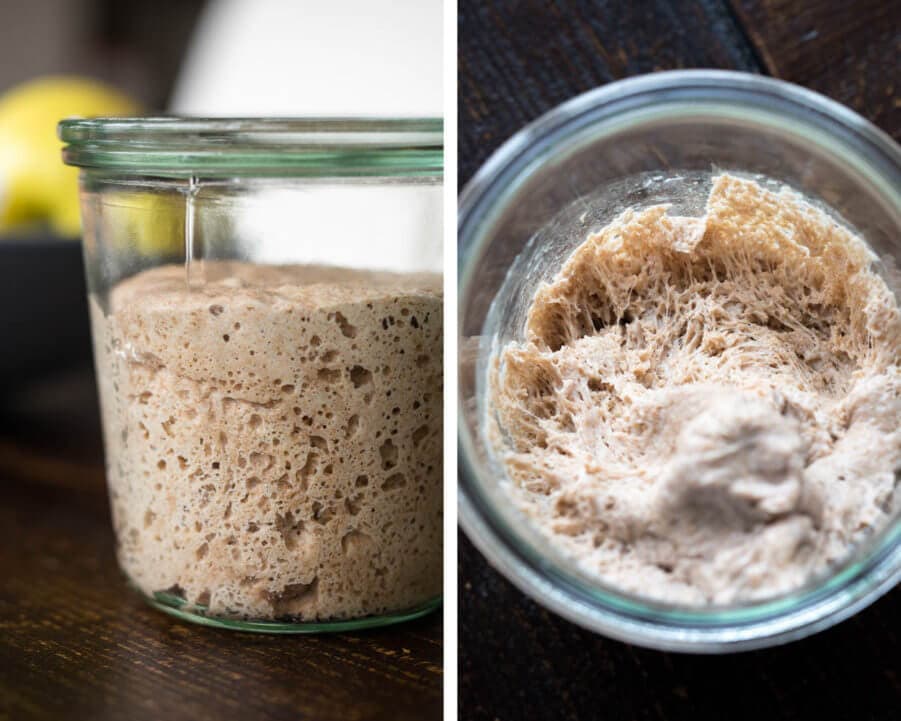
What Hydration is Best For a Sourdough Starter?
Of course. When it’s significantly hot and dry here in the summer, and the flour seems to need more water, I’ll increase my hydration to 105% or higher as required. You can adjust the amount of water you use at each refreshment so the mixture displays the desired viscosity. As the humidity level in your environment changes, adjust the hydration up and down by 5% to compensate.
My Starter Has Clear Liquid On Top, Should I Throw It Out?
You can either discard this liquid (or “hooch,” as it’s commonly called) or stir it back into the culture. I typically stir it all in together. This can be a sign you’re not feeding your starter often enough.
How Does Altitude Affect My Sourdough Starter?
You might see increased fermentation activity at high elevations. See my baking at high altitude guide for more tips.
What’s Next?
If you’re having issues with your sourdough starter and haven’t found help above, post at our member community for help!
For more starter-related things, look at my ultimate guide to sourdough starters for help and advice with feedings, maintenance temperatures, long-term storage, and much more.
Happy baking!


516 Comments
Hi Maurizio, I think I am ready to give this a go and my best friend who is a baker recommended your blog as a ‘go to guide’. I read your post about preparing a starter and I’m already nervous! I live in Melbourne where it’s cool for most part of the year (8-9 months). You’ve mentioned that 24-26 degrees is the ideal temperature, and I was wondering if there’s a way to achieve that kind of warmth without turning on the oven. Do you think wrapping it up in a warm blanket might help? Trying to do this with less energy consumption that’s all.
Don’t fret, Anuja, it’s not as complicated as you might think this is—you got it! To keep things warmer, you can slightly warm the mixing water in the microwave (or stove) for just a few seconds until it’s a little warmer. Then, wrapping your container in kitchen towel will definitely help. Those two things should help quite a bit!
Keep me posted on how it’s going 🙂
Hi Maurizio! I want to try using my starter instead of making a levain for your bagel recipe, but I’m not sure how much of it to use? Is it the same total weight as the levain, or do I need to calculate an adjustment based on the flour weight? Thanks so much:)
Yes, same weights if going that route!
Great, thanks for being such an amazing resource!!
Hi Maurizio, Loving the Table Loaf but lately the crumb has huge holes–what happened and how do I fix it????
Bobbie
Usually large holes like that are due to under proofing. Make sure to build your levain from a starter that’s strong and mature (meaning it’s risen to it’s peak height before you take some to use). From there, bulk fermentation is very important! Make sure your bulk fermentation goes sufficiently far, you want the dough to look smooth, it should have risen considerably, and have bubbles here and there — it should look alive. If you tug on the dough a bit it should offer resistance to your tugging, it’ll feel stronger. Give the dough the time it needs in bulk fermentation! If you have to give it another 30m or hour to see these signs, do so. It’s important for this step to go sufficiently far for the dough to have enough fermentation activity before its proof.
thanks so much
Hi Mario, Have a new B&T proofer! Do I put the starter/Levain in it? with water and no lid? Do I put the autolyse in the proofer? with water? uncovered? The proofer instructions don’t mention the steps before the bulk fermentation. Been concentrating on the 50-50 Whole wheat–fabulous. many thanks.
Yes, I put mine inside with a covered lid!
Hi again, I mix the flour and water and let it sit for 1 hr. When I then go to add the Levain and salt it is so hard and dry–almost impossible to mix. ! I think I’m going wrong on the 1st step!! Help!!!
BINGO!! You’re a genius. Let the bulk fermentation go on much longer and I have the best loaves yet. Crumb in perfect, taste divine! Thank you so much.
So glad to hear that, Bobbie!
Do you have any advice for a kitchen with both a sourdough starter and active kombucha brewing? I had heard it was a bad idea to keep them in the same kitchen from the instructor who taught me kombucha. She never elaborated on why that would be bad or what to do about it. Thanks for all the great recipes and amazing instructions for a newbie. I’ve been using your site for 3 years, and shared it with many friends.
I was making kombucha here for a couple of years, I never had an issue with this and my sourdough starter! No cross contamination or any off flavors. Funny enough, I asked Sandor Katz (the fermentation guru) this question in person at one of his classes, he confirmed that he has a sourdough starter and kombucha starter going and has for like 20 years with no issue 🙂 That’s my experience as well. Thank you for sharing my site with others and happy baking, Angela!
Maurizio, thank you for sharing your thoughts and experiences, I am one year into starting a cottage bakery operation here in Southern Vermont! I am researching why sourdough starter needs to be “mature” or at its “peak level” in order to have the strength to leaven bread in the oven? Theoretically, since mixing starter with flour and water to make bread dough is similar to feeding it again, could you extend the bulk fermentation and use sourdough starter that has fallen/ is past its peak level and still have oven spring to produce a quality loaf of bread? If you have any knowledge to shed some light on this I would much appreciate it, thank you!
That’s a great question, Grace, and one I often bring up with other bakers in conversation. My feeling is, using your starter/levain when it’s ripe means maximal (or close to maximal) yeast and bacteria populations. This directly translates to your bread dough which should yield max flavor and better texture. I do know some bakers who prefer to use their levain when it’s at a much “younger” state, in that case, the dough would likely need longer in bulk/proof to be properly fermented. The reason is, you’re using a levain with less than max microbe count, which means it will take longer for them to reproduce and metabolize. Hope that makes sense, and that’s my take on it!
Hey hey,
If I don’t want to start with making levain but straight away with starter, i am just adding for example 200g of recently fed (few hours before) starter to.flour, sal, water?
Yes, you can certainly just use your starter instead of making a new levain.
Hi
When making a sourdough bread with a mix of bread flour & whole wheat flour, does it mean that my starter should be fed with the same type of flour i.e a mix of bread & whole wheat flour? Or it does not matter? I now feed my starter a mix of 50% unbleached APF & 50% rye.
Nope, that doesn’t matter at all!
Hello, thank you for the guide! I have a question on containers for the starter. I’ve been using mason jars, but the curved rim makes it hard to clean properly. I’ve switched to wide rimmed pyrex container, I’m wondering if having wider rim that may not have much surface to climb on going to affect the rise of sourdough starter?
I use smoother jars as well, I prefer them. Shouldn’t be an issue!
Hello! thank you for the guide. I have a question about containers for sourdough starter. I’ve been using mason jars, which have worked ok, but the curved top makes cleaning very difficult, so I recently switched to wider pyrex container. I’m curious why everyone uses jars as the container, wondering if there’s some science about having more surface to climb with narrower jars, but I couldn’t find anything. Would wide containers work fine ?
Hey Maurizio! Thanks for answering all these questions!
I had the same rotten smell someone else mentioned on my second day and a little line of liquid in the middle. Also, I followed all the measurements and my mix didn’t seem as thick as the one on your post… I’ve used an organic stoneground whole meal what flour. I also didn’t get much activity over night but a few bubbles. Is that normal? I’m not doing the refreshments in the morning but at night, is that a factor..?
You’re very welcome, Carolin. What you’re describing—smell, line, consistency—is totally normal. If your starter is on the cool side, try to keep it warm, I like to keep mine around 76-78F for two refreshments per day. If you’re just creating your starter, stick to the schedule, it’ll eventually come around!
What formula do you use to convert a dry yeast recipe to one using starter?
Hey, Josef. I’ve never actually done this!
Ha. OK! Well I just test-ran a bialy recipe (that called for dry yeast) and simply replaced with 224g of mature starter (while removing equal flour/water from the total formula, of course). It worked out very well.
How does the amount of starter in a dough affect the taste, all other things being equal? I’m experimenting with some new flavors and one of the experiments that had a large amount of starter (like 2/3 of the added flour by weight) was pretty bland, wondering if decreasing the amount of starter would punch it up?
It can go two ways: if you add a high percentage of super ripe starter/levain to a dough it can bring a lot of sourness (in a good way) to the end loaf. If you add a small percentage, it can result in either a mild loaf or a sour loaf, depending on the rest of the formula/process. Adding a small percentage means the pH of the dough will remain low for a longer period of time, which lets bacteria produce more and more acidity for longer (until it’s inhibited by low pH). I’m working on a post outlining all of this!
Question: I just started my fourth or fifth attempt at sourdough starter yesterday. (Thanks for all your tips! I especially tried to maintain a healthy temperature, to the best of my current ability with the tools I have at present) It rose to the top of my quart Mason jar as of this morning and looks healthy, but it smells a little rotten. I’m familiar with my mom’s old sourdough starter and the sour smell it had. This is not like that. It’s also not the first time I’ve noticed this smell in my sourdough starter attempts. Is this a stage that the starter goes through before developing a strong sourdough culture? In other words, will the rotten smell go away as it develops into a strong, healthy starter or should I pitch it and start over? Thanks for your help!
Yes, that’s very, very typical. Stick with the schedule and that smell will go away!
Thank you, Maurizio!
You’re very welcome, Janice! Happy baking.
Hello! I’m a sourdough newbie! Was given a bit of starter, and have for weeks been maintaining just 10 grams of starter with 10 grams of flour (half bread, half rye) & 10 grams water twice a day, and “discarding” the rest. I need to have more starter to make a levain, but am unsure as to how to “bulk” it up. Should I just double everything twice a day until I have enough?
Yes, that will work! You could also just add as much as you need in one build, as long as it’s not too large. You might need to do several builds to get it up to strength to make a larger levain. You could do three or four, doubling each time.
Hey there, I finally have a good healthy starter. After trying for a long time with no success, I broke down and bought a starter. Lucky for me because that starter is kicking butt AND it must have scared the starter I have been making because that one started kicking butt the day after I bought the starter. I am a total newb to this entire process and appreciate your wealth of information and putting it in terms newbs like me understand. My question is about using the starter. Am I supposed to stir the healthy active starter before measuring it out for a recipe or leave it bubbly and angry (in a good way)?
Glad to hear you’re on your way, Jeff! All of my recipes call for weight measurements for every ingredient, so it won’t matter if you stir or not (it’ll weigh the same). However, if you’re doing another recipe that uses volumetric measurements, yes, I would stir before measuring out. Happy baking!
Hello there, wonderful posts and webiste, I am rather thankful you exist! So, I am a fairly new baker (first loaf Feb 2020) but since my first bread I have been baking regulary, 2 loafs 2-3x a week. My babes are sometimes not with a super open crumb but tasty and soft and I keep on going. Now here is my problem, 6 days ago I baked bread and refreshed my starter as usual. But unlike usually, I haven’t poped it back to the fridge as the temps have dropped. Two days later and hooch appeared. I wasn’t bothered. I then wanted to bake and refreshed it on Sun eve (3 days after baking and refreshingh it). Mon morning the starter looked the same. I perhaps hastly thought it has risen and fell overnight. I then refreshed it again. Bit, nothing happened and I repeted the process in the evening (so, fed it twice a day). Today morning I still see no action and I am puzzled! I refreshed it again (3rd time) and I can see no action. I really thought it needs more refreshemnts, now I am starting to think the first refreshement was too early (12 hours has passed between the feeds) and that I dilouted it and kept on dilouting it. Could this really be the case? My daugher is celebrating at school the days of bread on Thur, I hoped and offered to make the bread with her tomorrow and bake it early Thur but I am a bit scared now. Is there anything I can do? Is it better to leave it for 24hrs or keep on refreshing it and if so how often? My kitchen is at 20C at the mo. I have three jars on the go. Newly freshend up, one left from this morning (so almost fermeting for 12hrs now) and one newly mixed from the leftover starter I had in a fridge.
If any of this makes sense, I look forward to some guidiance and thank you so much.
Hey, Karmen! 20°C is cold, so this might be the reason for the reduced activity. Definitely give it longer between refreshments if you’re going to keep your starter at that temperature. Wait to refresh until you notice lots of activity: bubbles, a rise and perhaps fall, a loosening of the mixture, and a sour smell. I’d recommend warming your mixing water to 28°C (be sure not to go too hot!) or keep it in a warmer place to get it moving again. It’s ok if it’s cool, it just means it will be longer between refreshments.
Another thing you can do if it’s cold is keep more of your ripe starter in the jar at each refreshment, this will speed it up.
Thank you so much
for your time and reply. We took a loaf to school this morning successfully 💪 I popped the starter in the oven and kept the oven light on even overnight. I also tried to squeeze as many feeds as possible to stregten it back up (so one feed/the last one was at 5am to work with our schedule) but only after I witnessed it doubling in size and I was sure it’s ripe. This change of seasones got me off guard!
As it always does to me as well!
Hello and help. I have baked yeast bread for years. I am now a sourdough newbie and fairly confused. I was given a qt size ball jar of starter. The jar was full when I received it. Instructions were to feed weekly; the gifter said he uses a ratio of 1-1-1 and to look for directions on the King put Arthur flour site. I kept it in the refrigerator and after about 6 days it reduced by half. I think I misunderstood the instructions. I used 100 mg of bread flour and 100 mg of water in two different containers on Saturday. Today the starter in the bowl is very thick and bubbly, the qt size ball jar is loose and bubbly. Do I add either of these mixtures to my gifted jar of starter or have I started a new one that will also require feeding. (I truly hope this all makes sense).
Thank you
Hey, Denise! Have a look at my starter maintenance routine—it should help you!
Hi, Maurizio! I am trying to understand why it is important to incorporate the preferment when it is “peaking.” Pre-peaking or post-peaking preferment will still ferment the flour/water mixture, with some difference in flavor to the baked loaf, and perhaps some minor difference in overall fermentation time. Is oven spring, or crumb texture, or other aspects of the finished loaf also affected by the developmental stage of the preferment at its incorporation?
I just discovered an error on my part that has me wondering. I have been using a stiff preferment of 100% rye flour at 100% hydration. After it reaches full expansion in a sealed jar, it does not collapse as a more liquid starter does. I judged its readiness by float testing it, but at first I used too small samples of the preferment, and they kept sinking until by chance after eleven hours, a couple of consecutive tests floated. So I used 11-hour preferment in 3-4 loaves with very nice results, good flavor, big holes, and decent oven spring. Then I discovered that if I floated larger samples of my stiff preferment, they were floating earlier, and corresponding more to the peak times of the more liquid starters I first used. I just timed one sample floating after 8 hours, and have one making now to test at 7 1/2 hours. So it’s apparent that I’ve been successfully using a preferment way past its “peak.” I’m going to try an 8-hour preferment to see what happens, and I’m wondering what if I try a 15-hour preferment, or a 24-hour preferment. Besides a difference in flavor, what differences should I expect to see? Thanks!
I’ve been working on an update to this page (I just posted it, with more to come). And these days I’m less concerned with the “peak height” of my starter (i.e. the visual sign of it falling in its jar), and more focusing on general signs of sufficient fermentation: some rise (usually significant, if using white flour), lots of aeration (bubbles), a general weakening of the mixture, and a strong sour aroma. These are all general terms, too, because it very much depends on the makeup of your starter (water %, flour, temperature, etc)!
I don’t like using the float test as it can lead to incorrect assumptions. Your case is the best example: a rye starter might not ever float because it’s not able to trap gas in the same way as a wheat starter (and dough) will. I actually think your approach is the way to go, test a few times to use your starter/levain and see how the results, both in the dough and a the end of the bake, end up. Lately, I’ve been finding I can push my starter far past it’s “peak” and still get great, if not better, results.
Still working to update this page further!
Hey Maurizio, thanks so much for all this incredible info you post on your site. It’s so so helpful and is my go-to when I am trying a new recipe or wanting to learn new sourdough things!
I was wondering if it was ok to keep the starter in a cupboard, rather than out on the counter? Does that provide enough air circulation for the bacteria in the starter to stay healthy?
I was also wondering what your method is for warming the water you use for feedings to reach the 76-80 degree temp? I use distilled water and wasn’t sure if putting it in the microwave for a bit would alter the chemistry of the water and impact my starter? The room temp water is slightly too cold.
Your starter actually doesn’t need air circulation! So yes, a cupboard is just fine.
When I warm the water I either take warm water from the tap (turning on hot and cold intermittently until I get the temp I want) or I pour the mixing water into a glass pitcher and warm that in the microwave.
If it’s warm outside let nature warm it. Depends on the outdoor temp. Can always add cooler water it itt gets too hot.
I just found another use for “discard” starter: Onion rings. Just be sure to soak the onions in a cold salty water for a half hour, dip them into your dry seasoned flour mixture, then let them set awhile to dry before dipping into the discard. This allows the dry flour to adhere to the rings and create an almost unbreakable bond for your final dip. I sprinkled a few bread crumbs on after dipping and took them to a whole new crunch-level.
That’s an incredibly good idea, Justin! I’m going to have to try this.
Yes, I think it’s just semantics at that point. Some bakers don’t use the term “levain” at all, they call everything a “starter” — and that’s just fine! It’s all the same bread baking in the end, and there are infinite ways to do things 🙂
@petrchutny:disqus and Robert — your levain and starter really are the same thing in the end. A levain is an off-shoot of your starter that dies with the dough when it’s baked in the oven, but your starter goes on indefinitely. I like to use a levain because it gives me more control over the preferment for a single bake: I can change the flour composition (to push things to be more sour or less sour), the temperature, the time to ripeness, etc. You can use your starter directly for most bakes as well, but it is important to use it at the right time — it needs to be ripe, but not too ripe and overly sour/acidic.
So in the end, they’re the same, but the levain can be a special creation with different flour for a single bake or a single type of bread.
I’m working on a detailed post on this for the future!
It’s hard to say why he uses the same levain in the book, it might just be for clarity and simplicity in a book, or maybe that’s how he still does it at his bakery — either way, it all works in the end. I use the levain as a way to adjust the flavor, texture, and other aspects of a single bake, and you can test this easily in your own kitchen. Mix up a levain that is 100% white flour, 100% water, 10% ripe starter (this would be similar to Tartine style), let that ferment for overnight. Simultaneously, mix up a levain that’s 100% whole grain flour, 50% water, 10% ripe starter and let that ferment overnight. Mix each levain in a different dough and see how they are different through the process — fermentation activity, aroma, and ultimately, taste and texture in the end.
And that’s the fun part about baking, there are many ways to do things and this is probably why there are so many bakers and so many bakeries 🙂
You’re very welcome. Yes, consistency is tough with baking, it’s something we all strive for regardless of how many loaves we’ve pulled from the oven — always on our toes! Have fun and happy baking, Robert.
I am so sad.. I made the 50 50 loaf for the second time . it was the second fail! This time is was so sure it would come out perfect.. All through the process it looks and acted just like it was suppose to. It match all your pictures perfect to each step. Follewd the time line exactly. Followed the receipt to the key. Put it in the refrigerator and clean up the kitchen and went to bed. Set my alarm so I was on your baking schudel. Preheated the oven and my Dutch oven for 1 HR. When I opened refrigerator and found 2 kinda flatten dough balls . I took them out still hoping they were ok, scored and put in oven. After 20 I took the lid of my Dutch oven. Only to see 2 inch high loaf. The dough temp was perfect for the whole prepping . this the same thing that happen the 1st time.. What am I doing wrong.
Sounds like your dough over proofed on you! Sorry about that, I know it’s frustrating. Try cutting back the bulk fermentation time by 15-30 minutes, and get the dough quickly into the fridge after shaping. From there, be sure not to let the dough go too long in the fridge, it can over proof in there as well if pushed too far past the time I indicate in the recipe.
Don’t give up, Rena–I haven’t, and I haven’t had a success yet. (Unless you consider that brick holding my door open a success.) At least I make a different mistake–oops, “learning opportunity”–each time. I’ll get there yet!
Hey, all v informative, ta v much; now on day 7, looking ahead to 1st loaf, is there an alternative to the retarding/fridge stage? I ask as I have a tiny fridge and it’s summer so its full. my ambient temp is 24-26C, what’s a sufficient number of hours to let rest, get the best out of this 2nd fermentation, and bake not too late (per beginner’s loaf)?
Also, so as to maybe bake to same day, what about mix-n-matching the 4hr beginner’s levain with the weekday mix for a 3.5hr fermentation, to then proof at room temp for an appropriate amount of time, to ultimately steam bake?
Or is an entirely different mix required to sustain overnight proofing at room temp? if so, what do you recommend please?
Instead of the cold proof you can let the dough proof on the counter for 1-2 hours until ready to bake. The time will need to be adjusted depending on the ambient temperature in your kitchen.
thanks, didn’t think that would be enough; have been trying 4-5 hours, at 24-26C (is doubling in size), hoping for some complexity of flavour but shorter proofing would have it baked in time for dinner!
2nd proofed for 2 hours, worked out perfectly, came out picture perfect & tasted just as good; thanks mate
My daughter accidentally partially baked my starter that was rising in the oven…. is it lost or can I somehow salvage my week’s worth of work?
I’d guess you’d have to start over!
what does it mean, if my starter grows like crazy in the first two -3 hours, then falls? It’s crazy, but it more than tripled and grew out of the jar? its 100% hydration and its 1:3:3 ratio, and I feed it whole wheat- can I use it in as little as 3 hours? Also, the bubbles never get as big as yours- why?
Hi can you help with a very confusing question regarding using a small portion of starter to build the Levain? My starter passed the float test happily to say, and have been looking for recipes for a sour dough loaf. Some recipes say to use 300g of starter, this is going to take all of my starter for baking one single loaf surely? I thought the ideas was that the Levain is an off-shoot from your starter to build up through day/night ready to use? Some recipes are showing quantities for two loaves – I just require to make one loaf. Can you please help to clarify this confusion? Many thanks Sue
Hi! My starter has been doubling in 2-3 hours and I am having a hard time timing my bake. Your guides typically say to feed before bed and bake in the morning, but this would mean building the levain with starter past it’s peak. What should I do? Thank you!
Hey there I just got given about 500g of starter I’m guessing this is too much to hold on to What is a good amount to keep
Hi.. My starter is on day 5….i have started noticing a dry layer on the top…. Just like when the skin becomes too dry it kind of looks little whitish.. But it does not look like any kind of fungal growth or anything… Could you suggest anything…. It is rising well and everything…
I am new to baking bread, but had initiated to make a all purpose flour starter 7 days ago. I like to learn more of sourdough bread baking process
Hi Maurizio,
First off, this site is so informative, thanks for that. A question: when I’m first making my starter in that very first week (I’m on day 4) can I save the discard and use it in pancakes for example, or should it be tossed since the starter isn’t mature yet since it’s only just begun?
Thanks for your time.
Can you jumpstart a sleepy starter for immediate use by adding instant yeast?
Hello Maurizio, I’ve been reliably baking sourdough for a few months now, but my sourdough is never actually very sour. It tastes great, but I would like it to be more sour. Is there anything I can do to make my final loaf more sour? Thanks in advance.