


Your sourdough starter is a mixture of yeasts and suitable bacteria that co-exist to leaven and flavor bread dough. I’ve been maintaining my starter for over ten years now, regularly feeding it twice a day, every day, and the process is so familiar I don’t even think about it anymore. But it’s nothing mystical or magical, my sourdough starter is a culture I give nourishment (flour and water), and in return, it happily does work for me without even realizing it. But many uncertainties can arise along with its maintenance, and this frequently asked sourdough starter questions post is here to help.
I’ve been compiling this list of starter questions for almost as long as this website has been around. Each time I receive an email or comment asking a question about what I do in a particular situation, I’ve saved it and added the most commonly asked questions below.
If you’ve arrived here before you have a starter, it might be worthwhile to have a read-through to internalize some of these questions and answers. Then head to my guide to creating a sourdough starter and get started.

How Do I Create a Sourdough Starter?
I’ve written a detailed post with pictures and clear instructions on creating a sourdough starter in 7 easy steps.
Do I Have To Use Whole-Grain Rye Flour For A Sourdough Starter?
I call for whole-grain rye flour when creating a starter because the additional nutrients in rye flour help speed up the process. You can certainly use whole wheat flour or even white (sifted) flour if you’d like, but I find rye flour to be the most effective flour at the beginning. If you don’t have rye flour, then whole wheat works!
I Think My Sourdough Starter Died. Is it Dead?
It’s normal to see a lapse of activity at some point when first creating a sourdough starter—this is normal. The initial proliferation of action at the beginning of creating a starter is from a different type of bacteria in your mixture that will eventually be replaced by the kind we are looking for (lactic acid bacteria). Keep feeding, and discarding, as I outline in my creation guide. Eventually, your mixture will slowly become more and more acidic (low pH), killing off other bacteria and allowing the beneficial yeasts and bacteria we are looking for to take hold.
I’ve Been Following Your Starter Creation Guide, But Nothing is Happening. What’s Wrong?
The most common problem I see people face is low temperatures: it’s easier to create your starter if you keep it warmer. Cold temperatures (below 70°F/21°C) will slow the process down significantly, whereas warmer temperatures (around 76-82°F/24-26°C) will speed it up. Try to find a warm spot in your kitchen to keep your starter, or use more lukewarm water for feeding. For more information on starter and dough temperatures, see my post on the importance of dough temperature.

Should I Cover My Sourdough Starter Jar?
I like to keep mine covered loosely to keep anything from falling inside the jar and the starter from drying out. The lid does not have to be airtight. I loosely place a glass lid on top (my favorite sourdough starter jars have a glass lid that rests on top), but it’s not sealed shut.
When Is My Sourdough Starter Ready?
Once you see predictable signs of fermentation (rise, bubbles, a transformation in aroma from sweet to sour, etc.) each day, it should be strong enough for baking. When creating a starter from scratch, you might see a spur of activity at the beginning of the process, but you want consistent signs of fermentation day after day before it’s strong enough to use for leavening. Typically, when creating a new starter, this is after 5-8 days.
Do I Have to Make a Levain?
It’s always an option to use your starter instead of making a levain. But, for most recipes, I prefer making a levain so I can control the flour going into the levain, the ripening timeline, and when I use it to mix into a dough—all of this without having to adjust my continually maintained sourdough starter.
For example, I might make a levain with all white flour and use it before being overly ripe for my cinnamon rolls. This will help to ensure the end rolls will not have an overly sour flavor.
What Kind of Container Is Best For a Sourdough Starter?
You can use just about anything. I like to use clear glass containers to observe the sides and bottom, and these Weck jars are my favorite. They have a glass lid that rests on top just in case too much pressure builds up inside the jar from fermentation. Canning glass jars are also a perfect choice.
How Often Should I Clean My Sourdough Starter Jar?
Use the same jar daily and keep it as clean as possible. During a feeding, discard part of your starter per usual and then scrape down as much residual starter as possible, reincorporating it back into the mixture. Then wipe the top and sides of the jar with a towel to remove any remaining liquid. If you can get the top half reasonably clean, that’s good enough. The bottom half of the jar will most likely be covered when your starter rises during the day, anyway.
What Water is Best For a Sourdough Starter?
Regular drinking water from the tap is just fine. Fill up a large container and let it sit on the counter overnight before using it to allow any chlorine in your tap water to dissipate.
What Can I Do With Sourdough Starter Discard?
Cook or bake with it! You can use leftover starter into banana bread, waffles, pancakes, tea cakes, muffins, pizza, cookies, and so on. If you want to use less flour overall, check out my guide to maintaining a smaller sourdough starter. Aside from using sourdough discard in other foods, I will almost always compost any leftovers, only using the trash as a last resort.

Can I Refrigerate My Sourdough Starter?
You can absolutely store your starter in the fridge, especially for vacation. To prepare for the fridge, I will wait until the starter needs a refreshment, discard all but 20g of ripe starter, and then refresh it with 100g flour and 80g water (I like the culture to be a bit on the stiff/dry side). After refreshing, let it sit on the counter for 1 hour, then toss it into the fridge. I will usually use the same Weck jars for this, and the cover will be loosely placed on top so nothing can fall in, but excess gasses can escape.
When I want to bake again, I will remove my starter from the fridge, let it ferment on the counter for a few hours, and then feed it as I would normally. I will do this a few days before I plan to bake to get the culture back up to strength.
See my post on storing a sourdough starter for tips on keeping it in the fridge or other methods for longer periods over two to three weeks.
Why Doesn’t The Sourdough Starter Float Test Work?
The float test is a good general indicator for when a starter or levain has significant fermentation, but I find it is not 100% reliable in testing for when a starter is ready for use. It can lead to false positives, but, as I discuss below, when your starter makeup is not with a majority of white flour at a moderate to high hydration, it will also rarely float, even if your starter is ripe. Instead of using the float test, I look for signs of strong fermentation and ripeness.
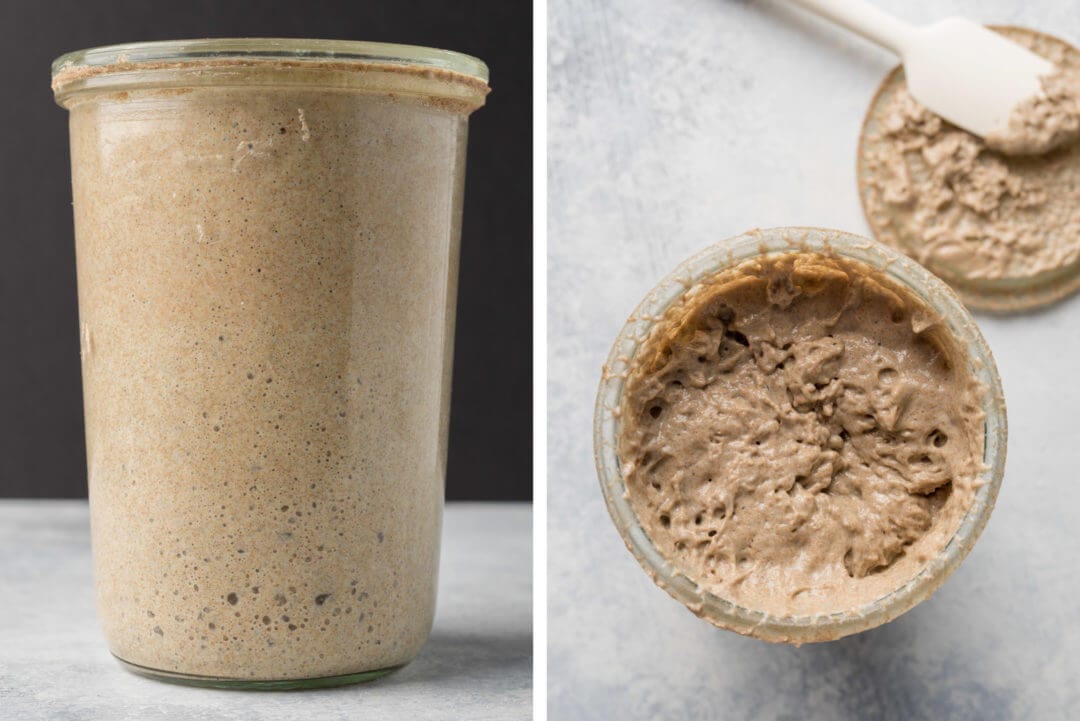
Why Isn’t My Sourdough Starter Strong?
If you’ve just created your starter, give it time to ripen. With consistent, predictable refreshments, you will “train” your starter into strength, and it will display the same signs of strong fermentation each day. Temperature is also incredibly important here: keeping your starter relatively warm (I prefer 76-80°F/24-26°C) will encourage increased activity.
Why Does My Sourdough Starter Take Forever To Ripen?
Several factors play into the fermentation vigor of your starter, and the most important one is temperature. Try to find a warm spot in your kitchen to keep your starter, or use more lukewarm water to feed it. Shoot for 76°F – 80°F (24-26°C) ambient temperature for increased fermentation activity. Maintaining a stable temperature is important, and if there’s one thing I like to focus on with my starter, it’s temperature.
Flour selection also plays into the fermentation activity; the more whole grains you use to refresh, the higher the fermentation rate in your culture.
And, of course, the amount of ripe starter you carry over from feeding to feeding plays a significant role. The larger the percentage, the faster your newly refreshed culture will ripen.
All of these variables can be tweaked to speed up, or slow down, the time it takes for your starter to ripen and need a refreshment. My preferred method for changing my starter’s ripening timeline is to adjust the amount of starter I leave in the jar for each refreshment (the carryover). If it’s summertime, I will usually carry over a smaller percentage of ripe starter (15% or so) at each refreshment to slow things down so I can maintain my twice-a-day refreshment schedule. If it’s winter and temperatures are lower, I’ll carry over an increased amount of ripe starter (25% or so) into my next refreshment.
How Often Should I Feed My Sourdough Starter?
This question is very temperature and flour-dependent. If the ambient temperature in your kitchen is on the warmer side, 75-80°F (23-26°C), then you’ll find your starter ferments much faster than if it were cooler (less than 75°F/23°C). Likewise, you’ll see higher fermentation rates if you use a large percentage of whole grains in your refreshment.
I prefer to feed my starter twice daily to keep it healthy and ready to bake at any moment. But then again, I bake very, very frequently. If temperatures are not overly high, I recommend a single daily feeding. If your starter falls significantly in its jar, looks broken down and loose, and smells like harsh vinegar or paint, try using a smaller percentage of ripe starter at each feeding. You can also find a cooler spot in your kitchen or use colder water to feed.
For example, in the summer (typically 75-78°F/23-26°C in my kitchen), I feed my starter twice a day, but even then, I have to reduce my ripe starter carryover percentage. Instead of my usual 20-25% in the winter, I drop it down to 10-15% and find a shaded, cool spot in my kitchen to slow things down. For more information on this, including pictures, see my post on maintaining your sourdough starter.
How Can I Feed My Sourdough Starter On Workdays?
For a very in-depth discussion on how to maintain your starter in the fridge during the week and use it to bake on the weekend, head over to my Weekend Baking Schedule guide! Additionally, see the previous question for what “tools” you can utilize to speed up or slow down your starter’s fermentation rate.
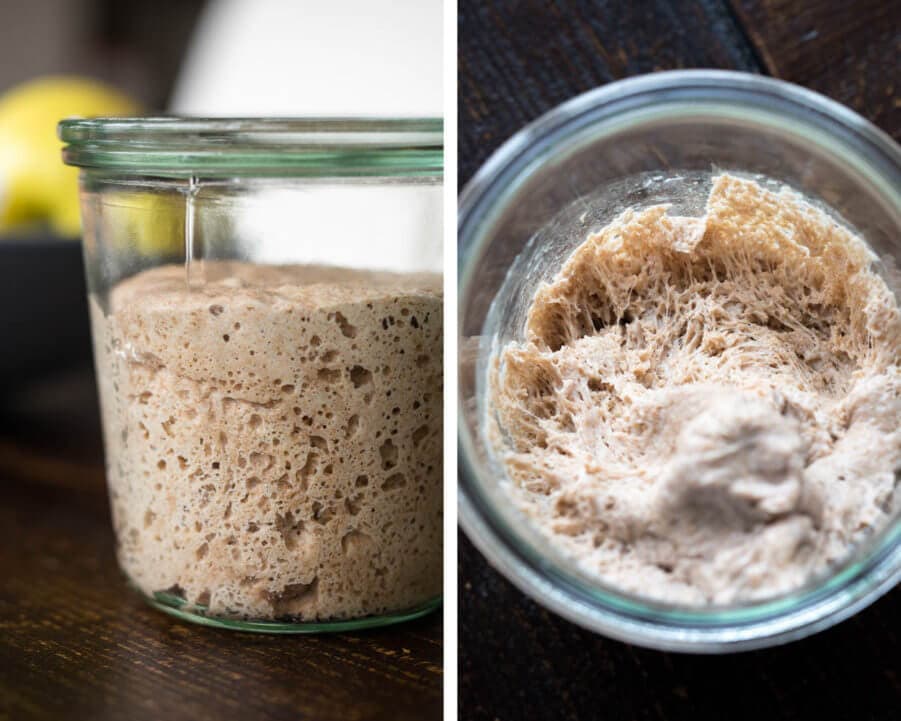
What Hydration is Best For a Sourdough Starter?
Of course. When it’s significantly hot and dry here in the summer, and the flour seems to need more water, I’ll increase my hydration to 105% or higher as required. You can adjust the amount of water you use at each refreshment so the mixture displays the desired viscosity. As the humidity level in your environment changes, adjust the hydration up and down by 5% to compensate.
My Starter Has Clear Liquid On Top, Should I Throw It Out?
You can either discard this liquid (or “hooch,” as it’s commonly called) or stir it back into the culture. I typically stir it all in together. This can be a sign you’re not feeding your starter often enough.
How Does Altitude Affect My Sourdough Starter?
You might see increased fermentation activity at high elevations. See my baking at high altitude guide for more tips.
What’s Next?
If you’re having issues with your sourdough starter and haven’t found help above, post at our member community for help!
For more starter-related things, look at my ultimate guide to sourdough starters for help and advice with feedings, maintenance temperatures, long-term storage, and much more.
Happy baking!


516 Comments
Hi! Thanks for sharing your formulas and methods. I’ve baked two batches and they’re great. I do have a question about how long one can leave shaped dough retarding in the refrigerator. Can it be longer than 12-15 hours if there are time constraints and not able to do per the prescribed schedule?
Thanks!
The end answer is it really depends on how much fermentation is in your dough when you first put it in the fridge (assuming your fridge can keep a pretty consistent internal temperature). When I’m casually baking at home sometimes I can’t get to baking both loaves at the same time and leave the second one in there for several more hours and it bakes up just fine. That second loaf can have a slightly more acidic flavor profile but not in a bad, just different. I’d say give it a shot if you need too and I can be it’ll bake up just fine!
Thanks!!
Hi! I’ve been trying to get the hang of my starter for several weeks now with only moderate success. Only when i first create my starter (first 2-4 days) does it puff up as described. After baking with it and having stored it in the fridge for a week, its just not the same. this is day two outside of the fridge and even with regular feedings (on the first day there was quite a bit of hooch when i got home from work after feeding it in the morning, same thing when i fed it in the evening and checked on it in the morning – i cooled the water down that i was adding to see if that would help – no hooch now) and its still not bubbling up much. I’ve been sticking to 20% mature starter / 100% flour / 100% water. It has a nice sour smell, does not have too many bubbles inside, but some..
Mon — make sure your starter is very strong, rising and falling predictably each day before you put it into the fridge. Placing it in the fridge is hard on the culture, and only when it’s strong enough should it be placed in there! Assuming yours was strong enough, try to keep it around 75-78°F and feed it with 25% dark rye flour for a week or so, if possible. Keep it out of the fridge this time and try to nurse it back to health — treat it like a sick child!
I find that a week rotation of dark rye flour and vigilant care usually helps bring a starter back from a struggling state.
Keep me posted if things turn around!
Hey, my starter is now 9 days old and rising really fast (high temperatures in Rio right now), I’m doing 3 feedings a day, but the bubbles are not as large as the ones in your pictures, they are mostly small. Do you think I can make levain or should I wait?
It sounds to me like you’re good to go. Each starter will be different depending on the environment, flour, and feeding schedule. As long as you’re seeing reliable rising and falling after feeding, you’re good to go!
I’ve had my starter for a few months now, my starter has mostly small bubbles, but passes the float test. My bread always turns out pretty flat. The starter has a sweet smelll like bananas. I don’t know what the problem is. My starter seems very active. It reaches it’s peak withi 8h and starts to fall, and the temperature is relatively low. My starter no matter how stiff I make it still ends up liquids at the end of the fermentation. Should I scrap this starter and start over?
Hey, Corey! I would not scrap it if it seems to be fermenting well enough. Have you tried switching flour types used for maintenance feeds? You could try switching to all-white flour and reduce the amount of mature starter you’re leaving in the jar to a very low percentage, perhaps 2-5%. This should significantly slow the fermentation timeline down!
Hi, Maurizio, I am following the starter instructions. Everything went beautifully the first 4 days, but yesterday, day 5, there was just very little response. Should I start the two feedings a day anyway? We’ve had a sudden drop in temperature; could I put the jar in an unlit oven for warmth? Thank you!
Anne — yes, try to keep it warmer if you can, around 76-80°F is really ideal and will help increase activity. I would hold off for a day or two on the 2x/day feedings if you don’t see any activity but please, continue feeding it and don’t lose hope! This lapse in activity is very typical.
Check out my Sourdough Starter Frequently Asked Questions for more questions & answers to help you get started!
Thanks, Maurizio, I tried to wait it out, but it is just so dead that I threw it out and will start over again this weekend. I’ve never had this problem before, so I think it was just bad luck. Thank you for the great blog!
You bet — I hope it took this time!
Hello!
I started a couple weeks ago using all the information on your website, and baked my first 2 loaves today. They were amazing! But… they weren’t very sour! I realize that “sourdough” bread does not necessarily mean that the bread will be sour, but I love sourdough and I want it to be sour! Any suggestions?
Hey, Paige. It’s great to hear the bake went well! There are a few things you can do to try and increase the sourness of your bread. First, you want to use your starter, and levain, when it’s very ripe. If it rises up to a certain height, let it sit there for a bit before you use it. If it starts to fall that’s ok too, just try to catch it right before, or after, it falls. That mature, ripe starter/levain has much more acidity than if used when it’s more on the “younger” side. Just be weary that your dough fermentation rate might be a bit faster than previous, keep an eye on it during bulk fermentation and divide the dough when it looks ready.
Additionally, you could try using some rye flour in your final dough mix. Rye helps stimulate more acid production for a more sour flavor. I wouldn’t go overboard on the rye, though, as the more you include the more dense your loaf will be. It’s up to you on the percentage, but even 5% plays a big role.
Finally, if you can try to push the cold proof in the fridge. There’s a limit of course, but if you could go even a few more hours you should notice more sourness.
Hope this helps!
Thanks so much, I will try it!
Hi Maurizio. In the question “How can I adjust the feeding schedule around my work schedule?” you are talking about a “12-hour” levain. Can you explain this? What is the difference with a 5-6 hours levain? I want to bake on saturday afternoon so have to make my levain friday evening. A 12-hour levain would be perfect is this case.
Thanks!
Either levain build will work just fine — sometimes I do a 12 hour build sometimes a 4-6 hour build. The key is you want to time the levain build such that it ripens (or matures) right when you want to use it. So, for a 12 hour build I would probably do 20% mature starter / !00% flour / 100% water and keep it at room temperature overnight. By the morning it should be well expanded and either have just fallen, or is at it’s peak and is just about to do so. If it doesn’t look ready, give it another hour and see how it looks.
We’re able to adjust the time it takes for the levain to ripen by adjusting that percentage of mature starter we use to inoculate the fresh flour and water (the levain “build”).
I hope that helps!
Hi, Seymour! I prefer to leave my starter in the fridge no longer than one week in between feedings. If I’m out on travel and I’m gone for two weeks I have no choice, but if I’m around I’ll take it out every week and give it at least one feeding. Hope that helps!
Hi Maurizio! Thanks again for your help, as always. Was curious about building up a levain for a much larger bake. If I wanted to create a much larger batch of dough, that requires a higher % of levain — is it necessary to discard after each feeding? Should I discard a little bit, and replenish with a higher ratio of flour + water? Or is it all good just to add in equal parts until I’ve reached the desired weight of levain and not discard anything during this process. (ie; If I started with a 40g levain, and added 40g water, 40g flour for the first feeding. Then did 120g flour, 120 water for the next feeding, and so forth until I’ve reached the desired weight — essentially the 1:1:1 method). Ideally, I was hoping to maintain a large levain for bigger bakes everyday, so I would need to build a levain big enough to reserve about 1/3 of it for the next day’s bake (instead of having to re-build a levain from my starter each day with the 1:1:1 method..). Any recommendations would be greatly appreciated!!
Thanks!!
You bet. If I was to scale things up I would not discard, especially when the starter quantity is small. I would calculate out a few days to get up to the amount of levain I would need to satisfy the formula, and then increase the amount of starter over the time period to reach the requirement. I’d do it exactly as you stated: scale up 1:1:1 each feeding essentially.
One thing I’d say is to keep an eye on the starter when your quantities start getting larger. You might find it ferments faster and you might have to slowly decrease the amount of starter you carry over at each feeding.
Hope that helps!
HI!! So your post has been very informative. I haven’t done a starter in so long that I might as well say this is my first time. I started my sourdough starter a couple of days ago-today will be my 3rd feeding. And it’s almost tripled in size. So I think I’m doing good, right? But I do have some questions. The instructions I’m following doesn’t seem to have me discard a portion of my starter at each feeding. Which tells me I’m going to have a lot of starter at the end of this week. So, my question is, does it matter how much I discard? Should I try to eyeball it and keep it equal with my feedings? or is there an exact amount? And with the amount I’m discarding, I’ve gathered that I can use it right away…correct? Also, I love to bake. Breads are my specialty, actually. But I don’t want to be baking every day. I saw the work schedule up there and now I’m thinking I can just leave my starter dormant during the week, bring it out on the weekends, make a few things and then return my starter back to the fridge…is this correct? I wouldn’t want to start that until I feel confident about how to “read” my dough each day and am able to recognize what it needs and whatnot. But I would love to keep some starter on hand and don’t mind the 2-3 days of feeding and baking.
Hey there! I do actually say starter needs to be discarded at each feeding. If you didnt, like you said, you’d end up with a huge mass by the end. Refer back up to my post and you’ll see each time I feed I leave only 40g starter in the jar — everything else is discarded.
That’s correct, you can use the fridge for most of the week and then take it out when you want to bake. Have a look at my Weekend Baking Schedule for a sample timeline for baking on the weekends with little maintenance during the week.
I hope this helps and happy baking!
Hi Maurizio,
I apologize if this has already been asked before. I’m in the middle of starting my very first starter. Right now it’s just 100% all purpose flour,as it’s the only flour I have right now. After my first bake with this starter, I’d like to try a starter with your suggested 25/75 ratio of rye/all purpose. Would I need to create a new starter from scratch, or can i just add the rye-all purpose blend when feeding?
Thanks!
Hey, Troy. No, you don’t need to create a new starter from scratch, just use a portion of what you’ve already created and you’re good to go. Really, you can change the flour you use to feed at any time, I just find it’s best to do so once your starter is rising and falling predictably. Rye flour definitely helps get a starter going faster, too!
Would you happen to have any tips for underproofed bread? I have noticed that the loaves I have made have risen minimally during cold fermentation and the crumb has been more gummy and chew. Also there is minimal oven spring. When shaping, the preshaping is a hassle because the dough is tacky. Final shaping is, consequently, a challenge due tacky dough.
I wonder if I need to do more stretch and fold sets when bulk fermentation is going on to build more strength of the gluten.
Eric, it does sound like perhaps your dough is under proofed. The first thing to look at is your starter. Make sure it’s rising and falling predictably and showing signs of strong fermentation — it all begins there. When you build a levain for your bake use the “float test” to make sure your have enough fermentation activity in your levain. This test isn’t mandatory (and isn’t always 100% accurate, either) but it’s a good indicator that your levain is ready and strong enough to use in your dough mix.
Minimal rise during bulk, dough that never seems to “smooth out,” and a general lack of strength are all signs fermentation isn’t moving along sufficiently. Stretch and folds are a good way to get strength in the dough, but if your dough is not fermenting appropriately during bulk you’ll never really get the dough together and it won’t rise much in the oven.
I hope this helps!
It certainly does help!
Thank you very much. 😊
I am on day 7 of the sourdough starter and it appears to be doing well. I’m a bit concerned with the smell though. It has a consistent vinegar smell, not the sweet smell you described after feeding. Is this a problem?
Nadine — that’s not a problem unless it’s left too long in that highly acidic state. Usually a very strong acidic/vinegar smell means your starter probably need a feeding (refreshment) earlier. Observe your starter and when it starts to rise and fall predictably, you could try feeding it a bit earlier to avoid the mixture becoming overly acidic.
If I’m starting off from scratch, can I just mix up flour and water as per the recipe and expect the microbiology to fall into line on it’s own or do I have to put in yeast, such as from a wine kit to get it going?
That’s correct, you do not need to add any yeast of any kind. By creating the right environment in our mixture, eventually wild yeast and (beneficial) bacterial will make their self at home and form a predictable, and lively, sourdough starter.
Hello, Thank you for sharing your expertise! My question: It seems no matter how much I feed my starter that I keep in the fridge between bakings, it ALWAYS develops a hooch within a day. My understanding is that it should keep for a least a week without feeding. Doesn’t it mean it is hungry if there is liquid forming on top? I am pulling my hair out about this. Help!! Thank you! Maureen
That hooch is not necessarily a bad thing and I do see this myself. You could try feeding it with more flour and water to see if that helps — it might be fermenting at a faster pace than expected. Also, you could try reducing the hydration percentage of the feed when you place it into the fridge, this will help slow things down as well. If you’re keeping a 100% hydration starter you could lower it down anywhere from 60% to 90% and see if that helps!
Thank you!
Hi! I just found your website, and it is so helpful. I have a week-old sourdough starter going, and it rises and doubles (lots of bubbles!), but never falls in 24 hours. Is there something I should be doing differently? The house is pretty warm, and I am on a 1-1-1 feeding schedule every evening (1x/day). I feed half whole wheat and half bread flour.
I’ve never personally had a starter that doesn’t fall but there are a few things that could cause this and it’s not mandatory that it falls — that falling just helps indicate when your starter needs a refreshment (feeding). If you’re maintaining a really small starter (quantity) you might not see the fall, or if your starter vessel is very wide and not very tall. These two things are the most common reason I’ve found when people email about your same issue.
The key is to give your starter fresh food when it needs it. If we refresh too early we run the chance of weakening things in the long run because we’re discarding a large portion and the mixture won’t be fully fermented. And conversely, if we feed too late the mixture will become overly acidic and will also weaken in the long run.
If your starter isn’t falling it can be hard to tell but you’ll still see signs of fermentation: bubbles on top, a smell that changes from sweet to sour, and most likely a mixture that goes from slightly stiff to very liquid. Try to time a feeding when the mixture is still slightly sweet smelling with a little sour, plenty of bubbles at the sides and top, and if you stir or pour it you’ll see a smooth consistency (if you’re at 100% hydration).
I hope that helps!
Thank you! The jar is tall, and recently I used a measuring cup, so I could see that it definitely doubled but didn’t fall… but there are all of the signs of fermentation that you described, so I’m hopeful.
You’re very welcome, Lisa! So both jars are really nice. The 3/4L jar (which is larger) is what I use to keep my starter in since I keep a large-ish amount and I want to ensure there’s plenty of space for it to grow without hitting the lid. The .5L jar I use for building a single levain, which is typically a smaller amount. However, use whatever jar you think works best for you in each circumstance. I do recommend the Weck jars in general, though, they are really nice for not only bread related things!
Hah! Yes, the Lodge sure is a nice piece, isn’t it? Happy baking!
Hi Maurizio…Just checking on your Weck Jar. They look ideal. I was going to order using link in your “my baking tools” section but noted that link went directly to the 3/4 L jar size. I think I read somewhere in your posts that you actually use the .5 L jar. I think the 3/4 jar size would be a bit of overkill and the .5L would also sit nicely in our crowded fridge. Thanks again for your blog. I am going to cook my first “Beginners Sourdough” bread recipe this weekend. I have purchased the Lodge Cast Iron pan/lid combo….what a great product. My cooking-guy partner’s eyes sparkled when he saw it. Stay back…its mine!!!!
Hey Maurizio I was wondering if you could shed some light on this.
Can you use Pasta Madre/Lievito Madre (50%) directly out of the fridge? That is very different from 100% hydration starter that you have to refresh first then use in recipes. Can you elaborate on how to use the madre if you put it in the fridge after refreshing it. In other words if I fed it Monday and put it in the fridge and I took it out Thursday, can I bake with it directly or do I need to refresh it wait 4 hours and then use it?
Pasta Madre is just stiff starter. How do you use your stiff starter compared to liquid. Feeding stiff starter seems much harder but do you do it less frequently? Also if you can bake with it directly out of the fridge that does sound appealing.
A stiff starter tends to handle refrigeration better than a liquid starter but I still prefer to refresh it once or twice before using it to leaven bread. If one, or no, feedings work for you then by all means go for it! For me, though, I need at least two feedings before I feel like my sourdough starter is ready to make the kind of bread I’m after.
I hope this helps!
I’m loving your page and your info and knowledge on the Sourdough Starter! I have started my Starter and it is on Day 3…it seemed to be active from the get-go. Room is 76/77*. Yesterday morning (Day 2) I fed the first feeding without throwing anything out beforehand. Shortly thereafter, my feeding portion had separated itself from the main portion and there was liquid in between. It seemed quite active last nite so I fed it again & didn’t toss any of it out beforehand. The odor also smelled like vomit…!? This morning I am going to feed it again but the same thing has happened…last nites feeding seems to have risen to the top with the thin layer of liquid (hooch?) in between. It is really bubbly and definitely dancing it’s day away! 🙂 Oh & I’m using white flour. Is it doing what it should be doing or should I start over??!
Thank you so much Grace, I really appreciate it! Sorry for the late reply, hopefully things have gotten better for your starter. Given your description I’d say it might be fermenting a little faster than expected and might need a feeding sooner. You could also try giving it more flour and water at each feeding so it’ll last a bit longer before needing more. I hope things have worked out by now!
Hey Maurizio,
What are your thoughts on convergent sourdough cultures (e.g. if I take someone’s SF culture and bring it to my house, will it evolve over time and end up similar to what I would get if I created a starter from scratch in my house)? I’ve seen proponents from both sides, but nothing quantitative or conclusive. What’s been your experience?
Thanks!
John
John, I don’t have any substantial data on the topic. I’ve only ever maintained my own starter here in my kitchen and haven’t received any other cultures from others. However, based on my reading the particular strain/ratio of bacteria/yeast of a starter does evolve over time relative to the maintenance schedule (temperature, time, etc.) and the flour used for feedings. My feeling is given enough time whatever culture you’d obtain from elsewhere would eventually converge on a starter you’d create yourself in your house.
Without any hard scientific data on the topic this is just speculation but it seems logical to me!
Hey Maurizio,
Thanks for the insight! That’s what I thought. I purchased a SF sourdough culture, but after a while I don’t think it smells/tastes much different than the one I started from scratch.
Best,
John
Hi maurizio. When you talk about mature starter percentage carryover, are you referring to the percentage with respect to just the flour? Or flour and water? So if I wanted to carryover 15% starter, would I add 15g mature starter, 100g flour and 100g water?
Love your blog! It is super helpful!
Anjali — yes, that’s correct. When I say mature starter carryover I just mean the small amount of starter we keep in the jar after discarding most of the rest.
Thanks and happy baking!
Thank you!
Hi,
Great step by step instructions here. It really helped.
I am wondering about day 7 when you have to feed the starter twice a day. Are you discarding the starter every time, so that only 40 grams remain in the jar?
Also how about when maintaining, are you also discarding the same amount every time? If so how come your starter seems to be almost your whole jar full?
Hi, Vladimir! Thanks for the kind words, much appreciated. Yes, every time you feed the starter you want to discard a large portion of the mixture. You always discard, even after your starter has taken hold and is rising and falling predictably. My starter looks full because after I feed it with fresh flour and water it ferments, producing gasses that cause it rise all the way up to the top of the jar. Then, when I do a feeding, I stir down the contents of the jar and discard a large portion until only a small amount is left. This amount is fed with fresh flour and water — the cycle repeats.
Hope this helps and happy baking!
Hello Maurizio!
Love your recipes! So easy to follow step by step!
I just made my starter last night 8pm, 24hours later mean just now, my starter already more than double in size n bubbling a lot. After few shakes it collapsed n I started to feed as your instruction.
So what does it indicates? Too active just in 24hours? Any harm?
Thanks for your advice in advance.
Really glad to hear that Chelsea, thanks!
No harm if it’s overly active at all, just keep with the feeding schedule and do more feedings if your mixture needs them.
Hi Maurizio
I really enjoy your blog and refer to it often in my baking. I am interested in scaling up from my normal dough (two loaves using the classic Tartine Country Bread recipe) to maybe baking as many as 8-10 loaves at a time. Can I simply scale up my starter, levain and dough recipes (maintaining the same percentages) or are there other adjustments I would need to make?
Thanks!
Melissa
Thanks so much Melissa! That’s correct and that’s the reason we use baker’s percentages in the first place: it makes scaling up and down easier. Just maintain the percentages of everything but scale up the quantity. Do note that some parts of the process will of course change as you scale up to more dough. One thing to keep an eye on is dough seems to ferment faster in a larger dough mass (most likely due to the increased heat retention of a larger mass) so the dough might move slightly quicker than you’re accustom to.
Hope this helps and happy baking!
Ive always used 50/50 mix of white bread flour and rye with varied success. I’ve just been told that to make white sourdough bread I should feed my starter white flour and for wholemeal bread feed it wholemeal flour. Is this correct?
It’s up to you. You can use a starter fed with just about any combination flour you’d like. Each exhibits different fermentation qualities and flavor qualities — use what you enjoy! Some bakers prefer to have things 100% when baking. For example, if a baker is making rye bread they might maintain a 100% rye starter. For me, I’m not so rigid and I like to maintain my starter the same no matter what bread I’m making.
Hope this helps!
I’m new at this. Love the great instructions but just wanted to ask do I always toss out half of met starter? Days 4 and forward? Thank u so much!
Thank you! Deanna, yes, you will always discard a majority of the starter in your jar down to some amount and add new flour and water to the remaining bit left in the jar.
Hope that helps!
Hi Maurizio, first of all, really great website! Last weekend I baked the first pair of sourdough breads ever (100% rye starter), following all of your instructions here. The outcome flavour of the loafs (one: 50% whole rye/50% whole wheat – the other: 50% whole wheat /50% all purpose flour) was a bit on the acid side, mostly in the Rye bread. Taking into account that I used a 100% rye levain and left it to proof in the fridge for 24hs, What would you suggest me to do in order to get a more sweet flavour? Thanks!!
Thank you, Ignacio! When using a high percentage of rye flour in the starter/levain and also the dough it’s easy to get a dough that has more tang. You could try using less levain in the mix and/or use your levain a little earlier before it is extremely mature (acidic). The key will be to try and reduce the overall fermentation in the dough.
Another approach you could use it to skip the overnight retard of the dough in the fridge and just let it proof for 1-3 hours on the counter after shaping, then bake it straight away. This will change the flavor profile of the bread and usually results in a more mild tasting loaf.
Hope this helps!
Ciao Maurizio, thanks very much for the reply! Did a 4hr proof in the counter and it was definitely more mild. Guess I’m going to try also to create a wheat starter from scratch and see what happens. Thanks!
Hey Maurizio, I’ve got a really good starter going and he makes good bread for me. The other day I replenished my starter when he was showing signs of finishing the primary fermentation (concave surface, starter shrinking slightly) but put the excess in another jar and promptly forgot about it. I came back a few hours later and the excess starter doubled in size again! Either I misjudged the right time to replenish or my excess starter went through a second distinct fermentation. Have you experienced anything like that?
Yes, I’ve seen this as well. If your starter has peaked to its tallest height you can sometimes stir it down a bit and come back later to another fully risen starter. I think at some point the starter has risen as tall as it can go with the flour it’s been given (taking into account the flour’s protein level, etc.) and that’s it. If you stir it down there’s still fermentation that can take place and it will rise again.
Usually for me when it reaches its peak, and I let it sit there for a bit before feeding, it breaks down considerably. So much so that if you stir it or tilt the jar it’ll just pour right out.
Very interesting, though!
I just finished baking your Best Sourdiugh Recipe. I made two loaves in a bread pan (Sandwich Style) with raisins and turned out beautifully. The next two loaves I made without raisins I baked one in a lodge pan and the other in Dutch oven just like I do every time . The last two loaves came out looking flat like a pancake. What do you think went wrong. I used the overnight levain process for the latter. The stretch and fold method. Everything looked like it was going to be the best sourdough yet.
Any suggestions?
Thanks
Bess
That’s great to hear! Surprisingly I’ve never baked with raisins — I’ll have to remedy that 🙂 A pancake could be the result of either over hydrating the dough, over proofing or even insufficient tension in the dough after shaping. I doubt you over hydrated as you’d see signs of this earlier in the process (“soupy” dough, very little structure, etc.), my guess is probably over proofing (although it’s hard to say definitively without more details/pictures). Make sure the dough has sufficient tension in it after shaping and then try pulling back your proof time 2-4 hours in the fridge and see if that helps!
Thanks for the detailed information on your site Maurizio. I am using your Sourdough Starter Guide to create my own starter. I used a mix of all purpose flour and whole wheat flour that I had milled at home in my electric mill, since rye is not easily available in my country. It’s been about 8 days and the starter is finally showing a decent amount of bubbles and has been rising about 40% but is not doing the rise and fall yet. However, I have noticed yesterday and today that there are a couple of blue dots on the top of my starter which itself is very dry (under the “crust”, it’s less stiff, but not soupy by any definition). I have been immediately discarding the top as soon as I see the blue dots but do you know what the problem might be? Is it mold? I keep it in a dry place, loosely covered. I do wipe down the walls everyday with a damp cloth. Sorry if you have already answered this question somewhere else but I couldn’t find an answer to this.
You’re very welcome, Sarah! I’m not 100% positive it’s mold but you really should not see any off colors like this (no pink, red, green, blue, etc.). If it were me (and I hate to tell you to do this) I would discard the entire batch and start the process over. Mold can be a tricky thing and it can be hard to get rid of once it gets in there.
One thing you could do next time is stir the mixture halfway between feedings to prevent any mold formation on the top of the mixture.
Sorry about that but it’s probably best to be safe!
Thank you for your reply. Sorry I thought I had replied to your comment but now I see that I had imagined that. I didn’t end up throwing out the starter because after that one day, I didn’t notice any other funny colors and my starter has gotten pretty strong. Thank you for your advice anyhow.
Great article – If I go for 10-12 hour levain, should it be in the fridge or is room temperature ok? Most recipes call for much younger levain.
That all depends on what flour you’re using to build a levain and also what temperature your levain is during the entire process. If it’s cooler, around 70ºF, and you’re using a small amount of mature starter to build the levain, it could definitely go for 10-12 hours. I do not recommend placing any levain in the fridge, almost all activity will stop!
Thank you, Maurizio. Most helpful.
You bet!
Hi Maurizio – I am new to all of this, have been working on my starter for 6 days or so and just this morning started on the twice daily feedings. My starter has bubbles, smells sweet/sour but does not rise and fall. It pulls away from the jar like your picture illustrates but other than that does not seem to “lively”. Two questions: can I change jars? My jar is a mess and too large. Also, have I started the twice a day feeding prematurely? I am also doing less water as while not liquidy, it does not seem to be as “stiff” as you describe.
Thank you.
You can absolutely change jars! I find it’s best to use a jar that’s just big enough to fit your starter at its peak. If the jar is too large it can spread out too much and slow fermentation. You can feed at whatever hydration you’d like, really. If you want it more stiff that’s fine, liquid is fine too. I find a liquid starter to be easier to maintain! I would wait to switch to 2x or 3x feedings a day until you see significant activity. You really want to feed your starter when it needs it, no more. Hope this helps!
Hello Maurizio, I have read through the FAQ and many comments to see if anyone else has had a similar query to mine, and there didn’t appear to be anyone so hopefully you haven’t answered this before! I made a starter following your instructions about a month ago, I haven’t baked with it yet as I haven’t found the time! I have been feeding it twice daily and there are plenty of bubbles and it doubles its size consistently, but it never seems to deflate. Today as an experiment I didn’t feed it this morning to see if it fell during the day but this evening it was at exactly the same level as it had been in the morning. I also tried a float test that sank. I notice that when it has doubled, the top half of the starter is less bubbly and almost seems more wet than the bottom half. I have been keeping 40g of starter and feeding around 45g whole wheat flour and 40g water – I started with 40g of both flour and water but soon adjusted it as the mixture seemed to wet / soupy. I’ve been using the same flour the entire time and using rainwater. I live in a warm climate though we use air conditioning in the evenings, I keep the starter in a cupboard to maintain a more steady temp.
Could something be wrong with my starter?
Thank you so much! I love your blog!
Bec – sorry for the late reply! Do you keep your starter covered? I’d recommend keeping it covered loosely with a lid (so gasses can escape but nothing fall in). Even though you’re in a humid environment it’s possible the top of your starter is drying out and forming a crust on top. Other than that I’m not sure why it would never fall, ti should eventually drop down if you’re maintaining a more liquid starter. A stiff starter (at 60-65% hydration) could stay at a high level and never fall, even though you’d still see some signs of fermentation in there.
Have you had any change in your starter?