


Your sourdough starter is a mixture of yeasts and suitable bacteria that co-exist to leaven and flavor bread dough. I’ve been maintaining my starter for over ten years now, regularly feeding it twice a day, every day, and the process is so familiar I don’t even think about it anymore. But it’s nothing mystical or magical, my sourdough starter is a culture I give nourishment (flour and water), and in return, it happily does work for me without even realizing it. But many uncertainties can arise along with its maintenance, and this frequently asked sourdough starter questions post is here to help.
I’ve been compiling this list of starter questions for almost as long as this website has been around. Each time I receive an email or comment asking a question about what I do in a particular situation, I’ve saved it and added the most commonly asked questions below.
If you’ve arrived here before you have a starter, it might be worthwhile to have a read-through to internalize some of these questions and answers. Then head to my guide to creating a sourdough starter and get started.

How Do I Create a Sourdough Starter?
I’ve written a detailed post with pictures and clear instructions on creating a sourdough starter in 7 easy steps.
Do I Have To Use Whole-Grain Rye Flour For A Sourdough Starter?
I call for whole-grain rye flour when creating a starter because the additional nutrients in rye flour help speed up the process. You can certainly use whole wheat flour or even white (sifted) flour if you’d like, but I find rye flour to be the most effective flour at the beginning. If you don’t have rye flour, then whole wheat works!
I Think My Sourdough Starter Died. Is it Dead?
It’s normal to see a lapse of activity at some point when first creating a sourdough starter—this is normal. The initial proliferation of action at the beginning of creating a starter is from a different type of bacteria in your mixture that will eventually be replaced by the kind we are looking for (lactic acid bacteria). Keep feeding, and discarding, as I outline in my creation guide. Eventually, your mixture will slowly become more and more acidic (low pH), killing off other bacteria and allowing the beneficial yeasts and bacteria we are looking for to take hold.
I’ve Been Following Your Starter Creation Guide, But Nothing is Happening. What’s Wrong?
The most common problem I see people face is low temperatures: it’s easier to create your starter if you keep it warmer. Cold temperatures (below 70°F/21°C) will slow the process down significantly, whereas warmer temperatures (around 76-82°F/24-26°C) will speed it up. Try to find a warm spot in your kitchen to keep your starter, or use more lukewarm water for feeding. For more information on starter and dough temperatures, see my post on the importance of dough temperature.

Should I Cover My Sourdough Starter Jar?
I like to keep mine covered loosely to keep anything from falling inside the jar and the starter from drying out. The lid does not have to be airtight. I loosely place a glass lid on top (my favorite sourdough starter jars have a glass lid that rests on top), but it’s not sealed shut.
When Is My Sourdough Starter Ready?
Once you see predictable signs of fermentation (rise, bubbles, a transformation in aroma from sweet to sour, etc.) each day, it should be strong enough for baking. When creating a starter from scratch, you might see a spur of activity at the beginning of the process, but you want consistent signs of fermentation day after day before it’s strong enough to use for leavening. Typically, when creating a new starter, this is after 5-8 days.
Do I Have to Make a Levain?
It’s always an option to use your starter instead of making a levain. But, for most recipes, I prefer making a levain so I can control the flour going into the levain, the ripening timeline, and when I use it to mix into a dough—all of this without having to adjust my continually maintained sourdough starter.
For example, I might make a levain with all white flour and use it before being overly ripe for my cinnamon rolls. This will help to ensure the end rolls will not have an overly sour flavor.
What Kind of Container Is Best For a Sourdough Starter?
You can use just about anything. I like to use clear glass containers to observe the sides and bottom, and these Weck jars are my favorite. They have a glass lid that rests on top just in case too much pressure builds up inside the jar from fermentation. Canning glass jars are also a perfect choice.
How Often Should I Clean My Sourdough Starter Jar?
Use the same jar daily and keep it as clean as possible. During a feeding, discard part of your starter per usual and then scrape down as much residual starter as possible, reincorporating it back into the mixture. Then wipe the top and sides of the jar with a towel to remove any remaining liquid. If you can get the top half reasonably clean, that’s good enough. The bottom half of the jar will most likely be covered when your starter rises during the day, anyway.
What Water is Best For a Sourdough Starter?
Regular drinking water from the tap is just fine. Fill up a large container and let it sit on the counter overnight before using it to allow any chlorine in your tap water to dissipate.
What Can I Do With Sourdough Starter Discard?
Cook or bake with it! You can use leftover starter into banana bread, waffles, pancakes, tea cakes, muffins, pizza, cookies, and so on. If you want to use less flour overall, check out my guide to maintaining a smaller sourdough starter. Aside from using sourdough discard in other foods, I will almost always compost any leftovers, only using the trash as a last resort.

Can I Refrigerate My Sourdough Starter?
You can absolutely store your starter in the fridge, especially for vacation. To prepare for the fridge, I will wait until the starter needs a refreshment, discard all but 20g of ripe starter, and then refresh it with 100g flour and 80g water (I like the culture to be a bit on the stiff/dry side). After refreshing, let it sit on the counter for 1 hour, then toss it into the fridge. I will usually use the same Weck jars for this, and the cover will be loosely placed on top so nothing can fall in, but excess gasses can escape.
When I want to bake again, I will remove my starter from the fridge, let it ferment on the counter for a few hours, and then feed it as I would normally. I will do this a few days before I plan to bake to get the culture back up to strength.
See my post on storing a sourdough starter for tips on keeping it in the fridge or other methods for longer periods over two to three weeks.
Why Doesn’t The Sourdough Starter Float Test Work?
The float test is a good general indicator for when a starter or levain has significant fermentation, but I find it is not 100% reliable in testing for when a starter is ready for use. It can lead to false positives, but, as I discuss below, when your starter makeup is not with a majority of white flour at a moderate to high hydration, it will also rarely float, even if your starter is ripe. Instead of using the float test, I look for signs of strong fermentation and ripeness.
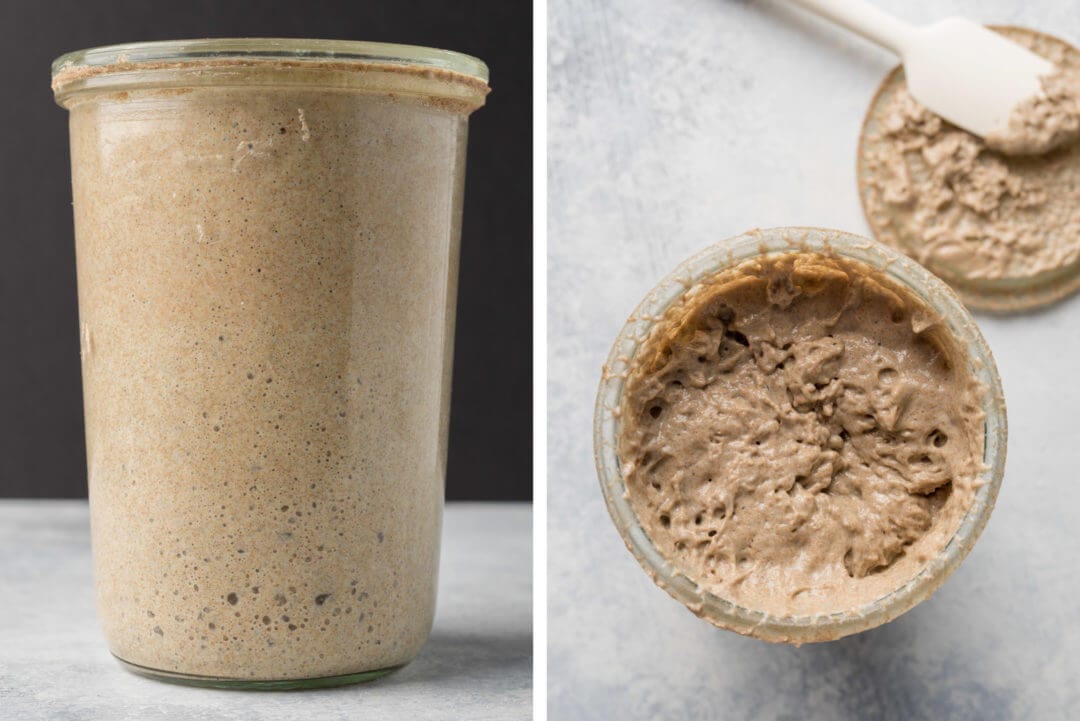
Why Isn’t My Sourdough Starter Strong?
If you’ve just created your starter, give it time to ripen. With consistent, predictable refreshments, you will “train” your starter into strength, and it will display the same signs of strong fermentation each day. Temperature is also incredibly important here: keeping your starter relatively warm (I prefer 76-80°F/24-26°C) will encourage increased activity.
Why Does My Sourdough Starter Take Forever To Ripen?
Several factors play into the fermentation vigor of your starter, and the most important one is temperature. Try to find a warm spot in your kitchen to keep your starter, or use more lukewarm water to feed it. Shoot for 76°F – 80°F (24-26°C) ambient temperature for increased fermentation activity. Maintaining a stable temperature is important, and if there’s one thing I like to focus on with my starter, it’s temperature.
Flour selection also plays into the fermentation activity; the more whole grains you use to refresh, the higher the fermentation rate in your culture.
And, of course, the amount of ripe starter you carry over from feeding to feeding plays a significant role. The larger the percentage, the faster your newly refreshed culture will ripen.
All of these variables can be tweaked to speed up, or slow down, the time it takes for your starter to ripen and need a refreshment. My preferred method for changing my starter’s ripening timeline is to adjust the amount of starter I leave in the jar for each refreshment (the carryover). If it’s summertime, I will usually carry over a smaller percentage of ripe starter (15% or so) at each refreshment to slow things down so I can maintain my twice-a-day refreshment schedule. If it’s winter and temperatures are lower, I’ll carry over an increased amount of ripe starter (25% or so) into my next refreshment.
How Often Should I Feed My Sourdough Starter?
This question is very temperature and flour-dependent. If the ambient temperature in your kitchen is on the warmer side, 75-80°F (23-26°C), then you’ll find your starter ferments much faster than if it were cooler (less than 75°F/23°C). Likewise, you’ll see higher fermentation rates if you use a large percentage of whole grains in your refreshment.
I prefer to feed my starter twice daily to keep it healthy and ready to bake at any moment. But then again, I bake very, very frequently. If temperatures are not overly high, I recommend a single daily feeding. If your starter falls significantly in its jar, looks broken down and loose, and smells like harsh vinegar or paint, try using a smaller percentage of ripe starter at each feeding. You can also find a cooler spot in your kitchen or use colder water to feed.
For example, in the summer (typically 75-78°F/23-26°C in my kitchen), I feed my starter twice a day, but even then, I have to reduce my ripe starter carryover percentage. Instead of my usual 20-25% in the winter, I drop it down to 10-15% and find a shaded, cool spot in my kitchen to slow things down. For more information on this, including pictures, see my post on maintaining your sourdough starter.
How Can I Feed My Sourdough Starter On Workdays?
For a very in-depth discussion on how to maintain your starter in the fridge during the week and use it to bake on the weekend, head over to my Weekend Baking Schedule guide! Additionally, see the previous question for what “tools” you can utilize to speed up or slow down your starter’s fermentation rate.
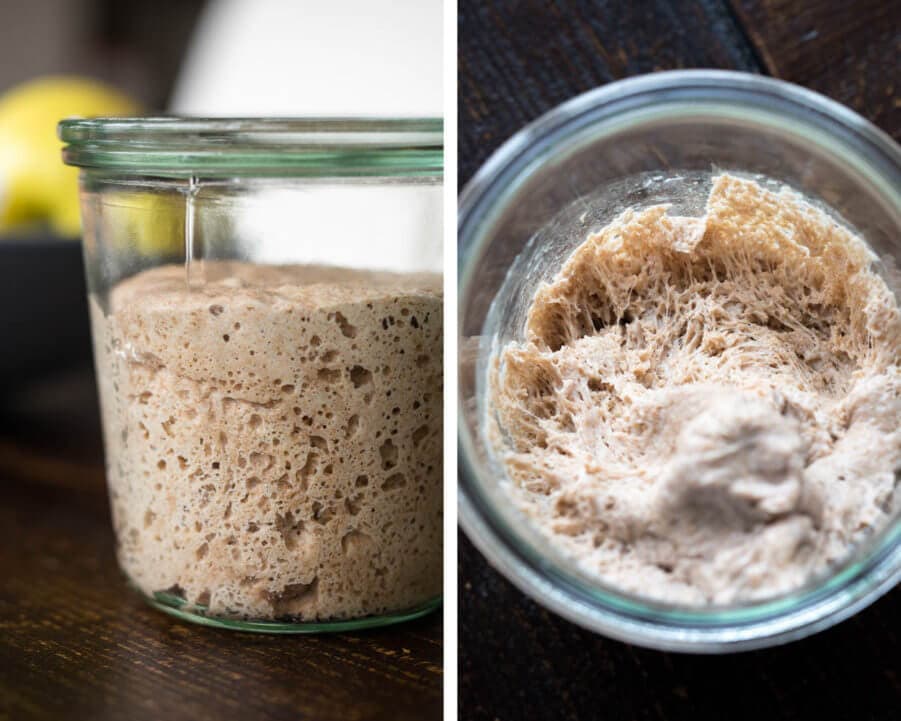
What Hydration is Best For a Sourdough Starter?
Of course. When it’s significantly hot and dry here in the summer, and the flour seems to need more water, I’ll increase my hydration to 105% or higher as required. You can adjust the amount of water you use at each refreshment so the mixture displays the desired viscosity. As the humidity level in your environment changes, adjust the hydration up and down by 5% to compensate.
My Starter Has Clear Liquid On Top, Should I Throw It Out?
You can either discard this liquid (or “hooch,” as it’s commonly called) or stir it back into the culture. I typically stir it all in together. This can be a sign you’re not feeding your starter often enough.
How Does Altitude Affect My Sourdough Starter?
You might see increased fermentation activity at high elevations. See my baking at high altitude guide for more tips.
What’s Next?
If you’re having issues with your sourdough starter and haven’t found help above, post at our member community for help!
For more starter-related things, look at my ultimate guide to sourdough starters for help and advice with feedings, maintenance temperatures, long-term storage, and much more.
Happy baking!


516 Comments
Hi there, I recently came across your website and began a starter about five days ago. Like others, I noticed a lot of activity in the first two or three days but then it seemed to drop off. (I am going to try increasing the temp a little to see if that helps.) But I’m getting close to the time that your creation schedule calls for feeding it more frequently. My question is, should I wait until I see more activity again before increasing the feedings to twice and then three times daily, or just stick to the schedule? Or, maybe to put it another way, what happens if you ‘overfeed’ a new starter that hasn’t finished consuming everything from the previous feeding? Thanks!
I hope your starter has picked up by now! Usually a warmer temperature will help kick things into high gear. I usually recommend waiting to do more feedings than one per day until you see things really get going. There can be an issue if you “overfeed” your starter in that you don’t really ever let it get a foothold and have sufficient populations of bacteria/yeast. Wait until your starter looks (and smells) like what I describe above before stepping up to 2x or 3x feedings per day. Hope that helps!
Hi Maurizio, I am in the process of building my starter. My question is, when you are building a levain, do you just feed the starter without removing down to the original 40grams? How do you build it up to get one or two cups? I hope there are not any stupid questions. Thanks
Linda, I typically make my levain in a completely separate container. Just add the requirements (mature stater, new flour, new water) as I’ve listed in each of my recipes until the “Levain Build” section and let it ferment. Once its ready use the amount of levain called for in the recipe from that new jar.
You’ll also want to keep your starter going in the same jar. Once you take some out to main the levain (above) discard per usual and feed with fresh water and flour like you’d normally do.
I like to have two separate containers like this just to ensure I don’t accidentally use all my starter/levain in a single bake!
Hi Maurizio, thank you for your great website. I’m a weekend baker, I’m Italian and I work and live in Geneva, Switzerland. I come back home in Florence for the weekend and my first thought when I get off the plane is.. baking. I have a good rye starter, nicknamed Mr. Rye (bakers are weird individuals, as you know). Lately it is not as strong as it used to be. It is 100% rye: with my baking schedule (I come back home on Friday in the afternoon) and I leave on Monday morning, what do you think is the better feeding schedule? I keep Mr. Rye in the fridge during the week.
Thank you and keep up the good work!
Hi, Stefano! I know how you feel… Usually my first thought after work is “what am I going to bake next!?” It should be fine to keep it in the fridge while you’re away. I like to take my starter out a day or so before using it to make a levain and give it a couple refreshments, this way you can build up strength and get it back in working order. I would take it out right when you get home Friday, give it a feeding late at night when it’s come back up to room temp. Then you could make a levain Saturday morning — this is probably your only schedule option since you have to fly back Monday. If you can bake Monday before leaving you could do one more feed for your starter Saturday morning and then make the levain at night, make the dough all day Sunday and bake early Monday morning. I would then put the starter back in the fridge Monday just before you leave.
Hope that helps!
Thanks Maurizio for your feedbacks! I have tried to feed my starter using 50% of rye flour and 50% of multi grains flour. It seems that Mr. Rye likes that. I noticed much more activity! I arrived early on Friday this week, so I managed to have a very active rye starter in the late evening. I made the levain at night and I’m making the dough this morning (Saturday). Let’s see how it goes ;-).
Awesome, really happy to hear that! Yes, rye flour is a wonderful thing 🙂
Hi Maurizio, I have put my starter in the fridge yesterday evening for the first time after 2 weeks of creating it. Ony now i got to read your method of putting a starter to “bed” though (20-100-80)..
So what I did, I fed it as per usual (40-40-40), let it on the counter for 1 hour and put it in the fridge. Now, after 28 hours its 2,5 times taller and it started declining slowly (2 mm). I am planing to take him out Wednesday afternoon in order to build my levain on Friday aerly morning so I will bake on Saturday early afternoon. Should I just leave him there until Wednesday afternoon? Will he be ok?
Thank you 🙂
Hey! I like to take my starter out a day or so before using it to make a levain to give it at least 2 feedings. I’d say take it out one day (preferably two) before making the levain to refresh it twice, once in the morning and once at night. This way you help get it back up to full strength before making a levain.
Hope that helps!
Hi Maurizio, Your site is awesome and thorough and inspiring. I’ve read all the Faq’s and your instructions, but don’t see my Q. I’m on day 5 of your recommended Starter procedure. I’m using 50% whole Rye flour and 50% Einkorn flour (an ancient form of wheat. This Einkorn flour is all-purpose, not whole grain). The temp in my kitchen is cool — mid-sixties or so. My starter is basically just sorta sitting there — not getting much bubble action, and not rising. But it’s still alive, and has not “gone bad.” It smells sorta vinegary by the time I feed it each day.
Should I abandon this starter and begin again? Or can I increase activity with this batch by using warmer water at feeding, or keeping something warm (like a bottle of hot water) near the starter? Or can I increase activity by retaining more starter with each feeding? Or something else? Thank you so very much!
Laura, thanks so much I really appreciate that! I also appreciate you looking through all the FAQs, you’re right you have kind of a unique case here. I’m not very familiar with using Einkorn as a flour for feeding a starter. I do know it’s a little on the “weak” side in terms of protein/strength so you might not see quite as much rise as you would with a modern wheat choice. That said, it should work just fine you just might have to adjust your expectations a bit for what to look for when it’s mature.
I wouldn’t abandon it at all, I’d stick with it. Try to do as you suggested: keep the culture as warm as you can. 75ºF – 80ºF would really, really help. Warm up some water to get your culture into that range and keep it insulated if you can. Temperature is significant when trying to get a culture going, warmer temps will really help get things moving!
So yeah, I’d focus on warming things up and then just stick with it. Sometimes it does take longer to get going and the cold temps don’t help. Let me know how it goes!
I too have the issue with a cool kitchen. I moved the starter in its container from the kitchen to a table with a lamp in the living room. The lamp has a 3 way bulb (50-200-250) and kept the table lamp on the highest setting 24 hours a day. The table top has a temp of 78 with the lamp on. After a few hours near that table lamp, the starter really amped up the activity level.
That’s a really great method, I did something similar when I first created my starter (I had a low-intensity heat lamp for a bit). Temperature is super important!
Maurizio and John, thanks again for these helpful responses. I amped up the temperature in the starter’s cupboard, and then the weather in my area suddenly shot up into the 80’s. Big help. So the Einkorn/rye starter has really great action now, and I’m grateful for your suggestions. Now . . . to increase frequency of feedings and then, hopefully a baking session this weekend. Cannot wait!
Glad to hear that, Laura!
It’s so satisfying for the reader when one finds out that your unique issue and original question has been answered and it actually helped you to achieve what you were looking for!
Hi, on Taritne book #3 they mention that starter can be put in the freezer for future use. I tried once to do this but when trying to bring it back to room temperature to start feedings nothing happened. Have you tried it?
I have frozen some but it was a long, long while ago. I do remember being able to revive it no problem. You might want to try dehydrating it more and then freezing it, perhaps 40-50% hydration refresh. Just an idea!
I have dried out my 2 last discardings and keep them in an airtight jar on my counter. Mainly for bringing the starter with me on a travel or giving it to a friend easier, or just for a back up in case of something bad will happen to my ongoing starter. Would you recommend to keep the dried starter in the freezer instead?
If it comes back to life after being dehydrated then that will work just fine. Personally I would probably dehydrate it a bit and then keep it in the refrigerator.
Hi Maurizio,
For maths sake..PLease just humour me if I sound stupid. If I have to make 4 to 5 loafs and need more levain and have only 80 g of stater…how do I do this?
No stupid questions! You just have to scale up the levain. Keep all the ratios (the percentages of everything) the same but increase the quantity. For example, if your levain is 100g flour, 100g water and 20g starter, you can increase this to 200g flour/200g water/40g starter and that maintains the ratios but increase the levain quantity.
Scale things up as needed!
Hi Maurizio, I’m so glad to find your web page, I have been after sourdough making for a long time and didn’t know how to make it, and there were you, thank you for all your generous instructions! Let me tell you that after fifteen days feeding my starter, I got the courage to make bread this week, and succeded! I’m excited about it, because it was like magic when I opened the oven and I had my bread. Now it’s becoming addictive and I’m on my way to baking my second loaf, thanks to you.
But I have a question as I live in a very hot humid place the dough is very sticky, difficult to shape unless I work it with additional flour, should I put less water to the dough? To the levain? Oh I was forgetting to say that I don’t find rye flour, just all purpose and whole wheat. Sorry for the long comment, thank you in advance
You’re very welcome, I’m so glad to have you along! Really glad to hear your bake went so well 🙂 You could definitely reduce the hydration of your dough if it’s too sticky to handle. You can also reduce the hydration of your levain but for now I’d leave it as is and focus on the water in the dough first. Reduce it by 5-10% and see if that helps for your next attempt.
Happy baking, Anna!
Hi Maurizio,
Remarkable blog, bread and pictures – thank you. It surely must be the best bread blog I’ve come across. I have a question for you. I’ve been using a sour dough starter I created for almost two years now – Charlie – and usually feed it 1:2:2 using unbleached white from a local mill. I’ll go through periods were I might not be able to bake for a month or more at a time 🙁 as life gets in the way and my starter gets neglected. I don’t always know when this is going to happen to me so I’m not intentionally walking away from baking. But it’s amazing how resilient the starter can be. I can leave it unfed for a month, pour off the hooch, feed it twice a day for a few days and it’ll be back at full strength. I wonder if a regular feeding matters between long periods of baking or if there’s a better way with a slightly more stiff starter feeding would be better? I could feed my starter your way 1:5:4 but suspect I’ll have the same issue if I left it alone for a few weeks in the fridge.. how would you maintain your starter if you were me? I know given my work travel schedule that I won’t be baking for the next few weeks and I’m wondering how to feed Charlie differently today. Thoughts? PS. Do you think these long unfed periods really affect my bread’s taste if after a long period I spend a few days feeding and rebuilding starter strength before using? In advance – thank you very much! frank!
Frank — thanks so much, I really appreciate that! They are quite resilient and can really go long stretches in cold temperatures with little attention. If I’m going to be gone for a very extended (more than 3 weeks) period I will usually dry my culture out quite a bit and then store it in the fridge. I’ll reduce the hydration down to 60-65%, let it sit for half an hour or hour on the counter, and then toss it into the fridge. The lower hydration does seem to help slow things down.
It’s hard to say whether these extended periods will affect the flavor/performance of your starter. I’d say you should be able to get things back into the right balance (yeast/bacteria) after a few feedings out of the fridge, though, so it shouldn’t be too big of a deal.
Hope this helps and thanks so much for your kind words. Happy baking!
Maurizio – thanks for the reply! Over this last week I found the 1:5:4 ratio really did slow things down. I fed it last Sunday and it only yesterday reached at rise of about 30% or so in the fridge. So I pulled some out to see how active it was, and had a double in about 6 hours with 1:2:2. So I decided to use it to make your leftover sourdough buttermilk waffles this morning.. time to go make them as the coffee’s ready! 🙂 And again, and seriously – your blog it outstanding. You’ve put a lot of work into this site – thank you for that! Can’t wait to try some of your recipes. Bake happy..
That’s great to hear! I’m happy you made those waffles, we love them here as well. Thanks for the comments and the kind words about my site, I really appreciate it. Happy to have you along!
Hi Maurizio,
I love your website and the enthusiasm you put in each bake. Thanks for suggesting the baking steel, it’s truly a wonderful tool to improve one’s bakes. If I may recommend for your European readers, there’s a family business making a similar product called The Pizza Steel (https://pizzasteel.uk – I’m in no way associated, just a happy customer).
I’ve had the most success maintaining a lievito madre (starter I created using yogurt and all purpose flour, then feeding it a 50% hydration using all purpose flour). It’s predictable, consistent and keeps well in the fridge.
However, my constant sourdough problem (?) is that the crumb of my breads is a bit… gummy. To be honest, I haven’t tried a sourdough bread other than my own, but from what I can tell from the photos, it should be a bit more dry.
I’ve read that it can be overproofed (I kind of doubt that, but being a sourdough beginner myself, I may as well be very wrong about this) and/or too acidic. Any ideas on what the issue might be, if there is one? Thank you 🙂
You’re very welcome! I’ve seen the Pizza Steel, looks great as well!
Your interior can be gummy if the dough is either underproofed (this is usually the case), very over proofed, or significantly under baked. Keep an eye on your dough during bulk fermentation and make sure that it looks similar to the photos here at my site for when I stop bulk and divide the dough. It should have risen significantly, it should jiggle in the bulk container when you shake it, and it should have some strength and elasticity to it. Keep it at a warm temperature!
If you think the dough is under baked you could try reducing the heat to something lower but bake it longer. I look for about 210ºF interior temp for when to stop baking.
Hope that helps 🙂
Hey, thanks for the reply 🙂 Just a question, I always feel like my sourdough dough vs my yeasted dough is much different in structure and feel. My yeasted dough always seems to have more strength, whereas my sourdough seems to have less tension. Is this normal and expected? I try to compensate by doing more stretch and folds with my sourdough.
I’m not super familiar with yeasted dough as I mostly work with natural leaven but it could be due to the fact that commercial yeast is much, much more powerful than wild yeast. This increased fermentation rate probably helps to condition the gluten during fermentation differently than sourdough. It’s good that you have the feel built up intuitively, though, you should be able to adjust like you do to compensate.
You might want to also make sure your starter is performing optimally as well. If you haven’t had a chance check out my sourdough starter maintenance routine for some tips (you might already be doing this, just a suggestion)!
I am relatively new to sourdough baking and love it! Some great successes and some not-so-perfect loaves with a general progression to the successes! I am moving from the fridge method of storing my starter to keeping it on the counter because I want to bake more frequently. So my question centers around when my starter can be used to build a levain…if I am feeding it morning and evening and want to build a levain in the morning, should I use the starter that was growing overnight? And, secondarily, when would the starter be ready to use again after the morning feed? Thanks so much in advance – your blog is fantastic.
Yes, you should always use a mature/ripe starter to build your levain — you want your starter to be at its peak height. You can use your starter any time it’s mature.
Have a look at my sourdough starter maintenance routine for pictures and info on when exactly to use your starter for building a levain, when it needs feeding and when its fermented too far.
Thanks for the kind words and happy baking!
I am new to this but have successfully worked with a countertop starter and fridge combo with baking once a week due to a work schedule. This week I took starter out of fridge, gave it a feeding and in 12 hours it tripled in size. Is this normal? Smells good but seems a bit dense. Is it more of a levian?
That’s great if you’re seeing that kind of activity — it could be totally normal for your starter and your environment. A levain is a small off-shoot of your starter you create for a specific build that will cease to exist when you use it totally in your dough mix. There’s really no other difference between a starter and a levain. See above for more on that!
Quick question about the banneton.
Thank you Maurizio, this website is wonderful. Do you highly recommended the use of a cloth (sprinkled with flour) on the inside of the banneton – aka a proofing liner? Can one simply flour (with rice flour) the banneton, place their dough in and put a cloth on top? Do the proofing liners aid in fermentation or do they simply keep the banneton cleaner?
I have been using cotton towels with my plastic bowls and I’ve recently acquired some wooden bannetons. The instructions that come with the bowls state that one need only flour the bowls, put the dough in and place a cloth on top – brushing the bowl out with a soft brush after each use. Again, thank you for the knowledge and recipes Maurizio!
You don’t have to add a liner to the banneton and many bakers choose to not use them, it’s up to you. I use them most times because it makes for easy cleanup and I haven’t noticed any issues with doing so. I always use them when I’m making a loaf of bread with fruit in it so the fruit doesn’t stain my baskets.
Have fun!
Thank you!
Quick question about starter hydration!
What if I want to turn my 100% starter to a different hydration what are the necessary steps for this conversation? For example I have a 100% hydration starter, I have 150g of this starter that I maintain by feeding 50 grams starter with 50 grams water and 50 grams flour. What if I want 150g of starter that is 85% hydration. How much starter do I need and how much water and flour do I need to feed it?
That’s a good question, I’ll have to add that to this FAQ!
You can easily change the hydration of your starter by simply changing the percentage of water to flour. If you want to maintain 150g starter at 85% hydration you would feed 54g starter with 54g flour and 46g water (46g water / 54g flour = about 85% hydration). Hope that helps!
So, my starter that has been going for a while has started to smell funky.
It used to smell of apples, even though it was only rye and bread flour and water. We forgot a few feedings, but it bounced back – then we let it hang out next to the sauerkraut we were fermenting.
It might not be causal, but it’s smelled funky since then, though it’s slowly getting less funky and more apple-ish since we moved it away.
Should we start over? It leveaned dough just fine last week before it started smelling bad. We are giving Rolland a break this week and have gone back to feeing him once a day.
Any advice or thoughts?
I’m not very familiar with baking sauerkraut and what kind of effect it would have on a sourdough starter but yes, if you’ve seen some strange cross contamination between the two maybe it’s best to keep them away from each other. My starter never smells off-putting at all but it definitely will start to smell pretty sour as it gets near time for a feeding. If you keep feeding it regularly it should bounce back.
If you ever see anything in the starter that looks off, like pink or red colors (or even green), then it would be best to discard the entire thing and create a new one. It’s possible, although I’ve never seen it happen, that a bad bacteria could take hold and not want to leave.
Hi, i baked my first sourdough the other day!
Over the last couple of days ive noticed the smell of the starter has changed its a bit acidic / acetone like – is that what you mean vy sour?
That’s great! Yes, that’s the typical signs for when I’m referring to a starter that’s on the sour side. It might be you need to refresh it sooner/more often before it starts to build up too much acidity. If temperatures have risen or you’re using new flour this can quickly happen. Nothing to worry about just requires some adjustments!
When recipes call to create the levain, they only use a percentage of the starter, and then you only use a percentage of the levain.
Do you prefer to keep the levain, or the starter – do you retain both?
I always keep a “starter” separate that’s an ongoing culture, a mother as it’s sometimes called. When I want to bake bread I make an off-shoot of that starter and use it to build a levain. The levain will get totally consumed in that single bake (whereas the starter is always ongoing).
In home settings, since we are baking far less than a bakery, you could certainly choose to skip the levain process altogether and just use a portion of your starter to make bread. Just make sure you leave a bit of your starter hanging around to keep refreshing!
Happy baking!
Thank you so much for publishing your perfect loaf instructions. I have been working at baking a whole wheat sourdough loaf for a few months without much success. I used your method and baked a loaf this morning with mixed results. The flavor was FANTASTIC! Unfortunately, the exterior was slightly overdone and the the interior was a little underdone even though the interior temperature registered at 205 degrees F. Can you tell me where I may have gone wrong?
You’re very welcome! You might have to adjust your baking times and temperatures to suit your environment. You might want to try reducing the temperature of your bake so the loaves don’t scorch on the outside too quickly, this will let you leave the bread in the oven longer to fully bake through without running the risk of burning the exterior.
I find it takes a few bakes to devise your own baking times, temps and schedule to suit your environment. Play with all of these things until the bread comes out how you want!
You are so right! I bought an oven thermometer and found that the temperature was actually 25 degrees higher than expected. I adjusted the oven temperatures, and am using a slightly bigger loaf pan. Today I baked my first perfect loaf today! I made a nice lobster salad sandwich, which was a bit drippy. Even so, the sandwich was not soggy. I love this recipe and technique. Thanks for the help!
Right on! Super happy to hear that. Mmm a lobster salad sandwich sound perfect with homemade sourdough 🙂
Hello Maurizio.
For a guy like me, who discovered the art of making handmade breads, his blog is a paradise.
I have made several breads with sourdough. All for your own consumption (for now!)
I have two doubts and allow me to abuse your patience.
First of all: I keep my starter in the refrigerator. When I make a loaf of bread (or not), once a week, I feed a part with an amount of water and flour in the ratio: 1: 2: 3 (starter: water: flour) and back to refrigerator. This is called maintenance of bacterial culture.
On the other hand, if I’m going to make a loaf of bread, I feed it in another ratio, something like: 1: 5: 5 and I wait about 4 to 5 hours before using it.
In summary: my starter food with two dosages: one for its maintenance in refrigerator and another to make a loaf – the levain.
Do these proportions seem logical to you? I live in Brazil and the temperature here varies a lot. Let us consider an average air temperature at 77 to 80,7F.
The second is about the quality of the bread. I usually work with 60% hydration in the final batter. Sometimes it gets very hard shell and not so developed kernel. What, in your opinion, can be the main cause?
Many thanks for your attention and patience.
Glad you’re enjoying my site! I prefer to not keep my starter in the refrigerator when I’m baking regularly, I notice I get much more activity and strength when it’s kept at room temperature and fed at least once, but preferably two, times per day. If you’re having issues I might suggest you try to keep your starter out of the fridge for the 2 days before baking to get it nice and strong and see if your baking improves. I’m not saying you can’t use the fridge at all, I just notice better activity when the culture is kept at a warmer temperature.
I know the flour is very, very different down in Brazil so it’s hard to comment too much on your results. If you’re getting too thick of a crust then it could be the way you’re baking and whether or not you have ample steam in your oven at the beginning of the bake. I like to preheat my oven quite high (525ºF) and then bake with steam for 20 minutes. This lets the bread rise nice and high before it bakes the crust to the point where it won’t rise any further. It could be that you are baking your bread at too low of a temperature for too long and thus the thicker crust — very hard to say. I’d experiment with baking temps and times to see if that helps the problem!
Hope this all helps — happy baking!
Thanks for your help. I will follow your advice.
thank you for this wonderful site!
I don’t get the nice “ear” that you have on your sourdough bread. I though maybe my dough was too wet, but I’ve made it harder this morning, and I still have a smooth opening, as opposed to a nice crisp peak the way you do. Do you know why this may be?
You’re very welcome, I’m glad it’s helped! There are several reasons this could happen:
1. The dough isn’t shaped tight enough. If you don’t have a tight enough “skin” on the dough when you shape it you won’t get a nice and tall loaf with crisp ear.
2. The dough is overproofed. Make sure you’re not letting the dough go too long before baking as it will sort of just spread in the oven instead of spring up.
3. Not enough strength in the dough. Make sure you’ve given the dough enough strength during kneading and bulk fermentation.
All of these are related in some way so it can be hard to decide which is the one that’s causing the problem. I’d say use the photos in my posts as a guide for how the dough should look and try to get close to that. Additionally, work on a single one of these at a time that way when you do get the ear you’re looking for you know which was the issue!
Hope that helps!
Hi, Maurizio,
I was wondering if you could provide some insight into some issues I’ve been having as of late with my established 6 month old, 100% hydration sourdough starter. It’s 100% King Arthur Organic Bread Flour, which is what I feed it.
I generally keep my starter in the fridge and feed it once a week, at the same time, on Wednesday mornings. When it’s time to feed, I take out all but 20% of the mature starter (which tends to be around 60 grams or so) and feed it 110 grams of flour to 110 grams of filtered water (i.e. equal parts). I let it ferment at room temp (which is always between 70 and 73 Degrees F) until it is nice an active (usually until it at least doubles in size) and then stick it back in the fridge. That is, unless I plan to use it.
Up until last week, it has been nice and active, super consistent, and rising and falling with regularity. It always passes the float test and up until last week, consistently doubles and often almost triples it’s size before falling.
I have been baking a lot more frequently lately, so the regular Wednesday AM feeding schedule has been interrupted because I have taken it out of the fridge two or three days before I plan to mix my dough (to start feeding it twice a day) to get in nice and active. After doing this last week, after making my levain, I fed it – per usual – and let it sit out at room temp for about 4 hours (less time than I usually have) and stuck it back in the fridge. It was the only time I did not let it sit out until it had at least doubled in size.
I took it back out of the fridge less than a week later to get it nice and active again to make bread and it takes forever to reach its peak and just reaches to – at most – less than double its size. I have tried increasing the amount of flour I feed it, increase the amount of mature starter to 25%, as well as increase the temp of the water to 80 Degrees F but it still seems just as sluggish. It is bubbly with lots of nice bubbles on the top, smells good still, but is significantly less active as it used to be. On a positive (I think) yet confusing note, it still passes the float test.
Thoughts, Maurizio? Is it still good to bake with? Do I need to start over? I’ve grown quite fond of my starter and am at a loss 🙁 Would love your input.
Thank you so much, Maurizio, I really appreciate it!
Warmly,
Christina
Christina, sure thing! Sorry for the late reply. I’d recommend you try to keep your starter out of the fridge for a week or two with at least daily feedings to get it back up to strength. It could be that populations (yeast/bacteria) are running low and never get a chance to fully strengthen before you place it back into the fridge. I’ve never done a schedule like yours so I’m just guessing at the cause and a possible solution, but I know if you keep it at room temperature and get it back up to strength again it should be just as good as “starting over”.
When I place mine in the fridge I usually place it in there long before it doubles in size, actually I place it in there about 30m-1hr after I feed it and just start to notice some activity. I’m not saying what you are doing is wrong in any way, that’s just how I typically do it. Each starter and environment is different!
If you don’t mind giving that a try I’d love to know how it works out — I’m pretty confident it’ll get back on its feet, so to speak 🙂
Great, Maurizio, will do; thank you! I started what you suggested yesterday and I am starting to see improvements and greater activity already. Poor little guy’s been in “cold storage” for a while and maybe just needed some TLC…I will let you know how it goes. Thanks so much again, Maurizio; you and your knowledge (and willingness to share it) are so greatly appreciated!
That’s why I like to keep my starter well fed on the counter, but then again I also bake almost every day so there’s little waste for me 🙂 I understand most people only bake once a week, or less, so the fridge can be a useful tool. You’re welcome, I’m glad I could help! Happy baking 🙂
Thank you for creating such an awesome website!
Just ten hours after my first feeding my starter doubled or tripled. Tons of large bubbles. I’m using 50% whole rye and 50% whole hard red spring wheat. I ground the wheat and rye the day before I mixed my starter for the first time. The room temperature is right between 75 and 80 degrees. Since it is growing so fast should I start feeding it twice a day already?
I just did my second feeding tonight and it looks like it’s on track to double or triple in size by morning.
Thanks
Well I just experienced the “It died!” stage. The 3rd day I was able to get an extra feeding it was growing so well. I am on day 5 (4th feeding) and it’s been 24 hours and no bubbles or growth. I’ll keep feeding it and wait for the good bacteria to take over.
Yes, very typical process there. Just stick with it and it’ll eventually get going!
You know your dough! It took some time but after two weeks of feeding every day my starter is doubling in size in 12 hours. For a whole week there was no rising at all. I almost started over. I’m building my levain and will attemp to bake my first loaf in 20 hours.
That’s excellent news, Ryan! Have fun with it, happy baking 🙂
This is a very useful post, thank you.
You mention a 12 hour levain – do you have a link to the ingredients/method for this?
You’re welcome!
For a 12 hour levain (at around 72F – 75F, room temp) I typically do 20% mature starter with 100g flour (50% whole wheat and 50% white flour) and 100g water (room temp water). This should result in a well fermented and expanded levain that will be ready around 12 hours.
hi Maurizio,
great website! really inspiring! I’ve started a whole wheat starter about a month ago. it was 50 hydration and had lots of fermentation, but at some point I decided not to keep starter and levain separate as I ended up with far too much starter. the levain was white wheat flour with 60 percent hydration. i did 20 percent carry over of levain. the fermentation looked and smelled fine, but my bread had a strange bitter/soapy taste… also my bread didn’t rise… The problem got worse and so I decided to try increasing the hydration to 100 percent a few days ago. the starter seems v weak, and has mildly mushroom like off smells… it is still producing bubbles and even passed the float test, but it doesn’t seem to be expanding to the normal volumes during peaks…. the only thing I could think of
is that it’s got too diluted at some point and has now for other bacteria living in it… any advice ?
Karen — thank you! Sorry for the late reply, I’ve been out on travel. That’s a hard one to diagnose from here, but it’s possible your starter does have other bacteria present that we do not want. I only recommend this in the last case, but you might want to consider creating a brand new starter (it does not take too many days, really) or if you know someone that has one, snag a bit of theirs.
I would describe my starter as smelling (ordered by time from new feeding): sweet, milky, slighly sour, ripe fruit or slightly like fresh paint (in a good way), sour, alcoholic, then finally extremely sour and alcoholic — almost too sharp to smell. If you don’t experience this progression you might want to consider recreating.
I hate saying that! But really, making a new starter is NOT a big deal and I don’t really put much stock in the myth of having century-old starters and such, I’ve recreated a starter many times at this point and my bread usually turns out pretty great.
Follow my guide to making a new sourdough starter and please let me know how it goes!
hi Maurizio! hope you enjoyed your travels! I’ve been thinking now it might be the water. you see I started my starter at my parents house using filtered water from the fridge. now at home I’ve been using tap water. also I’ve been given another starter from a bakery and still have the same results. I’ve even changed the flour I’m using. so I’m going to start using boiled filter water and see if there’s any difference.
That’s a great thought. You could also try using bottled water for a while just to see if that might be the issue… Good luck!
just an update to my situation. now I’m almost certain it is the water. I think the water is over flourinated in this place I’ve moved to. I have just made a loaf using yeast with the same soapy tasting result even though I booked the water, but i read that fluorine will actually get more concentrated with boiling… argh
used bottled water yesterday to bake 2 sourdough loaves, it confirmed my suspicion about unwanted chemicals in tap water…. phew I’m back on track!
Wow very interesting. I could see how that would be an issue. Thanks so much for the update, now I know if anyone is running into the same problem! Happy baking 🙂
Thanks for your post here and your site! I am starting my Tartine journey and found this very helpful. 🙂 Two questions: 1. I noticed you start your feeding schedule after day 1, where Chad in Tartine Bread says to leave it for 2-3 days before feeding. Is there a difference in doing one over the other? If I do not see activity after day 1 should I feed or leave it for another day? And 2. Does the starter and levain have to match in terms of flour? I have started a rye/apw starter and my levain will likely be ww/apw or ww/bread flour as in Chad’s recipe. Thanks so much!!
You’re very welcome, glad it’s helping!
1. You can definitely leave it for another day if you don’t see any activity. I like to feed often just to avoid any chance of mold forming on top but the risk is usually pretty low. Waiting one day may actually be a good thing.
2. You do not have to match the starter and the levain. In fact I’ll usually change this up when doing a bake — I’ll make a levain with a different mix of flours depending on the bake I have planned (e.g. a rye levain for rye bread, etc.)
Hope that helps and happy baking Sonya!
It does!! Thank you very much for your response!
Hi Maurizio!
I’ve been working on my first starter for about two weeks and it has great bubbles and smell, but it has never once risen. I’ve been baby-ing it with warm tea towels and scheduled feedings but still no rise. Should I toss it and start again?
Thanks for your help (and your awesome site!)
Katie
Hi, Katie! What type of flour are you using? How much are you stirring your mixture (make sure there are no dry bits of flour in there!)? What’s the smell like?
Need just a bit more info! Thanks for the kind words!
I’m embarrassed to admit I’ve been using white all purpose flour. The smell is sweet and slightly vinegary, and if I go a full 24 hours between two feedings it smells like alcohol. I bought some rye today to start incorporating that in. I have fully been stirring it so there are no dry bits. Another thing to note is that it’s stiff when I finish feeding it, but at the next feeding it’s really liquidy, like thinner than a milk shake. Also, I live in Vancouver, Canada, so it’s cool and damp here ALL the time.
Hope that Helps! If the answer is to start again fresh with 100% rye, I’ll understand! 😊
Katie
Not a problem, all purpose flour will work just fine! If you want to do a mixture of apw and rye that will work as well. Just keep in mind the more rye you use the faster your fermentation will be.
That’s a really good sign that it goes from stiff to liquid, it means fermentation is happening on schedule. I’m really surprised, though, that you see zero rise in your culture, especially given that it seems like fermentation is happening here. You might want to place a rubber band around the jar where your culture is right after feeding it, then you can see later if it ever rises above this level.
Not sure what else to suggest! Keep feeding it as it does sound like something is happening, but I’ve never seen an issue where it won’t rise and fall…
Thanks so much has for your help! I’ve started incorporating the rye in and will try the rubber Band!
Katie
Greetings from Maui, Maurizio!
I came to this post often while packing for our trip to Hawaii- I kept referencing the part about refridgerating the starter. I also took those moments to vote for you and hope to see your name announced as the leading food obsessive! Though I think of your site as far greater than obsessive. It’s been a constant source of valuable and most helpful information for me, and I cannot thank you enough.
Particularly this week I am truly grateful for this post, as I needed to fridge my starter for the first time since I created it. I either picked up from your site or elsewhere that my starter needed to be named. I gave my husband the honors and he chose “Aloysius.” Im sure with your guide and info, aloysius will be in good health when we return!
Ps: I’ve now tried all your excess starter recipes and have deemed them all favorites. thank you for testing and perfecting all the recipes on your site- thank you for being “obsessive”
Sincerely,
Mitsuko
Mitsuko,
Thanks so much for the kind words, I really appreciate that! I’ve used the refrigerator many times over the years and it always works out really well.
Glad you’re enjoying my excess starter recipes! I’ve been sneaking mature starter into lots of foods around here and have some more really promising recipes coming soon 🙂
Have a great trip out there and enjoy the sun!
Hi Maurizio, thank you for your great post on the sourdough starter. I started making it and keep them at room temperature for 10 days. It looks great with rage rising and falling. Then last Sunday, I decided to keep it in the fridge. I discarded all except 20g of the starter, mixed it with 50g of flour and 50g of water. I cover it with cling wrap and with the lid on. 4 days later, on Thursday night, I took it out from fridge and start feeding it for the past few days. But the starter doesn’t seem to be very active as before. I’m so troubled. Can you please help me.
Joanne,
I believe if you keep feeding your starter regularly, following the signs for when to feed it to ensure maximal population numbers at each feeding (essentially feeding it when it’s right at its “peak” or just as it begins to fall), you’ll get your starter back into shape. I’ve seen a sluggish response after the fridge as well and in my case my starter bounced back after a week or so of regular feedings.
Keep me posted!
Hi Maurizio, thank you for your reply. It turned into a mayonnaise texture in my case, with some small bubbles on top. Is that what you have experienced before?
Yes that sounds familiar. If it doesn’t spring back after a few feedings then I’d say start a new one, unfortunately. This hasn’t happened to me, though!
Hi Maurizio, Love the blog, it’s so well written and gives me confidence to bake my own sourdough loaves.
I’ve tried to make starter (twice with your recipe and another time with a different recipe) but I got the same unsuccessful result. With your recipe, after day 1, activity was really strong like your picture in day 3, lots of big bubble on top. I follow the recipe and by the end of day 2, the starter is really healthy and rising to triple the size. The first time, I waited until the end of day 2 to follow the instructions, the second time I got to it 12 hours later once it had risen and fallen but I only transferred 20g of starter and followed the recipe accordingly. Both times the end result is that I got pretty much no activity after that even after feeding for several days. The smell of the stater seemed fine, slightly vinegary with no off-putting smells.
Any thoughts?
The temperature in my kitchen did vary quite a bit as I live in the pacific northwest but I keep the starter on top of my fridge where there is heat coming off it.
Also, of note the second time I followed your recipe, on day 2 the activity was so strong, I put it in the fridge for an hour and half before heading to work and took it out before I left but it did not seem to slow it down at all.
Thanks, I appreciate that!
As I mentioned above in the FAQ this initial surge of activity followed by very little activity (or sometimes none at all) is totally normal! Not everyone will see this but it’s possible. Stick to the schedule I outline and eventually you will get consistent activity and a predictable rise and fall from your starter. This can sometimes take more or less time, depending on many conditions, just stick with it.
That initial surge of activity can be other bacteria that we don’t want to stick around, it will eventually go away as the culture becomes more and more acidic from the beneficial bacteria (LAB) we are looking to cultivate.
Hope that helps! Let me know if you’re still having issues.
Congratulations on the nomination! This post is so helpful, thank you so much. How long would you say it took for your starter to get all nice and bubbly? I have kept some in the past and they never got really bubbly even after months
Thank you, Jennifer! Really glad you’re finding the guide helpful.
Once your starter is falling and rising predictably it’s strong enough to bake bread, after that you could see bubbles and a strong rise at any time. I don’t think it’s necessary to see this and I’m not sure it’s even the best indicator of starter “strength”, it’s really just a combination of the hydration, flour used and how long it has been fermenting. You could do a test: feed your starter with warmish water (maybe 78ºF), feed with at least 50% white flour, and at least 100% hydration. Then let it ferment long enough to rise and see some bubbles — this will happen just before it falls.
Again, it’s not necessary to see this and it doesn’t always happen, even for me! Hope that helps 🙂
HI Maurizio,
i just stared readying your blog, as well as started my own starter. work in progress 🙂
Both of my starters have developed a thin film on top, have you ever had that happen to yours? Thank you for your time.
Hi, Paul! The film on top is probably what’s commonly called “hooch” and is totally normal. You can either pour this off when you do a refreshment or stir it back in with no ill effects.
I’ve noticed I’ll get this film when my starter goes a little too long between feedings, make sure you’re sticking to the schedule as close as you can!
Do you have or use multiple starters? Or do you handle hydration levels with the levain as you prepare to bake?
I use the same starter for all my different breads,
Like @kevinwillden:disqus mentioned below, I also only have a single starter. In the past I’ve maintained several for testing and reporting here at this site but I prefer to just keep a single one. It’s much easier to maintain and if there is a special recipe I’m making I’ll adapt my starter (or make an off-shoot of it) for the upcoming build, or just tweak the levain for the recipe.
Good to know, thanks!
I’ve seen you reference a couple different starter routines, so I was a little curious how that works for you. Do you have a preference?
I was a little surprised to see your 20g starter + 100g flour + 80-100g water starter routines, or your 40/40/40 routine… I imagine you baking all the time and keeping a larger starter. When I make bagels, I used about 2 cups of starter so I’ve been keeping a
larger starter on hand.
Since I don’t make bagels everyday, let alone bake every day, I can’t keep up with feeding such a large
starter 2x a day. To cut down on waster I am going to start making a separate starter in advance.
So far I really don’t have a set preference, only that it’s most convenient for me to do the longer 6 hour levain build so that’s what I typically do. I see bakers talk about which works best for them for various reasons but honestly both ways work well for me!
Sounds like a great plan. Yes I do keep quite a bit of starter going each day but I bake. A lot. So it makes sense for me. I realize most people out there don’t bake as often as I do and thus I try to have some other options for people out there who need a little bit of a change.
In the end it’s a very personal thing, something that needs to be tweaked for each persons schedule and what they’re looking for. I try to provide to tools for people to understand the process and make changes as needed. Sounds like you’re on your way!
Happy baking 🙂
Nice post, as always! Will try to up my starter maintenance game after this.
Just one question. When feeding, do you transfer part of starter to a clean jar and feed it, or do you re-use one jar for some days?
I do the later, but then after few days it becomes very smelly (old starter on top of the jar). Not sure if it influences starter, but just wanted to check 🙂
Thanks!
That’s a really good question I will add to the list above, I’ve been asked this several times. I use the same jar and try to keep it as clean as I can. I’ll discard part of my starter, wipe the top and top-sides clean with a towel and then add new flour+water per usual. I’ll use the same jar for about 2 weeks or so, but I change it out when it becomes a little too dirty for my tastes (hard flour/water on the sides, top, etc.). Two weeks is a good benchmark for me, that’s usually when I need a clean jar. I always use the same Weck jars, I have boxes of them (I use them all over my kitchen) 🙂
A little tip to keep the top of the jar clean is to really try to scrape the sides down as much as you can and then use a towel to wipe off the excess at the top half of the jar (the bottom half will be covered as your starter rises anyways, it will all get reincorporated).
Hope that helps!
I have pretty much the same process 🙂 Same jar for about one week, even though one week would be better but I am too lazy. I use canning jars which are a bit harder to clean properly when feeding because of rounded shape. Will try to get some with straight sides.
Canning jars work really well but the Weck jars I linked above are the ones I love — they have straight sides and no little nooks and crannies for the starter to hide in 🙂
Yeah, that’s the reason why I’ll try to find some replacement for my canning jars. If I don’t find something, cunning jars will do just fine 🙂
I use the same Jar all the time
This is really helpful thanks Maurizio!
Can you outline the pros and cons of long room temp bulk vs short and room temp proof vs retard? Thanks!
You’re very welcome!
I plan to have answers for questions like that in a future FAQ, but briefly…
Room temp bulk vs short: I find that you can shorten bulk by an hour or so with warmer temps but I don’t like to go lower than 2.5-3 hours. You really want a full and complete bulk and with sourdough you don’t want to rush things or you could compromise some quality in the end result. A longer bulk fermentation is totally fine, just keep an eye on the dough and don’t go too long. Look for the signs for when to call it quits, I outline them in most of my recipes here (and have pictures).
Room temp proof vs. cold retard: I find the flavor to be more complex and only a hint of sourness with a cold retard. A room temp proof (something which I don’t do often) is great too, it depends on what type of bread and flavor profile you’re after. Like I said i think the cold retard does have a more complex flavor profile overall (subtle sourness and depth) whereas my experience with a room temp proof is it has a slightly more forward sour flavor. Both are great, but different!
I hope that helps. Of course it all comes down to personal preference in the end and what your ideal loaf is!
Thanks so much Maurizio this is really helpful
Excellent…and timely post!
Right on Jinal! Thanks 🙂
This is a fantastic post. Thank you so much for taking the time to put it all together for us.
You’re very welcome, super glad it’ll help out! Thanks for the feedback 🙂
VERY WET DOUGH AFTER BULK RISE AND PROOFING
I am having problems coming up with a dough that can be shaped into a boule? The dough after the bulk rise is just to loose it just wants to flatten? Even after overnight proofing in the fridge it is just too loose and bakes into a quite flat loaf. The crumb is very nice and airy and the crust is nice and the bread tastes very good but its very flat?
What am I doing wrong?
I use 1Kg of 50/50 stone ground organic whole wheat bread flour and organic white hard wheat flour!, 850 grams of water and 150 grams of levain. I’ve tried reducing the water by 10% but its the same problem. I autolyse 4 hours, bulk rise 4 hours with 5 or 6 pulls and fold every 30 minutes. Then proof overnight in the fridge.
It sounds like you’re doing things correctly, but there are also a lot of variables at play here. It might be that you are not sufficiently building enough strength in the dough during bulk fermentation, you might want to try to do more stretch and folds at each set during bulk. For example, during your first set of stretch and folds, make sure you’re grabbing the dough and really stretching it up high and then fold it over to the other side. Do this 5-6 times during that first set until the dough is in a somewhat tight ball in the bulk container. Repeat that for the first 3-4 sets and then be more gentle the last 2-3 towards the middle/end of bulk.
My guess is dough strength here. Try that out and let me know how it goes! Feel free to shoot me an email if you have any pictures of the next loaf so I can help further diagnose. Click on the “Contact” link at the top!
Thanks Maurizio, I will hopefully be baking this weekend and will take a few shots if its still a problem after I follow your suggestion.
Hello, I have a similar problem with my first batch following a 75% water, 75% hard bread flour and 25% dark rye. How did you solve this issue?
Hi Maurizio, I sent you a message via “contact” but could not see how to include photos?
Will reply to your email!