


Your sourdough starter is a mixture of yeasts and suitable bacteria that co-exist to leaven and flavor bread dough. I’ve been maintaining my starter for over ten years now, regularly feeding it twice a day, every day, and the process is so familiar I don’t even think about it anymore. But it’s nothing mystical or magical, my sourdough starter is a culture I give nourishment (flour and water), and in return, it happily does work for me without even realizing it. But many uncertainties can arise along with its maintenance, and this frequently asked sourdough starter questions post is here to help.
I’ve been compiling this list of starter questions for almost as long as this website has been around. Each time I receive an email or comment asking a question about what I do in a particular situation, I’ve saved it and added the most commonly asked questions below.
If you’ve arrived here before you have a starter, it might be worthwhile to have a read-through to internalize some of these questions and answers. Then head to my guide to creating a sourdough starter and get started.

How Do I Create a Sourdough Starter?
I’ve written a detailed post with pictures and clear instructions on creating a sourdough starter in 7 easy steps.
Do I Have To Use Whole-Grain Rye Flour For A Sourdough Starter?
I call for whole-grain rye flour when creating a starter because the additional nutrients in rye flour help speed up the process. You can certainly use whole wheat flour or even white (sifted) flour if you’d like, but I find rye flour to be the most effective flour at the beginning. If you don’t have rye flour, then whole wheat works!
I Think My Sourdough Starter Died. Is it Dead?
It’s normal to see a lapse of activity at some point when first creating a sourdough starter—this is normal. The initial proliferation of action at the beginning of creating a starter is from a different type of bacteria in your mixture that will eventually be replaced by the kind we are looking for (lactic acid bacteria). Keep feeding, and discarding, as I outline in my creation guide. Eventually, your mixture will slowly become more and more acidic (low pH), killing off other bacteria and allowing the beneficial yeasts and bacteria we are looking for to take hold.
I’ve Been Following Your Starter Creation Guide, But Nothing is Happening. What’s Wrong?
The most common problem I see people face is low temperatures: it’s easier to create your starter if you keep it warmer. Cold temperatures (below 70°F/21°C) will slow the process down significantly, whereas warmer temperatures (around 76-82°F/24-26°C) will speed it up. Try to find a warm spot in your kitchen to keep your starter, or use more lukewarm water for feeding. For more information on starter and dough temperatures, see my post on the importance of dough temperature.

Should I Cover My Sourdough Starter Jar?
I like to keep mine covered loosely to keep anything from falling inside the jar and the starter from drying out. The lid does not have to be airtight. I loosely place a glass lid on top (my favorite sourdough starter jars have a glass lid that rests on top), but it’s not sealed shut.
When Is My Sourdough Starter Ready?
Once you see predictable signs of fermentation (rise, bubbles, a transformation in aroma from sweet to sour, etc.) each day, it should be strong enough for baking. When creating a starter from scratch, you might see a spur of activity at the beginning of the process, but you want consistent signs of fermentation day after day before it’s strong enough to use for leavening. Typically, when creating a new starter, this is after 5-8 days.
Do I Have to Make a Levain?
It’s always an option to use your starter instead of making a levain. But, for most recipes, I prefer making a levain so I can control the flour going into the levain, the ripening timeline, and when I use it to mix into a dough—all of this without having to adjust my continually maintained sourdough starter.
For example, I might make a levain with all white flour and use it before being overly ripe for my cinnamon rolls. This will help to ensure the end rolls will not have an overly sour flavor.
What Kind of Container Is Best For a Sourdough Starter?
You can use just about anything. I like to use clear glass containers to observe the sides and bottom, and these Weck jars are my favorite. They have a glass lid that rests on top just in case too much pressure builds up inside the jar from fermentation. Canning glass jars are also a perfect choice.
How Often Should I Clean My Sourdough Starter Jar?
Use the same jar daily and keep it as clean as possible. During a feeding, discard part of your starter per usual and then scrape down as much residual starter as possible, reincorporating it back into the mixture. Then wipe the top and sides of the jar with a towel to remove any remaining liquid. If you can get the top half reasonably clean, that’s good enough. The bottom half of the jar will most likely be covered when your starter rises during the day, anyway.
What Water is Best For a Sourdough Starter?
Regular drinking water from the tap is just fine. Fill up a large container and let it sit on the counter overnight before using it to allow any chlorine in your tap water to dissipate.
What Can I Do With Sourdough Starter Discard?
Cook or bake with it! You can use leftover starter into banana bread, waffles, pancakes, tea cakes, muffins, pizza, cookies, and so on. If you want to use less flour overall, check out my guide to maintaining a smaller sourdough starter. Aside from using sourdough discard in other foods, I will almost always compost any leftovers, only using the trash as a last resort.

Can I Refrigerate My Sourdough Starter?
You can absolutely store your starter in the fridge, especially for vacation. To prepare for the fridge, I will wait until the starter needs a refreshment, discard all but 20g of ripe starter, and then refresh it with 100g flour and 80g water (I like the culture to be a bit on the stiff/dry side). After refreshing, let it sit on the counter for 1 hour, then toss it into the fridge. I will usually use the same Weck jars for this, and the cover will be loosely placed on top so nothing can fall in, but excess gasses can escape.
When I want to bake again, I will remove my starter from the fridge, let it ferment on the counter for a few hours, and then feed it as I would normally. I will do this a few days before I plan to bake to get the culture back up to strength.
See my post on storing a sourdough starter for tips on keeping it in the fridge or other methods for longer periods over two to three weeks.
Why Doesn’t The Sourdough Starter Float Test Work?
The float test is a good general indicator for when a starter or levain has significant fermentation, but I find it is not 100% reliable in testing for when a starter is ready for use. It can lead to false positives, but, as I discuss below, when your starter makeup is not with a majority of white flour at a moderate to high hydration, it will also rarely float, even if your starter is ripe. Instead of using the float test, I look for signs of strong fermentation and ripeness.
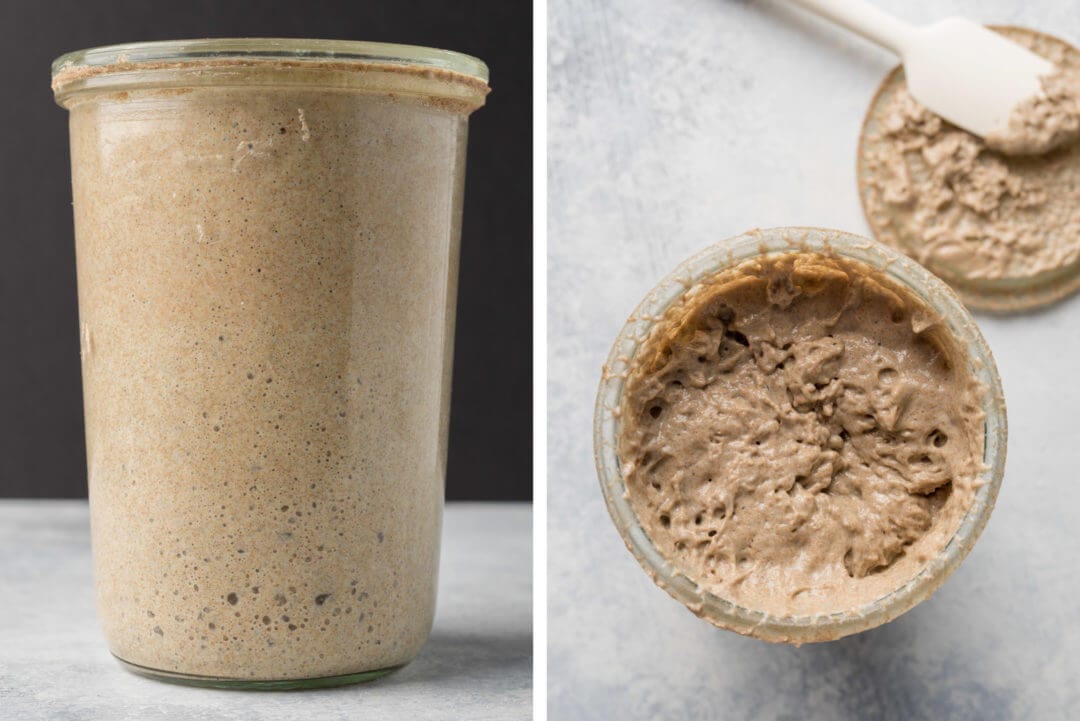
Why Isn’t My Sourdough Starter Strong?
If you’ve just created your starter, give it time to ripen. With consistent, predictable refreshments, you will “train” your starter into strength, and it will display the same signs of strong fermentation each day. Temperature is also incredibly important here: keeping your starter relatively warm (I prefer 76-80°F/24-26°C) will encourage increased activity.
Why Does My Sourdough Starter Take Forever To Ripen?
Several factors play into the fermentation vigor of your starter, and the most important one is temperature. Try to find a warm spot in your kitchen to keep your starter, or use more lukewarm water to feed it. Shoot for 76°F – 80°F (24-26°C) ambient temperature for increased fermentation activity. Maintaining a stable temperature is important, and if there’s one thing I like to focus on with my starter, it’s temperature.
Flour selection also plays into the fermentation activity; the more whole grains you use to refresh, the higher the fermentation rate in your culture.
And, of course, the amount of ripe starter you carry over from feeding to feeding plays a significant role. The larger the percentage, the faster your newly refreshed culture will ripen.
All of these variables can be tweaked to speed up, or slow down, the time it takes for your starter to ripen and need a refreshment. My preferred method for changing my starter’s ripening timeline is to adjust the amount of starter I leave in the jar for each refreshment (the carryover). If it’s summertime, I will usually carry over a smaller percentage of ripe starter (15% or so) at each refreshment to slow things down so I can maintain my twice-a-day refreshment schedule. If it’s winter and temperatures are lower, I’ll carry over an increased amount of ripe starter (25% or so) into my next refreshment.
How Often Should I Feed My Sourdough Starter?
This question is very temperature and flour-dependent. If the ambient temperature in your kitchen is on the warmer side, 75-80°F (23-26°C), then you’ll find your starter ferments much faster than if it were cooler (less than 75°F/23°C). Likewise, you’ll see higher fermentation rates if you use a large percentage of whole grains in your refreshment.
I prefer to feed my starter twice daily to keep it healthy and ready to bake at any moment. But then again, I bake very, very frequently. If temperatures are not overly high, I recommend a single daily feeding. If your starter falls significantly in its jar, looks broken down and loose, and smells like harsh vinegar or paint, try using a smaller percentage of ripe starter at each feeding. You can also find a cooler spot in your kitchen or use colder water to feed.
For example, in the summer (typically 75-78°F/23-26°C in my kitchen), I feed my starter twice a day, but even then, I have to reduce my ripe starter carryover percentage. Instead of my usual 20-25% in the winter, I drop it down to 10-15% and find a shaded, cool spot in my kitchen to slow things down. For more information on this, including pictures, see my post on maintaining your sourdough starter.
How Can I Feed My Sourdough Starter On Workdays?
For a very in-depth discussion on how to maintain your starter in the fridge during the week and use it to bake on the weekend, head over to my Weekend Baking Schedule guide! Additionally, see the previous question for what “tools” you can utilize to speed up or slow down your starter’s fermentation rate.
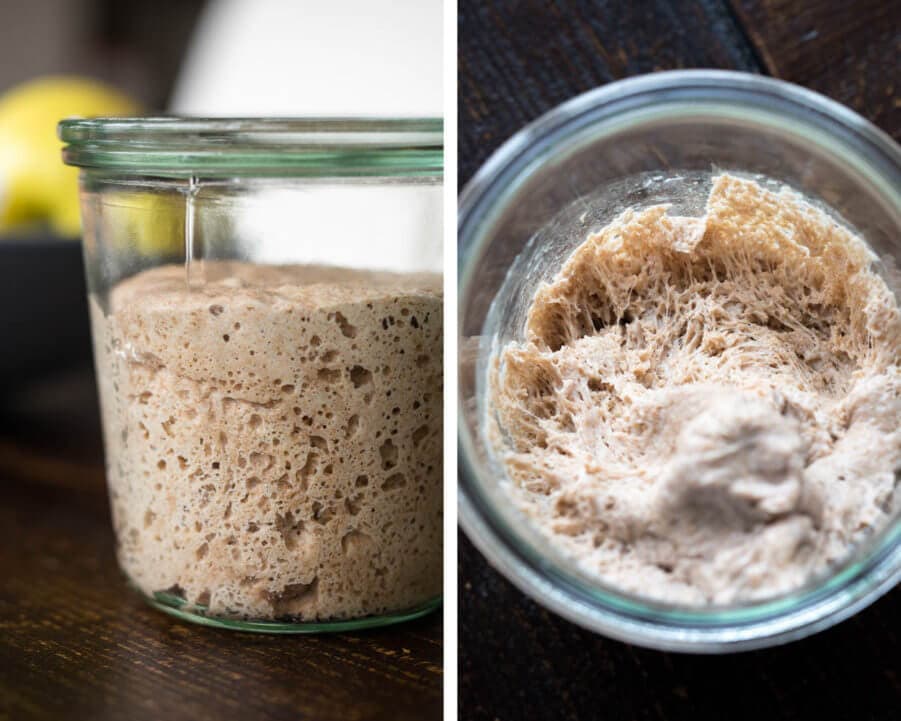
What Hydration is Best For a Sourdough Starter?
Of course. When it’s significantly hot and dry here in the summer, and the flour seems to need more water, I’ll increase my hydration to 105% or higher as required. You can adjust the amount of water you use at each refreshment so the mixture displays the desired viscosity. As the humidity level in your environment changes, adjust the hydration up and down by 5% to compensate.
My Starter Has Clear Liquid On Top, Should I Throw It Out?
You can either discard this liquid (or “hooch,” as it’s commonly called) or stir it back into the culture. I typically stir it all in together. This can be a sign you’re not feeding your starter often enough.
How Does Altitude Affect My Sourdough Starter?
You might see increased fermentation activity at high elevations. See my baking at high altitude guide for more tips.
What’s Next?
If you’re having issues with your sourdough starter and haven’t found help above, post at our member community for help!
For more starter-related things, look at my ultimate guide to sourdough starters for help and advice with feedings, maintenance temperatures, long-term storage, and much more.
Happy baking!


516 Comments
Yes, in fact, you can drop down the amount of carryover starter to a very small amount, even 1g!
You can keep a smaller starter, too:
https://slimlife.fit/keeping-a-smaller-sourdough-starter-to-reduce-waste/%3C/a%3E%3C/p%3E
I am really enjoying your website and all the sourdough information and tools. I do have a couple of questions……
In your recipe for Beginner Sourdough, you direct to make the levain at 8am with ripe sourdough starter. But when I feed my starter, it is at its peak activity/rise, 5 hours after feeding. So I would have to feed it at 3am, not realistic! How do I slow the peak activity down? Or is it OK to use the starter, even when it has started to “shrink” down again? At what point is the starter “ripe to bake with”? Or should I just use starter and not bother with the levain? And if so, how much starter?
I also am finding when baking (in a dutch oven), that I get good “oven spring” but my finished crust is really hard, very difficult to cut, even with a good bread knife. How can I fix that?
Thank you! It''s totally okay to use your starter a few hours on either end of "ripe." Yes, I'd rather use it after it's shrunk (or fallen).
I talk about this thick crust, here:
https://slimlife.fit/how-to-bake-bread-in-a-dutch-oven/%3C/a%3E%3C/p%3E
I have a deadline, I have hooch on top of my starter, will the bread look nice if I stir it in and us either without another feeding?!?!
You can, but I'd prefer giving it one more feeding! Or, you can make a fast 3-hour levain:
https://slimlife.fit/what-is-a-levain-and-how-is-it-different-from-a-starter/%3C/a%3E%3C/p%3E
I have issues with keeping my starter fed without accumulating too much discard. I normally keep my starter in the refrigerator (120 gm total). I warm it up and feed it once the day before baking, then make the levain as you suggest. It generally works fine, although occasionally a bit more time goes by and it will require a couple of days of refreshment. That said, I still end up with a fair amount of discard, and I don’t bake discard pancakes, crackers or other things very often. I’m wondering if it would hurt my breads to add some of the inactive discard to the loaf (in addition to the fresh levain), as long as it hasn’t begun to look or smell yucky? I would keep about the same ratio of water:flour.
You can do that, but you run the risk of adding more active starter and speeding up fermentation dramatically! Instead, I like to keep a discard cache in the fridge:
https://slimlife.fit/my-sourdough-starter-cache-how-i-keep-discard-for-weeks/%3C/a%3E%3C/p%3E
I got a starter from someone locally and I do not think it is established enough to bake with , can I get a more established starter and add to my under developed one?
Yup. Just combine them!
Hello all, when starting and mainting starter, is it okay to let it rest in your oven with the light on or is this too warm a spot? Thanks!
It should be fine in there, just be careful because it can get too hot. Put a thermometer in there to test! I don’t like to go much above 86F.
Has anyone ever baked a loaf with the lid on the Dutch oven the entire time? I just tried that because the flour turned brown on the top crust of the previous loaf, and I didn’t want a repeat of that. The internal temp was 210 and the crust was perfect when I removed this loaf from the covered pot, but I’m praying the inside is okay – can’t cut it to see as it’s a gift.
I’d love to hear if anyone else has tried this. Also, I’m baking in a gas oven – started at 495 then dropped to 475 for the last 20 minutes.
Very interesting, I’ve never tried this!
Your Dutch pot should be in the oven at the preheat with lids, when the temperatures reaches 450 then but the bread dough in along with two ice cube, put the lids in and let it bake for 25 to 30 minute , then lids off for 15 to 20 to brown , take out put on rack and your good…
When I see that the top of my loaf is getting too dark, I put a piece of foil over it. It keeps the dough from getting darker. Also, I turn my oven down to 375* when the lid is off, that also helps. I also spay mist I. My oven a couple times during that last part of the bake. Good luck!
When reviving a starter after it has been in the refrigerator (for just one week) and to prepare it for baking. How many times should it be refreshed and at what amounts per feeding to prepare it for making the Levain? I appreciate your direction on this… it just seems like there is so much conflicting information out there. Thank you!
I would refresh it for 2-3 days with 2 feedings each day. You want to see it rise and fall with the same predictability each day.
Loving the book. On the first feeding of day 4, I put 20g carryover, 30g rye, and 70g All purpose. I noticed the typo in the chart after mixing everything up. I added the missing 55g of carry over. Is it okay that the rye and all purpose were 30g,70g, instead of 50g, 50g.
Thanks!
So glad you’re enjoying my book, Joshua! Yes, it’ll be fine and so sorry for the typo. I hope your starter is up and running and you’ve been baking thus far!
I am new to sourdough, and have just started my first starter. I used whole wheat flour and bottled, chlorine free water. The issue I am concerned about is temperature fluctuation–during the day our house is about 70, but at night we turn the temp down to about 66. My starter raises and is starting to bubble during the day, but in the morning it has slumped down. Is this a concern? (I’m on day 3 today)
Can you make another starter using the discard? I am just learning to make this. When you use the started to make bread, do you use it before or after feeding it?
Yes, you can use the discard to create a completely new starter if you’d like.
Hello.
Do you think I could travel with my starter, will the long flight affect my starter? 🫣
It’s not a problem, I’ve done this many times!
Hi and thank you for your blog.
I hope this isn’t a dumb question. I started a starter about a week ago and it’s getting a pretty good rise. I have never used a starter before. Does one use the starter at peak rise or are we just looking for an active starter
You’re welcome! You want to use your starter when it’s ripe to bake with (or make a levain).
I had to refrigerate my started for about a week and a half. Since then I have been refreshing regularly but it smells different. More like glue and not sour. It is rising and bubbling like normal. Im a little nervous to use it, do you think i need to start over from scratch?
Yes, what you’re seeing is normal. After you keep it out on the counter for a few days, and with regular feedings, it will return to its normal aroma.
Hey there! If it’s too watery, just leave out some of the water when you go to give it a feeding. Leaving out some water will help stiffen it and make a stronger dough. If you want to switch flour, no need to do it slowly, you can do it all in one feeding if you’d like!
My sourdough starter is having a nail polish smell even after refreshing. Ive checked my four (its not rancid). What could be causing this?
It needs a feeding sooner!
I am wondering if I can use a portion of my sourdough starter to switch over to a sweet friendship bread starter?
I’m not very familiar with that style of bread, but if it’s using natural fermentation, yes it should work!
I’ve been saving my discard in a separate container in the fridge. I pulled out 100 g and fed it. It looks and smells perfect. I can easily get the requisite 2 cups by feeding my discard. Will that work to make bread with?
I wouldn’t make bread with it, but would use it for any discard recipe!
I am a beginner, but just feed it and keep it warm in the oven until it gives you that 1-2 inch rise for leavin.. then make the bread.
Hi,
I recently started my own starter from scratch with a mix of whole rye and white flour. It was great the first week and I actually was able to make a couple of loafs from it. They weren’t the best but I was still quite proud of them.
I put the starter in the fridge for a week after my first bake and then continued to feed my starter.
It’s been 3 weeks since I started the culture and for some reason my starter has a very strong alcohol smell when I open it to feed it. It used to smell amazingly yeasty and fruity but now it’s straight alcohol.
I read that maybe because it doesn’t have enough food but I feed it twice a day and I can’t be home earlier to feed it. My starter activates really well and reaches the top of the jar each time but the smell has me worried.
Do I need to discard more of it?
Is there a way to slow it down?
Can I use it as is or do I need to solve this problem before using it?
I have learned so much from this place and appreciate all that you do to help.
No worries about the alcohol smell, that’s to be expected when it goes too long without a refreshment (feeding). I’d just discard down, and keep it at room temp for a few days to get back into full strength.
Hi Maurizio,
I have been working with sourdough for a few years with some pretty good success. I started out with a decent starter and maintained it for a couple of years and with advice from your site my results improved significantly. I went on a baking hiatus for a few months (too much bread, not enough mouths), and keeping a 2-month long story short, my starter died and got moldy, so I needed to start a new one. I have been trying for over a week now and I cannot get it going. I have been using the same feed stock I have been using for a few years – Bob’s Red Mill organic whole grain rye flour and filtered tap water – and it seems to be completely stagnant. It even smells just like flour and water with no hint of anything else. I have been feeding it on about once/day. i tried keeping it warmer (around 80F) or cooler (around 70F). A friend recommended ‘onion water’, which is simply soaking an onion in water, and using that water to get it started. I even checked the pH – my filtered water is at about 8, the onion water is at about 5. I cannot test the starter itself with the tools I have.
What am I doing wrong????
Thanks!
Carmine
Hey, Carmine! I hope by now you’ve gotten it going. If not, have you tried bottled water from the market? That usually helps when someone is super stuck. Also, if you can get some whole grain rye flour, it may also help. In the past, I’ve had issues with whole wheat, but rye has always worked.
Hi,
I see my starter is rising much more than I anticipated. Can I switch it to another jar or will it ruin the starter ?
Thanks !
Yes, absolutely change!
Last night I fed with AP and buckwheat (it was in reach).
This morning it smells like bananas 🤪 and I can see that it has risen & fallen in the night.
Do I change what I’m feeding?
Is it too warm?
Did it eat up all of its food and is that why it fell?
Thank you.
It’s probably the buckwheat you’re smelling!
Hi there 🙂
I have been baking for almost two years now and get a relatively good loaf from instructions from another course i did but i don’t think it is the best it can be. I keep a lower hydration started and i keep it in the fridge. before baking i will feed the day before and leave it out until it doubles in size and then put it back in the fridge and will only take it out just before i mix it into my recipe…. this seems very different to what you are suggesting…Should i feed my starter and then leave it at room temp until all the signs of ripeness are achieved and then can i put it in the fridge and use the next day? Thanks for a great blog!
Yes, I’d recommend feeding it and keeping it at room temperature to get the best fermentation activity in your final dough!
Hi Maurizio!
Thank you so much for your helpful website.
I am on day 3 of my starter and all is going well. I am using the proofer that you recommended. But I am going out of town for 2 days (day 5-7). Can I feed it Friday and turn down the temp until I get back on Sunday?
Thanks for your help!
Yes, that’s what I’d do!
I’ve let my starter ignored in the back of the fridge a couple months. The liquid is brown, but I don’t see mold. Should I chuck it? Or use it?
Should be fine as long as you don’t see mold!
Hi Maurizio!
First, thank you for your clear and insightful website.
I have made a starter from 100% whole wheat flour and maintaining it for a couple of weeks. Is it still possible to switch over to rye?
Also, it smells (alcoholic) and on many blogs I read it is supposed to smell fruity (which mine definitely does not smell like). Can I work with that?
I kept feeding it on a daily basis.
Last question: because I use whole wheat flour it stays a bit grainy, but when I look at your (or other’s) starter dough, it looks so smooth: how can I achieve that?
Thank you a lot in advance!
Maurice
You can certainly switch over to all rye, not a problem. The aroma will certainly change based on what flour you’re using, so expect it to change if you go all rye. I wouldn’t worry too much about how grainy it looks, it’s almost certainly just a factor of the flour you’re using (which may be less finely milled, and that’s okay).
10 years and now my starter smells lijeblue cheese!
I am heartbroken!
Any remedies?
Ah! It might still be ok. I’d discard it heavily at the next feeding, and give it a mix of white flour and a little whole rye. Do that for a week and try to keep it around 78F if you can. I’m guessing it’ll spring back!
One question I can’t seem to find an answer to is… can discards be combined if not used immediately after feeding?
Sure!
If you want to save the discards to use together, (1) should they be stored in the refrigerator and (2) how does one prepare them for baking with (ie bring to room temperature for X number of hours, etc)?
Yes, I’d store them in the fridge. Since they are a miso-mash of discards, I personally wouldn’t use them to bake bread with, but rather, only in things like waffles, pancakes, or banana bread.
Hello,
My levain more than doubles in about 4-5 hours after preparing it from a refrigerated starter. Do I have to keep feeding before using it in a recipe? Some sites have said to do a couple of 12 hour feeding before using, but the goal is to have it doubling within a 6 hour window… Since mine seems to be achieving that already, I want to make sure I can just go ahead and start getting the dough ready to bake. Any advice is much appreciated.
Hey, James. For me, I like to do at least 2 feedings from the fridge, spaced out at 12-hr intervals. But that’s my starter! I wouldn’t say doubling is the goal, though, that’s very much based on the flour you’re using. You could always give it a try, bake with it right out of the fridge, then keep it out and bake again after a few feedings. Do the same recipe, see which you like best.
But in the end, for me, I like at least 2 (and usually 3) feedings before using it from the fridge.
Hi Maurizio, I mistakenly used my starter before peak activation. Understandably, my dough has not risen as much. If I let it rise longer, will it reach a good height? Will it just take longer to rise or is it ruined? I see bubbles in the dough and it has risen some.
Yes, let it rise longer until you see the activity in the dough you’re looking for. It should smooth out, gain elasticity (strength), some bubbles like you’re seeing, and generally look alive and jiggle in the container.
Do you stir the starter before using it
I don’t typically.
Hi Maurizio, I just mixed my first starter. I was surprised how dry it is, it was difficult getting all the flour wet (I hope I did). Should it be super dry in the beginning?
Hey! It’s ok if it’s dry–or wet, it’s whatever you prefer. If you want it a little more loose to make stirring easier, just add more water to loosen it up and you’re good to go.
Thank you!
Hi! Question:
Does overripe SDS float? I’m just trying to figure out when its peak is, by observing its different stages. I’m refreshing it from the fridge, and after 10 hours of its last feeding it’s still doubled but does not float. I’m guessing its peak was overnight and now it is overripe, that’s why it does not float right now.
I don’t particularly like using the float test as an exclusive test for ripeness/readiness–many times it can lead to false positives. I would also say that out of the fridge, I like to refresh it for a few days before using it to bake with!
Hi! Following your sourdough starter and I like I killed it! the starter was in the oven with the oven light on…. I realized on day 5 that the starter was as warm as 100 degrees. It has not “come back after 4 days of feeding… Should I just start again?
Ah bummer, Kate! Yes, depending on the oven, it can get quite hot in there. I would probably start over. Sorry about this! I hope by now you’re back up and running.
Hi Maurizio,
I have commented elsewhere, but once again thank you for this wonderful website and the resources you have provided us all!
I typically bake once a week, or every other week. I always put a small amount of starter in the fridge contained in a covered jar or glass bowl. When I am ready to bake, I feed the starter and it does what it is supposed to, and I get wonderful loaves.
However, when I pulled it out this past weekend, the starter smelled off/funky. I tried making bread with it anyway and the bread tasted borderline moldy. It wasn’t awful, but definitely not good! I have spent the last 4 or 5 days giving the starter regular feedings of 50% Rye 50% All Purpose flour (my typical feed) at 100% hydration. It smells a bit better, but not much. I tried making bread again last night and it still smells like it did during my last attempt 5 days ago. Should I give up and start over at this point?
Thank you for any insight you can offer!
You’re very welcome, David! Hopefully by now things have come back. I personally have never experienced this, my starter has never been “contaminated” in this way. I’d suspect with some regular feedings it’ll come back, but if you’re seeing any signs of traditional mold (greens, pinks, white fuzzy, etc.) I would create a new starter.