


Your sourdough starter is a mixture of yeasts and suitable bacteria that co-exist to leaven and flavor bread dough. I’ve been maintaining my starter for over ten years now, regularly feeding it twice a day, every day, and the process is so familiar I don’t even think about it anymore. But it’s nothing mystical or magical, my sourdough starter is a culture I give nourishment (flour and water), and in return, it happily does work for me without even realizing it. But many uncertainties can arise along with its maintenance, and this frequently asked sourdough starter questions post is here to help.
I’ve been compiling this list of starter questions for almost as long as this website has been around. Each time I receive an email or comment asking a question about what I do in a particular situation, I’ve saved it and added the most commonly asked questions below.
If you’ve arrived here before you have a starter, it might be worthwhile to have a read-through to internalize some of these questions and answers. Then head to my guide to creating a sourdough starter and get started.

How Do I Create a Sourdough Starter?
I’ve written a detailed post with pictures and clear instructions on creating a sourdough starter in 7 easy steps.
Do I Have To Use Whole-Grain Rye Flour For A Sourdough Starter?
I call for whole-grain rye flour when creating a starter because the additional nutrients in rye flour help speed up the process. You can certainly use whole wheat flour or even white (sifted) flour if you’d like, but I find rye flour to be the most effective flour at the beginning. If you don’t have rye flour, then whole wheat works!
I Think My Sourdough Starter Died. Is it Dead?
It’s normal to see a lapse of activity at some point when first creating a sourdough starter—this is normal. The initial proliferation of action at the beginning of creating a starter is from a different type of bacteria in your mixture that will eventually be replaced by the kind we are looking for (lactic acid bacteria). Keep feeding, and discarding, as I outline in my creation guide. Eventually, your mixture will slowly become more and more acidic (low pH), killing off other bacteria and allowing the beneficial yeasts and bacteria we are looking for to take hold.
I’ve Been Following Your Starter Creation Guide, But Nothing is Happening. What’s Wrong?
The most common problem I see people face is low temperatures: it’s easier to create your starter if you keep it warmer. Cold temperatures (below 70°F/21°C) will slow the process down significantly, whereas warmer temperatures (around 76-82°F/24-26°C) will speed it up. Try to find a warm spot in your kitchen to keep your starter, or use more lukewarm water for feeding. For more information on starter and dough temperatures, see my post on the importance of dough temperature.

Should I Cover My Sourdough Starter Jar?
I like to keep mine covered loosely to keep anything from falling inside the jar and the starter from drying out. The lid does not have to be airtight. I loosely place a glass lid on top (my favorite sourdough starter jars have a glass lid that rests on top), but it’s not sealed shut.
When Is My Sourdough Starter Ready?
Once you see predictable signs of fermentation (rise, bubbles, a transformation in aroma from sweet to sour, etc.) each day, it should be strong enough for baking. When creating a starter from scratch, you might see a spur of activity at the beginning of the process, but you want consistent signs of fermentation day after day before it’s strong enough to use for leavening. Typically, when creating a new starter, this is after 5-8 days.
Do I Have to Make a Levain?
It’s always an option to use your starter instead of making a levain. But, for most recipes, I prefer making a levain so I can control the flour going into the levain, the ripening timeline, and when I use it to mix into a dough—all of this without having to adjust my continually maintained sourdough starter.
For example, I might make a levain with all white flour and use it before being overly ripe for my cinnamon rolls. This will help to ensure the end rolls will not have an overly sour flavor.
What Kind of Container Is Best For a Sourdough Starter?
You can use just about anything. I like to use clear glass containers to observe the sides and bottom, and these Weck jars are my favorite. They have a glass lid that rests on top just in case too much pressure builds up inside the jar from fermentation. Canning glass jars are also a perfect choice.
How Often Should I Clean My Sourdough Starter Jar?
Use the same jar daily and keep it as clean as possible. During a feeding, discard part of your starter per usual and then scrape down as much residual starter as possible, reincorporating it back into the mixture. Then wipe the top and sides of the jar with a towel to remove any remaining liquid. If you can get the top half reasonably clean, that’s good enough. The bottom half of the jar will most likely be covered when your starter rises during the day, anyway.
What Water is Best For a Sourdough Starter?
Regular drinking water from the tap is just fine. Fill up a large container and let it sit on the counter overnight before using it to allow any chlorine in your tap water to dissipate.
What Can I Do With Sourdough Starter Discard?
Cook or bake with it! You can use leftover starter into banana bread, waffles, pancakes, tea cakes, muffins, pizza, cookies, and so on. If you want to use less flour overall, check out my guide to maintaining a smaller sourdough starter. Aside from using sourdough discard in other foods, I will almost always compost any leftovers, only using the trash as a last resort.

Can I Refrigerate My Sourdough Starter?
You can absolutely store your starter in the fridge, especially for vacation. To prepare for the fridge, I will wait until the starter needs a refreshment, discard all but 20g of ripe starter, and then refresh it with 100g flour and 80g water (I like the culture to be a bit on the stiff/dry side). After refreshing, let it sit on the counter for 1 hour, then toss it into the fridge. I will usually use the same Weck jars for this, and the cover will be loosely placed on top so nothing can fall in, but excess gasses can escape.
When I want to bake again, I will remove my starter from the fridge, let it ferment on the counter for a few hours, and then feed it as I would normally. I will do this a few days before I plan to bake to get the culture back up to strength.
See my post on storing a sourdough starter for tips on keeping it in the fridge or other methods for longer periods over two to three weeks.
Why Doesn’t The Sourdough Starter Float Test Work?
The float test is a good general indicator for when a starter or levain has significant fermentation, but I find it is not 100% reliable in testing for when a starter is ready for use. It can lead to false positives, but, as I discuss below, when your starter makeup is not with a majority of white flour at a moderate to high hydration, it will also rarely float, even if your starter is ripe. Instead of using the float test, I look for signs of strong fermentation and ripeness.
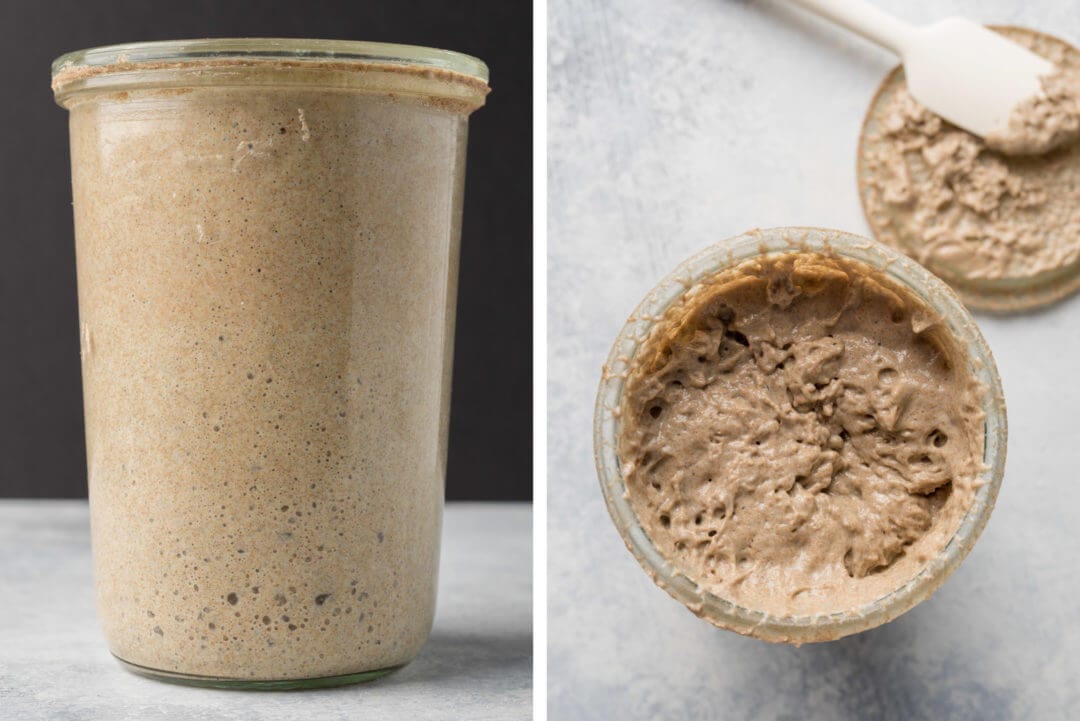
Why Isn’t My Sourdough Starter Strong?
If you’ve just created your starter, give it time to ripen. With consistent, predictable refreshments, you will “train” your starter into strength, and it will display the same signs of strong fermentation each day. Temperature is also incredibly important here: keeping your starter relatively warm (I prefer 76-80°F/24-26°C) will encourage increased activity.
Why Does My Sourdough Starter Take Forever To Ripen?
Several factors play into the fermentation vigor of your starter, and the most important one is temperature. Try to find a warm spot in your kitchen to keep your starter, or use more lukewarm water to feed it. Shoot for 76°F – 80°F (24-26°C) ambient temperature for increased fermentation activity. Maintaining a stable temperature is important, and if there’s one thing I like to focus on with my starter, it’s temperature.
Flour selection also plays into the fermentation activity; the more whole grains you use to refresh, the higher the fermentation rate in your culture.
And, of course, the amount of ripe starter you carry over from feeding to feeding plays a significant role. The larger the percentage, the faster your newly refreshed culture will ripen.
All of these variables can be tweaked to speed up, or slow down, the time it takes for your starter to ripen and need a refreshment. My preferred method for changing my starter’s ripening timeline is to adjust the amount of starter I leave in the jar for each refreshment (the carryover). If it’s summertime, I will usually carry over a smaller percentage of ripe starter (15% or so) at each refreshment to slow things down so I can maintain my twice-a-day refreshment schedule. If it’s winter and temperatures are lower, I’ll carry over an increased amount of ripe starter (25% or so) into my next refreshment.
How Often Should I Feed My Sourdough Starter?
This question is very temperature and flour-dependent. If the ambient temperature in your kitchen is on the warmer side, 75-80°F (23-26°C), then you’ll find your starter ferments much faster than if it were cooler (less than 75°F/23°C). Likewise, you’ll see higher fermentation rates if you use a large percentage of whole grains in your refreshment.
I prefer to feed my starter twice daily to keep it healthy and ready to bake at any moment. But then again, I bake very, very frequently. If temperatures are not overly high, I recommend a single daily feeding. If your starter falls significantly in its jar, looks broken down and loose, and smells like harsh vinegar or paint, try using a smaller percentage of ripe starter at each feeding. You can also find a cooler spot in your kitchen or use colder water to feed.
For example, in the summer (typically 75-78°F/23-26°C in my kitchen), I feed my starter twice a day, but even then, I have to reduce my ripe starter carryover percentage. Instead of my usual 20-25% in the winter, I drop it down to 10-15% and find a shaded, cool spot in my kitchen to slow things down. For more information on this, including pictures, see my post on maintaining your sourdough starter.
How Can I Feed My Sourdough Starter On Workdays?
For a very in-depth discussion on how to maintain your starter in the fridge during the week and use it to bake on the weekend, head over to my Weekend Baking Schedule guide! Additionally, see the previous question for what “tools” you can utilize to speed up or slow down your starter’s fermentation rate.
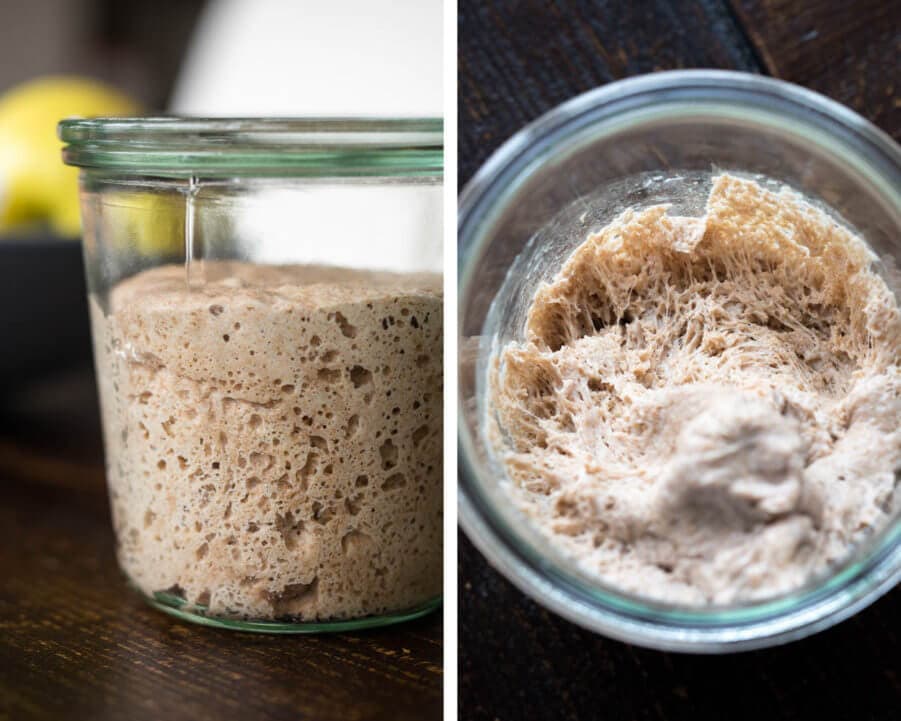
What Hydration is Best For a Sourdough Starter?
Of course. When it’s significantly hot and dry here in the summer, and the flour seems to need more water, I’ll increase my hydration to 105% or higher as required. You can adjust the amount of water you use at each refreshment so the mixture displays the desired viscosity. As the humidity level in your environment changes, adjust the hydration up and down by 5% to compensate.
My Starter Has Clear Liquid On Top, Should I Throw It Out?
You can either discard this liquid (or “hooch,” as it’s commonly called) or stir it back into the culture. I typically stir it all in together. This can be a sign you’re not feeding your starter often enough.
How Does Altitude Affect My Sourdough Starter?
You might see increased fermentation activity at high elevations. See my baking at high altitude guide for more tips.
What’s Next?
If you’re having issues with your sourdough starter and haven’t found help above, post at our member community for help!
For more starter-related things, look at my ultimate guide to sourdough starters for help and advice with feedings, maintenance temperatures, long-term storage, and much more.
Happy baking!


516 Comments
If they are covered completely (airtight) you don’t need the water pans in the proofer. I never use those pans, I just keep my dough/levain/starter covered.
What is a mature starter?
A “mature starter” is one that’s risen to its highest peak in the jar, and perhaps has just started to fall. It’s the point at which the fresh flour (food) has essentially been totally metabolized by the yeast/bacteria in your sourdough starter — this is the point when you want to discard down and give it fresh flour and water.
Does that help?
Hi, I’m wondering if you want to keep a mature starter/discard instead of throwing it out, do you need to keep feeding daily or just leave in a fridge and feed weekly? Thank you.
You can definitely use the fridge if you’d like, it’s a good tool to help reduce the maintenance needed when feeding a starter. Have a look at my weekend baking schedule for a sample schedule for doing this!
Hi, I recently started using the Brod and Taylor proofer for my starter after recently moving to a cooler location. I’m keeping the box temp at 79 degrees and feed once a day, but the starter forms a crust between feedings. I never had this problem before when I lived in a warm climate and kept the starter on the counter. The water tray in the proofer is full, and the starter is covered. Do you have any ideas why it would be forming a crust? I’m using the same kind of flour but the water is different. Could that be the problem?
That’s interesting. I’ll definitely see this happen here if I don’t keep my starter jar covered, but if it’s covered you shouldn’t see a crust form. I would recommend turning down the proofer just a bit, perhaps to 76-77F and see if that helps. It’s possible it’s getting a bit hot in there (if you keep it right in the middle it might be getting over 79F) but even so, I have a hard time justifying a crust forming. Additionally, make sure the lid is on there so no air can get in the jar. I leave my lid resting on top so gasses can escape but nothing can get in. I hope this helps!
Hello, I am working on building my first starter, and was curious for more information on what different smells might indicate as the starter is gaining strength. Mostly i am just curious for more information. without getting into a lengthy description I’m on day 4 and have what i would consider a sweet smell and some bubbling. So far i think it is going well, I am simply interested in understanding more of what is going on.
It’s hard to precisely quantify what smells you should look for — I’ve found the smell can vary wildly and is also interpreted differently by each person. Generally, though, you want to eventually smell a sourish smell, kind of like yogurt, mild vinegar, or even sometimes a little stinky (this usually happens later, though, especially if you’re feeding with freshly milled flour). As long as you’re seeing bubbling and consistent rise and fall you’re definitely on the right track!
Hi Maurizio, does it matter if I accidentally use unbleached all purpose in my levain instead of bread flour?
Technically did this last weekend with the Beginners sourdough since I used my refreshed starter as a substitute for the levain & the boules turned out flatter than expected (though I think it was more of a lack of building sufficient surface tension during shaping).
Am about to try the spelt recipe but ended up using plain instead of bread flour cos I spaced out.. Just wanted to know if this makes much of a difference..
It can make a difference, it really depends on the flour you’re using. “Bread” flour usually has a higher protein percentage and will add significant strength and structure to a dough mix. If you’re using all-purpose (in place of Bread Flour) you might want to reduce the water a bit, maybe 2-5%, to compensate (this will bring more strength to the dough). Alternatively, you could also knead it longer or add in another set or two of stretch and folds — all of which should help offset the flour change.
Thanks for the reply! Makes sense, my loaf came out pretty flat again.. It was rather wet and hard to shape. Will incorporate your advice next time 🙂
Hi, great post and I wish I had read this before starting my starter. I followed someone elses protocol to start a starter and it went like 1/4cup of flour and 1/3 of water in the morning, then 2 tbs of flour and 1.5 tbs of water added to the starter in the evening. The next morning discard half and repeat the process. So I did that and everything was going fine with lots of bubbles and expansion, then I somewhat missed a feeding, but decided to reverse the feeding schedule so it’s 2bs flour and 1.5 tbs water in the morning and 1/4cup flour in evening with water. In the morning discard a half of starter and add 2tbs of flour etc. It’s when I reversed my feeding schedule things slowed down. Did I kill some yeast? How long does it take for them to die?
I doubt anything was “killed” off — I wouldn’t worry about it. Just stick to the schedule and eventually you’ll get high enough populations of both, and commensurately, an environment that’s suitable for their growth!
Hi – Great website, thank you for all the useful information. I am on my 7th day with little activity. Only twice did I see some bubbles and I’ve yet to experience a rise. I’ve started warming the water to 80 degrees, but I’m still not seeing increased activity. I checked my starter temperature and it shows 65 to 69 degrees, though the house is warmer, so I assume the issue relates to temperature (storing in oven, as I assume least drafty place). Absent buying a proofer, is there anything else I can do? 7 days with little activity, should I start over? Thanks, Matt
Hi – saw a previous answer to feed only once, so I skipped the 2nd feeding and this worked! Hopefully I will start to see some consistency from now on.
Ok awesome, glad to hear that Matthew! Sometimes, especially if it’s cold, skipping a refreshment can help as more of the fledgling yeast/bacteria will be left in the mixture. Happy baking!
Hi Maurizio, I am writing from Portland OR. At what stage of the starter is the optimum time to use for the levain build? Just before the peak?
Hey, Rishi. Love Portland, such a great city. I like to try and time my starter right when it’s at its peak, or just a little after it’s fallen (and leaves streaks on the side of the jar).
Hi Maurizio, I am on my day 6 and I can see no signs of fermentation. When feeding on day 2 and 3 by your schedule I noticed the starter rose to the top of 1l jar since the towel cower was stained with starter. After that I saw no activity. I think I have done everything right – 78°F (bathroom), 100% rye flour, distilled water… I am keeping with your schedule and feeding 2 times a day since day 4. Should I switch to feeding once daily? Thanks for help. Rok
Hey, Rok. Sounds like you’re doing all the right things. Yes, drop back down to 1x feeding a day until you see some activity (bubbles). If you have white flour, I might suggest going to 75% rye and 25% white flour, just to help give it some structure — not mandatory, but if you feel inclined.
Keep me updated.
Hi, thanks for help. I switched back to one feeding per day as you suggested and since two consecutive days when starter trippled in volume than started falling down in less than 12 hours I am feeding twice a day again. With the residue I baked some buns with the help of dry yeast two times now. First time dough rose moderately and baked buns were a bit dense, but the second time they doubled in size and buns were quite soft, so I guess starter is getting stronger and doing it’s job. I just mixed with general purpose white flour to desired density, added some salt and a teaspoon of butter.
I will ditch distilled water and make transition to whole wheat flour shortly.
Thanks for all of your help! My starter definitely prefers some rye. I’ve cranked the proofer up to 82°F partly because it’s in a colder room. I also put the tray with water underneath, because with the heat on, it might be getting “dehydrated”. In any case it’s alive again. I’m on day 14, so I hope I can make some bread soon! Thanks again.
The proofer arrived! Everything looks great. (I also got the weck glasses. I was using old Chinese take out plastic…) This morning I changed from half rye to 100% white. Its not rising as nicely as it did with the rye – but still seems ALIVE (yeah!!) Thanks for your help. I had bought 5 lbs of Bobs all purpose flour. Which recipe do you suggest? (They all seem to call for Bread Flour & or mix of that & Whole Wheat.) AND I sent a separate question under the baking tools section. I wanted to cook a bread in my Creuset Dutch oven, but don’t see details how to do that. (The lid couldn’t be used as the “shallow side” as you do in the combo cooker.)
I think my starter doesn’t like all purpose flour (Bob’s) I don’t have hardly ANY activity since switching over to 100% all purpose flour (no rye) despite using the proofer. Bummer
Ok. Definitely stick with using the proofer, set it to 78°F. I’d go back to feeding some all-purpose flour and some whole grain rye flour for a while until you see activity in your starter. Keep feeding it 1x a day until you start to see some bubbles and keep it warm in the proofer. It will pick up with some activity eventually. At that point you can keep going with rye flour or switch over to all-purpose only — up to you.
I answered your Dutch oven question on the other post!
After more than a week, my “starter” doesn’t even have bubbles. (It did for a few days, but now nothing) What is “too hot”? I’ve broken down and ordered a proofer, but until then I was putting in the oven with the light. The temperature got up to 88 degrees, but without the light would drop to 70. Is it dead? Why do you feed only one time the first couple of days and then twice a day? Should I feed once a day until it starts rising and falling? Should I just “give up” until my proofer arrives? Should I try going back to using 100% rye flour until I see activity again?
Stick with it! It’s normal to see some activity at the beginning and then a sudden drop. That temperature, 88F, is a little warm but that should be fine. You can toggle the light on and off periodically to keep it a little closer to 80F if that’s possible. I would stick to using some rye flour but 100% rye flour isn’t necessary.
Have you tried leaving some water out or buying a gallon of filtered/distilled water and using that for feedings for a few days? If your tap water has high levels of chlorine this can impede fermentation, especially at the beginning! Keep me posted.
I have my own well water, so no chlorine. I did try using distilled water though, but still no signs of recent fermentation. It does smell a bit vinegary, so I’m not convinced its dead, but “feeding” doesn’t seem to have any affect at all. I was wondering if it was strong enough to “eat” before I changed its food for a new batch. What happens if I go back to feeding once a day?
Ok, good to hear about the water. If you can filter it with a simple home water filter that would be good, at least for a while until your starter gets going (I’m not sure if well water is typically filtered or not).
You can definitely go back to 1x feedings a day. Your thinking is valid here on this, I’d say try that for a few days and see if you get more activity. You do want to see some signs of fermentation activity, even if it’s just one or two bubbles on top, before progressing to the next steps.
I know this is a frustrating thing — please keep me updated!
Hey Maurizio! I’ve began a sourdough starter numerous times (though not using your recipe YET… I just barely found your website!!) and each time, around day 6, some of the starter on the side of the glass jar started to mold and grow white long hairs! Yuck! What the heck happened? Everything I’m using is super clean (jar, spatula etc), distilled water, and organic hard red whole wheat flour. It’s been 6 weeks of doing this and I’m about ready to give up…. Thoughts? And yes, I and going to try your method before I completely lose hope 🙂
Bummer! What you can do is keep the jar loosely covered with a lid and also give it a stir halfway between your feeding times. For example, if you feed at 8am and then again at 8pm, stir it in the middle of the day (without adding new flour or water) just to reincorporate things. Stirring should help keep that top layer of flour/water from too much oxygen exposure which could cause mold.
Let me know how it’s going!
Hello! I’m currently in the process of making my first ever sourdough starter. All seemed to be going well until I got to day 7 when I switched to 50 grams of fermented mixture, 100 grams of flour (no rye) and 100 grams of water. However, instead of all-purpose flour (as suggested), I’ve been using 100 grams of strong white flour (which I think it has more gluten). Since then the mixture has becoming like a cross between runny chewing gum and sticky glue. It isn’t rising at all. Have I made a mistake by using strong flour? Any thoughts on what I sure do now? I’ve been working on the starter for 10 days now. Looking forward to any thoughts. (I love this site by the way!)
Stick with the feeding schedule! I’d say add back in 25g of rye or whole wheat flour to see if that helps increase activity. I don’t typically like to use high gluten flour to feed my starter, but if that’s all you have… In the end, keep it warm and feed it according to the schedule, it should come around!
Hi, I starter a fresh whole wheat starter about 1.5 weeks ago and I see lots of little bubbles on the side of the jar but it is not rising at all and barely no smell. It is roughly a 100% hydration. It is kept at room temperature which is around 70F I feed it once a day.
Any insight on what is going on or if I should keep going?
Hopefully by now it’s picked up and it’s rising and falling predictably each day. Typically my answer is to just stick with it and the feeding schedule, it’ll eventually come around provided the environment is right. I would recommend you try to keep it warmer than 70°F, it will take a long time to get started at this temperature. If you can, feed it with warmer water and try to keep it as close to 80°F as possible.
Just bake my first loaf of sourdough bread from my starter. I’ve baked yeast bread for many years. My question is that the bread turned out gummy. I did test the temp of the bread before I took it out of the oven and it was around 220. What are some possible reasons for the bread turning out gummy? I used King Arthur bread flour. I tried finding a FAQ link as I’m sure you have address this question before.
If the hydration is too high for your dough it can lead to an overly wet or gummy interior. If the dough feels “soupy” or very “slack” then try pulling back the water percentage by 5% and see if that helps.
If your loaf is under proofed then this will typically lead to a gummy or “wet” textured interior. Make sure your starter and levain are very vigorous and strong when you use them. This is very important! From there, make sure to bulk ferment your dough fully (use the images you see in my posts to guide you on what the dough should look/feel like). You want the dough to be alive and aerated before you divide and shape. From there, a full and complete proof is also very important.
Those are a few ideas!
Beautiful site, I hope you garner the awards you want! I have been a baker for many years, primarily a yeast baker. I love white wine, olive oil focaccia! I also used to brew beer before the hardware in my neck stopped me. I admire your responding to questions, feel free to back burner this one or not answer. I flirted with sourdough years ago, I gave up. Seeing as I have much more free time now, I may try. What is your opinion of the many sourdough starters available online? Does your own starter or culture (meaning everyone’s) always revert to whatever your local microbiome and temperatures and feeding schedules, use of flours, mineral content of the water etc dictate? Have you ever maintained a starter in the refrigerator, or does this not give good results? I live in a cold winter climate, my oven is a Bosch with proof setting, I suppose I could use that.
Doesn’t population biology play the largest part in determining what starter you end up with, meaning the selection of flours as food source?..in beer brewing, you learn not to “pitch” the yeast to a significantly different food at first if you are going to add a bunch of different stuff later, because the yeast responds to a source by creating the exact correct enzymes to digest it. It can adjust, but this creates a “lag time.” Have you ever tried adding salt, alcohol or an acid to adjust conditions to create/foster a certain starter? I wonder if those additives would discourage the growth of “bad bugs.” Anyway, again, love the site, your attention to detail, and your lovely recipes..good luck, and good baking!
Thank you! Totally fine to buy a starter online but it’s really easy to create your own sourdough starter from scratch, which is what I usually recommend. Yes, everything I’ve read indicates that over time your starter will adapt to your local environment, feeing regiment, and probably most important, the flour you use for feedings. If you think about it, your starter is like a mini snapshot of evolution: the strongest yeast/bacteria for the “climate” in which it’s kept will survive.
I don’t usually keep my starter in the fridge, but if you do, I’d recommend feeding it at least once a week.
I haven’t tried modifying my starter to promote certain strains but as I mentioned above, this is definitely happening to some degree based on the temperature it’s kept, feeding schedule, and flour. I do know salt (a small, small percentage) can be used in some environments that are too hot/humid to help slow fermentation rates down to a more manageable state. I have never been in this situation but it’s a tool I keep in my back pocket just in case.
Hope that helps and keep me posted on your bakes!
Interesting. So does that mean basically replacing the wheat flour for rye flour in the levain? Could I do that even with 50/50 apf/rye starter to make it extra sour?
Yes, both approaches would work. You could even make a levain from 100% whole wheat, this would also promote more acid production.
Nice. I will experiment soon.
Hi Maurizio, awesome blog! A quick question before I make my first starter. I intend to make mostly sandwich bread for work lunches with a fine crumb and a softer crust, will the flour I use in the starter influence that at all?
Thanks, Simon! I would say no. The amount of starter that actually makes it to the final loaf is rather small, unless you skip the levain stage and mix in a large percentage of the starter into your dough. Happy baking!
My starter rises quite a lot. Is it bad to mix it when it’s about to overflow my container?
No, it’s totally fine to do so. It’ll typically rise back up again to some height, perhaps not the same level, but it’ll still rise. If this happens I usually recommend to pick a larger container for your starter or feed it with less quantity into the future!
I have had a starter going for about two weeks now and it gets lots of bubbles and rises and falls, and when i make a levain and leave it overnight it never passes the float test the next day. is there something i am doing wrong? or do you think it is still fine to go ahead with the bread?
The float test is not a foolproof test for levain viability. There are many reasons it could fail, one big one is it could totally depend on the flour you’re using. For example, if your levain has a high percentage of rye flour it’ll likely never float (rye and it’s gluten properties do not trap gasses the same way as wheat).
I’d say if your starter is strong, rising and falling predictably each day, go forward even if it fails the float test. Just look for the same signs of fermentation and use it at the right time.
Hope that helps!
I am using the Brod and Taylor proofer to get my started going since my kitchen is usually around 65 degrees. I have my starter in a Weck jar with the lid perched on top. If the yeast that makes starter do it’s magic is captured from the air, how will it get to my starter that’s sitting in the proofer with a lid on it? Can you tell I’m new at this?
Hey, Marci! You don’t have to keep the lid open at all, closing it completely will still allow your starter to take hold. The majority of beneficial bacteria and yeast we want to cultivate in our mixture will actually be present on the grain itself rather than from the air. Sure, there is definitely some present in the air, but I find I get better results covering the jar (to prevent stuff from falling in, a crust from forming, or in a very humid place, mold from forming).
I hope this helps!
I am currently using some of my all purpose flour starter to start a rye/all purpose starter to get it more sour. You stated that on the 7th day you can switch to 100% all purpose for feedings or continue with the 50/50 rye/all purpose. My question is, since I see alot of your starter pictures with a darker grain to them, do you personally continue to do 50/50? If I switched after 6 days to all purpose, would it remain at the same sour intensity? If I want a consistent sour flavor with more depth than my all purpose one, should I continue with 50/50?
You can really use any flour you’d like to feed your starter. However, I noticed when feeding with rye flour this helps to intensify the sour flavor in the resulting bread. This is most evident when building a levain with rye flour as the amount of starter typically used to make a levain is a small percentage anyways (whereas a larger portion of levain is added to the dough).
What you could do, if you’d like, is switch your starter to 100% ap flour and then make a levain with at least 50% rye flour. This should help promote more sourness in your bread.
I hope that helps!
Hi 🙂
my starter developed kind of purple /gray color segments on top .i am afraid to use it and get some bad bacterias in my food ..
is anybody knows the reasone , why color is changing in my sourdough starter ?
thanks !
There could be many reasons for this, usually it’s either not enough bake time (sounds like you’ve ruled this out), insufficient fermentation in the dough, and/or over hydrated. Have you tried reducing the water in the recipes to see if that helps?
My loaves, muffins, and pancakes are still too moist and gooey in the middle no matter how long I cook/bake them. I’m using a rye sourdough starter and I grind the rye fresh when I bake. Why is this happening? and how can I fix it?
Never had luck with sourdough. Told my husband this and (obviously) he wanted to try it. Worked up a starter at 100% hydration for two weeks before using. First two “loaves” came out as rock hard disks (though quite tasty). This was the problem I always had. Curious about why. The smells, the float test, the bubbles…all there. It just never really felt like bread dough. Too sticky and broke during he window pane tests. Wondering if I should use unbleached white flour during the levain instead of the whole wheat flour we used to make the starter? Any reassurance to this theory? Almost seems that the whole wheat isn’t contributing enough gluten to make a stretchy, dough-y loaf. I keep watching videos of the rise and screaming “LIES!” at my monitor. X-) BTW, we are measuring by weight, not cups.
Hey, Donica! I’d say try using your starter with a different flour and see how it bakes up. As long as you’re seeing strong fermentation in your starter and it rises and falls about the same time each day (assuming conditions are the same each day) it should be strong enough to leaven dough. Try mixing up a formula (like my beginner’s sourdough) that’s mostly white flour just to get a feel for it and to eliminate flour as the problem.
It does sound like the whole wheat you’re using to make the dough isn’t strengthened enough or it’s over hydrated. It can also be challenging to bake with 100% whole wheat flour — it usually takes some practice and persistence!
Let me know how it goes. Don’t give up, you can do it!
Maurizio,
I’m on Day 6 of the starter … it does not appear to be rising and falling at all. Temps in my house are not really getting above 70 but I am following your instructions of warming the water to 80 or slightly more. I’m just not seeing a ton of activity. There are a few bubbles on top when it comes time to feeding, and smaller bubbles throughout on the sides … I’m continuing with the schedule and it smells sour so I think it’s OK … but last time I made it (in my old house a few years ago), there was so much more activity that it worries me. Any thoughts?
Don’t be worried. It might just take a few more days, up to a week, to get things going. It sounds like your kitchen is a little on the cooler side so warming the water will help, but stick with the schedule and keep at the feedings with whole grain rye flour — this will help considerably. I know it’s hard to stick with it but you’ll see activity soon enough!
Maurizio, Thank you for the amazing blog! I’d like to ask why you choose to use malted flours in some of your recipes. I recently ordered flours from Central Milling and super impressed, but I didn’t get malted. Is/are there substitution(s) for malted flour? Or can it be swapped out for an similar un-malted flour?
Adding diastatic malt is usually an optional thing, I find it adds crust color, increases enzymatic activity, and also helps with prolonged fermentation times (like I typically do here). If you don’t have any on hand that’s fine, your bread will still be delicious! When I buy from Central Milling (or other millers) I usually choose their malted options because it means I won’t have to add any in myself. I don’t always add malt, but when I feel like the formula could benefit from some I’ll add it in. Usually with some formulas (like 100% whole wheat, or formulas with lots of fresh milled flour) you really don’t need malt as there’s enough enzymatic activity and malt won’t add too much.
So in short, it’s really optional!
Fantastic, glad to hear that!
Hi Maurizio – I’m on day 8 of your sourdough starter schedule so have switched to 100g all purpose flour, feeding every 12 hours. Getting bubbles but still pretty soupy and no rise yet – I’ve read here and elsewhere that whole wheat flour will help with yeast production (and thus rise), so should I switch back to half AP and half WW? I should add it’s winter here in Toronto and with an old house I’m struggling to find a consistently warm place to keep it!
Many thanks! You’re the bomb – love the blog.
David- Im also in Toronto. I had to drive down to Starsky to get some Polish Rye flour and whole wheat. That did the trick for me. Once it was bubbling, I switched back to plain old Robin Hood flour. My starter is now a year old and still bubbling away. Good luck!
Thanks Jani! Seems to be working well now but never could find rye flour, so good to know I can go to Starsky’s to get it – would be good to try a few different flours.
Hey, David! You could absolutely use some whole wheat flour if you’d like. It will definitely increase the activity you see in your culture. Try it out and see if it helps bring more rise and activity. Keep me posted!
Wouldn’t you know it….about two days ago it came to life! I think I was actually keeping it somewhere too warm (next to an air vent) so moved back to the top of the fridge and now we’re getting some good activity. Thanks!!
Hei Maurizio. Maybe this question can be stupid, but I want to be sure. I have a 100% hydration starter but I want to take it to 50% hydration, any example on how to do it? Thanks.
The answer is most likely what you’re thinking: just use half as much water as flour for your next feeding. For example, if you have 20g mature starter, 100g flour, and 100g water, shift that over to 20g starter, 100g flour, and 50g water.
You might notice that it won’t be exactly 50% hydration because we’re not taking into account the water in that 20g starter carried over at each feeding, but over a few feedings this discrepancy will disappear as the hydration of that 20g will decrease.
Hope that helps!
I’ve been using my own starter for about 2 months now, first beginning with rye and now to sourdough. The starter is nice and bubbly(when I stir it),and definitely smells sour. The bread recipe I follow said the actual bread dough should be moist like oatmeal or porridge, and not dry or kneadable. It rises nicely in the pan, but then flops down part ways. The finished loaf never has big “holes” or bubbles in it and is just more of a solid chunk. Am I doing something wrong?
It’s very hard to say based on your description alone. It could be lack of strength in your starter, over hydrated dough and/or lack of strength in the dough, or something else. I’m not sure what recipe you’re following, either!
I feed the starter once a day with a 50/50 ratio of water and spelt flour. Is that too much water?
Not at all, it depends on your flour and your starter. The really is no upper bound for the hydration although it’s rare to see over 125% hydration.
Hi Maurizio, I’m using a Brod & Taylor proofer box – which is awesome – but just wondered if you (would) use the little water bath in the box when maturing a new starter? I have two starters on the go, one being revived from a spell in the fridge which is doing well and the other which I just discovered fine white fluffy mold on (which is on only on day 3). Could the humidity in the proofer be an issue? Thanks! 🙂
Yes, the humidity could cause excessive water in there and create the perfect environment for mold to form. When I make a new starter I keep the jar covered to prevent it from drying out but I don’t use the humidity tray.
I would be hesitant to keep that mixture where the mold formed but this is up to you (I know bakers who do both, keep them and discard them).
I hope this helps and have fun, there’s nothing like creating a starter and baking at home!
I am on Day Two with my starter. I am keeping it in my yogurt maker container (to regulate temperature.) I am using a mixture of rye flour and Artisan flour. When I opened it to mix Day Two, the starter smelled very putrid, and was dry and crusty on top. Is this normal??
It’s not typical if you keep your starter covered. I’d cover it with a lid that isn’t screwed tight (if you’re using Weck jars like me don’t use the clamps, just set the lid on top so gasses can escape but still keeps moisture inside). It’s possible your yogurt maker is drying the mixture out too much causing that crust to form.
Great idea using the yogurt maker, just make sure to keep it below 85°F or so!
I have a wolf oven that has a proof setting of 80°. Would it be safe to get my starter going in there since my kitchen is typically on the much cooler side?
Yes, that would be perfect!