


These soft sourdough potato buns call for the addition of an unapologetically high amount of baked and then riced potato. This fluffy potato mess brings all the gelatinized starches of the baked potato straight into the dough mix (similar to adding scalded flour, or tangzhong), imparting the best kind of softness to the baked buns. When you bake a dough with an excess of starches, you transform the result into something delicate and light beyond what you might expect. Right out of the oven, I feared one might disappear into my mouth. And while that may or may not have happened in my last test bake, I’m sure you’ll love this recipe.
In eating these, you’ll find the potato flavor isn’t all that apparent. But our friend, the tuber, has a more critical role: improving the texture. This amplified texture plays so well with the running flavor undercurrent we expect from natural fermentation: subtle complexity, a touch of sourness, heightened “wheaty” flavors, and, thanks to the tiny bit of sugar, the slightest suggestion of sweetness.
These buns are fantastic sliced in half and grilled right on the hot grate; the exterior rapidly becomes crispy, whereas the interior retains most of its initial softness. And the juxtaposition of the two makes for perhaps the best hamburger bun I’ve ever eaten. “Ahh, the platitudes!” you cry—no, these are really good.
When compared to the buns you might find in bags at the market—which always, ALWAYS, disappoint with their marshmallow (in a bad way) texture and flavorless composition—these are in another class altogether. And while they’re a little extra work preparing the potato, it’s justified.
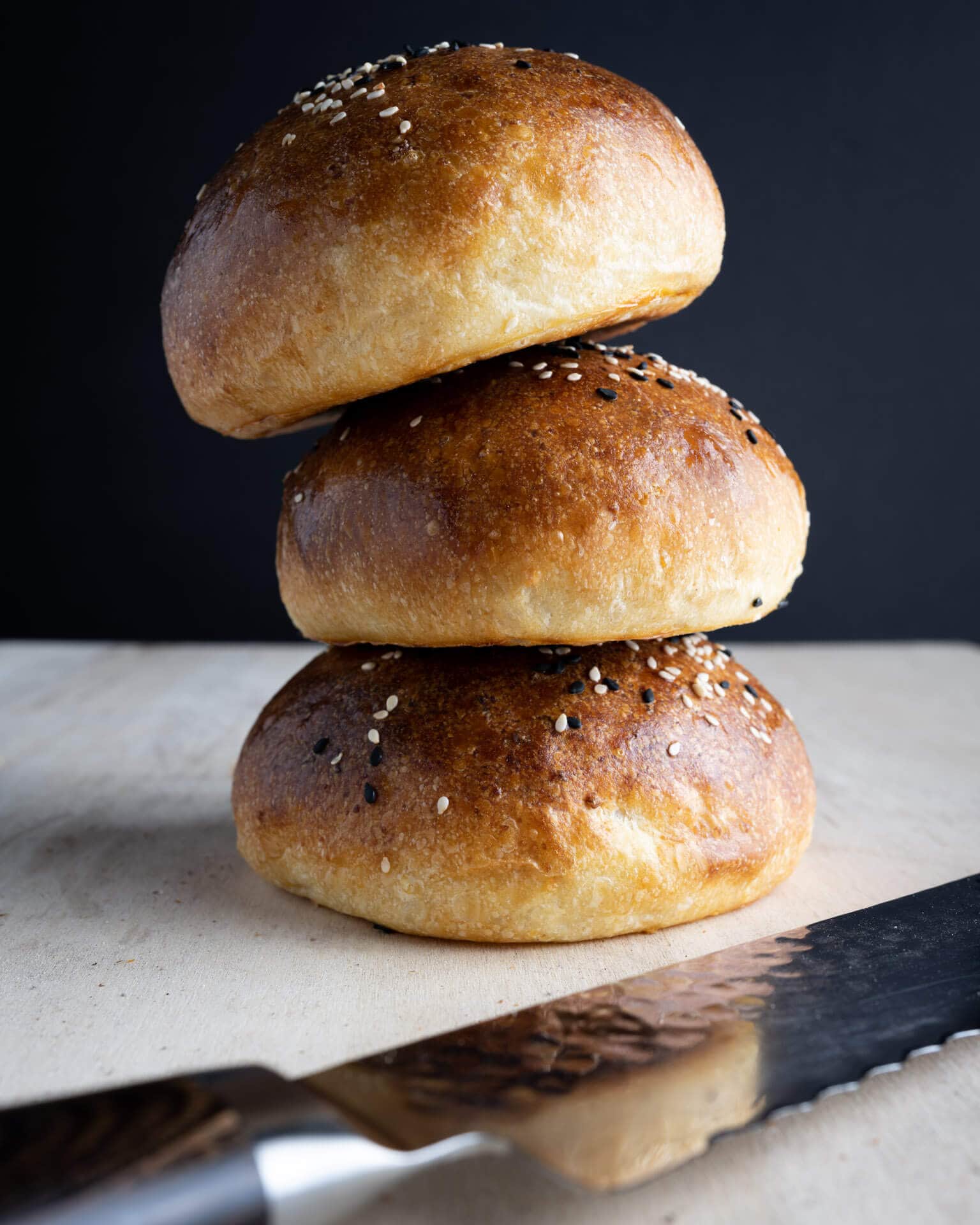
The small margin of extra work isn’t much, but I’ve found a few tools that help make these even more manageable—and all the tools will be helpful in your other baking endeavors.
Video: Soft Sourdough Potato Buns From Start to Finish
Watch me make these potato buns from start to finish in my YouTube video below!
Tools
First, a few of the tools and ingredients I use to bring these buns together:
- potato ricer—for preparing the potato to add into the dough (and making gnocchi!)
- pre-cut, half sheet parchment paper (I also use these in my combo cooker when baking—no sticking)
- KitchenAid stand mixer—the best for mixing enriched doughs
- black and white sesame seeds—my go-to topping these days
- Pastry brush—for spreading on the egg wash
Flour Selection
The goal for these buns was softness, softness, and more softness. But for flavor, I wanted them minimally sour. Building a fast, high-inoculation (inoculation refers to the amount of ripe starter added to the levain build—the levain is inoculated with your starter to seed fermentation) levain with 100% white all-purpose flour will help in this pursuit, and after testing with combinations of whole wheat—and even whole spelt—I dropped back to using all white flour. Whole grains are wonderful in a hamburger bun, but there’s absolute joy in a supremely soft bun with a delicate flavor.
Baking Schedule

This recipe is a direct process recipe, meaning it’s started and baked the same day with no overnight, cold-proof (retard). You can begin the dough first thing in the morning when your sourdough starter is ready and finished before dinner.
Alternatively, if you want to split this over two days — which might introduce a touch more sourness, I would place the dough after 2 hours into bulk fermentation in the fridge, covered. The next day, take the dough out, divide and shape, and proof until ready (this might be 2-4 hours at room temperature).
Soft Sourdough Potato Buns Formula
For tips on how to calculate baker’s percentages or how to modify this formula, see my post on baker’s percentages (baker’s math).
| Total Dough Weight | 1,250 grams |
| Pre-fermented Flour | 12.00% |
| Yield | 10 x 120g buns or rolls |
Total Formula
My final dough temperature for this dough was 78°F (25°C). See my post on the importance of dough temperature for more information.
Note that this is the Total Formula which lets you know all the ingredients you need for this recipe. Scroll down to the Method section for what you need in each step.
| Weight | Ingredient | Baker’s Percentage |
|---|---|---|
| 508g | All-purpose white flour, ~11-12% protein (Central Milling Artisan Baker’s Craft, Malted Flour) | 100.00% |
| 203g | Potato, russet (about 3 medium; baked, riced, and cooled) (I’d imagine just about any potato would work very well here, even sweet potato.) | 40.00% |
| 112g | Butter, unsalted (pliable, room temperature) | 22.00% |
| 91g | Eggs (cold from the fridge) | 18.00% |
| 25g | Sugar, caster (Caster sugar is superfine white sugar. If you don’t have caster sugar, pulse granulated white sugar in a food processor for 30 seconds or use the finest white sugar you have.) | 5.00% |
| 178g | Milk, whole (cold from the fridge) | 35.00% |
| 61g | Water | 12.00% |
| 11g | Salt (sea salt) | 2.10% |
| 61g | Sourdough starter (100% hydration) | 12.00% |
In addition to the above ingredients, you’ll need one more egg and a tablespoon of whole milk or heavy cream for the egg wash.
Soft Sourdough Potato Buns Method
1. Prepare Levain and Potatoes – 8:00 a.m.
Prepare levain
Mix the following ingredients together in a container and leave covered to ripen for 3 hours. Be sure to keep it warm—and warm the mixing water if necessary—around 78°F (26°C).
| Weight | Ingredient | Baker’s Percentage |
|---|---|---|
| 61g | Ripe sourdough starter (100% hydration) | 100% |
| 61g | All-purpose white flour, ~11-12% protein (Central Milling Artisan Baker’s Craft, Malted Flour) | 100% |
| 61g | Water | 100% |
40.91% levain in final dough mix.
Prepare potatoes
Note: Baking vs. boiling potatoes: I prefer to bake the potatoes instead of boiling them to prevent the absorption of extra water, which might add hydration to the dough. Additionally, baking ensures maximal potato starch gelatinization, which results in a light and fluffy texture.
Preheat the oven to 350°F (178°C) with a rack in the middle. Grab three or four potatoes that together weigh at least 300g or so—you will need a little extra to avoid coming in short (I baked 3 and had a little leftover) and scrub the skin clean under running water. The recipe calls for 203g of potato flesh so make sure the potatoes you’re baking are a little over this to cover any lost potato in processing — go for 300g to play it safe.
Place the whole potatoes into a small roasting pan or dish and, with a fork, prick the skin around the potatoes several times to allow them to breathe during baking. Bake the potatoes for about 1 hour, flipping them halfway through. Remove them from the oven when a knife can easily slide into the center of the potato (internal temp of 208-211°F / 98-99°C).
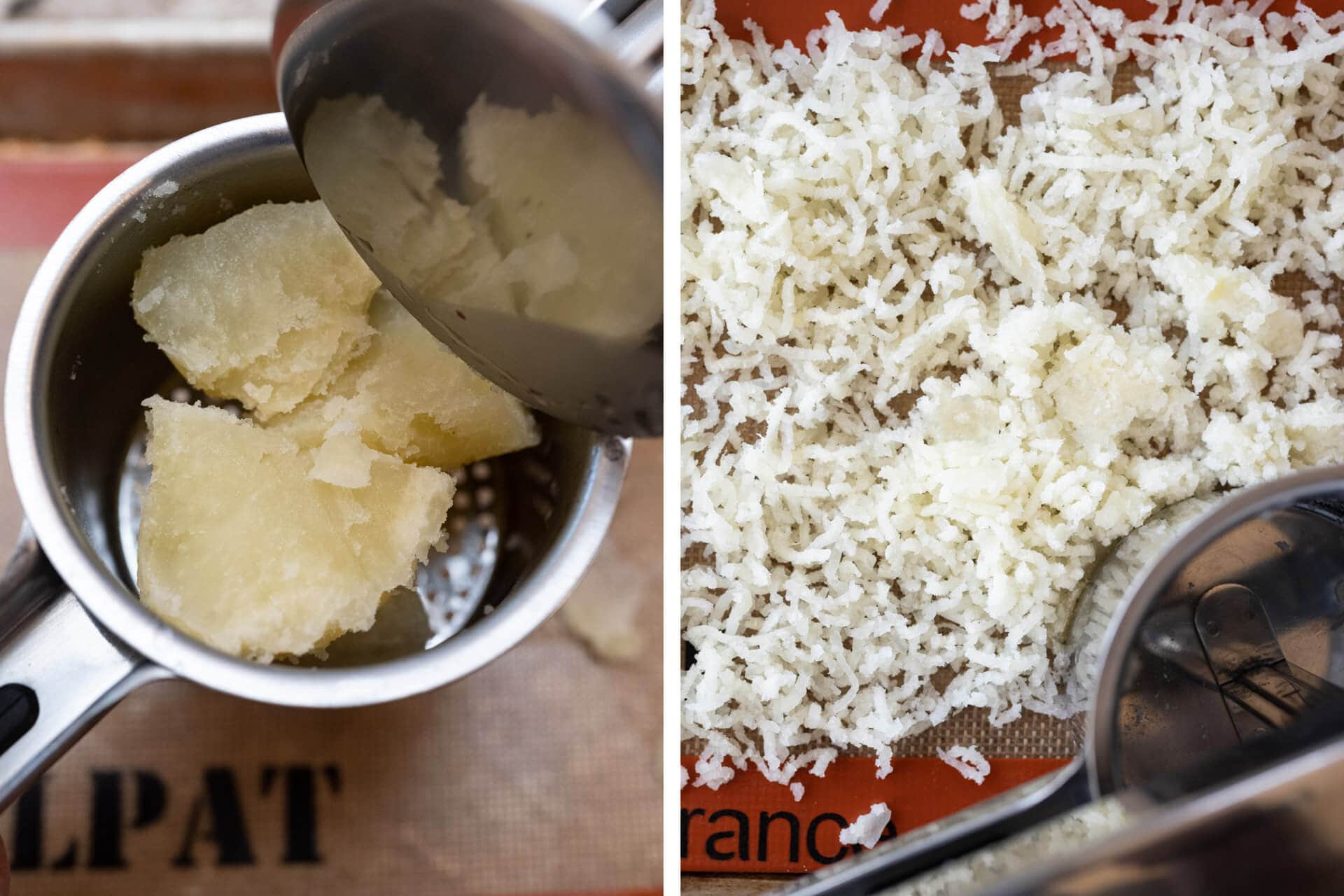
When finished baking, remove the potatoes from the oven. Using oven-safe gloves and tongs, remove the skin from the potatoes while they’re still warm. Then, roughly chop the potato flesh into large chunks. Using a potato ricer, rice the warm potato out onto a baking sheet to cool. If you don’t have a potato ricer, mash the potatoes very well or chop finely and spread on the sheet to cool.
2. Mix – 11:00 a.m.
Soften butter: Take out the called for 112g butter and cut it into 1/2″ pieces. Let the butter sit out on the counter until called for later in mixing.
I used my KitchenAid stand mixer to mix this dough. It’s possible to mix this all by hand, but it will be challenging with the added butter (the potato shouldn’t be a problem at the end). If you choose to do it by hand, you could knead the dough in a bowl with a wet hand or slap/fold on the counter.

Mix and strengthen the dough: To the bowl of a stand mixer, and when your sourdough starter is ripe (see the image, above), add the ingredients below.
Note: the butter and potato will be added later in mixing once the dough has sufficient strength from mixing.
| Weight | Ingredient |
|---|---|
| 447g | All-purpose white flour |
| 91g | Eggs |
| 25g | Sugar, caster |
| 178g | Milk, whole |
| 11g | Salt (sea salt) |
| 183g | Ripe levain (everything in the Levain Build section) |
Turn the mixer to the lowest speed and mix until everything is incorporated. Scrape the sides of the bowl and dough hook and increase to speed 2, mix for 3-5 minutes until the dough begins to cling to the dough hook and remove from the sides of the bowl. Then, scrape the hook clean, cover the mixing bowl, and let rest for 10 minutes.
After the rest, mix on speed 2 for another 2-3 minutes until the dough again begins to cling to the hook and look smoother. If you did a windowpane test at this point it would not pass, but it would start to show a thin membrane forming.
Add the butter: The butter should be at room temperature at this point: a finger press should easily press into the butter with little resistance. With the mixer set to low speed, add the butter, one pat at a time. Continue mixing on low until all the butter is added and the dough again becomes one cohesive mass.
Add the riced potato: Once all the butter is added to the dough, add in half of the riced potato and mix on low until incorporated (this should not take long). Then, add the remainder of the riced potato and finish mixing until the potato is mostly incorporated into the dough, again, this should not take long.
Transfer your dough to a bulk fermentation container and cover.
2. Bulk Fermentation – 11:15 a.m. to 2:30 p.m. (about 3.5 hours)
At 72-75°F (22-24°C), bulk fermentation should take 3.5-4 hours. During this time, we will strengthen the dough through a series of stretch and folds directly in the bowl.
For each set wet your hands, grab one side and stretch it up and over the dough to the other side. Rotate the bowl 180° and perform another stretch and fold (this forms a long rectangle in the bowl). Then, rotate the bowl 90° and do another stretch and fold. Finally, rotate the bowl 180° and do one last stretch and fold.
Give the dough 3 sets of stretch and folds starting after the first 30 minutes of bulk fermentation, and two more times spaced by 30 minutes. After the last set of stretch and folds, let the dough rest, covered, until the next step.
3. Divide and Shape – 2:30 p.m.
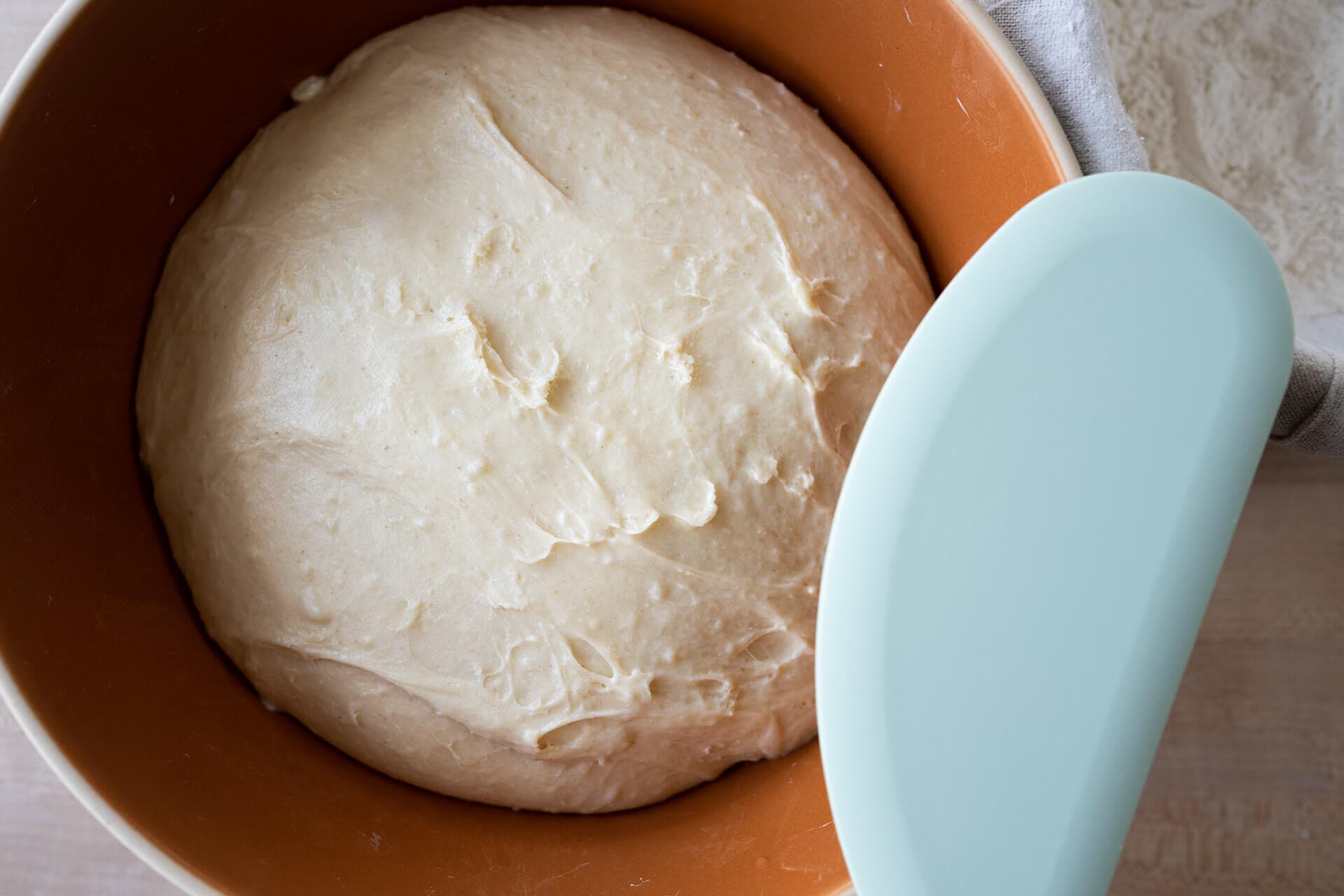
Chilled dough option: This dough is very, very soft. I shaped the dough right at room temperature, but if you want to make shaping a little easier, place the bulk container in the refrigerator for 20-30 minutes until the dough cools and slightly firms to the touch.
This dough is very, very soft. Chill the dough in the refrigerator if you worry shaping might be difficult.
Line two baking sheets with parchment paper. Liberally flour your work surface and, using a bowl scraper, gently scoop the dough out to the floured area. Lightly flour the top of the dough and divide it into ten 120g portions.
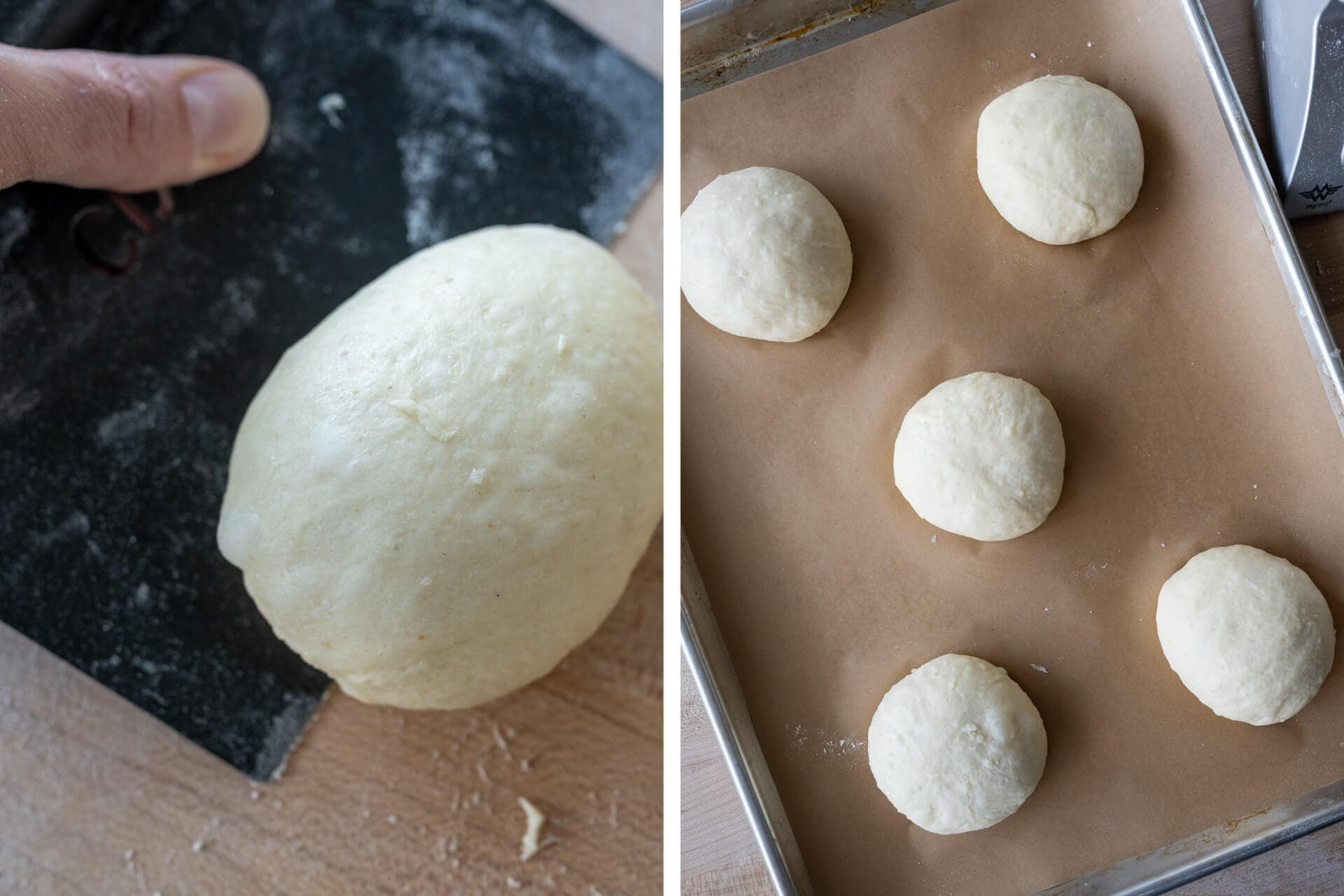
Lightly flour the top of the resting dough pieces. Using floured hands and a bench scraper, shape the portions into tight balls. As seen above, after I shaped the dough into a ball, I used the bench scraper to push the dough against the work surface to impart a tight skin on the outside.
For more shaping instruction, see my guide page to shaping buns and rolls.
4. Proof – 2:45 p.m. 5:15 p.m. (or when the dough is ready)
After all the pieces are shaped, cover each baking sheet with a large, reusable plastic bag and seal shut. To keep the bags up off the dough, place something tall, like a small cup, in the bags before closing.
Or even better, use these snap-on reusable baking sheet covers.
Proof for 2.5 hours or longer until the dough has puffed up considerably. When gently poked, they should feel extremely soft and yield immediately to almost no pressure. If you notice the skin on the dough starts to tear during the end of the proof, bake them immediately.
5. Bake – 5:15 p.m. (pre-heat oven at 4:45 p.m.)
Preheat your oven to 450°F (232°C) with one rack at the bottom third and another at the top third.
Make the egg wash: in a medium bowl whisk together one whole egg and 1 tablespoon of whole milk. Whisk until no lumps remain and the mixture is frothy.
Uncover your baking sheets and, using a pastry brush, paint on an even layer of the egg wash (avoid drenching the dough, the wash will just pool at the base and crack in the oven). Liberally sprinkle on black and white sesame seeds.
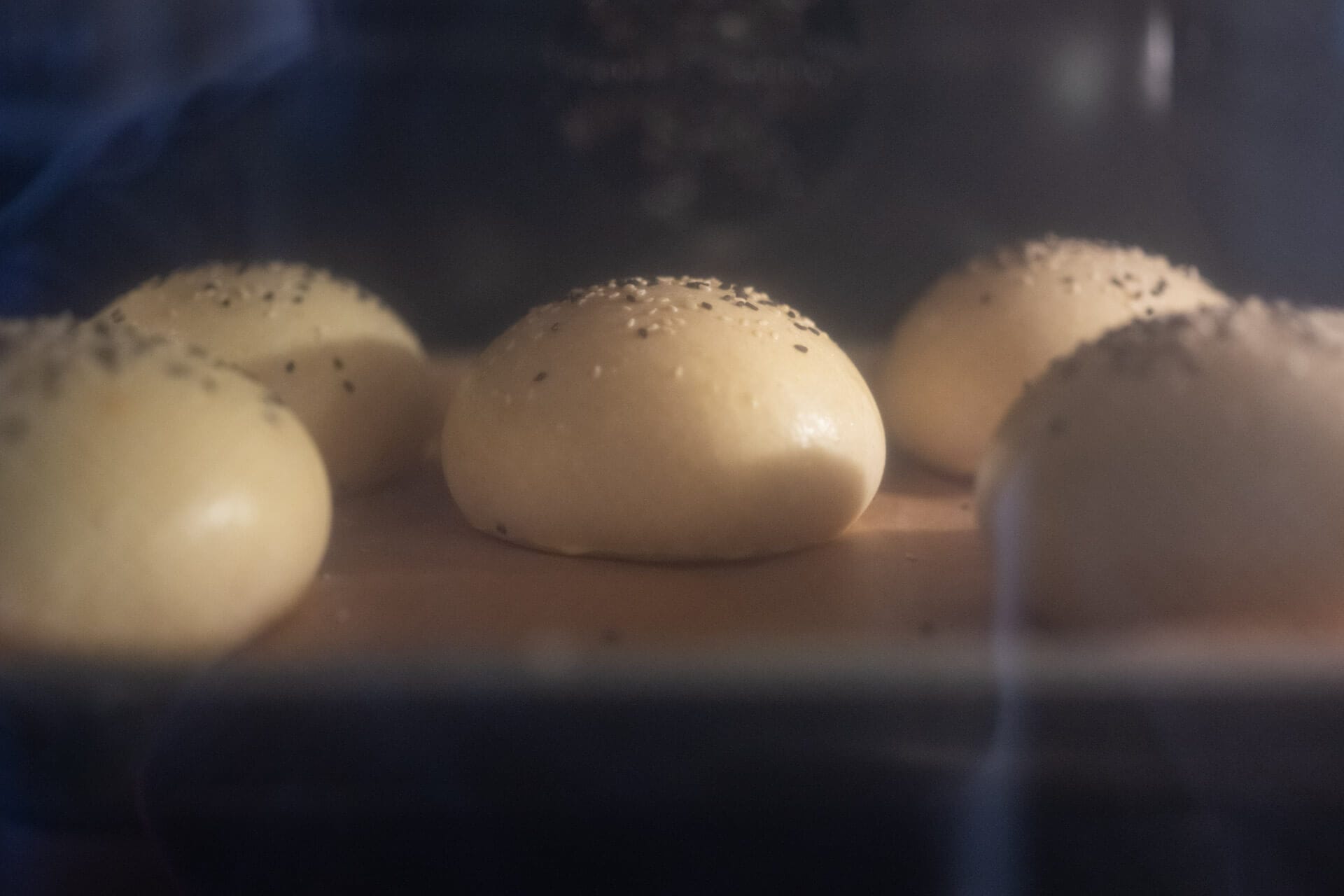
Place the baking sheets into the oven and bake for 25-30 minutes until well colored. Rotate the pans halfway through baking. Because of the egg wash, there is no need to steam the oven.
Remove the buns to cool for 5 minutes on the baking sheets, then transfer to a cooling rack until cool to the touch. If you cut the buns too early (or eat one straight off the baking sheet), they may be excessively soft—better to wait.
Conclusion
The surprising thing about these soft sourdough potato buns is that they successfully thread the needle between delicacy and rigidity. I’ve run them through their paces as hamburger buns, dinner rolls (torn apart and dipped in all manner of sauces), and playing the structural (but so much more!) component of a classic egg-avo-tomato-arugula-chile sandwich. How’d they fare? They avoided crumbling and completely dodged the dreaded soggy bun syndrome, even with extra doses of that sweet, sweet Tapatío. Success ✅
Crust

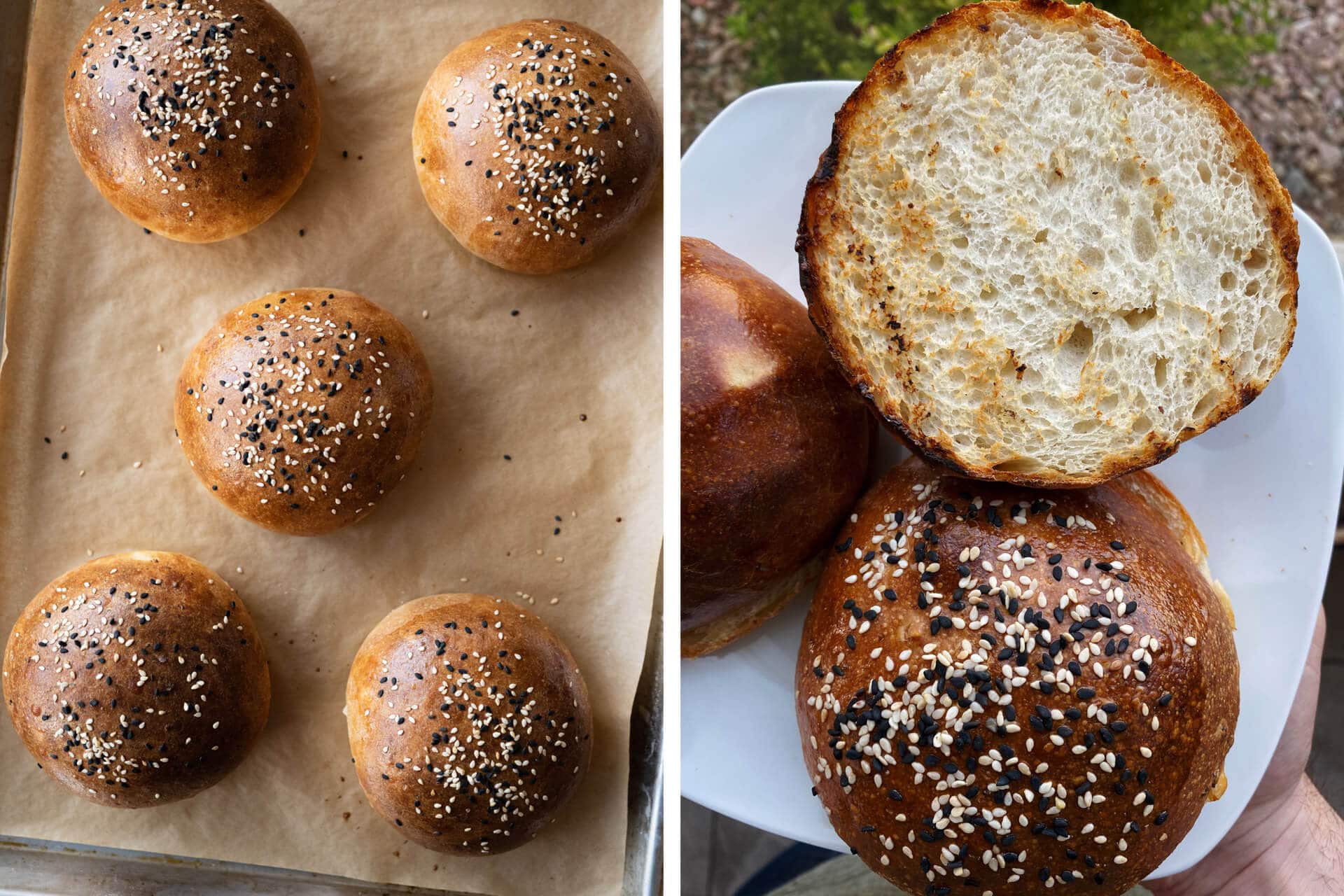
Utterly soft and thin—that is, until they’re grilled or toasted. If you want to keep the buns soft-as-can-be, then eat them as is, but I prefer toasting them directly on the grill grate — the exterior firms ever so slightly with perceptible chew at each bite.
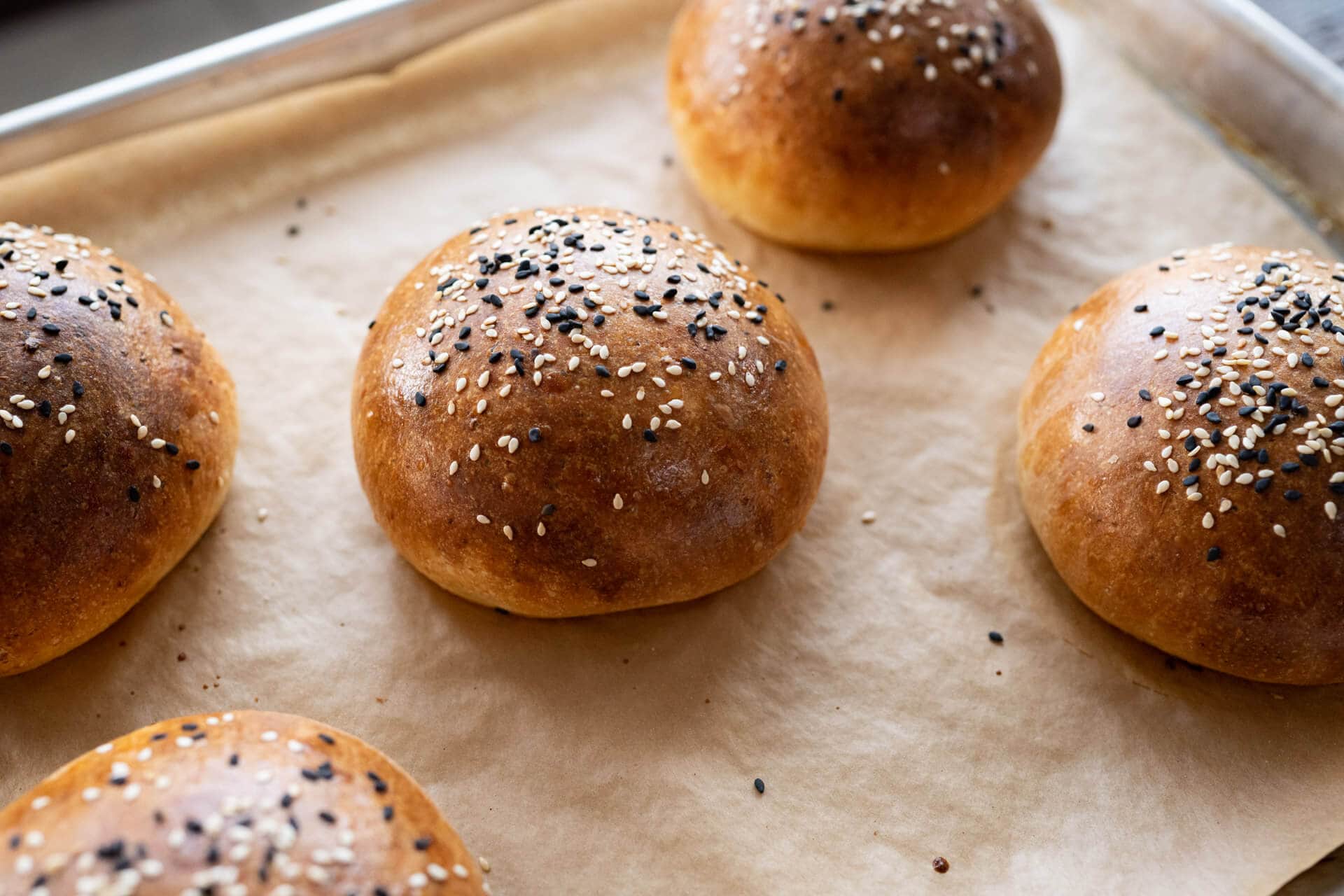
The egg wash turns the crust into a mahogany marvel, but also surprisingly shiny when the light catches them just right. And the two pieces really entice, making it hard not to grab just one more bun…
Crumb & Taste
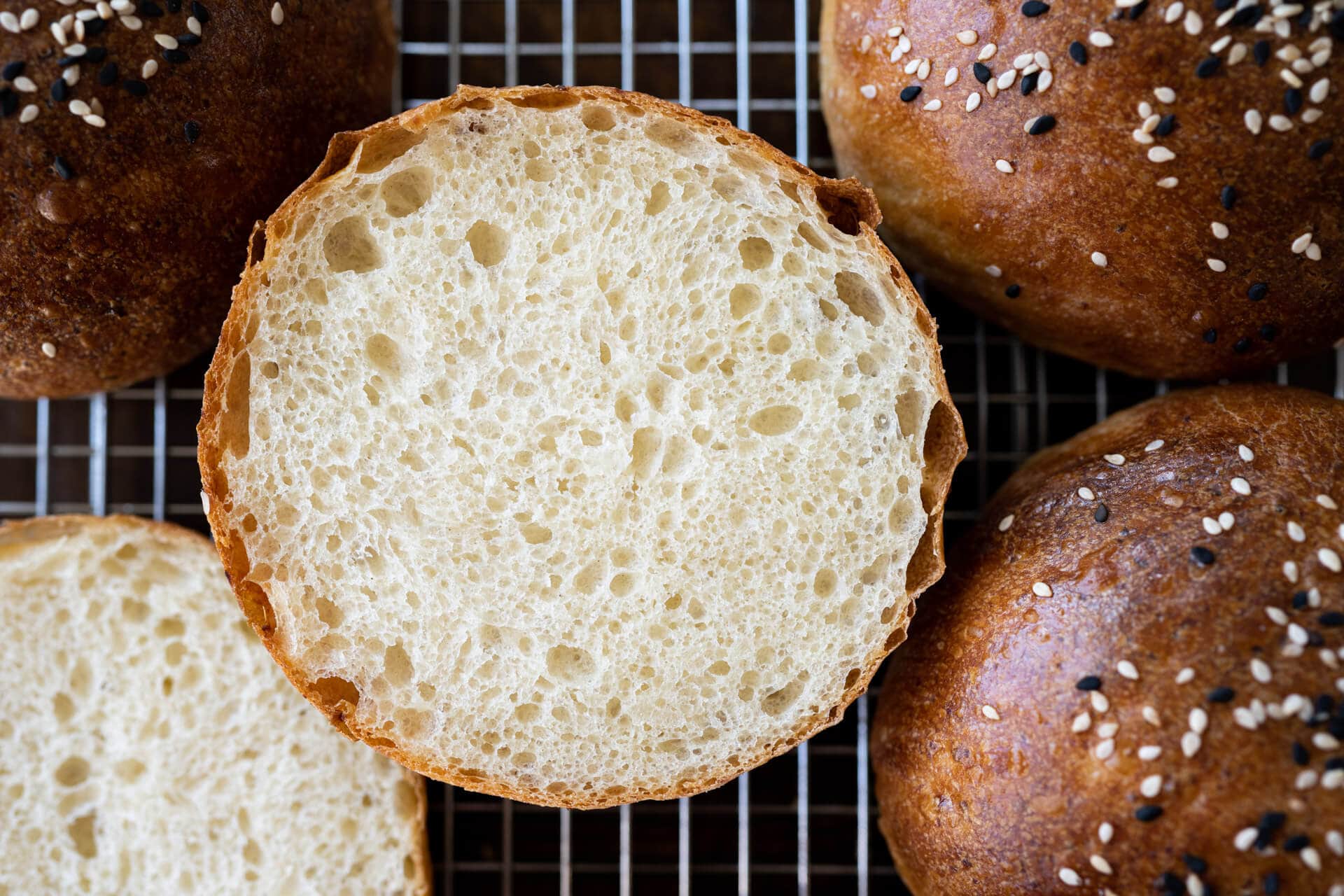
Soft like a cloud—how else better to describe the tenderness imparted by the added potato? The interior is light and airy without being overly open, which would spell disaster for a bun or roll. Even though the potato was riced, in the end, you’d be hard-pressed to find a single potato bit left in its original form (unlike my hearth-style sourdough with roasted potato recipe).
As I mentioned earlier, these are certainly my favorite hamburger buns I’ve yet to create. They have a depth of flavor and subtle sweetness that’s really hard to ignore, even when the buns are stacked with ingredients. If you’re going the hot dog route, check out my homemade hot dog buns for an equally delicious grilling experience.
Buon appetito!
Print
Soft Sourdough Potato Buns
- Prep Time: 9 hours
- Cook Time: 30 minutes
- Total Time: 9 hours 30 minutes
- Yield: 10 buns
- Category: American
Description
These sourdough buns with added potato are the perfect hamburger bun. Extremely soft with enough strength and structure to support anything you might be grilling.
Ingredients
Levain
- 61g all-purpose white flour
- 61g water
- 61g ripe sourdough starter
Main Dough
- 447g all-purpose white flour
- 203g potato, russet (about 3 medium; baked, riced, and cooled)
- 112g butter, unsalted
- 91g eggs
- 25g caster sugar
- 178g whole milk
- 11g sea salt
- 183g ripe levain
Egg Wash
- 1 egg
- 1 tablespoon whole milk
Topper
A mix of white and black sesame seeds, if desired.
Instructions
- Prepare levain and potatoes – 8:00 a.m.
In a small bowl, mix and knead the Levain ingredients. Transfer to a small container, cover, and keep it at a warm temperature for 3 hours. Preheat the oven to 350°F (178°C) with a rack in the middle. Grab three or four potatoes that together weigh at least 300g or so — you will need a little extra to avoid coming in short (I baked 3 and had a little leftover) and scrub the skin clean under running water. Place the whole potatoes into a small roasting pan or dish and, with a fork, prick the skin around the potatoes several times to allow them to breathe during baking. Bake the potatoes for about 1 hour, flipping them halfway through. Remove them from the oven when a knife can easily slide into the center of the potato (internal temp of 208-211°F / 98-99°C). When baked, remove from the oven, skin them and rice them onto a baking sheet to cool. - Mix – 11:00 a.m.
To the bowl of a stand mixer fitted with the dough hook attachment, add all of the Main dough ingredients except the potato and butter (leave the butter at room temp to soften at this time). Turn the mixer to the lowest speed and mix until everything is incorporated. Scrape the sides of the bowl and dough hook and increase to speed 2, mix for 3-5 minutes until the dough begins to cling to the dough hook, and remove from the sides of the bowl. Then, scrape the hook clean, cover the mixing bowl, and let rest for 10 minutes. After the rest, mix on speed 2 for another 2-3 minutes until the dough again begins to cling to the hook. Next, add the room temperature butter, one pat at a time, while the mixer is set to low speed. Once all the butter is added, add half the riced potato and mix on low until incorporated. Then, add the remainder of the potato. Transfer the dough to a container for bulk fermentation. - Bulk fermentation – 11:15 a.m. to 2:30 p.m. (about 3.5 hours)
This dough will need 3 sets of stretches and folds during bulk fermentation where the first set starts after 30 minutes into bulk fermentation and the subsequent sets are at 30-minute intervals. After the third set of stretches and folds, let the dough rest, covered, for the remainder of bulk fermentation. - Divide and shape – 2:30 p.m.
To make shaping easier, place your bulk fermentation container into the fridge for 30 minutes. Line two baking sheets with parchment paper. After the dough is chilled, scrape the dough out to a floured work surface and divide into 120g potions. Using floured hands, flour the top of the dough pieces and shape them into tight balls. Place 5 on each baking sheet. - Proof – 2:45 p.m. to 5:15 p.m. (2.5 hours)
Cover the baking sheets with large reusable plastic and seal shut and proof for about 2 1/2 hours until the dough has puffed up considerably and is very soft to the touch. - Bake – 5:15 p.m., pre-heat oven at 4:45 p.m.
Preheat your oven to 450°F (232°C) with one rack at the bottom third and another at the top third. Make the egg wash: in a medium bowl whisk together one whole egg and 1 tablespoon of whole milk. Whisk until no lumps remain, and the mixture is frothy. Uncover your baking sheets and, using a pastry brush, paint on an even layer of the egg wash. Liberally sprinkle on black and white sesame seeds, if desired. Bake the dough for 25-30 minutes until well colored. When baked, remove and let cool for 5 minutes on the sheets, then transfer to wire cooling racks.
Notes
If you don’t have a potato ricer, mash the potatoes while still warm with a potato masher or fork.
Soft Sourdough Potato Buns Frequently Asked Questions
What can I do if I don’t have a potato ricer?
Instead, mash the warm potatoes into a smooth puree or grate the potatoes on a box grater.
What can I use instead of eggs?
Use a vegan flax egg substitute instead of the eggs in this recipe.
What’s Next?
Are you looking for a lighter—but no less delicious—bun? My fluffy milk bread hamburger buns have you covered.
Or, perhaps, something other than burgers this holiday? Sourdough starter discard tortillas might just be what you’re looking for!


263 Comments
Hello Maurizio, what should I do if when I get to the stretch and fold process and my dough is very sticky. Way more sticky than yours when you do the stretch and folds. My dough is not cleaning the sides of the fermentation bowl, instead it is leaving pieces of dough on the sides. I followed the recipe exactly and used a scale for measuring. Since you probably won’t be able to answer this question in time I’m going to try kneading in some more flour. Hopefully this will save it. I’d still love to hear your suggestions in case I get in this situation again.
How did it turn out Tina? Yes, it sounds like the hydration was too high for your flour, or you should try using a stronger bread flour.
Hello, can you post the link for the reusable sheet pan covers please?
Yes, the snap-on baking sheet covers are here (and I love them!).
Hello, Could this formula be baked as a boule(s)?
Whoa, I’ve never thought to do that. I would say for a pan loaf, absolutely. You could do smaller boules (essentially larger buns), but I would be hesitant to do a 900g or larger loaf with this dough. It’s just too delicate and may collapse!
Hi Maurizio. Just a heads up. In the final recipe the flour amount is listed at 508 grams instead of 447g. That’s where the confusion is. You have it at 447 earlier in the post but in the final recipe that can be printed out, at the end of the post, the flour amount has not been adjusted to account for the 61 grams in the levain.
Just thought I would point that out because the final recipe is where most people are looking at with all your instructions. Great buns by the way! Huge hit!
Thank you Sharon, that’s now been fixed!
Hi Maurizio, I want to make these buns but, I don’t have all purpose flour. I just started milling my own flour. I don’t have soft wheat. What other grain can I used instead? Would spelt work? Or spelt and red turkey, ref fife, yecoroña Red, I also have all the ancient grains. Thanks. They look amazing!
I made your dinner rolls this past Thanksgiving and everyone raved about them! Thank you.
I would not use spelt for these without other adjustments. Turkey Red and Red Fife work well, and Yecora Rojo will be fantastic. So glad these are all working well for ya, Hope!
I was looking forward to using these for salmon burgers for dinner but the dough came out so stiff so I knew something wasn’t right. I was following the recipe card which said 508g of flour for the main dough. It was too late to incorporate more milk when I figured out what was wrong. At this point, I don’t think there’s anything I could do to save these. Such a waste of ingredients.
Oh gosh I’m so sorry about the typo. I’ve gone in and fixed this! I hope you’ll give this another try!
I tried making these again with the correct amount of flour and they were so good.
I tend not to read the bulk of any post and jump straight into the recipe and instructions and just read the notes in case there’s something important.
When I made the dough, it was super stiff. I live at over 6k ft in altitude so I add more liquid and bake for longer (about 5-10 more minutes). I used your guide on baking at high altitudes where I found out you’re at a high altitude as well. I’m curious how you do your own recipes. Are they made for sea level and you make adjustments from there?
Even though I added 10 more grams of milk, it was still stiff; it wasn’t the consistency of the description.
I read the comments and others pointed out that 61g of the main dough went towards the levain. My final product also came out burned on the bottom.
I’d suggest adding to the notes of the recipe card about the 61g for those of us who don’t read the post (I’ll read it from here on out, lesson learned).
I’m going to retry this recipe next weekend. I’m currently making your sourdough waffles. The batter smells amazing. Overall, this is definitely my go to site for bread and sweets recipes.
Sorry about this, Tug. I’ve gone in and fixed things!
I’d like to add fresh milled whole wheat. How much? Hard or soft?
I would go with hard wheat and start at 20% to total flour.
Hi! I made these (first attempt) today. Although I need to do some fine-tuning on the temperature/time (my oven runs hot) they were a great success. Really pleased with them. My levain took 4 1/2 hours to get up to speed…on the other hand, the buns were proved after 2 hours. Great recipe, Maurizio!
Thank you 🙂
Can you use potato flakes instead of a baked potato? How do you account for the water needed to make the mashed potatoes from the flakes when doing this recipe? Thank you.
I haven’t tried using flakes… Though I know one other reader did have success doing this. You can take the water from the main mixing water in the recipe.
I also accidentally used 508g I wish the below recipe was bit more exact or if there were a note in the bottom even.
Ahh, sorry about that Adrienne. I’ll update the post to try and make this more clear.
This guy has screwed up listing recipes like this consistently I suggest going somewhere else tbh
After the initial mix, I sat down to read the comments here and read that the recipe as printed is incorrect. No wonder I had such a stiff dough! Apparently the 508 g flour as written for the main dough, is actually the total flour amount, including the 61 g that goes into the levain. So the recipe is supposed to read 447 g flour in the main dough. I went ahead and added 40 g more milk to my dough, to bring it up to 65% hydration. Thankful that I caught this in time to add more liquid! It would be great if you could edit this recipe and make that correction. Reading further from those who had a dense result – I think this may be why? Anyway now I’m hoping for a delicious result! If it’s as good as your focaccia pugliese I will be swooning, lol.
Oh gosh, sorry about that, Shelley! I’m going to update the post to make this more clear.
How about you just fix the numbers in the recipe instea dof saying 508g put 447g of flour.
Have a separate section ofr the starter and put 61g of flour in that section.
or, looking at it, just change 508g to 447g.
This recipe needs some clarification on how much flour goes into the main dough. In the detailed version of the recipe it says 447g AP flour (and the additional 61 g goes into the levain) – in the printer version it says 508g AP flour PLUS the 183 g levain. This is also what it says on your youtube video. Which is correct? Please clarify! Thank you.
Following up, I went ahead and made this with 447g flour in the main dough. This seemed to be the correct amount. Buns came out perfect.
A side note: I also had some larger potato chunks/granules persisting in the dough even though I thought I had mashed them thoroughly. However they were completely undetectable in the finished buns. I will try this recipe again with Bob’s red mill potato flakes and report back since I found the potato prep to be a bit annoying.
Yup, you got it right: 447g in the main dough (the Mix step). I put those tables in that Mix step to tell you what you need right there in that step.
Prepping potatoes does take a bit of work, but it’s worth it for these buns, I think 🙂 Glad you liked them despite the issues!
We made these as hot dog buns (with my husband being from Montreal, we are forever searching for the perfect soft bun to make proper steamies), and wow they are incredible! Probably our favourite recipe of Maurizio’s (and that is saying something, as we make the pain de mie biweekly, the cardamom buns are our Christmas morning tradition, and have made most things on this site at least once). We cut some buns in half to make the best garlic toast (as in what all garlic toasts wish they could be when they grow up) alongside manicotti tonight, which prompted me to come write this rave review. It’s worth buying a good potato ricer for.
Amazing, Quincy! Hot dog buns with these would be incredible 🙂
Hi Maurizio, I would like to try this recipe using either potato flakes or potato flour instead of mashed potato. Should I use the equivalent weight of the mashed potatoes as indicated in the recipe for the potato flakes or potato flour?
Thank you
David
I would likely use less potato flour than called for. Remember, the potato I add is both the starchy bits and some water. It’s hard to say how much, though! For the flakes, I’d probably use half of what I call for. I haven’t tested any of this, though!
Hi, I would love to make these buns, but I have 2 kids severely alerting to milk. What can I replace the butter and milk with?
You can sub out the butter for a vegan butter alternative, and you can just use water instead of the milk, or a full-fat nut milk will work great!
Hi Maurizio, it’s a great recipe. I spotted a mistype in the printable version. Namely the weight of the flour in the main dough tells 508g, however at the beginning it was just 447g, which is the correct one I think. Thanks for the recipe again.
Glad it turned out well for you, Brigitta! It’s correct at 508g at the beginning, that’s the total amount of flour needed for the recipe (the flour used in Mix plus the flour used in Levain). Enjoy and thanks for the comments!
I think she means in the recipe card. It calls for 508g flour then 183g ripe levain
Hi Maurizio, what can I use in replace of a ricer? Would I grate the potatoes?
Yes, grating or mashing will work!
I’ve heard from others mashing works better than grating!
Love everything that you do, but why didn’t you use potato flour vs a potato, as potato flour is more controllable with water, faster, easier to store, and overall less expensive? I’m not being critical. I’ve only used flour, but would use real potato’s if the end result was better! Everything I read about potato flour, is that its the whole peeled potato, just dehydrated. Thank you in advance 😉
Thank you, Steven! Yes, potato flour would be awesome to use instead of full on potatoes, the reason I don’t is because I can never seem to find any in the store! It’s more of a specialty ingredient, so I’m trying to appeal to all of those who won’t have it.
That said, I’ll order some and do some testing 🙂
Great! I’d love to hear the results!
King Aurther Baking says:
Potato starch is “washed” out of crushed potatoes, then dried to a fine, bright-white powder. What’s the difference? Potato flour includes fiber, protein, and flavor, while potato starch is pure flavorless starch. Starch helps keep bread and rolls soft, moist, and fresh by absorbing and holding liquid.
Apology, the question was potato flour vs fresh potato-not potato flour vs potato starch
Are you able to freeze these buns?
Yes, they freeze very well!
I would love to be able to print your recipes, but the commercials keep getting in the way. Is there a way you can turn the off while we print? I would greatly appreciate it!! Thank you. Kimberly
Ahh, so sorry about that, Kimberly 🙁 A necessity to pay the bills, unfortunately. You should be able to click the Print Recipe button up at the top of this recipe (or in the little grey recipe card down at the bottom) and it shouldn’t get taken over by ads.
(As a side note, and not pressuring here in ANY way! TPL Members who support the site have all ads removed! Check out how you can support, here.)
I hope you love these, Kimberly, they’re without a doubt my fav 🙂
Hi @maurizioleo:disqus, I’ve made these several times. I always use the same russets from the same store and use a wired high-quality thermoworks thermometer probe to pull the potatoes when they are between 208-210F. I rice them when still hot and let them cool as instructed.
I’ve noticed sometimes the riced potato fully incorporates into the dough while other times it remains in little granules, like match heads but a little smaller. Even after bulk ferment, you can feel potato granules in the dough.
I can’t figure out why sometimes the potato becomes an indistinguishable part of the dough and other times it doesn’t. Any ideas? Maybe mixing longer till I can’t feel potato granules anymore?
They are delicious either way though, huge fan!
– Jonathan
Hey, Jonathan! Sorry for the delay. Hmm, that’s very interesting, I have never had this problem when making these buns. Yes, I would definitely say mix longer until the potato completely disappears in the dough. It might also help if the potato is very slightly warm, to help it break apart and incorporate easier (just be sure to watch the final dough temp!).
Hi Maurazio,
Have you tried making slider buns with this recipe and if so how many grams of dough do you think you would use for each bun? Thank you for your insight! I’m looking forward to giving this a try for our Super Bowl sliders.
That would totally work. Perhaps 65g?
Great recipe. About to bake mine.
Are you baking fan forced or convection?
Thank you
These were without convection, but you can absolutely do that if you have the option. I’d either drop the temp by 25° or reduce the total bake time if using convection.
Hi Maurizio! I love this recipe– I’ve made it twice now. I am interested in turning it into a pan loaf… Have you tried that? Do you have any suggestions? Thanks!
So glad to hear that, Alice! I have not, but I would probably do the recipe as-is and just kind of use my Pain de Mie recipe as a loose guide 🙂
Hey Maurizio! Is it normal to have chunky pieces of potato in the dough? Or it have to be like purê? I baked the potatos for more or less 1h, peeled and than mashed in the potato ricer and waited until cool. Best regards!!!
For these there should not be any visible chunks of potato! I don’t think it would be the worst thing, but I definitely mash them to make a puree. I think they’ll still be tasty if you go forward, or you could pluck out those pieces 🙂
I’ve been wanting to try these buns for a few weeks and finally got to it yesterday – they did not disappoint!! Excellent texture and taste, perfect for hamburger buns. With homemade beef patties and lots of fixings, my guests thought they were in a high-end restaurant for gourmet burgers!! Thank you for the recipe. I would decrease my oven temp 25 next time so the bottoms don’t get quite so dark but everything else was perfect.
So glad to hear they worked out for you, Kathryn! They are without a doubt my favorite hamburger buns 🙂
Good night Maurizo, how are you ?! to bake at Rofco, how many degrees and for how long?
Hey, Caio! Check out my guide to baking in a Rofco for detailed information!
I am about to make these for Mother’s Day, and I am a little confused on the oven rack instructions. Should one baking sheet go on the top one, one on the bottom, then switch half-way through the baking time?
Hey, Carolyn. Yes, one on top, one on bottom. Halfway through baking I rotate the pans 180° and swap racks, just to ensure completely even baking.
Slam Dunk! This was a huuuuuge success. I was very apprehensive with how things were going with me. I started to doubt my abilities. Then I remembered to trust your recipe. And guess what… they were Perfect!
By far the fluffiest buns I’ve ever made. The sour taste was on point. I must admit I use a rye starter and didn’t feed it differently for this recipe.
Totally worth having to get more All-purpose flour.
Next up is your potato bread since I should use up the leftover roasted potatoes.
Thanx, Maurizio, for another wonderful recipe.
So great hearing they turned out well for you! These are definitely some of my favorite buns to date, they are a bit of work, but worth it. Enjoy 🙂
For those interested, I followed @maurizioleo:disqus’s recipe precisely but substituted butter for a good olive oil and milk for a pure almond milk (that stuff is basically water!) and the results were great. Perhaps the flavour is slightly less rich, but hey, for the lactose intolerants…..
Awesome, Dan! Thanks for reporting back, that will definitely help others 🙂
I baked these last evening and even though I miss calculated on the levain the rolls turned out super soft and delicious. Thanks so much, maurizo! Have you tired these with bread flour?
So glad to hear that! I did test with higher protein flour and didn’t find it necessary. Would work fine, though! You might get a little more volume, but perhaps a little less tenderness.
yes can imagine so 🙂 But i am with you on the note that burger buns need the tenderness that comes with using all purpose flour 😉 So guilty here.
Hello! Could i do the bulk fermentation and shape the buns and then keep them in the fridge for a day and a half and then take them out day of and do the last proof? Do you think they would turn out ok?
That might be pushing it a little too long for a final proof… I’d say 12 hr max depending on how the dough is when it goes in!
I made these in my Challenger bread pan. 450° covered for 15 mins, uncovered for 10 mins. I had used the baking sheet method before, but this batch was 100% better. Highly recommend it if you have one. I did 5 at a time and put the others in the fridge while baking the first batch. They really were perfect! I ate one just with butter.
I made these fantastic sourdough potato buns yesterday. The whole house smelled wonderful with that rich, buttery aroma and the flavour was incredible! I plan on making hamburgers for dinner this evening. Thanks once again Maurizio for another great recipe.
Awesome, Helga! These really are great buns, and I venture to say the best buns for hamburgers there are 🙂