


Crafting the perfect hamburger bun is hard. You’re not looking for the utmost softness because the bun will erode beneath a stack of meat, veggies, and condiments. Yet you don’t want to eat a burger supported by two rigid crackers, either. Instead, you want a soft and squishy bun but still sturdy in all the right places.
And that’s the challenge: Make a bun that’s almost a paradox. It must combine the best of two opposed qualities, outperforming the Platonic ideal of both. It’s like a mosaic of traits that’s nonsensical until you view (or, in this case, eat) it whole.
…you want a bun that’s soft and squishy but still sturdy in all the right places.
These milk bread hamburger buns take inspiration from Japanese milk bread (shokupan): They have a bit of sugar, lots of milk, and use the tangzhong technique to amplify the softness and shelf life.
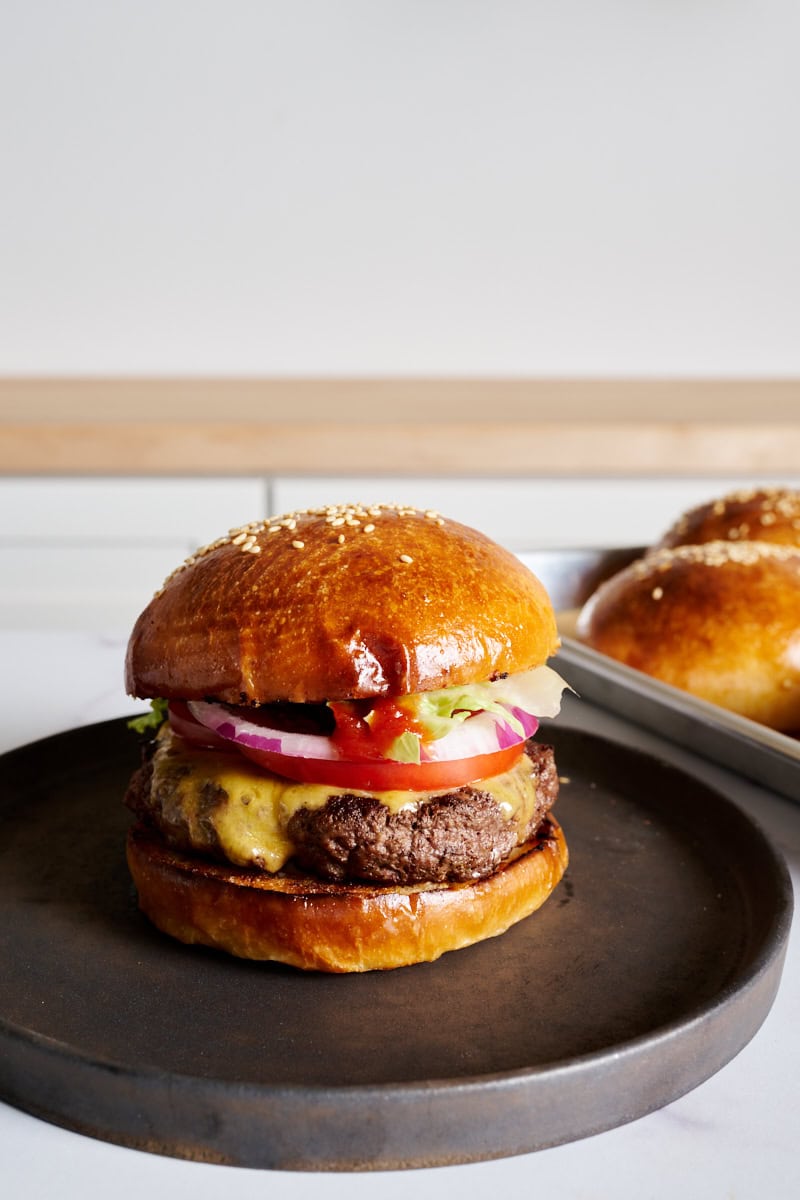
Further, Japanese milk bread makes for incredible toast, and these buns act very similarly once they’re grilled—the superficial layer exposed to the grill’s heat crisps up into a sturdy, anti-soggy platform for anything from hamburgers to sloppy joes to fish sandwiches.
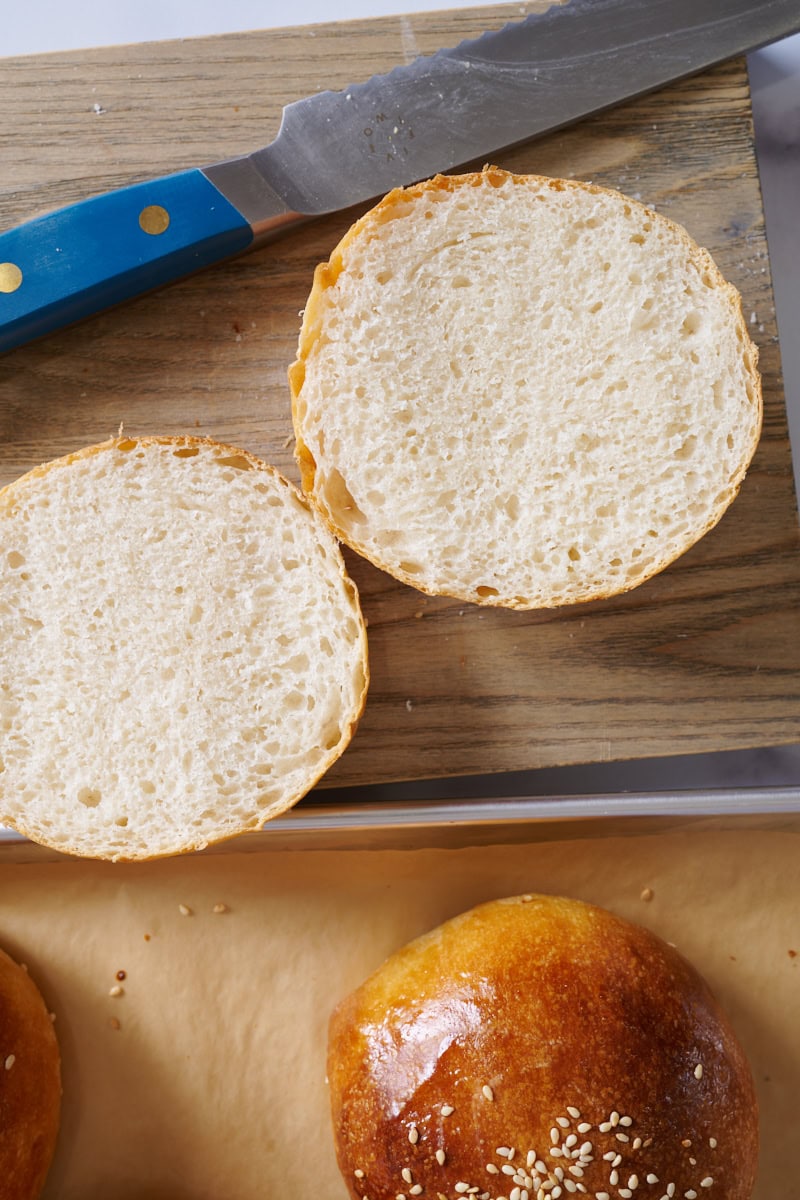
Milk Bread Hamburger Buns versus Soft Potato Buns
I often declare that my Soft Sourdough Potato Buns are my best hamburger buns. And I have to say, they are downright incredible. But these milk bread hamburger buns hit a little differently. I labeled them “fluffy” because they’re like little clouds buoying your hamburger to the next level. Where the potato buns are soft, substantial, and a bit dense, these are soft, light, and plush.
Honestly, both buns are lovely and will serve you well at the next cookout. But these milk bread buns are like the lighter cousin to the potato buns.
What is the Difference Between a Sweet Liquid Levain and a Sweet Stiff Levain?
A sweet preferment, or a sourdough starter or levain with a small amount of sugar added, emphasizes yeast activity (as opposed to bacterial activity) for less sourness and more volume in the final product. Both sweet liquid and sweet stiff levain will produce the desired result.
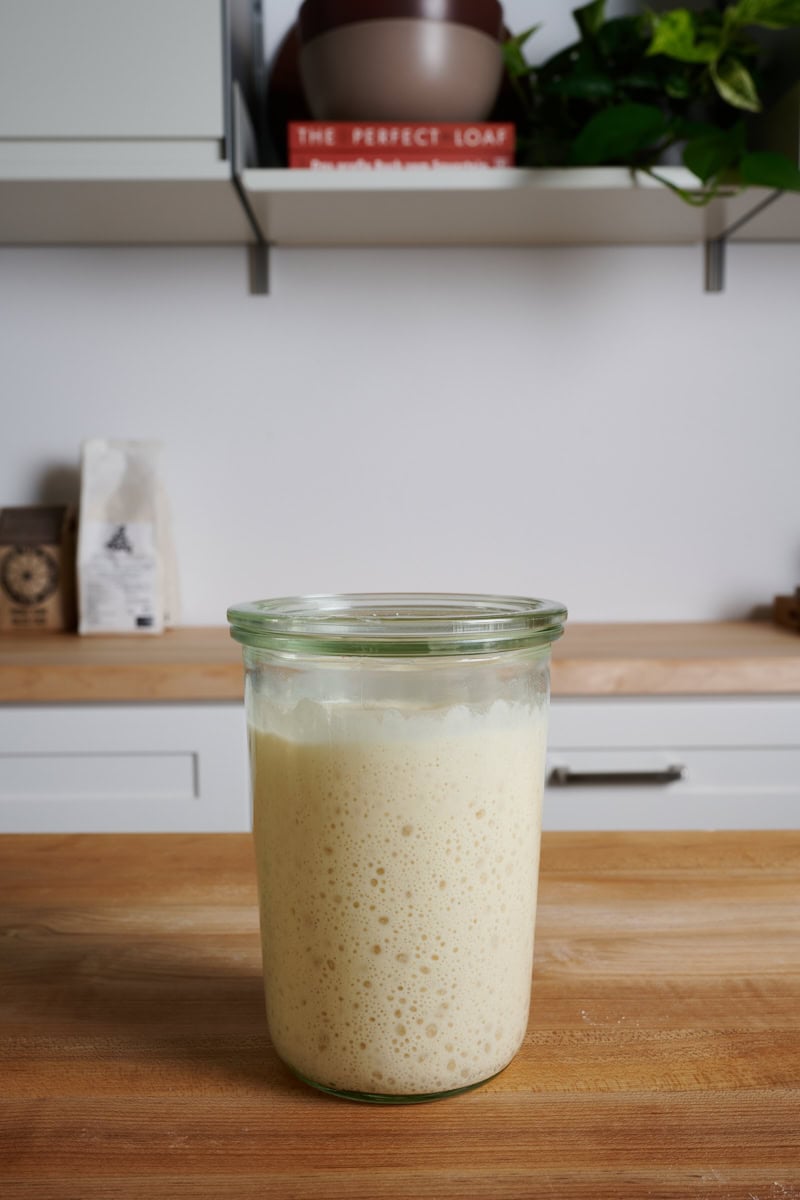
Technically, reducing the hydration of the sweet levain to make it stiffer can lead to an even more mild-tasting result (reducing bacterial activity further). But, I find mixing the levain very laborious. After testing both sweet levain types, I’ve found that a sweet liquid version is just as effective in emphasizing yeast activity for maximum volume and reduced sourness while still being incredibly easy to mix with a spatula.
This recipe for milk bread hamburger buns uses a sweet levain to reduce sourness in the final bun—but not entirely (though, gosh, it’s close). Any slight perceptible sourness only brings additional flavor to the final buns, IMO—though I don’t detect any.
For more information on the why and how behind making a sweet levain, see the preferment section in my cookbook.
Flour Selection
As with my Japanese milk bread loaf, I use 100% high-protein white bread flour for these milk bread hamburger buns to achieve maximum volume and minimal sourness. The flour’s high gluten content helps support the fat (milk and butter) in the dough. Additionally, because this bread flour is heavily sifted (with a low ash content), the reduced amount of bran and germ results in less dough acidification during fermentation.
I used King Arthur Artisan Bread flour, but any high-protein white flour will work well with this recipe.
Baking Schedule
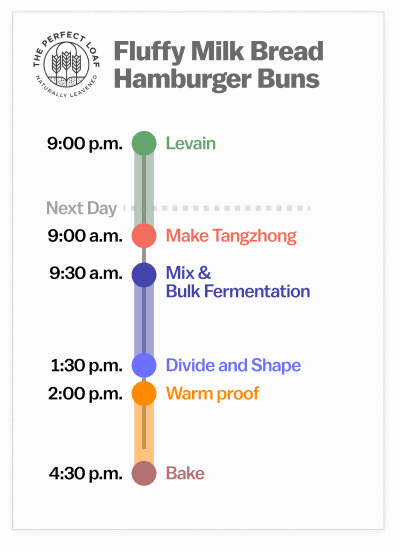
These sourdough milk bread hamburger buns are made over the course of a single day (aside from the overnight levain). This preferred fermentation schedule ensures the mildest possible flavor profile. It also makes for a convenient schedule: Mix the sweet levain the night before, mix the dough in the morning, and have hamburger buns ready for the evening.
If you’re looking to cold-proof (retard) these buns so you can bake them early in the day for lunch, that will undoubtedly work (see the FAQ at the end of this post). However, I prefer to follow the baking schedule as outlined and bake them the day the dough is mixed. Then, let the buns cool overnight and use them the next day (they get even better with proper cooling).
Milk Bread Hamburger Buns Recipe
For tips on calculating baker’s percentages or modifying this formula (like making only 5 buns instead of 10), see my guide to using baker’s percentages.
Vitals
| Total dough weight | 1,450 grams |
| Prefermented flour | 13.5% |
| Levain in final dough | 40.6% |
| Hydration | 29.0% (does not include the milk) |
| Yield | 10 x 135g buns |
Total Formula
Desired dough temperature: 76°F (24°C) (see my post on the importance of dough temperature).
| Weight | Ingredient | Baker’s Percentage |
|---|---|---|
| 617g | High-protein white bread flour (King Arthur Bread Flour, 12.7% protein) | 90.0% |
| 69g | Tangzhong: High-protein white bread flour | 10.0% |
| 274g | Tangzhong: Whole milk | 40.0% |
| 69g | Whole milk | 10.0% |
| 123g | Unsalted butter | 18.0% |
| 48g | Superfine white sugar (or granulated sugar) | 7.0% |
| 199g | Water | 29.0% |
| 14g | Fine sea salt | 2.1% |
| 37g | Ripe sourdough starter, 100% hydration | 5.4% |
Additional Ingredients
1 egg and 1 tablespoon whole milk for the egg wash (optional)
Raw sesame seeds, for topping (optional)
Milk Bread Hamburger Buns Method
1. Prepare the levain – 9:00 p.m. (the night before mixing)
| Weight | Ingredient | Baker’s Percentage |
|---|---|---|
| 93g | High-protein white bread flour | 100.0% |
| 28g | Superfine white sugar | 30.0% |
| 83g | Water | 90.0% |
| 37g | Ripe sourdough starter, 100% hydration | 40.0% |
Mix the ingredients in the chart above in your favorite jar and leave them covered at a warm temperature, 74-76°F (23-24°C), to ripen for 12 to 14 hours. This is a sweet liquid levain and it will expand in volume significantly. Be sure to use a tall jar so it doesn’t overflow.
At this time, also take out the butter from the fridge, cut it into 1/2-inch pats, and let it warm to room temp on a plate.
2. Prepare the tangzhong – 9:00 a.m. (the day of mixing)
In a medium saucepan over medium-low heat, combine the 69 grams high-protein white bread flour and 274 grams whole milk. Cook, whisking continuously, until the mixture thickens and becomes a paste (it should look like mashed potatoes), 5 to 7 minutes. Remove the pan from the heat and spread the tangzhong on a small plate to expedite cooling. Set aside.
3. Mix – 9:30 a.m.
| Weight | Ingredient |
|---|---|
| 524g | High-protein white bread flour |
| 342g (All*) | Tangzhong (from Step 2) |
| 69g | Whole milk |
| 123g | Unsalted butter |
| 20g | Superfine white sugar |
| 116g | Water |
| 14g | Fine sea salt |
| 240g (All) | Ripe levain (from Step 1) |
*Note that it may be difficult to scrape every bit of the tangzhong out of the pan, and plus or minus 5g won’t make a huge difference in the end.
Like Japanese milk bread, these milk bread hamburger buns require intensive kneading to ensure the dough is smooth and elastic and for the best structure and volume.
I used my KitchenAid stand mixer or a spiral mixer to efficiently mix and knead the dough. However, it’s also possible to mix this dough by hand using the slap and fold kneading technique. Just be sure to hold back the butter until the dough is significantly strengthened, smooth, and elastic.
To the bowl of a stand mixer fitted with the dough hook attachment, add the flour, tangzhong, milk, sugar, water, salt, and ripe levain. Mix on low speed (STIR on a KitchenAid) for 1 to 2 minutes until the ingredients come together, no dry bits remain, and the sides of the bowl are clean. This is not an overly wet, slack, or sloppy dough, it should be cohesive. If the dough is very dry, conservatively add a splash of water as needed to moisten. Next, mix on medium speed (2 on a KitchenAid) for 7 minutes until the dough smooths and begins to cling slightly to the hook (it will still be sticky and shaggy; see the image below).
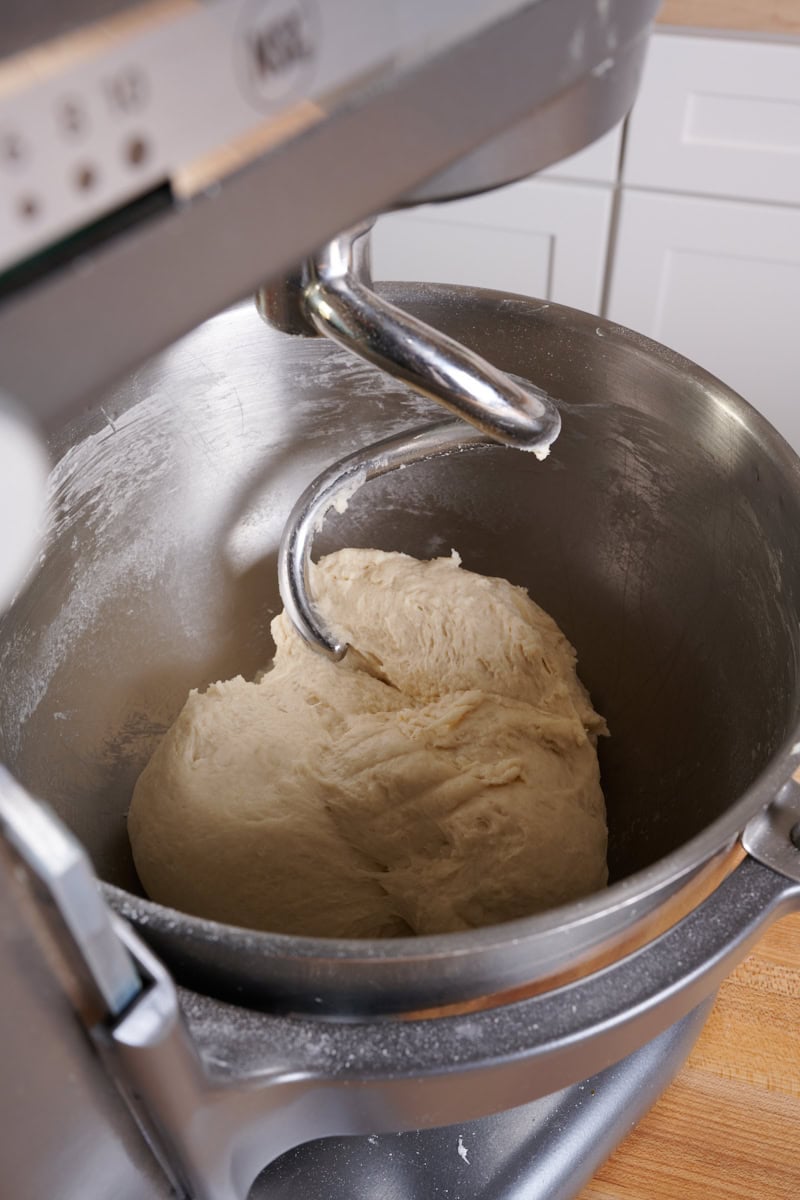
Let the dough rest in the bowl for 5 minutes.
Return the mixer to medium speed and mix for 3 to 4 minutes until the dough gains more strength and clings again to the dough hook. The dough will still be sticky to the touch and might be attached to the bottom of the bowl, but the sides will be clean (see image below).
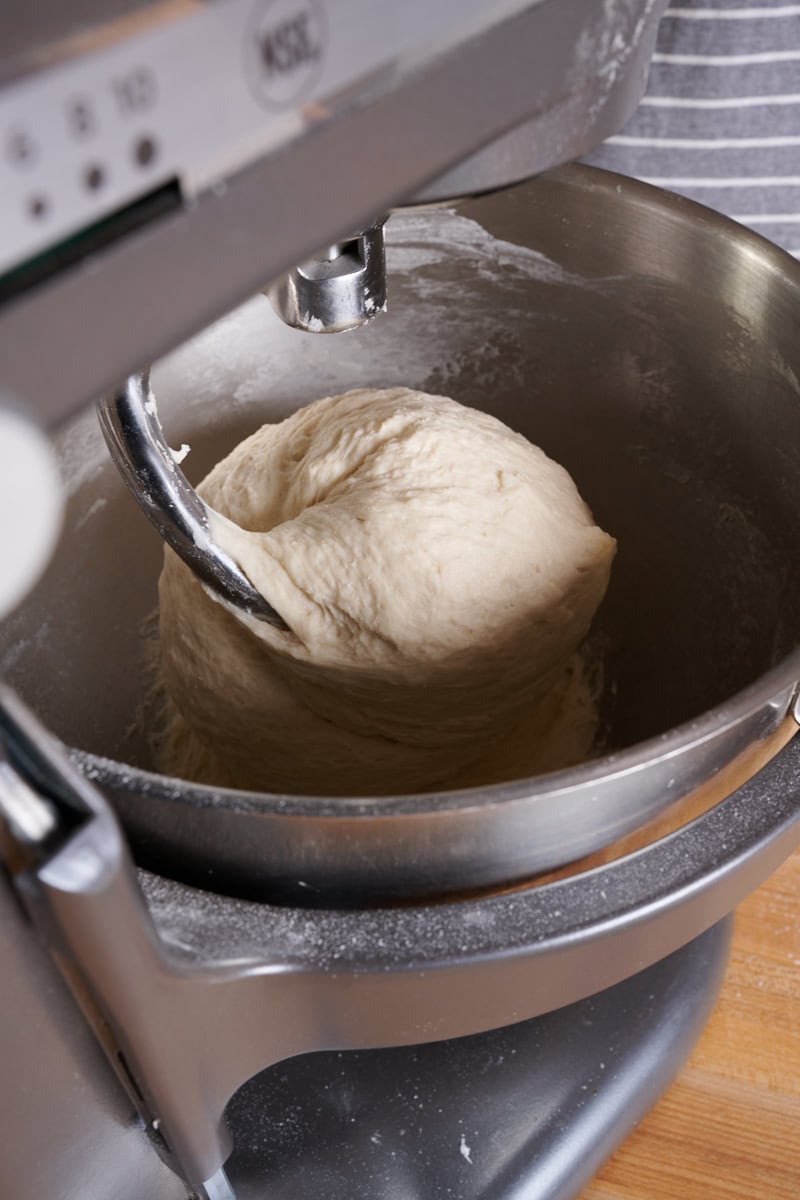
Reduce the mixer speed to low speed and add the room-temperature butter, one pat at a time, waiting to add each until the previous is absorbed. Use a spatula to scrape the sides of the bowl as needed. Once all the butter is added, about 4 to 6 minutes later, the dough will be in a cohesive ball in the mixing bowl with the sides mostly clean.
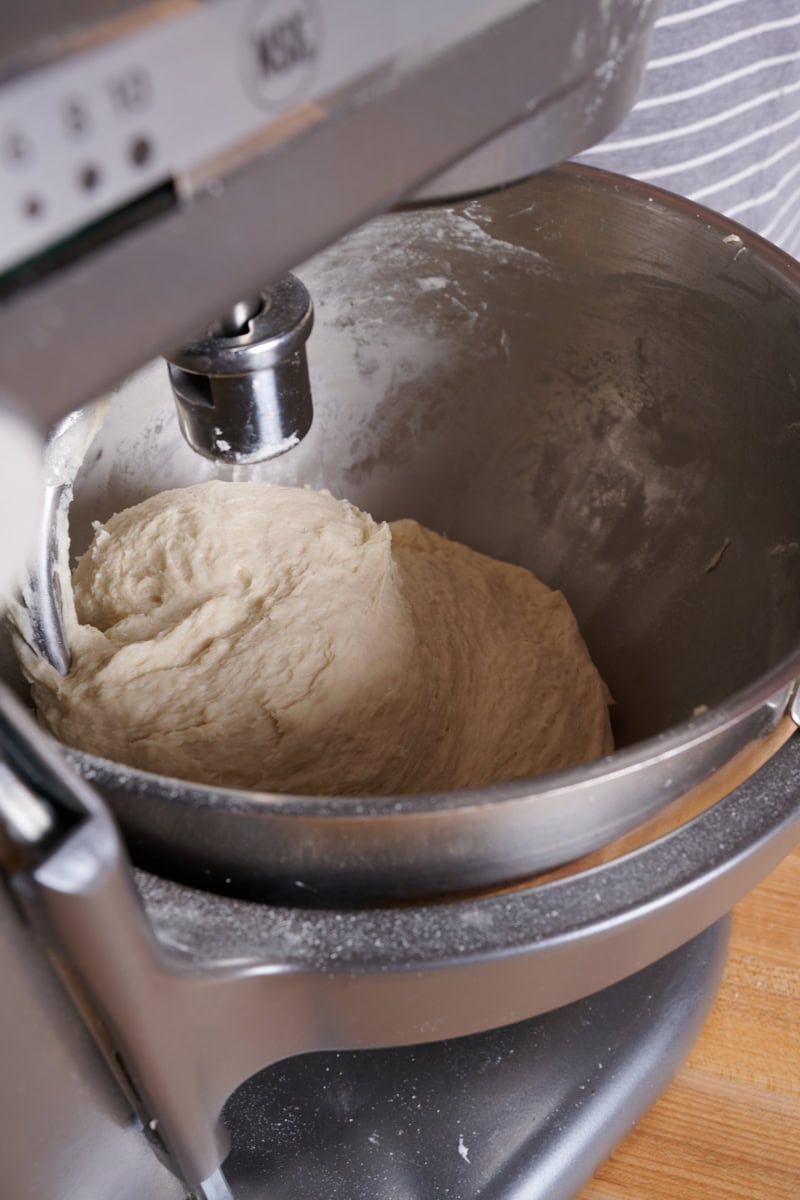
At this point, the dough will be very soft to the touch and a bit sticky. Transfer the dough to a bulk fermentation container and cover.
4. Bulk Fermentation – 10:00 a.m. to 1:30 p.m. (3 1/2 hours)
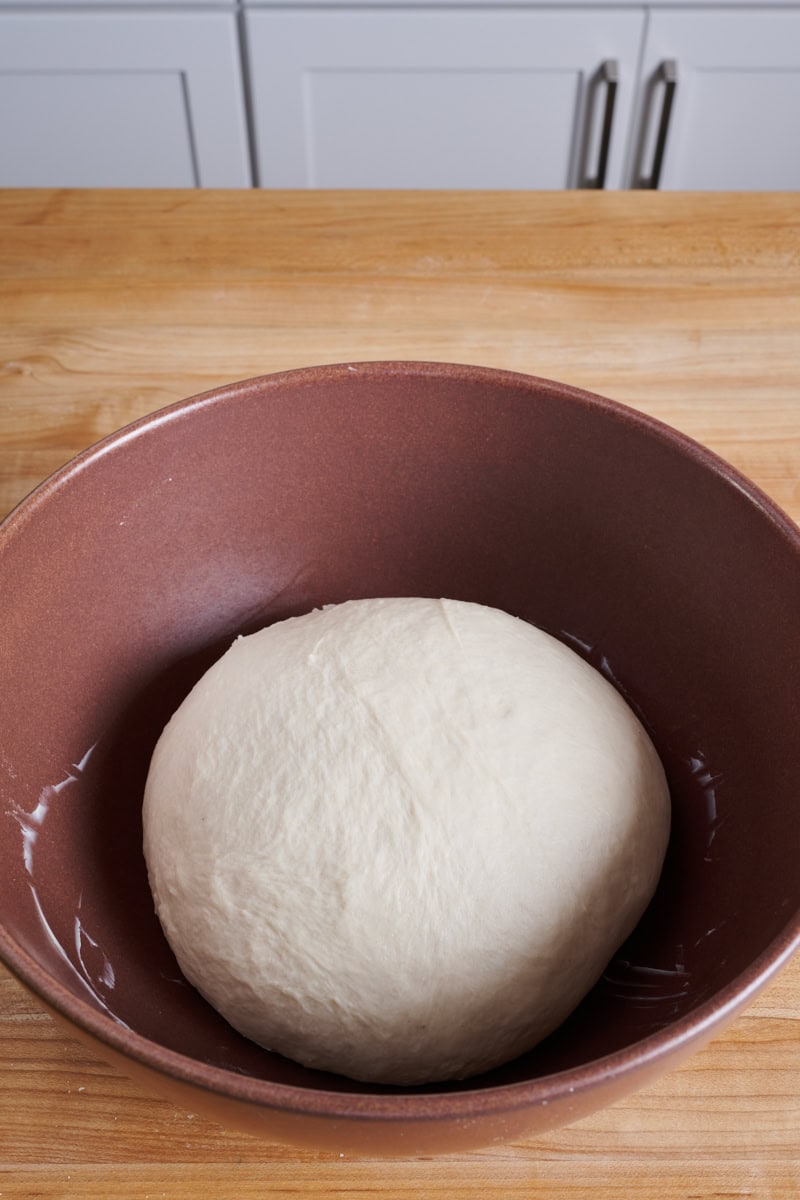
At a warm room temperature, 74-76°F (23-24°C), bulk fermentation should take about 3 ½ hours with no sets of stretches and folds (the dough is sufficiently strengthened during mixing).
Let the dough rest, covered, for the duration of bulk fermentation.
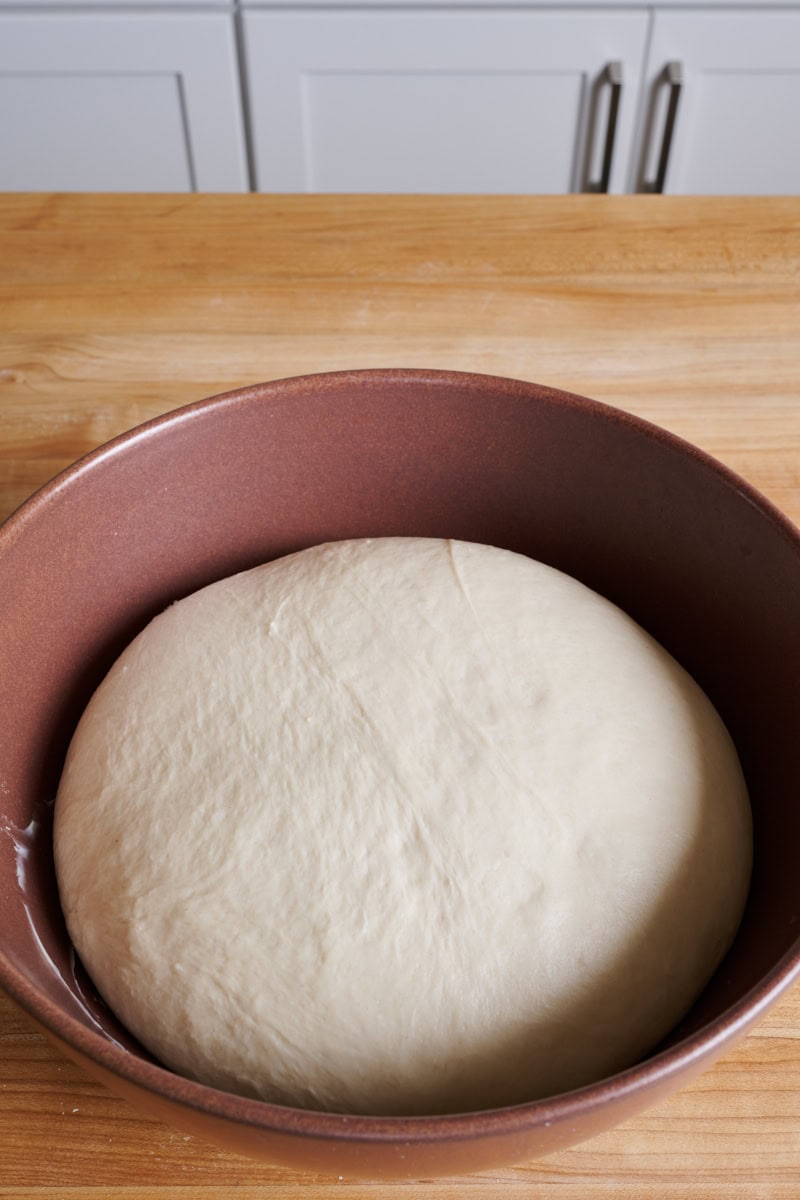
5. Divide and Shape – 1:30 p.m.
Line two baking sheets with parchment paper. Lightly flour your work surface, and using a bowl scraper, gently scoop the dough out to the floured area. Lightly flour the top of the dough and divide it into 10 (135-gram) portions. You might have a small bit of scrap dough left over.
Using floured hands and a bench scraper, shape the portions into tight balls. I like to use the bench scraper at a high angle to the work surface to help shape the dough. A high angle tightens the dough more assertively.
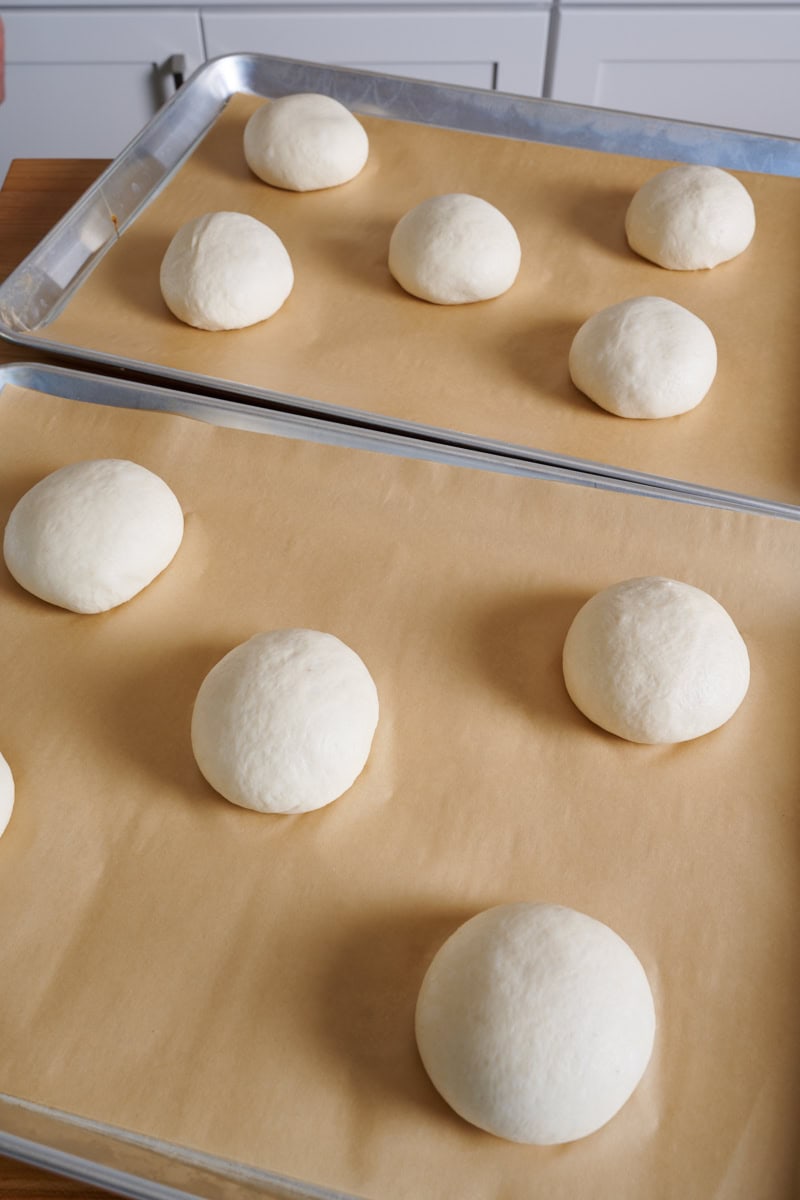
6. Proof – 2:00 p.m. to 4:30 p.m.
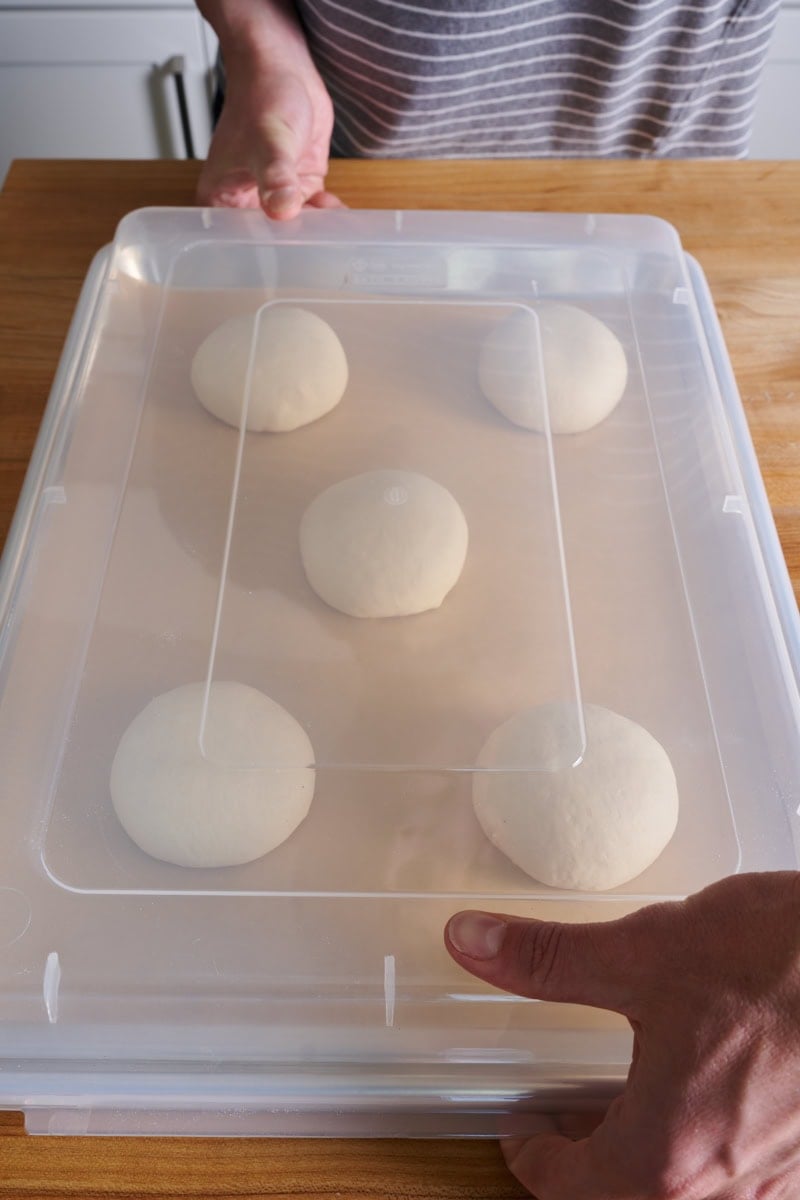
Cover the baking sheets with reusable plastic or these life-changing snap-on baking sheet covers (see image above) and let the dough proof for 2 ½ hours.
7. Bake – 4:30 p.m. (preheat oven at 4:00 p.m.)
After 2 ½ hours the dough pieces should have puffed up, and feel very light and airy when poked.
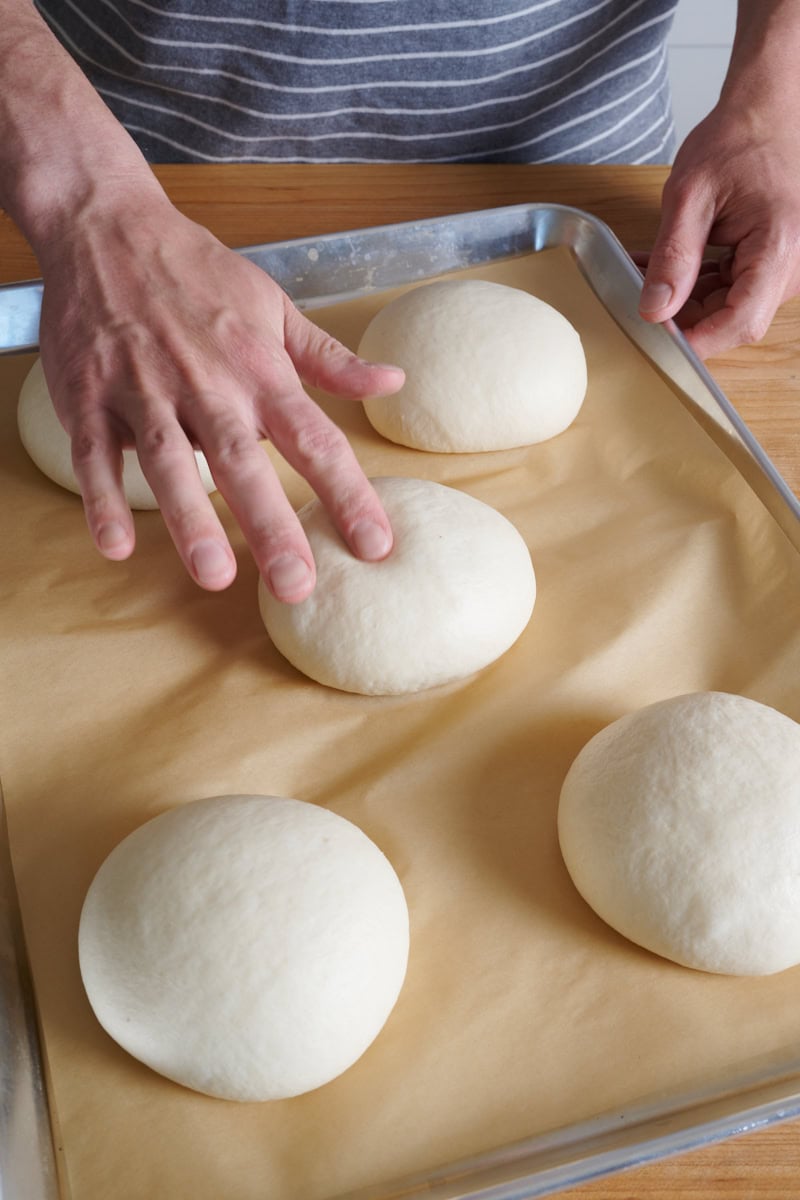
If you’re used to using the poke test to determine when your bread dough is ready for baking, this dough will feel different. It will feel more like poking a marshmallow or balloon that’s not fully inflated. If the dough feels dense or tight, give it another 15 minutes to proof, then check again.
Below, you can see how jiggly the dough is and the texture when I poke it to determine how well proofed it is.
30 minutes before you want to bake, preheat your oven to 450°F (232°C), with racks in the upper and lower third.
If making the egg wash, whisk together 1 whole egg and 1 tablespoon of whole milk in a small bowl until no lumps remain and the mixture is frothy.
Uncover the baking sheets and, using a pastry brush, brush on an even, thin layer of the egg wash. Liberally sprinkle on sesame seeds if using.
Place the baking sheets in the oven and bake for 15 minutes. Rotate the pans back to front and top to bottom, then reduce the oven temperature to 425°F (220°C). Bake for 5 to 10 minutes until well-colored.
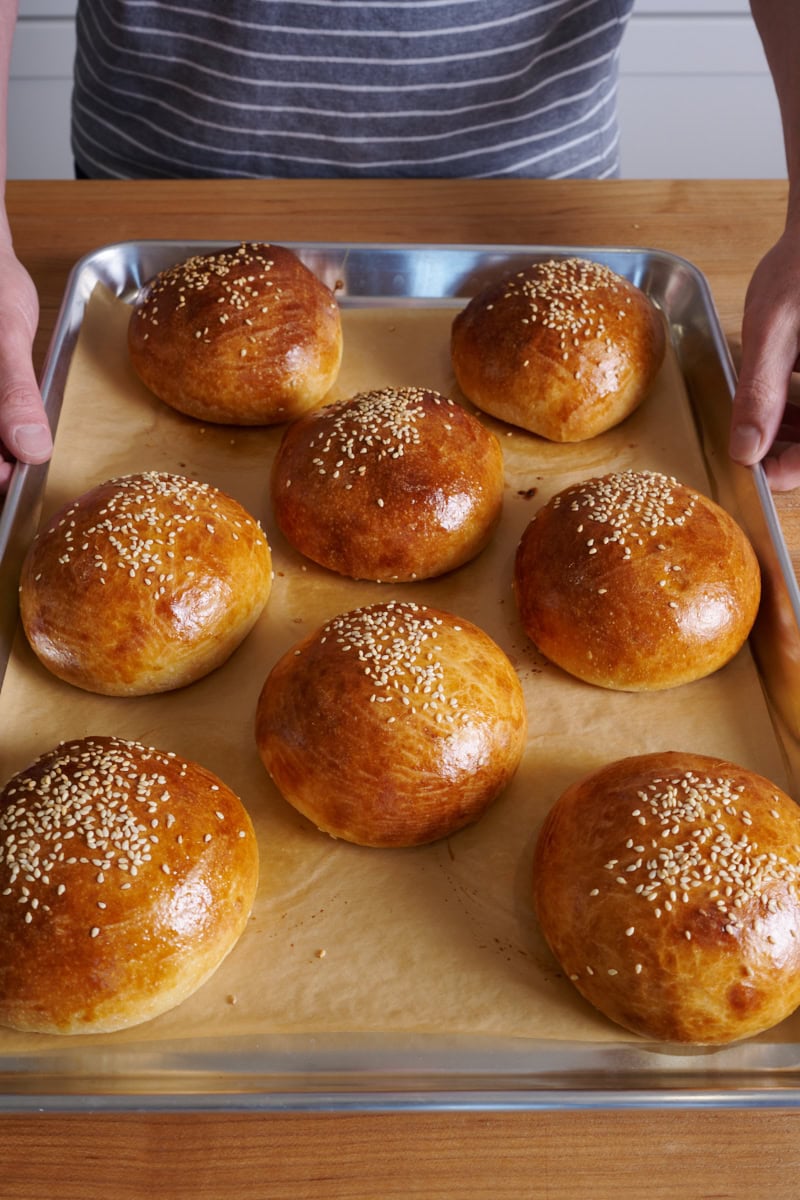
Remove the baking sheets to a heat-safe surface and cool for 5 minutes. Then, transfer the buns to a cooling rack and let them cool completely before slicing, about 30 minutes.
Print
Fluffy Milk Bread Hamburger Buns
- Prep Time: 19 hours 30 minutes
- Cook Time: 30 minutes
- Total Time: 20 hours
- Yield: 10 buns
- Category: Lunch, Dinner, Main Course
- Method: Fermentation
- Cuisine: American
Description
These sourdough (naturally leavened) milk bread hamburger buns are soft and fluffy yet sturdy enough to hold your burger and all the desired toppings.
Ingredients
Levain
- 93g high-protein white bread flour
- 28g superfine white sugar
- 83g water
- 37g ripe sourdough starter
Tangzhong
- 69g high-protein white bread flour
- 274g whole milk
Main Dough
- 524g high-protein white bread flour
- 342g (all) tangzhong
- 69g whole milk
- 123g unsalted butter
- 20g superfine white sugar
- 116g water
- 14g fine sea salt
- 240g (all) ripe levain
Topping
- 1 egg and 1 tablespoon whole milk for egg wash (optional)
- Raw sesame seeds (optional)
Instructions
- Prepare the levain – 9:00 p.m. (the night before mixing)
Mix the ingredients in the chart above in a tall jar, covered at a warm temperature, 74-76°F (23-24°C), to ripen for 12 to 14 hours. This levain will expand in volume significantly. Be sure to use a tall jar so it doesn’t overflow. At this time, also take out the butter from the fridge, cut it into 1/2-inch pats, and let it warm to room temp on a plate. - Prepare the tangzhong – 9:10 a.m. (the day of mixing)
In a medium saucepan over medium-low heat, combine the tangzhong ingredients. Cook, whisking continuously, until the mixture thickens and becomes a paste (it should look like mashed potatoes), 5 to 7 minutes. Remove the pan from the heat and spread the tangzhong on a small plate to cool. Set aside. - Mix – 9:30 a.m.
To the bowl of a stand mixer fitted with the dough hook, add flour, tangzhong, milk, sugar, water, salt, and ripe levain. Mix on low speed (STIR on KitchenAid) for 1-2 minutes until combined, with no dry bits remaining. If the dough is too dry, add a splash of water. Mix on medium speed (2 on KitchenAid) for 7 minutes until smooth. Let rest for 5 minutes. Mix again on medium speed for 3-4 minutes until the dough gains strength and clings to the hook. Reduce speed to low and add the room-temperature butter, one pat at a time, scraping the bowl as needed. After 4-6 minutes, the dough will form a cohesive ball with clean sides. Transfer the dough to a bulk fermentation container and cover. - Bulk Fermentation – 10:00 a.m. to 1:30 p.m. (3 1/2 hours)
At a warm room temperature, 74-76°F (23-24°C), bulk fermentation should take about 3 ½ hours with no sets of stretches and folds (the dough is sufficiently strengthened during mixing). Let the dough rest, covered, for the duration of bulk fermentation. - Divide and Shape – 1:30 p.m.
Line two baking sheets with parchment paper. Lightly flour your work surface, and using a bowl scraper, gently scoop the dough out to the floured area. Lightly flour the top of the dough and divide it into 10 (135-gram) portions. You might have a small bit of scrap dough left over. Using floured hands and a bench scraper, shape the portions into tight balls. - Proof – 2:00 p.m. to 4:30 p.m.
Cover the baking sheets with reusable plastic or snap-on baking sheet covers and let the dough proof for 2 ½ hours. (See the video up in this post for what the dough looks like when fully proofed.) - Bake – 4:30 p.m. (preheat oven at 4:00 p.m.)
30 minutes before baking, preheat oven to 450°F (232°C) with racks in the upper and lower thirds. For the egg wash, whisk 1 egg and 1 tablespoon of milk until frothy. Uncover baking sheets and brush with egg wash. Sprinkle sesame seeds if desired. Bake for 15 minutes. Rotate pans, reduce temperature to 425°F (220°C), and bake for another 5-10 minutes until well-colored. Remove the baking sheets to a heat-safe surface and cool for 5 minutes. Then, transfer the buns to a cooling rack and let them cool completely before slicing, about 30 minutes.
Notes
To make this recipe vegan, substitute the whole dairy milk for full-fat nut or oat milk and use a butter substitute (such as Earth Balance Vegan Butter).
If you don’t have superfine white sugar (caster sugar), use your finest white sugar.
Milk Bread Hamburger Buns FAQs
Can I prepare the tangzhong ahead of time?
Yes, you can prepare the tangzhong the night before mixing. After cooking the flour and milk, let it completely cool on the counter, transfer to a covered container, and place it in the refrigerator.
Can I make these milk bread hamburger buns vegan?
Yes, substitute the dairy milk, both in the tangzhong and main dough, for any whole-fat nut or soy milk. In place of the butter, use a vegan butter alternative such as Earth Balance. Omit the egg wash completely, and instead, brush the tops of the dough with more nondairy milk before baking.
Can I reduce the amount of sugar in these hamburger buns?
I would not reduce the sugar in the sweet levain because the specified amount is needed to ensure reduced bacterial activity. However, feel free to reduce the sugar in the main dough, though it’s there primarily to ensure the final buns are soft and have good keeping quality.
Can I refrigerate the milk bread hamburger bun dough overnight?
Yes. After shaping the dough into balls and placing them on the baking sheets, cover the dough, let it proof for 30 minutes on the counter, then place the pans in the refrigerator. The next day, take the trays out to finish proofing on the counter for 1 to 3 hours, until very puffy as directed in Step 7.
Can I use this bun for anything other than a hamburger?
These sourdough milk bread buns would be fantastic for egg sandwiches, tuna or egg salad sandwiches, or sloppy joes.
My milk bread hamburger buns had large bubbles form on top, what happened?
This is a telltale sign the dough is overproofed. Next time, reduce the proofing time by 15 to 30 minutes. The dough should feel very light when poked, but not excessively gassed up or delicate. You might also see partially collapsed areas when the dough is overproofed.
What’s Next?
Since you’re likely making these milk bread hamburger buns during the summer, why not make an easy sourdough starter discard pie or galette to house all that excellent summer produce and complete your cookout?
Buon appetito!


92 Comments
First off this is a wonderful recipe and will be making them again. For health reasons I used almond for the milk and olive oil instead of the butter. Other than that I followed the recipe as given. The rolls came out fantastic. I did have to add more flour possibly because of the use of the olive oil. Next time I may start with less olive oil and see how the dough feels and add more if needed and bake at 425 degrees the entire baking time. Thank you Maurizio I have really enjoyed your weekly emails and the recipes included.
Hi. I maintain a dough starter and successfully made these hamburger buns. I reduced the quantity to make 6 buns (in case got it wrong)
They’re soft and squishy and smell delicious.
I’m in Australia and appreciate that your recipes are in grams
I made the tangzhong last night when I mixed levain. This morning when mixing dough, it only weighed 304g and my levain only weighed 203g (and I use a rubber spatula to scrape every bit out). I proceeded with the recipe as written. I’m not used to this kind of shrinkage. Fingers crossed it is normal to lose some weight on both and doesn’t affect the outcome. Have you had this problem with the weights being that different?
Do these freeze well and what is the best way to freeze and then thaw
You know I havent tried freezing them, but I’d imagine they’d do well. Be sure to cool them thoroughly after baking, then freeze them in a bag with as much air pressed out as possible (without squishing!). To thaw, just leave in fridge overnight. I would gently warm them in the oven before cutting and grilling.
Maurizio, I only use Einkorn all-purpose flour. How wild you recommend I adapt this recipe to einkorn? Thanks for sharing!
I fear these would be too dense if you used a lot of einkorn, but swapping 2-5% of the total flour in this recipe for einkorn would work really well!
can I use coconut sugar instead of white sugar?
If the granulation is very fine, it should work!
I followed the recipe as you indicated in the post, but when I shaped the buns, the dough was very soft and sticky. I’ve made buns before, and the dough is usually firmer. What can I do to make the dough less soft?
Ariel—you can use stronger flour (use a “bread” flour with higher protein), and/or reduce the final water in the dough. Go from 116g in the recipe, down to 50g, and see how the dough feels when mixing.