


Olives—there’s something about them, isn’t there? How can there be so many different types, yet still, all of them taste so good? I have yet to find an olive I did not like. I got lucky this week and had many extra olives. We had planned to make another Moroccan dish (our current obsession) for dinner one night, but we never had the chance. No worries, I could do something with all those incredible little things—enter this Tartine olive Sourdough.
Before I started baking sourdough at home olive bread was always one of my favorites. I knew baking my version would go well, but I didn’t realize it would go this well. The result is just so dang tasty having it sit out on the counter is just a bad idea. One more slice, sure why not.
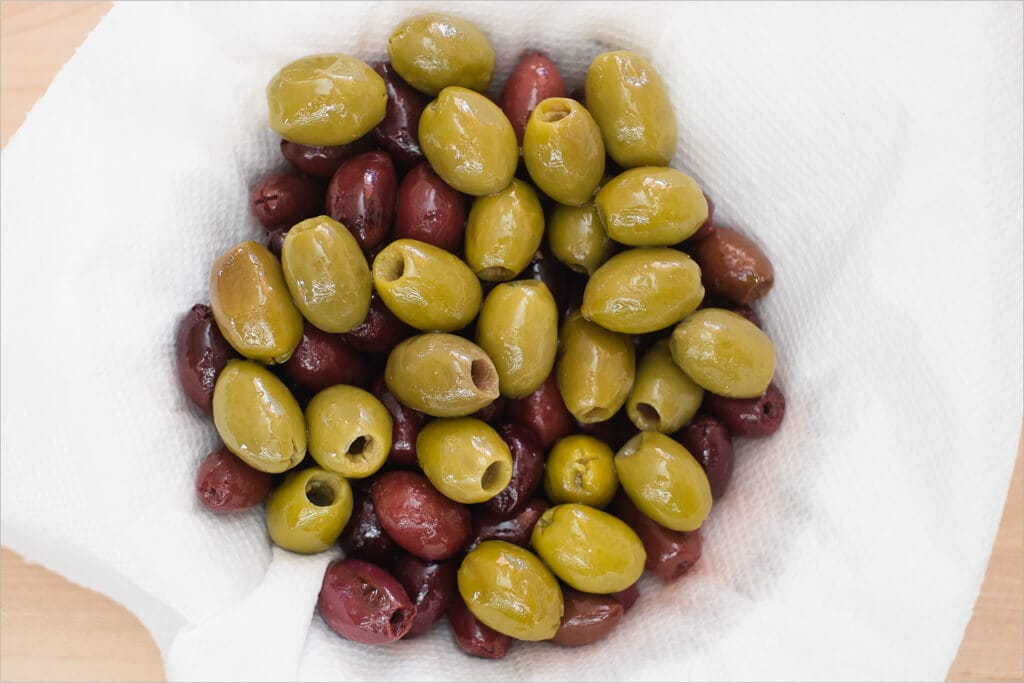
The olives I used for this were marinated in a salty garlic sauce that wasn’t what I had intended to use at the onset. The olives sure tasted good, but I think they contributed just a little bit too much flavor to the bread — just some straight pitted kalamata and Castelvetrano olives would be perfect. We recently signed up for a bi-weekly local produce box here in town, and I was pleased to find I could get organic olives in the shipment. I doubt they are local, but they don’t come drenched in spices. This will be perfect for the next iteration of this bread.
Prepare the leaven – 10:30 p.m.
My typical 100% whole wheat leaven, prepared the night before:
- 31g ripe sourdough starter
- 110g whole wheat flour
- 110g water
After mixing the above in a glass container, cover it and set it out on the counter for an overnight rest. I started with water, just a bit cooler than usual; I had some errands to take care of in the morning and needed more time to mix after waking up.
I’ve realized that water temperature is one of the most useful tools in the baker’s arsenal.
Temperatures are crucial in baking, and they are usually hard to control. The flour temperature is possible but not easy/practical, and the ambient temperature can be controlled to some level, but even a few degrees can drastically affect things. All that’s left is water temperature; this is easily modified in the microwave. Based on your schedule, mix with warmer water to speed things up or colder water to slow things down.
Mix the flour, water, olives & spices and autolyse – 9:00 a.m.
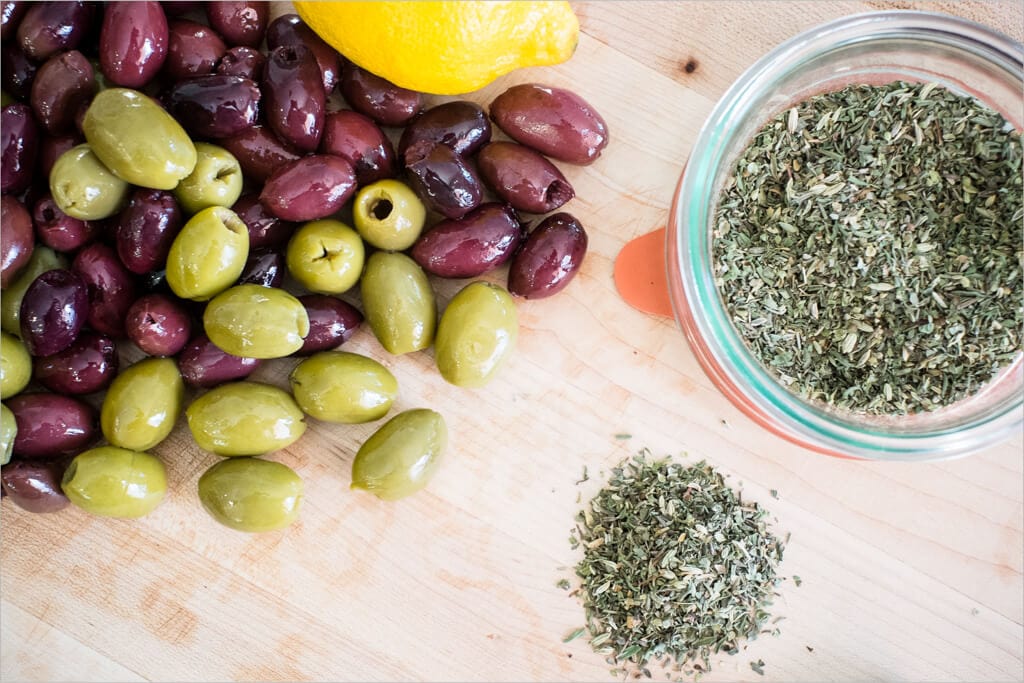
Ingredients:
- 250g (25%) leaven
- 800g (80%) white bread flour
- 200g (20%) whole wheat flour
- 20g (2%) salt
- 730g water and 50g in reserve for after you add the salt (step #5 in Method below)
- 3 cups pitted olives (I did 2 cups kalamata and 1 cup green), loosely chopped
- 2 tsp herbes de Provence
- Zest of one lemon
You might also notice that I’m pushing 78% hydration with this loaf. I’ve slowly been increasing the water amount to try and achieve a softer and more tender crumb. I’ll journal my experience with these wet doughs in a future post. It can get challenging! You could reduce the water amount by up to 5% with no problem here.
Method:
- Add the 250g of leaven to a large mixing bowl
- Pour in the 730g water & mix with your hands until the water and leaven are thoroughly mixed and dissolved
- Add 800g white flour and 200g whole wheat flour and mix with your hand until all the dry flour is incorporated
- Cover your bowl with a towel and let it autolyse for 40 minutes
- After 40 minutes, add 20g salt to the dough and slowly pour your 50g reserved water on top. Squeeze the dough with your hand to incorporate the salt
- Now reach your hand under the dough and pull one side up and over onto itself. Do this several times until you notice the consistency of the dough to turn sticky
- Transfer your dough to a large bowl for the bulk fermentation step. I usually use a clear-sided plastic container for my bulk fermentation, but adding the olives will be too much for the smaller container. Instead, I use my trusty large Heath Ceramic bowl (nice and thick for insulation).
After transferring to the large bowl, I read the final dough temperature: 75°F (24°C). Wow, it’s COLD out! This means the duration of bulk fermentation will need to be lengthened, or I will have to improvise and keep the dough warmer. In hindsight, I should have used much warmer water, maybe even up to 90°F (30°C).
For more on dough temperatures and how they affect fermentation, see my post on the Importance of Dough Temperature.
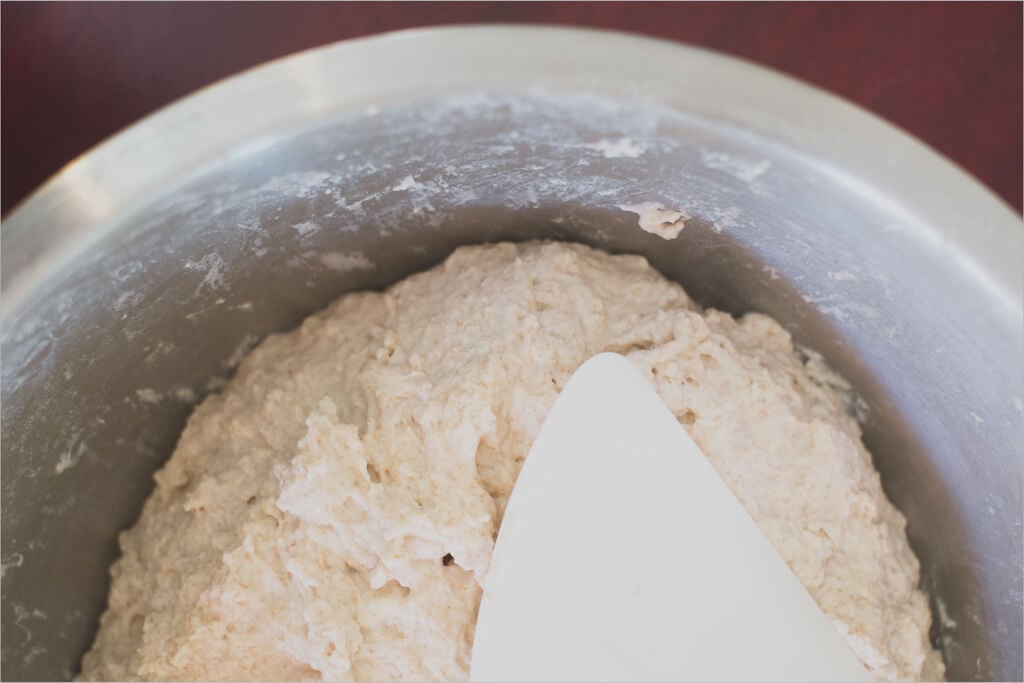
Bulk Fermentation – 9:45 a.m.
During bulk fermentation, you want to do six sets of stretch and folds spaced 30 minutes apart. The stretch and folds should be quite intense to strengthen your dough over the next several hours. After the first set, add the olives and herbs de Provence. If the mixture is overly dry after the addition, add a splash of water to help incorporate the ingredients. If you follow my recipe exactly, you might not need any extra water (because of the already high 78% hydration).
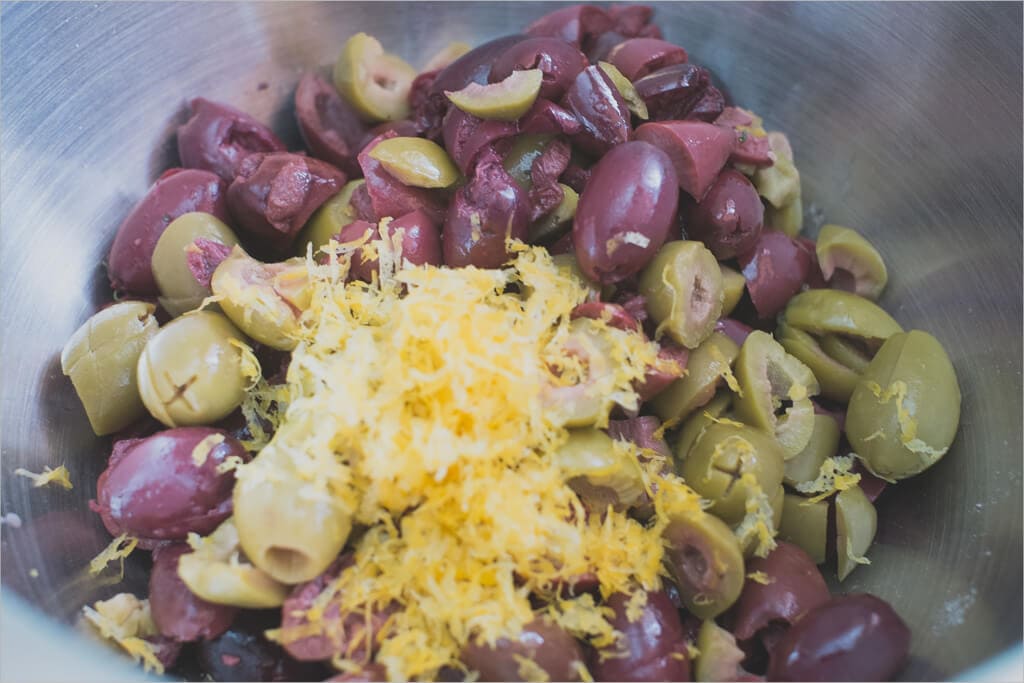
Mix the olives, herbs, and lemon zest in a medium bowl before incorporating into your dough. Set this mixture aside, and we’ll add these to the dough after the first turn; get started:
- 10:30 a.m. – Turn 1
After the first turn, add 3 cups olives, 2 teaspoons herbs de Provence, and lemon zest. Mix thoroughly with your hand, and cut the olives into the dough with your thumb and index finger.
- 11:00 a.m. – Turn 2
- 11:30 a.m. – Turn 3
- 12:00 p.m. – Turn 4
- 12:30 p.m. – Turn 5
- 1:00 p.m. – Turn 6
- 1:00 p.m. – 3:30 p.m. – Rest on counter untouched
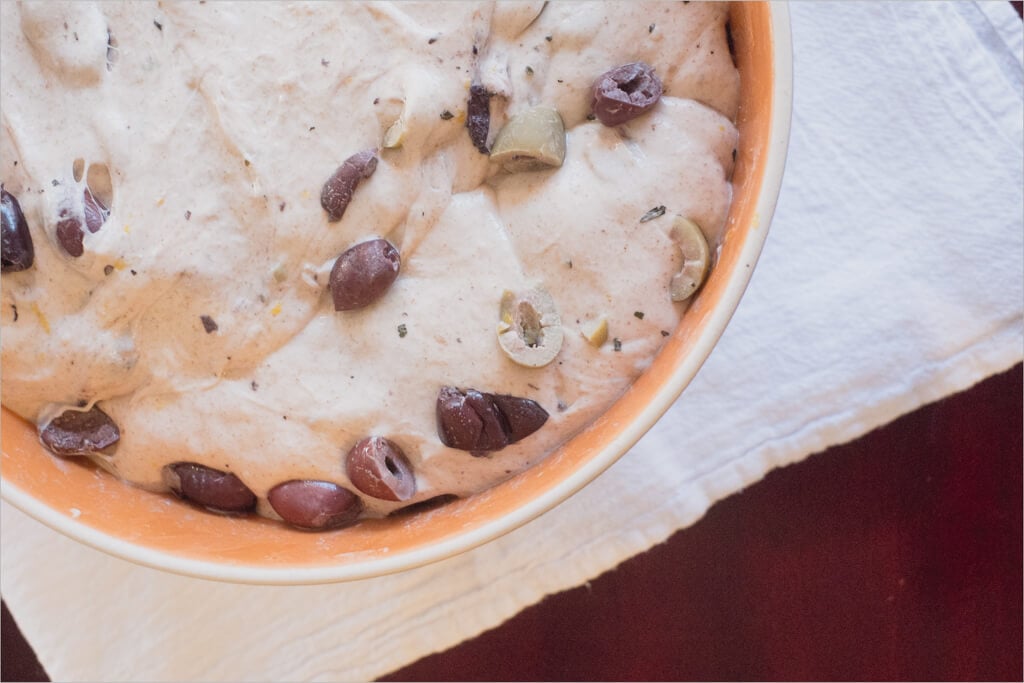
By 3:30 p.m. the dough had risen almost to the top of my bowl and was ready to be shaped. The olives dotted the dough and had me wanting to pick one or two out while shaping. It’s impossible to cook/bake good food without tasting the ingredients as you go along, right?
Pre-shape – 3:40 p.m.
Remove the dough from the container onto your unfloured work surface and sprinkle some flour on top before dividing. Divide the mass into two halves and flour the top of each half. After shaping, I inverted a bowl on top of each shaped mass to keep it from drying out and set a timer for 30 minutes.
I recently purchased another set of oblong proofing baskets so now I can do two batards instead of one batard and one boule. I much prefer the look of the batard, especially that single long score down the middle. Now that I have four baskets I can do a double batch of bread (that’s the plan for Christmas) and have all of them shaped in my favorite style.
Lightly dust your two linen-lined bowls with white rice flour. These bowls will hold our fermenting dough overnight in the fridge to proof.
Shape – 4:10 p.m.
Higher-hydration doughs such as this can be very tricky to handle. I try not to incorporate any more flour than necessary, but there is a fine line between too much flour and too sticky. Finding that balance only comes with experience.
I shaped each piece as an oblong, as seen in my guide to shaping a batard.
Proof – 4:30 p.m.
After shaping, gently place the dough into their baskets and the fridge for overnight proof. My wife keeps telling me we need either a bigger fridge or a dedicated breadproofing fridge, not enough space for food with double batches of dough! “It’s worth it,” I keep telling her. She silently agrees each time she toasts a piece of bread in the morning with her eggs.
Score + Bake – 7:30 a.m. (the next day)
Gather your tools:
I baked these loaves using the combo cooker above, but a Dutch oven also works well. See my guide to baking bread in a Dutch oven for tips and more guidance!
Preheat your oven with an empty combo cooker (or Dutch oven) inside to 500°F (260°C) for one hour.
After one hour, take one of your loaves out of the fridge and cut a piece of parchment paper to place on top of the basket containing the dough. Take your peel, then put it on top of those two and quickly invert it so the dough rests on the parchment paper and the peel.
Get your razor blade out and score the top of the loaf to allow the bread to expand while rising in the oven. I’ve been practicing more with my single long slash for the batard, and I think I’ve found my perfect angle. Place the razor 90° over the loaf and then rotate left (I’m left-handed. If you’re right-handed, rotate right) by 45° and score.
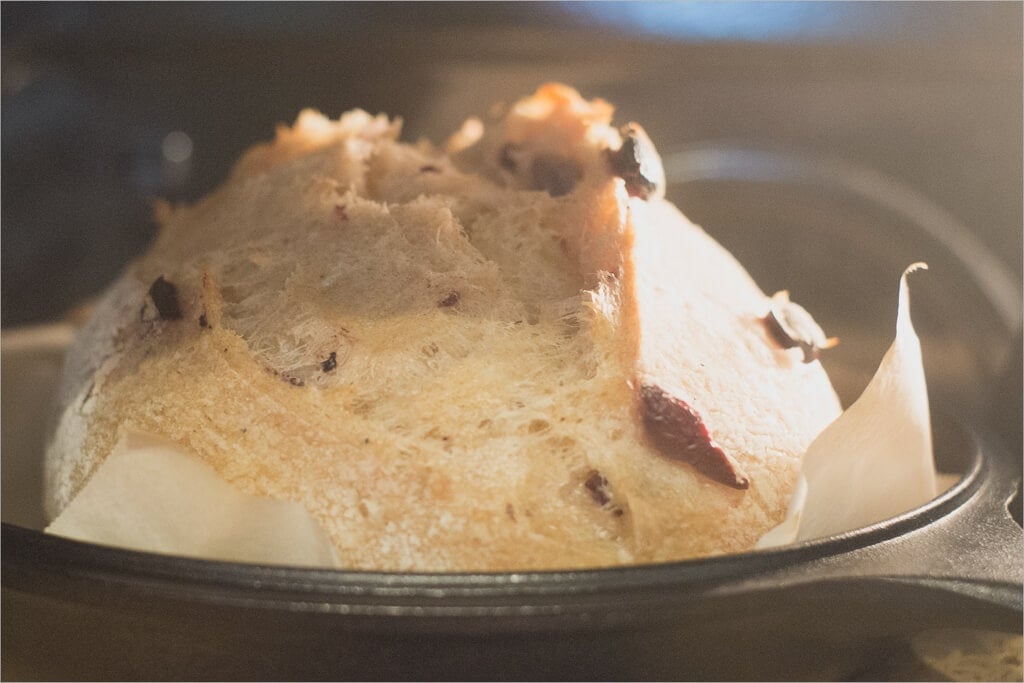
Place the dough in the combo cooker, turn the heat down to 450°F (230°C), and bake for 20 minutes. After this time, open the oven, remove the top lid of the combo cooker, close, and bake for an additional 35 minutes or until done to your liking.
Repeat for the second loaf.
Conclusion
The salty taste of the olives set this loaf off. I could hardly wait for the two loaves to cool before cutting into the first one. When you bake these, start early so you aren’t tempted at lunchtime to just cut right in and make a sandwich.
Crust
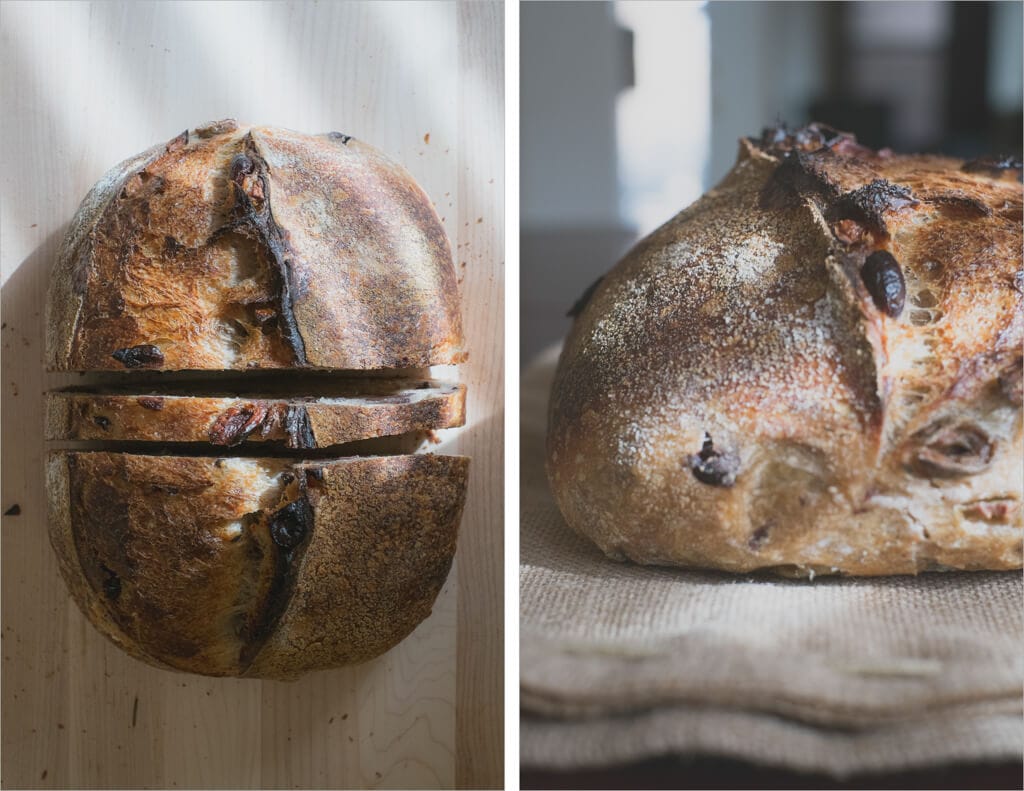
It is a beautiful crust; the color, tears, and openness are all just great. I love how the olives dot the surface of the bread, hinting at what’s inside. The crust turned out to be thin and very brittle. After a few days, it hardened a bit more, but that just added to the beautiful rustic nature of this bread.
Crumb
Soft and open, a great combination. Next time, I will try to have a more decisive yet gentle hand when shaping. Perhaps I squished out too many precious air pockets developed during bulk fermentation. Still, the crumb was very lovely.

Taste
I’ve probably already beaten this to death, but I’m serious: this bread is something. Bake it and find out. You’ll be happy you did!
If you want to try another olive-based loaf, check out my green olive and herbes de Provence sourdough bread for another winner!
If you’re a big fan of Tartine like I am, check out this Bread Baker’s Date and Banana Tea Cake made with sourdough starter discard—it’s incredibly delicious.
Buon appetito!
If you use this recipe, tag @maurizio on Instagram so I can take a look!


250 Comments
Just baked my olive bread this morning and wow! This is soooo yummy! I have two questions, though: 1. Using the same quantities of ingredients for the Leaven, mine came up 7 grams short. Should I have done a bulk feed of my starter prior to making the Leaven? I ended up using the smaller volume of Leaven and my bread seemed just fine. 2. You mentioned a final dough temp of 75 degrees was cold, but you didn’t state what the ideal dough temp would be. Mine was 84 degrees at this stage, is that too high? I read your DDT section and it seems between 75 – 80 degrees is ideal, is this what we are looking for in this recipe?
Glad to hear it worked out well for you, Heidi! No worries about the 7g, it’s normal to come up a bit short. No, you want to make your levain from your ripe starter (meaning, it had fermented overnight). Yes, 84F is a bit high, but it’s not “bad” in any way, just expect a higher temp to speed things up (fermentation). I typically shoot for 78F, depending on the bread.
I have unbleached bread flour and whole wheat flour. Can I use these in this recipe or not?
That’ll work!
I made it and it came out soooooo good, Best one I have ever made, perfect texture, crust…
one interesting “fact”, I have 2 proofing baskets, one is a bit smaller than the other, but for some reason the smaller one turned out to be the bigger bread at the end. The other thing is the bread is really soft on the inside so it was hard to cut, any suggestions how to workaround that?
Hi Efrat – do you have an offset bread knife? I know it sounds too easy, but I had a hard time slicing soft bread until I bought a bread-specific, offset knife (the handle is offset to the blade, the blade is about 10″ long, and it is a thin, serrated blade). It cuts soft bread just like this one so nicely. Best knife purchase in my “arsenal” by far.
Hi Maurizio,
I’m working on your steam oven technique. Do you recommend one cooking style (steam vs dutch oven) over the other for this Olive Tartine?
Also, I’ve shaped it into the batard but see that the Lodge Combo cooker is suggested here. I think i’ll just make if fit into the combo cooker..
I made the bread, it was fabulous. My parents are strongly hinting for MORE. Suppose I wanted to make sourdough olive rolls (little breads). I get that it should be about 100g per roll, but how long/what temperature would you recommend baking them? I’d be baking on a baking stone.
Hi! Thank you for this helpful site, it has been the ultimate go-to for me these past few weeks as I’m starting my sourdough journey.
Quick question-I made this olive bread this week, and it came out absolutely wonderful! I want to keep practicing it, but would love to try walnuts instead of olives. I know you have your version of the Tartine Walnut bread but it is different from this recipe. Do you think I can use this (olive bread) recipe and just sub olives for walnuts?
Thank you!
Glad to hear that, Yoonoa! I’d omit the olives and use up to 15-20% walnuts in their place. You might find you need to add a touch more water to this dough as walnuts can absorb some, but it might not be necessary.
Thank you for the quick response! Do you mean 15-20% baker’s percentage? So in this case, if flour is 1 kilo, walnuts should be around 150-200 grams?
Thanks again
Correct!
Hi Mauricio, a more general question. Why do you transfer your dough after mixing. Is it wrong to leave it to ferment in the mixing bowl? Thanks!
Hi Maurizio, I have heard of a prime rib getting “stuck” at a temperature but never bread. I just made a roasted garlic, caramelized onion parmesan boule and batard and I could not get the temperature above 194 degrees for the life of me. I was determined to get to 200 degrees and it never went past 194 and I ended up with a very dark crust. Any thoughts? Ps. I am baking at 11,200 feet in Colorado and that alone is a feat in of itself! Thanks
Hi Maurizio, I’m wanting to make this and your walnut cranberry recipe to give one loaf of each to a family member. Would it be possible to make these two from one batch of dough or would I have to make completely separate levains and doughs because of the difference in hydration and proportions? Thanks
I would say make the Tartine loaf and just add walnut and cran to that dough (split it in half after mixing). Or, my preferred method, make one batch of each recipe and keep the extras 🙂
Hi! When you are preparing to bake – is the 7:30am start time when the loaf goes in the oven? (15hr total proof ) or do you start the oven to preheat at 7:30pm which makes it a 16hr proof? I’m scared of over proofing!
I bake right at 730am, but it’s ok if it’s an hour later, the dough will hold fine in the fridge.
Are you baking directly out of the fridge or do you let it rise to room temp first?
Hi! Could you do your best sourdough recipe with the olives? And just add them after the first fold?
Absolutely. As always, watch the hydration if the olives have any sort of liquid with them, that’s already a highly hydrated dough.
Thank you!
Excellent! I follow this recipe step by step (with the 5% reduction in water) and the result was awesome…
I baked it for the first family meeting (keeping distances) during the phase out of the pandemic and they loved it.
Thank you for sharing it. 👍🏻🙏🏻
Happy to hear that!
Any issue with cutting everything in half starting with the starter (i.e., 15g)? There are only two of us and I only have one cloche.
Thanks again!
That’ll work just fine!
I tried the olive loaf and got very minimal oven spring. I can’t figure out what went wrong. I followed the steps exactly and have had great success with the regular sourdough bread. Does adding olives reduce oven spring?
The olives will certainly weigh things down, but as long as the dough isn’t over hydrated and you have strong fermentation from a well-maintained sourdough starter you should get plenty of oven spring (the photos in my post show nice spring!).
Thank you so much for replying! I love your site!
Hello,
My fridge isn’t big enough to allow the dough to proof overnight. I can instead just leave it to proof on the counter for less hours? If yes, how many hours would you recommend?
Yes, you certainly can do this. Depending on the dough, it’ll be somewhere between 2-4 hours or so. Check out my latest bread post using all-purpose flour for a video on how to determine when the dough is ready for baking!
Hi Maurizio! I don’t happen to have any whole wheat flour at home, could i swap the whole wheat flour with spelt flour? Looking forward to making these loaves, thank you!
Yes, that should work just fine!
Hello!
I made this loaf and have to say is exquisite! The only problem I have encounter is that the crumb looks “wet”, it is not heavy or doughy just looks wet.
Looking back at the recipe I realized I did not rinse the olives, could that be the reason?
Thanks!
Maria
It’s possible, or it could have been over hydrated in general. Try reducing the water 25-50g next time to see if that helps (and I’d also rinse the olives).
Also, be sure to fully bake out the bread, the interior should be between 206-210°F.
Newbie here- this is my 1st time branching away from your beginner recipe. The dough rose really well in bulk and proof. But with cooking the bread looks ‘flat’- like the top 1/3rd just didn’t rise in the bake. My scoring was good. The only thing I can think of: I did have slightly longer bulk and proof due to schedule issues and maybe I didn’t shape it well enough? Just trying to understand what happened for future loaves. I am sure it will be delicious but looking for that ‘perfect loaf’!thanks! Having so much fun experimenting!
Hey there! Yes, sounds like either over proofed or not a tight enough shape to encourage upward expansion. I’d try reducing bulk fermentation (or proof) a bit and shaping just a bit tighter so it keeps shape. It’s possible it was all shaping as well. Hope this helps!
Thank you! Definitely noticed the shaping was tougher on this recipe!
Hi – if you say you can “reduce the hydration 5%” while mixing the dough – does that mean the amount of water would be 693g instead of 730g? Am I doing the math right? Thanks!
That’s correct!
Happy you’re enjoying the site! Good call with the cornmeal, that’ll work very well. Have fun and happy baking 🙂
Hi! I’m making this for the first time today, and I just realized that I threw in oil-coated olives without rinsing or drying them. Is that going to be a problem? Do you prep olives in any special way before adding? Thanks!
How did your loaves turn out in the end? Thanks 🙂
Ah! That’ll likely be just fine, the oil might give the crumb a little extra tenderness 🙂
Hi Jackie, I did the same thing with the loaves I baked this morning. They came out beautifully – the interior of the bread is nice and soft/pillowy. The oil being on the olives did not detract at all.
This loaf cooks for a total of 70 minutes. Your beginner sourdough cooks for a total of 50 minutes. I’m curious why this one goes so much longer? By the way, I love your blog – making great sourdough for the first time in my life!
Glad I could help! The olives do play a role here, but I baked this long ago in an older, run down oven. Nowadays I don’t usually bake for so long… That highlights the importance of spotting the differences between ovens (which are always there!).
I am not sure what I did wrong: leaven didn’t “grow” as I expected – Maury was too cold for it, but bulk fermentation was quite ok (I kept it in higher temperature), but while baking one loaf didn’t rise 🙁
I use Dutch oven, and I think that I should put it back to reheat after a first baking 🙁
Now I know 😀
Can I swap olives for something else? Sundries tomatoes, onion or garlic?
Live your recipe, olives didn’t go Well in my family but I Will definitely try it just plain with no extras 😄
Yes, you could swap out the olives, those other ingredients sound great. I’ve not used garlic, but I believe it might cause fermentation to slow if used in high percentages. Have fun with it!
I am a bit confused. Why use a pizza stone when using a Dutch oven/ combo cooker? Why not just preheat it and invert dough directly into it? This would require bringing the loaf to room temp before baking but at least this would shorten the preheating time to 30 minutes and baking time to 40 minutes instead of 70 minutes.
Yes, this is an old post when I used to take the approach above (I’ll update the post). Nowadays I use either the Dutch oven or the baking stone, not both. Inverting it works really well, or just using the DO only.
Where can I get whole wheat bread flour? I’ve seen everything but. Is there really such a thing? If I can’t find it, should I substitute white bread flour, or regular whole wheat flour?
Regular whole wheat flour is what’s needed here! Sorry for the confusion.
I have two oval proofing baskets (10 x 6 x 4). Will that be enough to hold the dough in this recipe?
It’s so hard for me to say, I usually have to test my baskets to find out what they can hold. What I do is scale things down to about 700g per loaf and use that — it’s pretty much the smallest loaf I bake (besides rolls). Then, I’ll scale up as I know it can fit. My gut says yes, your baskets should work, though.
If I used a large proofing basket and cooked one large loaf (instead of splitting into two loaves) on a stone, could I use your lava rock/moist towels steam technique? I’d guess such a big loaf would take about 1 hour and I’d need to drop the temp to 425-450 F after removing steam so crust would not burn.
Made this yesterday. Wow. Great recipe. Put the entire dough ball into a large banneton and made a giant 5lb loaf. Good oven spring using your lava rock+wet towels steam treatment. Had to remove loaf from oven after 1hr + 5min because getting too dark. Was only at 200 degrees internal temp, but was fully cooked. Would’ve preferred 205 degrees. Next time I’ll tent with foil. Rinsing the olives prior to mixing was a good call, Maurizio. Used 3C of kalamata. Delish. Next time I will mix the olives in with the salt. It was difficult to incorporate them after the first turn.
The overnight rise in the fridge yielded a GIANT, round loaf that I thought would deflate like a balloon when slashed. But it held up nicely.
Right on, Sally! Glad to hear things went well. I have to say, I don’t think I’ve made such a large loaf myself, I like the idea, though — kind of like a much later miche. Your modifications sounds spot on as well, usually a larger, single mass requires a longer back with a potentially lower temperature to avoid burning. Have fun and enjoy!
Hi! I was trying to understand does the amount of starter effect the overall proofing time ? Or only size of the dough. Was trying to find an answer and came to this post and you mentioned 250g starter which isn’t very typical, is there specific reason for this?
Thank you!
Yes, the starting amount does impact the schedule of the final dough. Assuming all else is equal, more starter mixed into your dough the shorter the fermentation timeline.
Hi!
I have a question. So i usually feed my starter around 6pm and 6am which are most suitable for me. Ambient temp at 26.
So when i make my levain in the morning the starter has already collapsed a bit. Is that okay? Or does it neeeed to be at its prime? Problem is i sleep early around 9pm so its difficult for me to make a levain at its prime which is around 12am. Could you please help?
That’s actually perfect. A collapse means it’s mature and ready to be fed or used to make a levain!
Hello, using rye starter will change something? i mean maybe i need use more flour or water if i will use rye starter.
I’d say it’s likely just fine! If you find the dough feels a bit stiff and dry, you could add in more water, but this will ultimately depend on the flour you’re using.
You’re absolutely right, the key is always to hit the listed final dough temperature. This post was written before I had my post up on all that (including my calculator) — I’ve updated the post. The olives should ideally be at room temperature. If they’re excessively cold or warm, yes, they’ll have an effect on the final dough temp!
Except for my first loaf, now my sourdough breads seem to always come out very heavy, no matter what I do. I can’t figure out if it’s my starter or what. Will proofing help this? The recipe I have doesn’t call for proofing overnight in the fridge. I happened to fine your recipe b/c I was looking for a sourdough olive bread. Hope to get pointers. Am newish to sourdough.
There can be many reasons for a dense loaf of bread, it’s really hard to say. Typically the issue is from under proofed dough, but it’s possible over proofing can cause this issue as well.
If your loaf is under proofed then this will typically lead to a gummy or “wet” textured interior. Make sure your starter and levain are very vigorous and strong when you use them. This is very important! From there, make sure to bulk ferment your dough fully (use the images you see in my posts to guide you on what the dough should look/feel like). You want the dough to be alive and aerated before you divide and shape. From there, a full and complete proof is also very important.
Conversely, it could be that your loaves are over proofed. There are a few indicators your dough could be going over: sluggish rise in the oven, the score on top of the dough might not open with a nice “ear” and instead just kind of fuse together, the interior will have lots of small holes and perhaps one or two large ones near the top (but no dense areas of unfermented flour), and finally the loaf could be a little on the sour side.
It’s hard to say which it is without pictures and/or more information, but I hope this helps!
Hi Maurizio, may i ask do you need to preheat the combo cooker? Thank you.
Felicia — yes, I do typically preheat the combo cooker. There’s really no need to preheat for an entire hour (the time I usually preheat my oven for), just stick the combo cooker in the oven halfway through the 1 hour preheat and it should be nice and hot after 30 minutes. Happy baking!
Thank you for your reply.
Hi! I made this loaf it and the crust is great but the crumb was quite gummy. I assume there are a lot of factors that may come into this but have you had the same issue with this particular recipe? I put it in the fridge for final proofing at 9am, and took it out at 530 to warm up while the oven was preheating. Went into the oven at 6pm.
Bettie — I haven’t seen any particular issues with this loaf versus any of the others here, but there are some suggestions:
If the hydration is too high for your dough it can lead to an overly wet or gummy interior. If the dough feels “soupy” or very “slack” then try pulling back the water percentage by 5% and see if that helps.
Additionally, make sure to bake your loaves completely. The interior should register around 208°F or higher.
If your loaf is under proofed then this will typically lead to a gummy or “wet” textured interior. Make sure your starter and levain are very vigorous and strong when you use them. This is very important! From there, make sure to bulk ferment your dough fully (use the images you see in my posts to guide you on what the dough should look/feel like). You want the dough to be alive and aerated before you divide and shape. From there, a full and complete proof is also very important.
Hope that helps!
Hi Maurizio! I have these in the oven now and they smell amazing. I realize you don’t use combo cookers much anymore, but I’m curious about this size of batard as you did w/ the 10″ bannetons – seems like it wouldn’t fit…? I’m about to purchase more bannetons and would love to do batards, but I’m committed at this point to my combo cookers (I have 4 of them!) so wonder if I should just stick w/ boules. I typically do 1000g-ish loaves. Thanks for all of your helpful posts. I’ve sent many learners to your site, saying I wish it had been there when I was first trying to figure out sourdough. Congrats on all of your success (& beautiful bread!).
Excellent! Yes, these truly are decadent loaves. I’d say with combo cookers I much prefer just sticking to boules. You can make a batard-ish shape in them, but in the end I find it just easier to proof in a round basket and bake them as rounds. If you want to make a batard, I highly recommend just baking straight on a baking stone or Baking Steel. You don’t have to perform an intensive steaming method, either, it can be simple by just covering the dough with a roasting lid during the steam portion.
So, yes, I’d stick to boules with the combo cookers!
Thanks so much for spreading the word. That’s exactly why I made this site: when I first started baking so long ago there was nothing out there! Happy I’ve been a help 🙂 Ciao!
🙂