


Wintertime, for me, means soup, soup, and more soup. But wait! It also means walnuts. “You silly, walnuts aren’t in season right now,” I hear you say. Well, that’s true, but I say, hey, why not use those bagged, shelled walnuts from the market or, if necessary, order a sack online? I don’t need much convincing, just a slight nudge or the faintest craving when it comes to walnuts. And so yes, I made fresh milled whole wheat walnut sourdough with roasted walnut oil. I also made soup, but I think you’re here for the bread.
Sourdough with walnuts is something I’ve done in the past with my walnut and cranberry sourdough, and while working on this formula, I was quickly reminded why I love them so much. It starts with the smell: the vibrant, intoxicating aroma that permeates the kitchen when toasted. Then they sit there on the counter, waiting to be used in any recipe but lucky if they make it that far. Gone unchecked, I could finish off a sack of fresh-shelled walnuts in record time — and then you’ll see me clawing through the expelled shells in hopes I may have missed something—an animal.
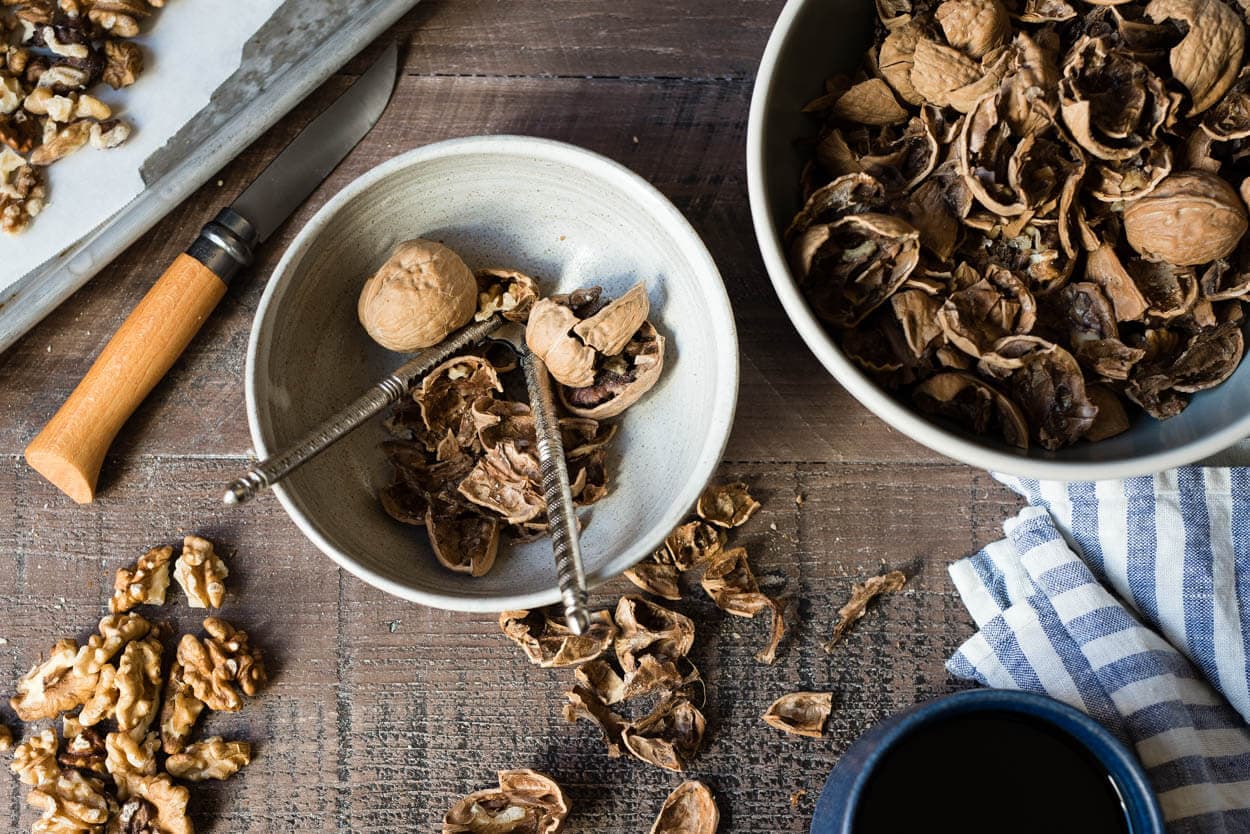
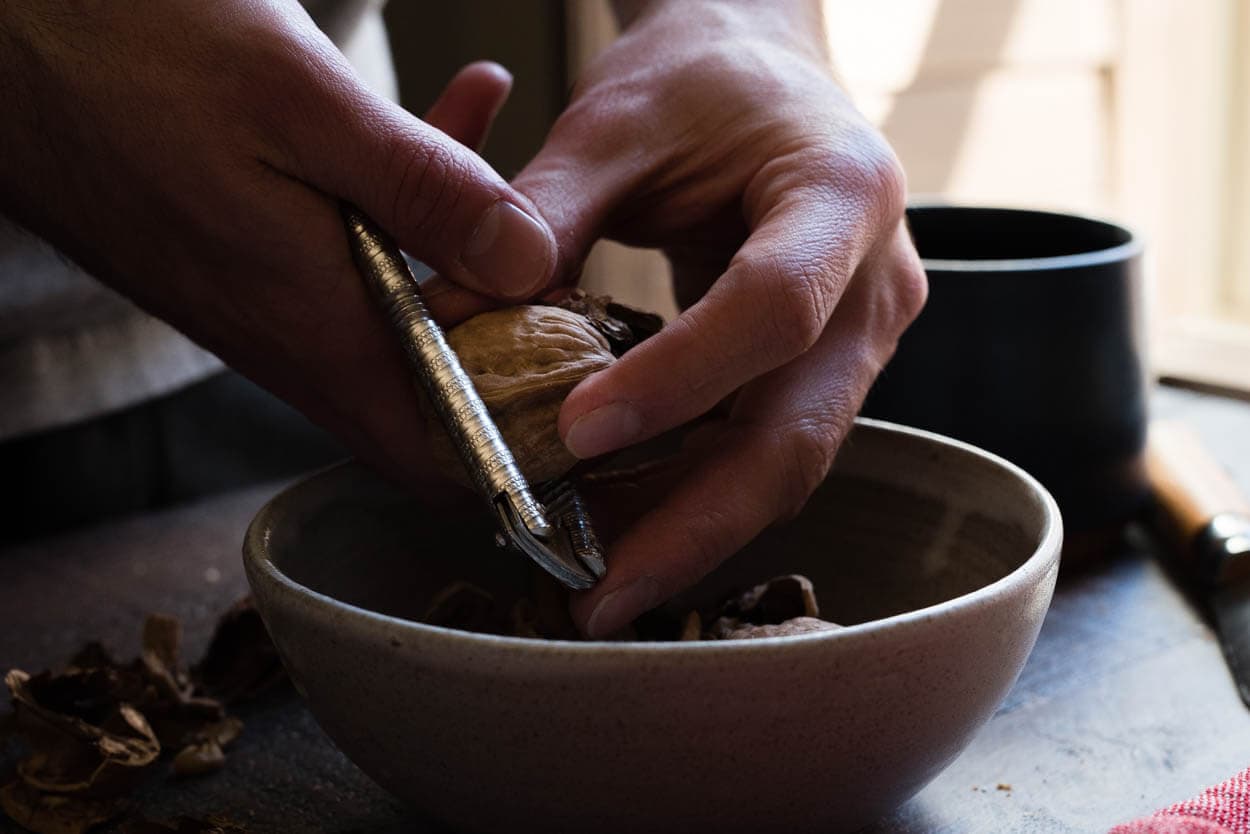
I ordered two bags of unshelled walnuts for this recipe, and thankfully one of those bags made it out of my grubby hands to mix time. I suggest when you prepare these walnuts shell a few extra grams because you will eat a few just before you toss them into your dough. If you’ve not had the chance to use walnut oil before, you’re really in for a treat. You can not only use it for baking but whisked up in a vinaigrette it adds an intense and complex flavor to your salads that’s hard to beat. And to streamline this whole thing eat this walnut sourdough with your walnut-y vinaigrette salad — sure to win over even the pickiest of picky. This is not a cheap bread to make. Good quality, organic walnuts (especially in the shell) can be a costly endeavor, particularly so when out of season. I’ve tried this bread with your run-of-the-mill bagged whole walnuts, and you know what, the bread still tastes fantastic. Still not cheap, but incredible nonetheless. It’s a bread you occasionally splurge on and one you’ll thank yourself for long after that first bite. Let’s get shelling and let’s get baking.
Flour & Nut Selection
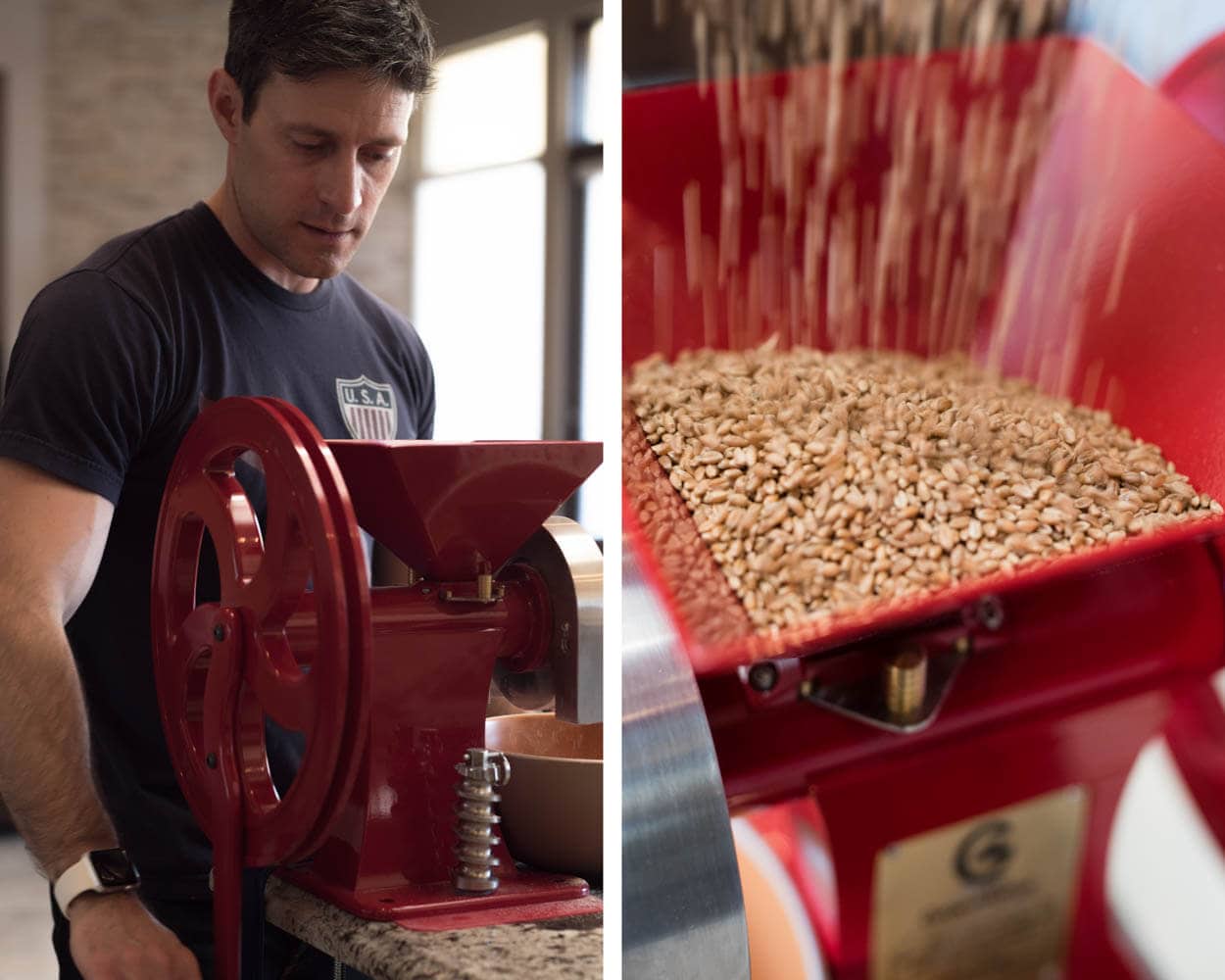
I milled my organic hard red spring wheat by hand using my GrainMaker 116 manual mill (as I do in my other loaves with freshly milled flour) in the morning around 8:00 a.m. I mixed my levain later that morning and later that day proceeded with my bake—no aging of flour, no soaking of grains.
If you don’t have a grain mill you can certainly use aged whole wheat flour and this bread will still be superb.
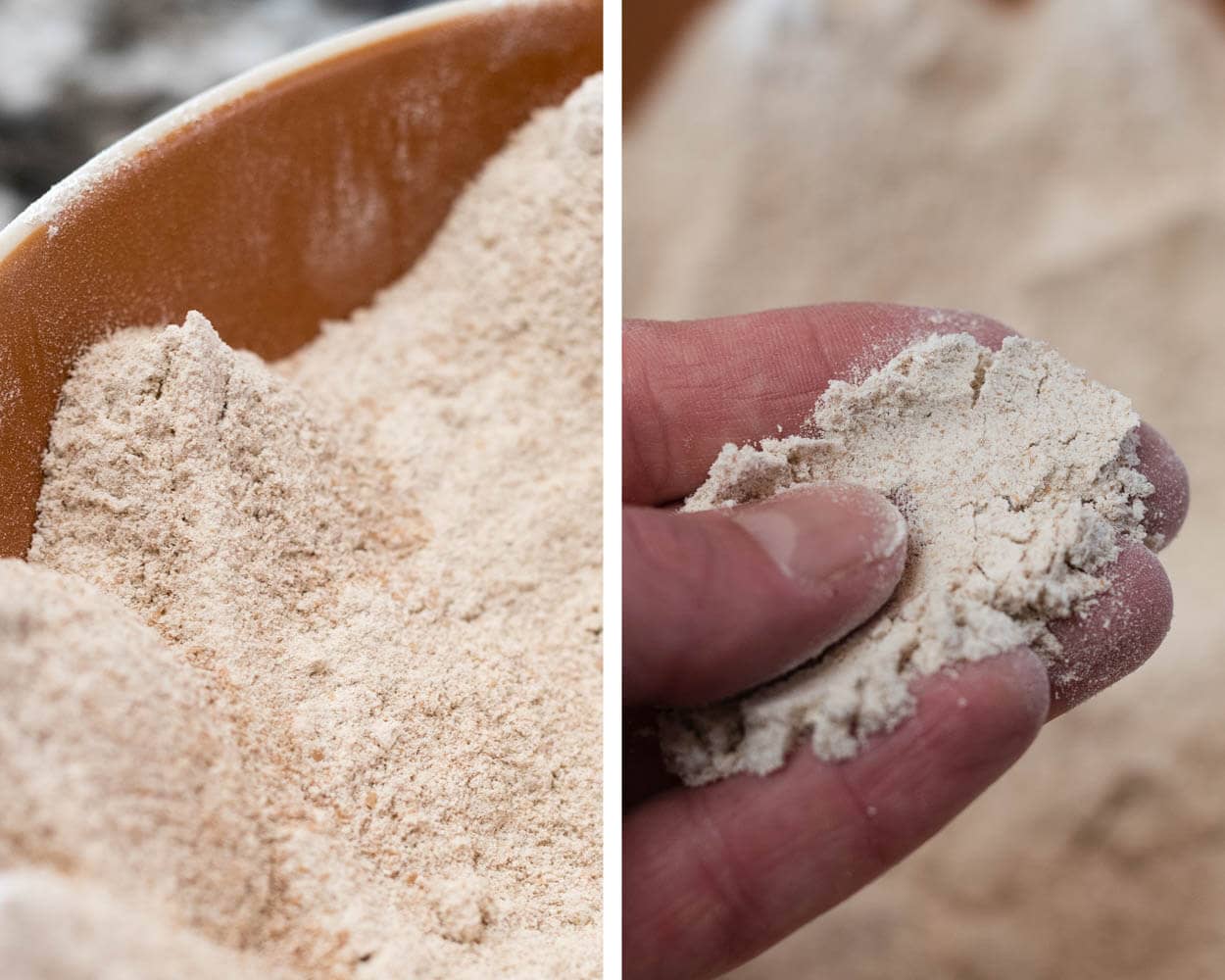
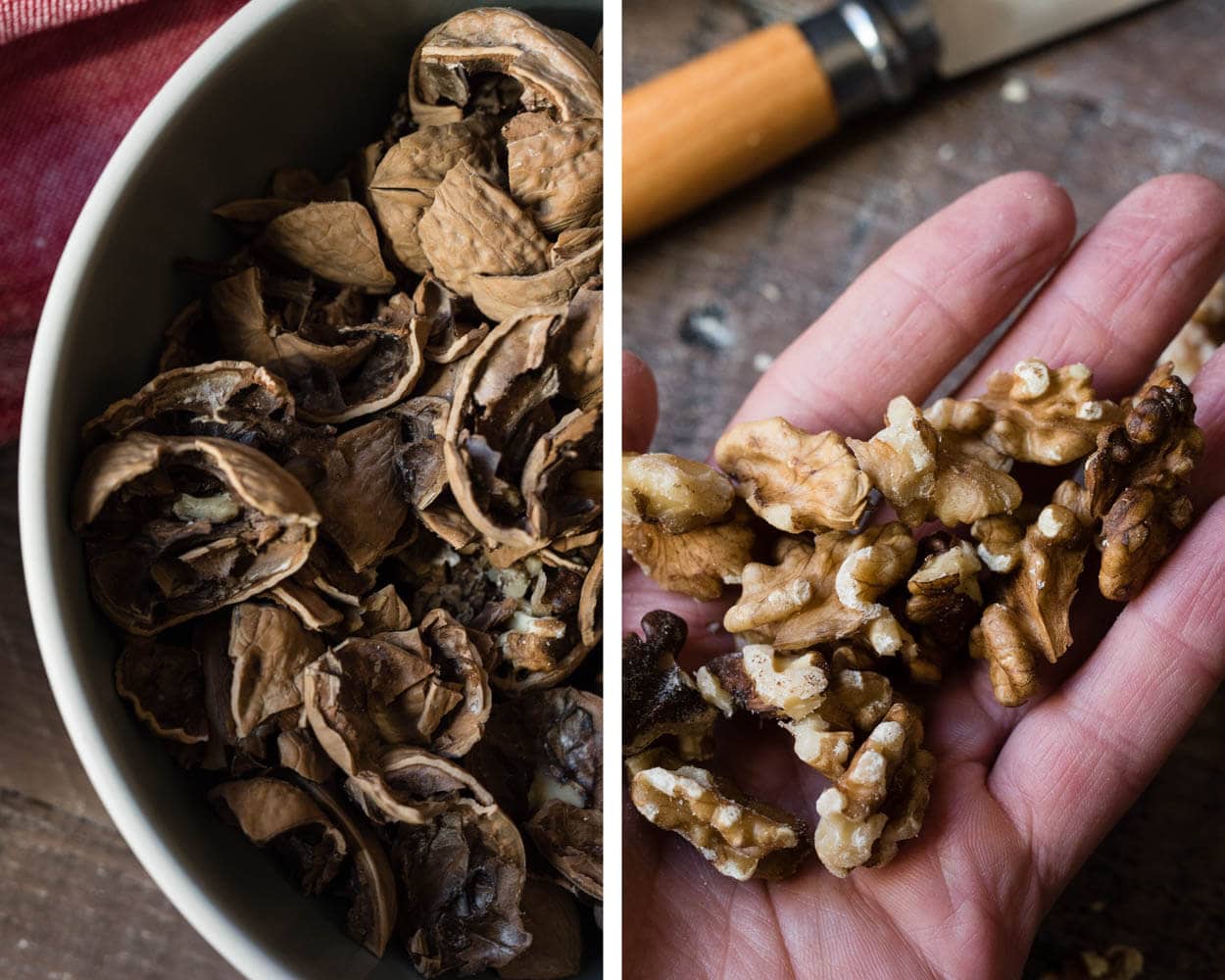
If you’re milling your wheat try to mill as finely as your mill will reasonably go. You can see in the picture below how fine I’m able to mill with my GrainMaker and that you can pick out small bran/germ flecks in the flour. As I mentioned above, I’ve tried this recipe a few times using bagged walnuts and also freshly shelled walnuts. I’d say the taste is very similar between the two. Fresh walnuts do have a slightly better taste to them and have far less “dust” (not sure what it is really, small walnut particles?), but shelling them takes quite a bit of effort. If you have access to walnuts in their shell, and a few spare minutes, by all means, give it a try.
Fresh Milled Whole Wheat Walnut Sourdough Formula
Vitals
| Total Dough Weight | 1,700 grams |
| Pre-fermented Flour | 5.00% |
| Hydration | 94.00% |
| Yield | 2 x 850g loaves |
If you want to halve this recipe, divide all the ingredients (including the levain) listed below by two.
Levain Build
| Weight | Ingredient | Baker’s Percentage |
|---|---|---|
| 25g | Mature liquid starter (100% hydration) | 50% |
| 25g | Fresh Milled Hard Red Spring Wheat | 50% |
| 25g | Central Milling Type 70 | 50% |
| 50g | Water | 100% |
I used half freshly milled whole wheat and half Central Milling Type 70 for the levain build, but you could use 100% whole wheat if you’d like. When using 100% fresh milled flour, I like to build my levain with a little aged white flour to bring stability and help tame fermentation just a bit.
Dough Formula
Note that the baker’s percentages listed below are with respect to the final dough ingredients and do not take into account the levain.
The target final dough temperature (FDT) is 79ºF.
| Weight | Ingredient | Baker’s Percentage |
|---|---|---|
| 830g | Fresh Milled Hard Red Spring Wheat (I used Great River Organic) | 100.00% |
| 9g | Diastatic Malt Powder | 1.03% |
| 758g | Water | 91.28% |
| 18g | Fine sea salt | 2.15% |
| 106g | Mature, liquid levain | 12.82% |
| 170g | Shelled & toasted walnuts | 20.51% |
| 21g | Roasted Walnut Oil (optional) | 2.56% |
Method
1. Levain – 10:00 a.m.
Build the liquid levain in the morning and store somewhere around 74-76°F (23-24°C) ambient.
2. Toast Walnuts – 10:30 a.m.
If using walnuts in their shell, you can toast them either in their shell or removed from their shell. I opted for the latter. Toast the walnuts early on, so they have ample time to cool before you mix them into your dough.
Toast at 350ºF (175°C) for about 10 minutes. They should start to give off a very nice smell and look slightly deep brown. Be careful near the end of the toasting time, as walnuts will quickly go from perfect to burned.
Keep an eye on these walnuts in the oven, if it looks like they are browning quickly, or you start to smell burning, take them out immediately.
3. “Autolyse” (with levain) – 2:30 p.m.
I used the word “autolyse” in quotes because this isn’t a true autolyse (which is just flour + water). Because I’m letting the dough rest for only 20 minutes, I decided to just add the levain along with mixing the flour and water.
Mix flour, water (reserve 50g water for the mix, later), malt, and required levain in a bowl until all dry bits are hydrated. Cover the bowl and store it somewhere warm—around 75°F (24°C)—for 20 minutes.
I’ve found I get much better performance from freshly milled flour if I cut my autolyse time down to 20-30 minutes (instead of my usual 90 minutes). Since the dough is so highly hydrated for this recipe and is already quite extensible (the ability for the dough to stretch out before tearing), I don’t see a need to do any longer.
4. Mix – 2:50 p.m.
We want to build a little bit of strength in this dough here at the start. I chose to do slap and fold (see here for my guide to the slap and fold method) for about 4 minutes, just until the dough starts to show signs of a smooth surface. If you aren’t comfortable with slap/fold method or don’t like it, you can do stretch and folds in the bowl until your dough tightens up and becomes tighter, and slightly hard to stretch out and fold over. Medium development.
When finished slapping & folding, sprinkle the salt on top of the dough and use the remaining water to help dissolve. Pinch through a few times and fold the dough over itself to help incorporate.
Transfer dough to a tub or thick-walled bowl for bulk fermentation.
5. Bulk Fermentation – 2:50 p.m. to 6:50 p.m.
At 74-76°F (23-24°C) ambient temperature, bulk fermentation should go for about 4 hours. Perform three sets of stretch and folds during the bulk (adding cooled walnuts and oil after the second set), spaced out by 30 minutes. Be very gentle with your stretch and folds (especially the last set). Lift just enough to fold the dough over itself, long before it feels like it would tear.
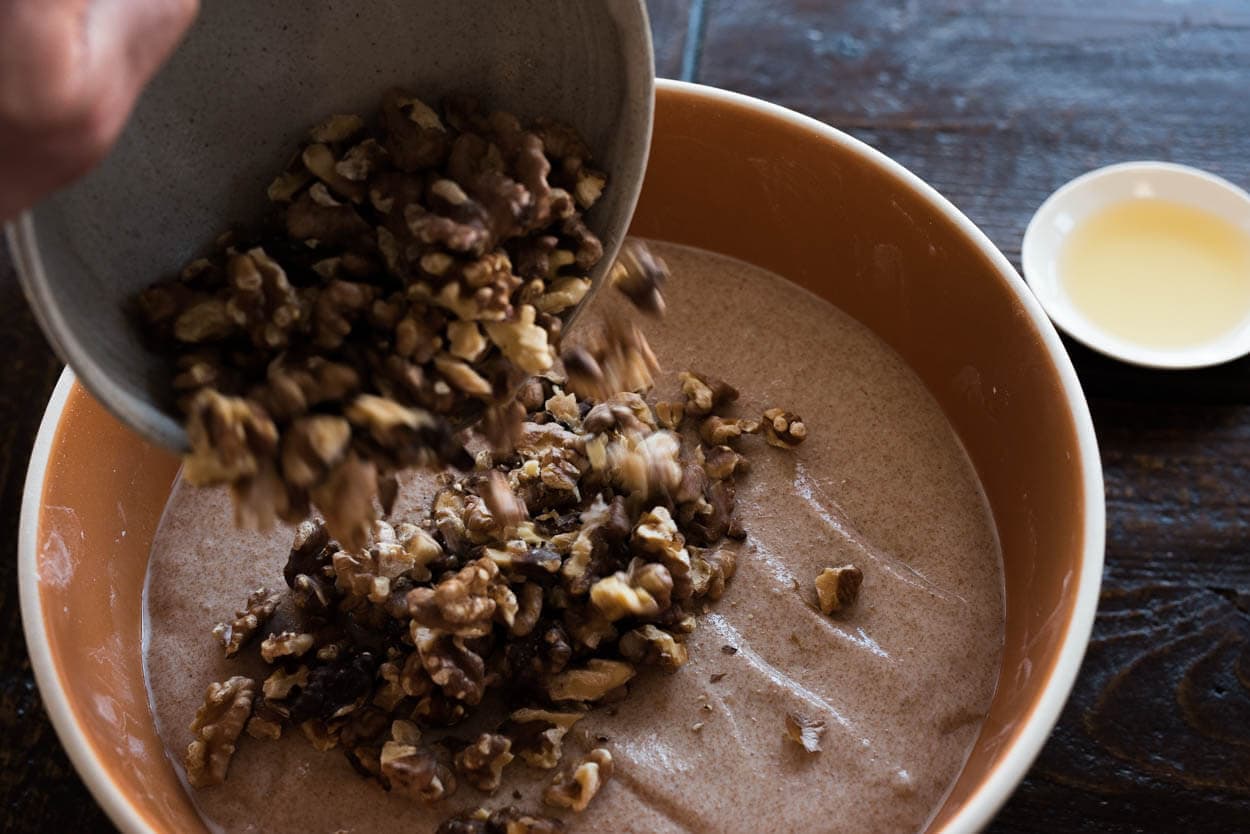
After the second set of stretch and folds sprinkle your toasted (and now cooled) walnuts over the dough, pour over the walnut oil if using, and wet your hands with a bit of extra water. Gently fold over the dough to incorporate the walnuts and oil several times until the walnuts feel mostly mixed through.
After the third set of stretch and folds, performed gently as the dough now has a bunch of walnuts within, let rest for the remainder of bulk. The dough will not rise an incredible amount, but it should be slightly jiggly and some bubbles on top and sides.
6. Divide & Preshape – 6:50 p.m.
Dump out the dough onto a lightly floured surface and divide the dough into two masses. Lightly shape each mass into a round, cover with an inverted bowl or moist towel, and let rest for 20 minutes. After, remove the towel or bowl and let the dough rest five more minutes exposed to air.
7. Shape – 7:05 p.m.
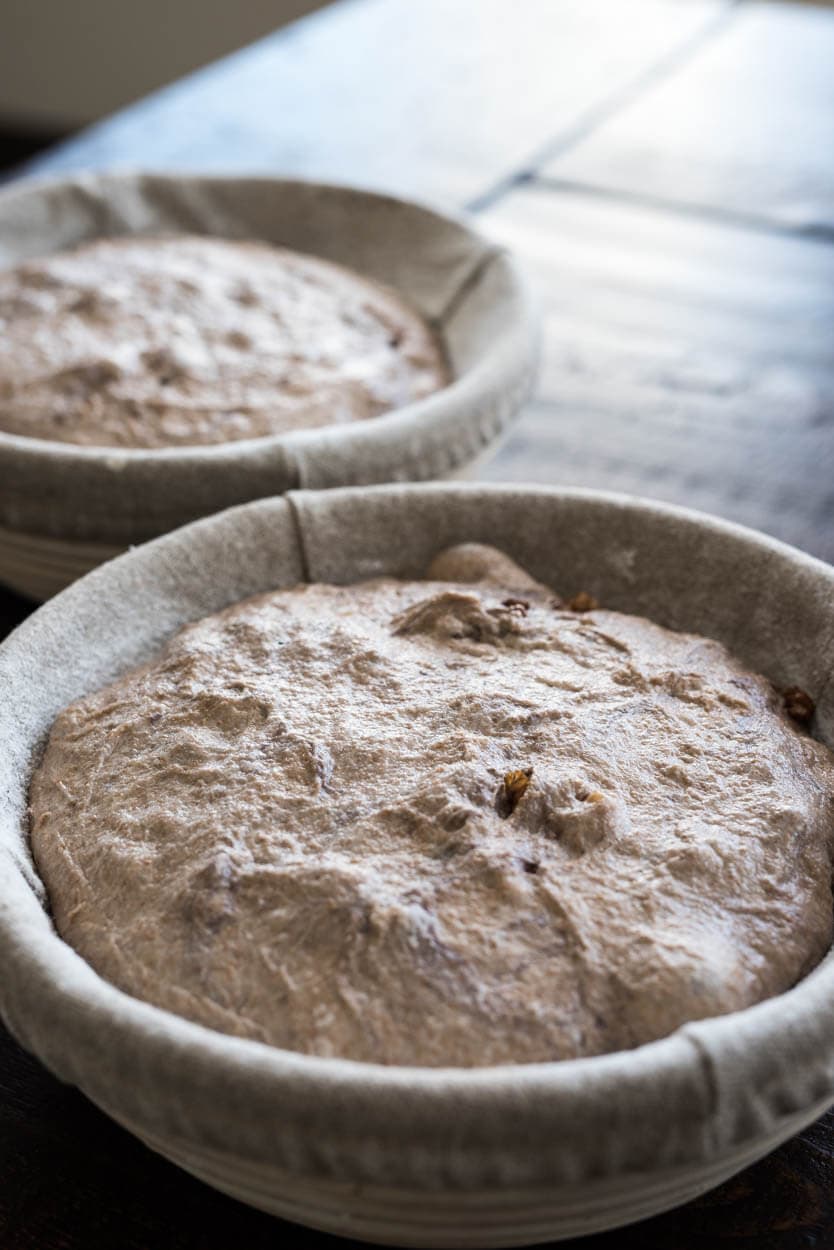
Lightly flour the top of your dough rounds and flour the work surface. Flip each round and shape into a boule. Try to get some proper tension on the top of each boule, but don’t over-handle the dough (easier said than done, I know). After shaping, let rest on the bench for a few minutes and then place it into a banneton that was very lightly dusted (see note below) with white rice flour, seam-side-up.
I prefer to use linen-lined bannetons for this extremely wet dough: it removes easier from the basket, and any liquid that escapes from the dough will go into the linen, which is far easier to clean. I mentioned very lightly dusting the linen with white rice flour—that’s important! If you over-dust the linen, it will become soggy and stick to the top of your bread most unpleasantly.
8. Rest & Proof – 7:30 p.m.
Cover your banneton with plastic and let the dough rest on the counter for 20 minutes. Then, retard in the refrigerator at 38°F (3°C) for 15 hours.
9. Bake – Next Morning: Preheat oven at 9:00 a.m., Bake at 10:30 a.m.
Preheat your oven to 450°F (230°C).
Score these loaves rather deep, with the blade at a 90° angle to the dough. I chose to make a “box” pattern that seems to work quite well but feel free to be creative.
Bake 20 minutes and then remove the steaming pans (or the lid of your Dutch oven). Then, bake for an additional 35 minutes. Go for a beautiful dark color on the crust. Remove from the oven and cool on a lifted, wire rack (here’s why it’s best to let your freshly baked bread rest before cutting).
Let these boules rest for 4 hours or more (preferably overnight!) before cutting into them. The flavor of this bread improves, even more, a few days after baking.
I steamed my oven in my usual way, described here in my post on how to steam your home oven for baking, but you could also bake these boules in a Lodge Combo Cooker to create steam.
Conclusion
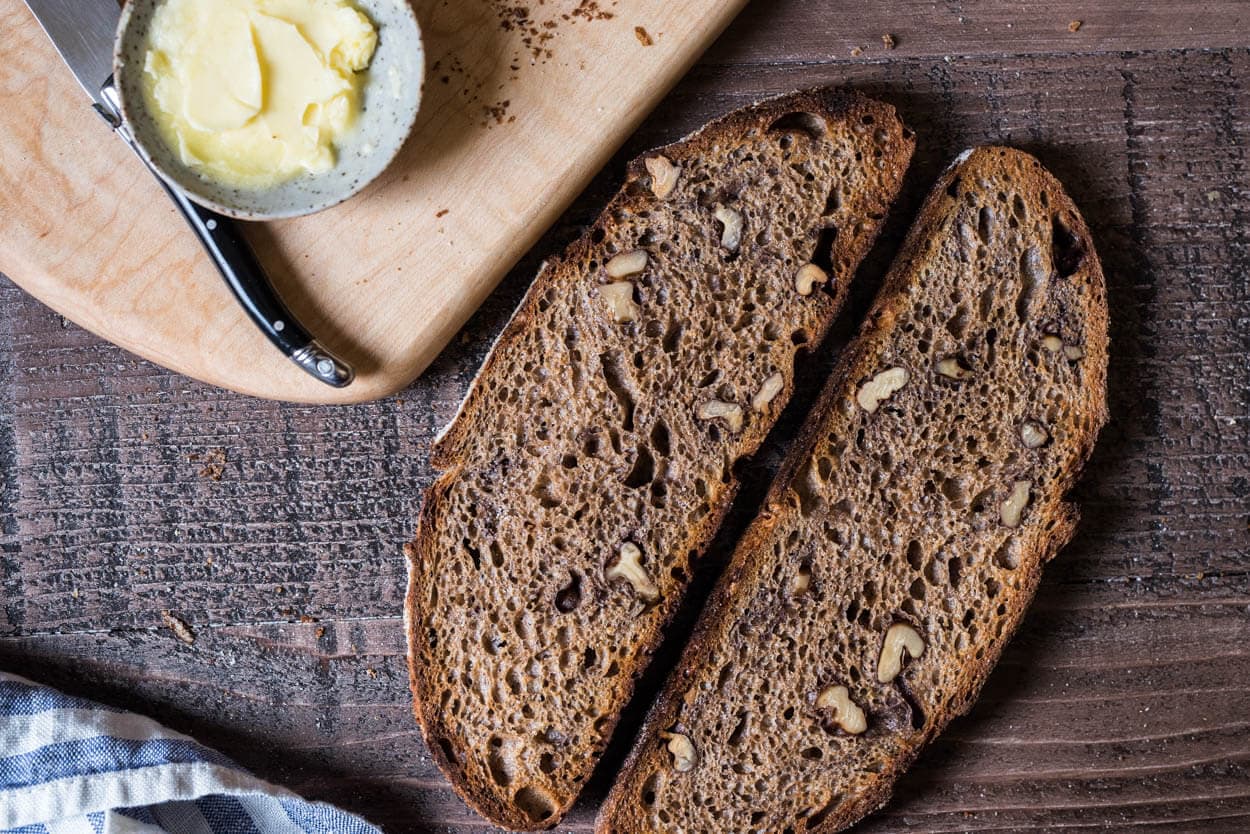
While the cost of walnuts can make one hesitant to make this bread it is worth it, trust me. The rich flavor of the toasted walnuts and roasted walnut oil makes this bread a luxurious shift from weeks of white bread. Bread that can break any rut, make you buy more cultured butter at the store than you thought possible, and have you lusting after just one more slice for lunch. Shoot, this is lunch.
Crust
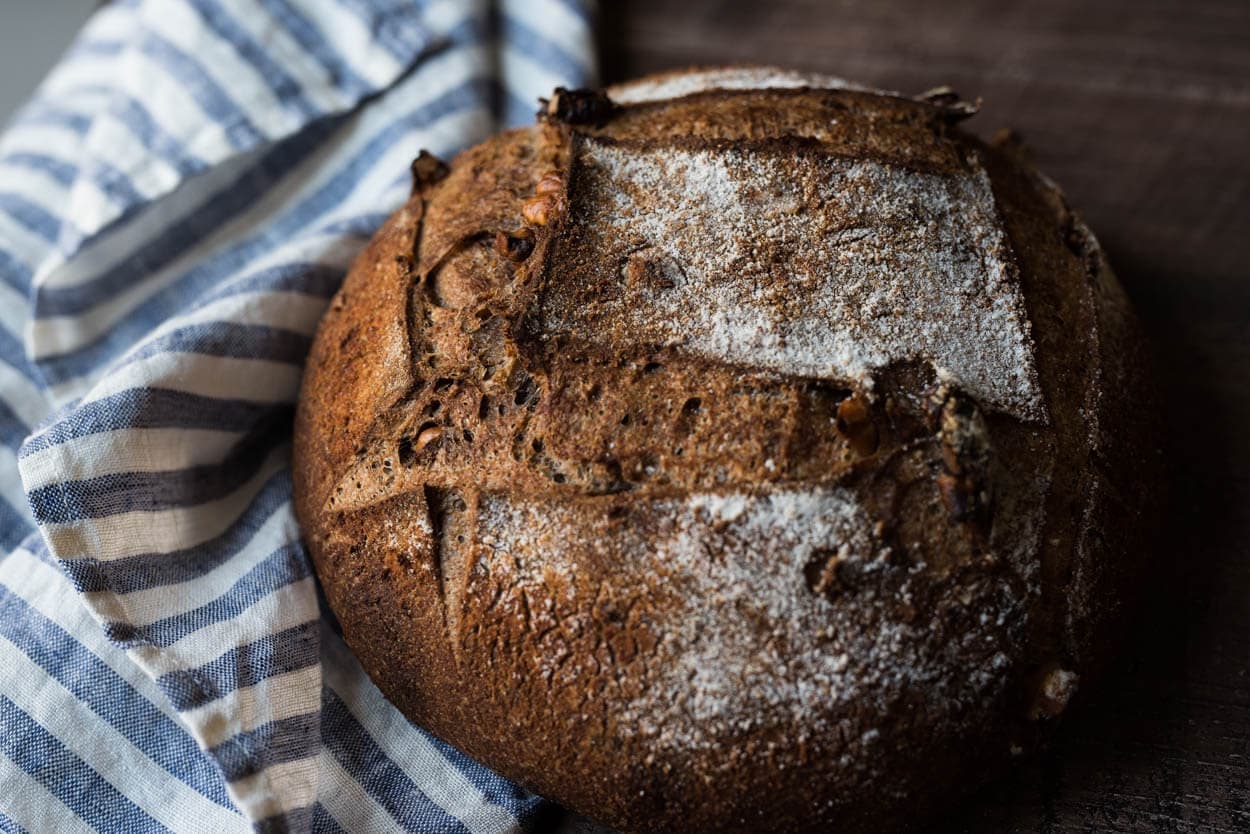
A crackly, crunchy delight. The thin crust reminds me of a cracker just broken at the first bite. When slicing this bread, I find myself moving the knife just a bit more to the side to make sure that one peeking walnut makes it into my slice. Again, an animal.
Crumb
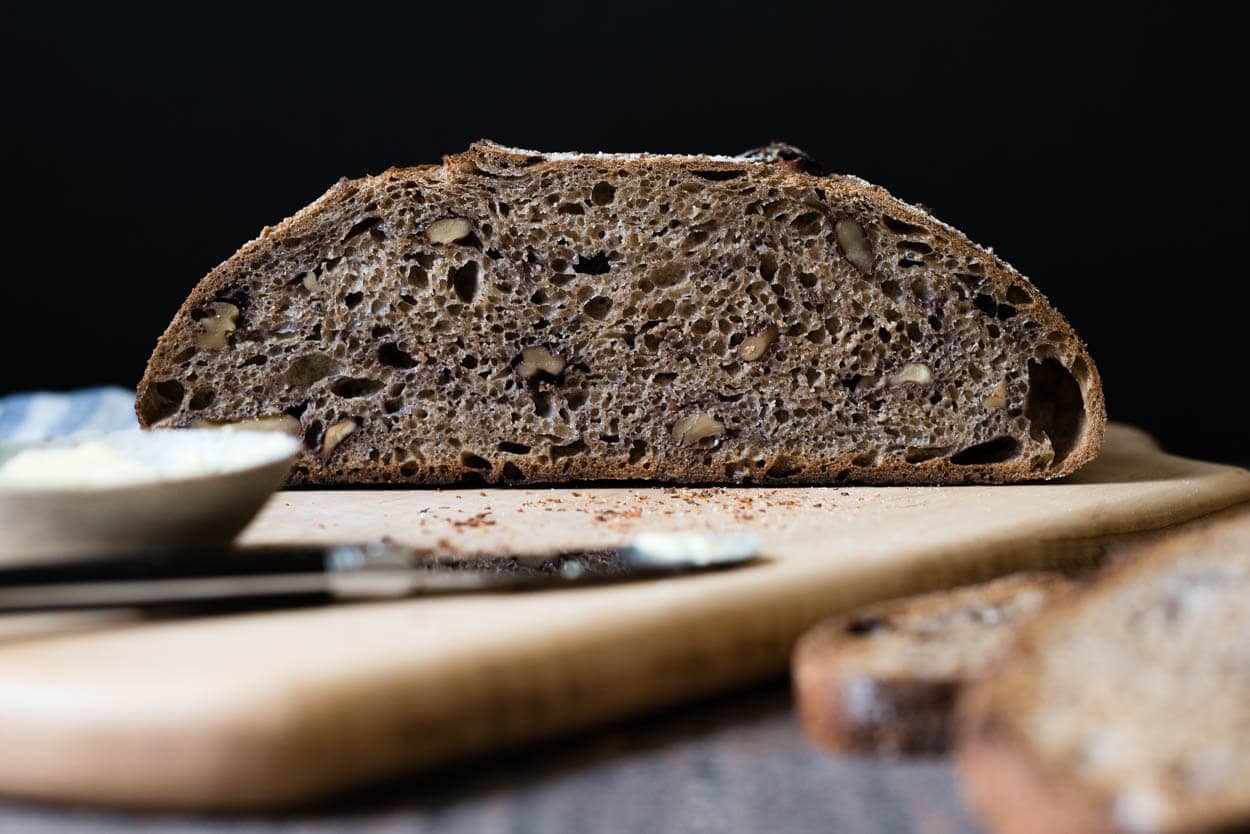
Fabulous for 100% whole grain. The fresh flour and the walnut oil gives this bread a sheen broken only by the purple striations from the tannins in the walnuts. Bread that is light in hand and might make you think there “has to be some white flour in here.”
Taste
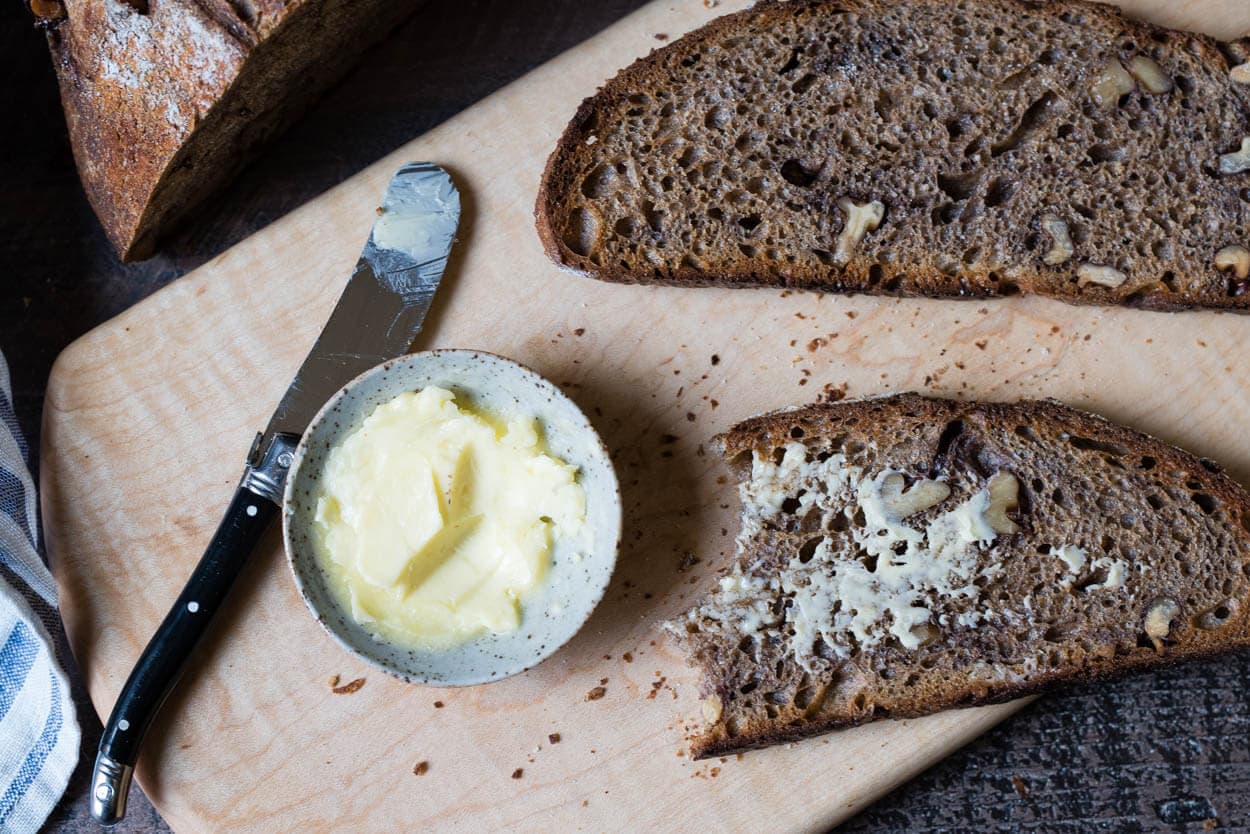
The freshly milled flour, at one-hundred-percent, brings so much flavor it’s good on its own. Add the walnuts, though, and you have a winner. I love this bread, plain and simple. I enjoyed it heavily toasted with cultured butter — that’s all you need. Healthy, hearty and deeply satisfying meal on its own. Adding 20% walnuts is perfect for this bread: just about every bite has some walnut. However, you can increase this to your liking. Additionally, feel free to increase the walnut oil or leave it out entirely.
Future Modifications
I decided to throw in this section at the end to describe some changes I might attempt for this fresh milled whole wheat walnut sourdough in the future — some things for the avid reader to consider.
Up the hydration
I’d like to try increasing the hydration even more, to perhaps 100%. The walnuts suck up water from the dough, and I think this formula might benefit from about 2-5% more water.
Buon appetito!
If you use this recipe, tag @maurizio on Instagram so I can take a look!


66 Comments
Have you soaked nuts and seeds you include in the dough to avoid them sucking up excess water from the bread itself?
Hi Maurizo, I would like to make the 100% ww and walnut bread. What do you mean by “aged ww flour” ? As a new baker, I’s prefer to use flour readily available. Many thanks, Carol
PS how do I know if you have commented to this question? (I am a new TPL member!)
By aged I just mean flour that was not milled by me!
Hi Maurizio,
Let me add my thanks for providing this recipe. I have made it twice now, and it keeps getting better and better. Your technique for handling whole wheat is really interesting and I didn’t expect to get the oven spring or the open crumb with 100% fresh milled whole wheat.
The first time I followed the formula exactly, using hard red spring wheat (I had some in the pantry). The next time I didn’t have enough HRSW berries so I used a combination (roughly a third each) of HRSW, HRWW and Turkey red. The dough is really a pleasure to handle, and the flavor is truly lovely.
My question is, why did you choose HRSW for this bake? Have you tried it with other hard wheat types?
Thanks,
-Brad
Hi! Thank you for this lovely recipe. I’m wondering how to interpret the baking instructions… how should I bake this if I am using a combo cooker? Thank you so much.
If using a combo cooker, follow my steps here: https://slimlife.fit/how-to-bake-bread-in-a-dutch-oven/%3C/a%3E%3C/p%3E
HI Maurizio.
For this recipe I have milled ecological wheat grain from local Norwegian farmer on KoMo Classic with close to fine settings. But the dough did not form any gluten strings at all and looked more like rye dough. I had to make the bread in forms instead which turned out great however.
I’ve just bought the mill, so this my first experience with the fresh-milled flour and this particular grain.
So I’m curious if low strength of dough can be due to the quality of the grain or some other reason. Could the grain have been overheated during milling as it was close to 40deg C when finishing the process? What do you think?
Andrey
Andrey, that’s really great to hear, sounds like you have a source for some awesome, local flour! The heat produced from the KoMo is not likely an issue, those temps are pretty common when using small electric mills.
I would contact the farmer and ask if they have any specs on the flour. I don’t want to say it’s the flour for sure, but that’s the first place I would look. The reason I say that is because I’ve milled so many times with the KoMo with a wide variety of grains and haven’t seen issues like you’re describing. Perhaps the farmer has done tests on the grain: falling number, protein, etc.. If they have, then those numbers will tell you a lot about how the grain will perform in a baking situation (of course the real tests comes down to actually using it for baking), but it might also tell you whether they intend for their grain to be used for bread. Some farmers grow wheat for other applications, such as pastry or other household baked goods.
Just some ideas, I hope this helps!
Hi Maurizio, thank you for all the great recipes. I am somewhat new to baking bread — been doing it a couple of months now — and bought a big bag of Central Milling Organic Type 85 flour. I just realized that there are not a lot of recipes on your site that call for this type of flour. I am not as familiar with hydration levels so I’m wondering what types of recipes I can substitute it in? Would this be a good one instead of the Fresh Milled Hard Red Spring Wheat?
The addition of a double handful of chopped dried figs at the same time as the walnuts took this from darn good to indescribably decadent. Just sayin’… 🙂
Yea, that’s a good idea I have to say. I love figs in bread! Will have to give that one a shot 🙂
Hi! If I left the walnuts out, considering that you noted that this formula may benefit from 100%hydration, would you alter the water amount?
Also, have you made any all fresh milled loaves with bran sifted out and noticed a more open crumb? Thanks! Enjoy your baking adventures!
Yes, I’d most likely reduce the amount of water if the walnuts were omitted. They, surprisingly, do absorb some of the water in the dough!
If you sift out the larger bran/germ particles from the flour you’ll definitely see a more open crumb (assuming everything else is in place to support this). This is usually seen in more white loaves versus whole wheat ones.
Hope that helps and happy baking!
Thank you, yes, that helps. I am baking in loaf pans and hoping to push the hydration a bit since the loaf pan supports. Thanks again!
Hi Maurizio — I haven’t tried to make this bread exactly, but I’ve added walnuts to my 100% whole wheat loaves before (and I mill my own flour). Why do you recommend adding malt here? And how do you determine how much levain to add? I noticed the WW loaf had 17.5% and this one is lower even thought the levain build here has more water.
Thanks a million
I like to add a little malt to my flour mix when using mostly fresh milled flour to help with long fermentation times, especially for doughs like this that are fermented for extended periods (overnight retard). Additionally, it helps add color to the crust. Malt is not mandatory, but I’ve found I like the performance of my dough when I do add it in.
The percentage of levain is usually first a gut instinct I have based on the type and percentage of flour, the flavor I’m after and I also take into account how long I want the dough to ferment. When using fresh milled flour I tend to drop the levain percentage quite a bit as fresh flour has higher fermentation rates (in general) than aged flour — I drop the levain to help slow the entire process down.
Hope that helps!
Hi Maurizio — I’m a bit confused. Do you add malt to increase fermentation activity? And drop levain to decrease fermentation activity?
I tend to have the same 2 issues when I make WW sourdough — would you have any tips?
1) The poke test never changes. No matter when I poke my dough, it always stays indented, and maybe raises a little bit over time, but as far as I can tell it doesn’t spring back. Ever.
2) After mixing in walnuts (or whole wheat bran that has been removed and soaked per your 100% WW recipe), the dough tends to rip during the stretch & fold. Ripping may not convoke the right image… it’s more like many small holes form in the stretched area so that after the dough is folded, the surface is hole-y.
Malt can increase fermentation activity overall but what it does mostly is “unlock” the sugars in flour so fermentation (specifically yeast) can take more advantage of them as they become more readily available. Sugars help provide color to the crust and allow the dough to ferment for extended periods, like we do here. The drop in levain is to slow fermentation activity, it will take longer for the dough to become fully fermented with a smaller starting inoculation.
1) That’s interesting. Are you shaping the dough tight enough? I use the poke test for ww, specifically 100% ww, when I do a cold bulk fermentation and the dough is proofed at room temperature until baked. I usually wet my finger, then gently poke 5 or so times around the dough to gauge it’s readiness.
2) Yes, adding in ingredients will cause the dough to kind of tear and become “stringy” in places — this happens to me as well. In these cases I usually just try to be as gentle as possible while still ensuring everything is as evenly distributed as possible. Totally normal!
Maurizio, Love your site! I am new at this but how come you don’t let your loaf rise after the refrigeration period? my dough barely rises in the refrigerator and feel I have to let it sit for a couple hours after I take it out and before I bake.
Diana, thank you! You can definitely let it rise after the fridge period. I find that my dough usually doesn’t need any extra “floor time” as it’s developed enough when I put it into the fridge. Each environment and each dough is different, though, so adjust as necessary.
Happy baking!
Thank you Maurizio!, I have been preparing this walnut w/w bread dough today for a bake in the morning. .can’t wait! So thankful for your beautiful, informative site! my family thanks you too.
You’re very welcome, thanks and glad to have you along!! Happy baking 🙂
What a yummy bread…especially toasted! I found your site by accident when looking for ideas to do with extra wild yeast, which I am loathe to part with since I have named it (it was suggested when I started it that, since it is a live organism, one might do so). I don’t have most of the equipment you have and only have one enameled cast iron pot since we’re downsizing in preparation to move. So, one of my loaves was made in a standard loaf pan. It burned pretty badly on the top, but is beautiful inside. I haven’t cut the one done in the pot yet. There’s a definite sponginess to it that might be a sign of slight gumminess, but is fine when toasted. I didn’t want to burn it further, so shortened the bake time by a few minutes.
Have you ever thought of doing English Muffins? I tried to adapt another recipe using my wild yeast, but they didn’t turn out too good. Maybe a longer ferment would do the trick. I’ve been milling my own grain for 15 plus years and only in the last 5 have tried the wild yeast. Only the past 5 months without any other yeast added. Mostly i’ve just used my favorite recipes from Laurel’s Kitchen Bread Book and adapted them very unscientifically to adjust hydration and the amount of flour. But, I am now in love with your site and all the recipes on here! I might try some of your techniques to do some of the recipes in that book, but am also going to try more of your recipes as your pictures are absolutely beautiful and give me courage that I can achieve the same results here at home. I’ll be feeding my yeast on Thursday-Friday this week and I’ve already planned to make waffles (which my daughter loves) with the extra. I’ll let you know when I next try another recipe…maybe before I start because I have many questions about the flours you have listed. I’ve always just milled or use King Arthur White Whole Wheat in a pinch. Happy New Year! Happy Baking and Buon Appetito!
I cut the second loaf last night to have with the soup that inspired me to make this bread…or was it the other way around? It was even more flavorful than the first loaf and doesn’t appear to have any sponginess to it. (I cut the first one around 4 hours after it was taken out of the oven.) Full-on walnut mixed with the sweetness of the wheat loveliness.
Fantastic! Perhaps they needed a bit more time to rest. I’d still try out lengthening the bake time at a lower temp to see if that helps as well. By the way, I find my inspiration for cooking does indeed revolve around what bread I have planned to bake that week 🙂
I considered lowering the temp to start with but didn’t follow my gut. Thanks Maurizio! I did bake over the weekend a sandwich loaf style from LK Bread Book…Golden Date Bread…and did an autolyse as well as a 4 hour bulk fermentation, then let the loaves rise slowly in the fridge overnight. I even baked them with steam for the first 20 minutes. I haven’t yet tried the slap and fold technique. I have used a DLX machine for all these years of bread baking to save my hands (which I use for my main job as a Sign Language Interpreter) that does a nice job. I believe I’ll be trying one of your spelt bread recipes next since I also made your banana bread recipe with the leftover wild yeast taken from the feedings of Essie for the date bread. I milled too much spelt and have quite a bit leftover. I’ll let you know how it goes. I might have to order those baneton’s from Amazon first tho.
Happy baking and cooking to you!
Sounds like you’ve been up to a lot of baking, that’s awesome! Nothing wrong with using a mixer at all, whatever gets the dough into the shape we need is fine with me.
My spelt breads are some of my favorites, I love that grain and the flavor/texture is incredible. Your thinking is the way to go: plan a few things over the course of the week that use the same grain, this way you can do a single milling session but have plenty of products from it.
Have fun!
Really glad to hear it turned out well (toasted)! There can be some gumminess to this bread if it’s not baked out fully, you could try reducing the temperature of your oven next time so it can bake longer but not burn. Each oven and environment is different so it may take a bit of tweaking to find that sweet spot for you.
I have thought about doing English muffins and will definitely get there — I even have the tins and am ready for it! I’ll get there sometime soon I hope, I love that type of muffin with a good slather of butter.
King Arthur Whole Wheat is great flour to use and it’s readily available. I do have some other flours listed on my Tools Page you could try out but they do require a shipping charge (most likely).
I do hope you give some more of my recipes a shot, let me know how they work out! Happy New Year and happy baking!
I’ve been allways suprised by the amount of hidratation used in baking with USA wheat (or canadian, i suppose). From my experience (spainish local wheat) I’d never ever imagine an 90%, in my wholemeal home milled wheat I’m arround 67% (maybe more with korasan).
I think -never used non european wheat- that the amount of gluten -higher- hold that extra water.
On the other hand I have an electric mill with two circular stones and the flour source at 95F-100F , I thinking in cold down in fridge the amount of berries ahead. Regarding the smell of fresh flour is like wet grass something really amazing.
Anyway great post.
Hey, there! Totally missed this comment, sorry about that! Yes hydration can really be pushed with most of the USA wheat I use, it’s just able to hold up to the high water content. It’s all relative though, if your wheat requires less water to get to the same point of “wetness” than that works just as well. Each baker’s environment also plays into it quite a bit — it’s very dry here, I basically live in a desert.
Yes, you can definitely chill those wheat berries in the fridge or freezer before milling to help reduce the end temperature after milling.
I actually just finished milling some hard white wheat and yes, the smell is divine!
Thanks again for the comments and sorry for the late reply!
Hello Mauriziu. Could I sub the malt powder with malt liquid? And the walnut oil with some olive oil? Thanks!
I don’t have any experience with malt liquid but I would assume that, yes, you could use that instead — it should have the same effect on the dough. You can leave out the walnut oil entirely if you’d like. I think olive oil would probably be fine, but I’m not sure the taste would be quite right… It’s worth an experiment!
Something wrong happened… probably in the levain. My dough was too wet. I could not shape it. The dough did not ferment properly. The result was a heavy bread with only a few big holes under the crust. But the flavor was great. Surprisingly sweet!
Any tips for my next attempt?
It sounds like you’re right, there might have been too much water for your flour to handle. The dough should be very wet, but not “soupy”. Reduce hydration next time, try 5-10% and see how it turns out. If you see the top crust in your bread separate from the bottom it could be a sign of overproofing as well. Keep an eye on your dough and make sure it doesn’t ferment too far — this can happen rather unexpectedly with so much whole wheat! It’s a good sign the taste is sweet, that’s good flour you’re using!
Thank you for your answer. I can’t remeber and I didn’t write down but I think my bulk fermentation was about one more hour than it should, now that you mentioned overproofing… Next time I’ll follow the recipe straight, no deviations, because I really want to get a nice bread like yours in the photo. Now that I tasted it (even it was heavy, dense bread), I want to achieve the right (hole-y, soft) crumb too!
It real was a surprise that sweet flavor, organic flour really makes the difference!! Thank you once again.
Ana
You’re very welcome. So yes, definitely sounds like you over-proofed. Good luck and enjoy your sourdough!
Hi Maurizio!
A new bread was baked. This time, this dough had too differences in the preparation. I finally could get fine flour with my wheat berries! And I also reduced the final hydration (maybe I shouldn’t ou at least (I think) I dind’t need it). The result? It worked, definitely! The crumb only has small holes but it looks pretty good. It looks like “well done”, not “underbaked”. And it feels a really light bread, not dense, after baking.
Now that I know that I can get fine whole flour, I will try to follow your recipe as it is. Maybe with nuts (I’m getting closer to “the perfect loaf” so now it’s time to have all I deserve) and then the spelt bread!!
We’ll talk again after the next baking!
Until then, just curious about your beautiful next post…
Fantastic!! That sounds great, this is definitely one of my favorite breads to make, and when I have fresh walnuts I make it! I love that spelt recipe as well, I’m slowly building up a list of loaves I just cannot live without…
Next post is in the works — a tinned whole wheat loaf (as I’ve posted on Instagram) 🙂 Soon! Till then, happy baking 🙂
Finally success!! This time I got a beautiful bread with some big holes and walnuts!! You are right, the walnuts give a nice taste to this bread. Now I understand what you said about it 😉
Yet, I think if I warm up a little bit more my dough, I will get a better bread. Maybe near a window with the sun light… or near the oven while roasting something 🙂
Waiting the news!
Ana
PS: this bread already have 2 fans at work!!
EXCELLENT! Super happy to hear that. You’re making me want to make this again soon… I might have to 🙂
Let me correct, 3 fans now! Including me makes four of us!! Last week I already bought 1kg of wheat berries instead of 500g as usual. Can’t wait to bake this one again!! 🙂
Grist & Toll sold to you?? I asked awhile back and they said absolutely not! How’d you get your hands on it..
Got it, I’ll have to ask her what’s available. Wait, does she have an online store for whole berries? I know the flour shop.
Thanks for the heads-up, just picked up some charcoal wheat flour 🙂
I actually added 5lbs of that to the same order! Now I’m really happy I did since I’ve been experimenting with pizza dough pretty heavily (post coming sometime soon!). Thanks for the info, Cynthia. And yes, my pantry is getting a bit out of hand at this point. Must… stop…
Haha, I’m forcing myself to stop. I have around 15 pounds of red fife from Camas, 6 pounds of Sonora wheat from Hayden, a pound of einkorn from Anson Mills, and 5 pounds of rye. Have to get through all this before another purchase, I must.
I’m so addicted to walnuts, Cynthia, it’s a bad, bad thing. Or is it?! That’s really cool you can snag some walnuts from the farmer’s market, I looked here and we didn’t have any. Actually I looked a few markets and stores, had to order online. Off to check out Triple IV…
Let me know how it turns out, I think you’ll love it!
Thanks, Sally! Sorry, I just had to do it 🙂 Can’t wait to read your walnut/cran post!
Yeah I think I need help… walnuts should be a controlled substance 😉
Wonderful post and great results! I just left a comment (although I think WordPress may have accidentally submitted it twice! Feel free to reject the second one :)).
Sounds like a winner to me!
Can you talk about how you mix in the nuts after the second S/F? Why do you not do it as you mix in the salt after autolyse? Does pinching in the ingredients ruin the development you get during the first two stretch and folds?
Absolutely. You want to mix in the walnuts after your dough has developed a little strength so as not to compromise the gluten structure too much. Typically nuts, seeds, etc. will be added in midway through bulk once you’ve strengthened the dough just a bit.
I perform the second set of stretch and folds, pour the nuts and oil on top of the dough and sprinkle a bit with water. Then gently fold the nuts in the dough by stretching the dough up and over the nuts, squeezing a bit with my fingers pushing them through. Do this for a few minutes gently, don’t tear the dough or forcefully squeeze too much. Remember, you’ll still have one more set of stretch and folds to help incorporate them further.
I hope that helps!
I never tried a recipe made only with whole wheat… This one looks nice to start! I just need the wheat berries to grind… and a schedule to fit my day (or wait until the weekend…). If I leave the walnuts out just to try the “basis” dough, I need 15h of proofing?
You should definitely give it a try, the taste is excellent. Yes, to get maximal flavor you should still do a long, cold proof overnight. If you want to fit this into a single day of baking you could proof your bread on the counter for a number of hours (perhaps around 4, depending on the temperature in your kitchen). It won’t taste exactly the same, but you’ll still get excellent bread!
Thank you Maurizio. If the rain continues around here, this weekend I’ll bake this bread for sure…
Second atempt. Almost perfect! A better result this time… instead of using walnuts I added some dried tomatos in olive oil. It came out delicious! Next time I need to grind my grains until very fine flour. The crumb seems more dense than your bread… beside that the dough was very nice to work with, and it turned out with little holes. And the taste… twice better! It really worth every try until perfection.
Sounds fantastic! I think this bread does get better with practice, it’s challenging at times but worth it. I like your use of tomatoes and OO! Great idea.
Enjoy and thanks for the feedback!
Hello again. Another try, anothet problem yet to solve… I’m having trouble with shaping. The only way I can work the dough is my hands wet… I even did the slap and fold, but when the “slightly flour” part came, my trouble began. So I quit and I did the shaping with my hands wet. The dough tears, of course…
You can definitely preshape/shape with wet hands instead of using flour, in fact some bakers actually prefer this method so they don’t get excessive “raw” flour in their end bread. Shaping takes time and practice, that’s for sure! You have to have a gentle yet assertive hand — I know it’s easier said than done 🙂 If you use water instead of flour, you can use a little water on your counter to help the dough slide just a bit, but you don’t want too much or the dough wont stick a little and create tension.
Hello Maurizio. Another question. I need to bake again during the week. So, my question is, can I leave the levain while I go to work? On the bench or in the fridge? Will the bread taste much more sour?
Thank you!
Where can I get a banneton and linen like yours?
I purchased these bannetons and linen liners from The San Francisco Baking Institute’s website. They are really great quality.
Nice! I just received the wicker baskets from SFBI. H’m… Was wondering how do I clean the liner? Because it’s sewn into the basket… Thanks!
The ones I purchased actually are removable from the basket, but I never remove them. I just wipe them a little bit after each use and when there’s a serious buildup of flour I scrape or brush it out. If there’s anything else on the liner (like fruit stains, etc.) I will wipe them clean with wet towels and let them thoroughly dry in the sunlight.
And yet another beauty! I have the ingredients at hand and will give this a try with increased hydration. Thanks for another great read and keep the fresh milled formulas rolling!
Thank you! You’re very welcome, glad you’re going to try this one out — it’s seriously good.