


This may seem like a mundane post to some, but it’s one of the most common questions I receive: what is the best way to store bread after baking it? And really, it makes sense: we spend considerable time fussing about with our sourdough starter, preparing a levain, mixing dough, and tending to it for hours—and finally, all our work culminates in the oven. But after baking (and eating), there’s still the task of storing the bread, to try and keep it as fresh as possible for as long as possible.
One of the beautiful things about sourdough bread is it will last longer before staling and molding than commercially yeasted bread.
The acidification of the dough by lactic acid bacteria in our sourdough starter and other physical-chemical changes during the breadmaking process help protect against premature bread firming and drying. These acids also help prevent molding, and in my experience (and also that of the WSU Bread Lab), they usually keep a loaf perfectly edible for a week or more—all without any chemical preservatives.
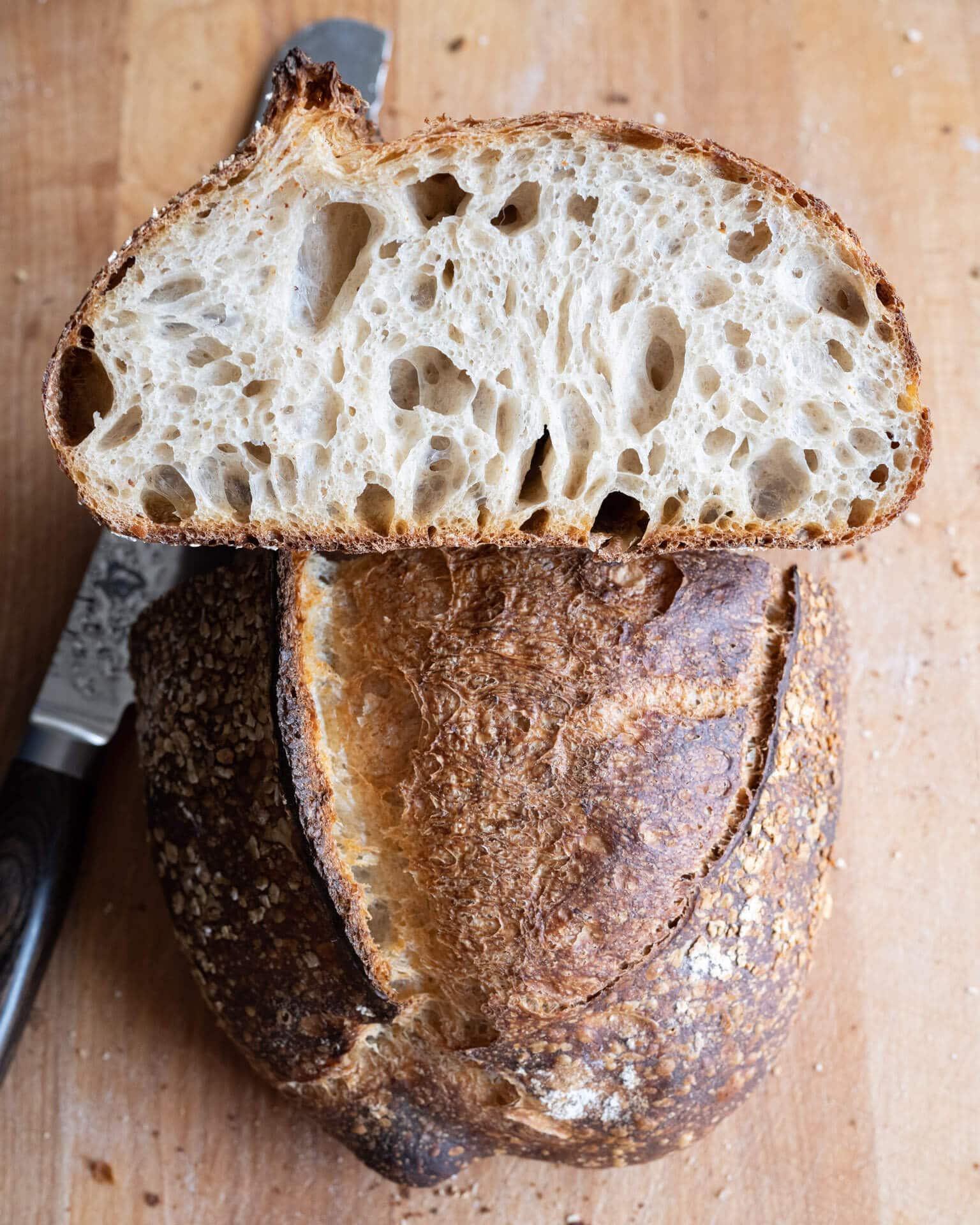
The science: from baking to staling
Before we get into solutions for the best way to store bread, we should first briefly talk about stale bread: no one’s favorite, unless we’re making French toast, ribollita, bruschetta, or bread crumbs and croutons, of course. But what happens behind the scenes when the dough is baked, left to cool, and on its way to staleness?
As bread dough is baking, the starch granules (which wheat flour primarily consists of) gelatinize. When they gelatinize, they swell from the moisture in the dough, and their rigid, crystalline structure transforms into a non-crystalline (amorphous) form (very similar to when you make a tangzhong or yudane). When the baked loaf is removed from the oven, it cools. From this point on, the crust and crumb begin to harden over time as starch—and most significantly, amylopectin(J.A. Gray and J.N. Bemiller 2003, Bread Staling: Molecular Basis and Control, p. 3) undergo retrogradation, a re-ordering into a crystalline form.
This retrogradation means a hardening of the crumb as moisture moves out from the starches, eventually taking a loaf of bread from soft and pliable to excessively hard and what we identify as stale. Other processes begin to take effect with the crust as well, as it begins drawing moisture out from the crumb into itself, making the crust rugged and leathery.
In general, staling can be reversed somewhat by reheating the bread to a sufficient temperature (140°F / 60°C), but it can’t completely reverse the effects of staling, and the results from heating will only last a short time. You can see this directly in your kitchen: reheat a slice of stale bread in the oven or toaster, and you’ll think you almost have a slice of fresh-baked bread on your plate—for a few minutes at least.
It’s also worth knowing that doughs containing some percentage of fats (lipids) will typically last longer before staling. The fat present in the dough slows the re-crystallization of the starch granules and reduces the movement of moisture between starches and proteins (de-gelatinization), which causes the crumb to harden.
Staling vs. drying
Note that staling and drying are distinctly different processes at work. Staling can result in a firm, hard loaf of bread but is not necessarily due to the evaporation or loss of water from the crumb and crust; it’s more about the retrogradation process described above. However, drying can also occur and can especially be a problem in arid climates (like where I live in New Mexico).
To avoid excessive drying, it’s important to ensure bread is stored properly (cut-side-down, using a breadbox, etc.—more on this soon, I promise) so it doesn’t prematurely dry to a bone.
Ok, enough science. So how do we put this into practice?

The practice: keep bread fresh longer
The following steps are loosely how I take a loaf of my baked bread from the oven to cooling, cutting, and long-term storage.
But first, are you using the best bread knife for sourdough bread? If you don’t have a good knife, you’ll squash your loaf instead of cutting it cleanly. If you have a sharp, hefty knife, read on!
After baking sourdough bread, wait to slice until it’s cooled
Slicing a warm loaf of bread too early will result in a gummy and sticky interior.
First and foremost, it’s always best to let fresh bread rest until it’s cool and fully set before slicing. I know, fresh-from-the-oven is hard to resist, but your bread will not only taste better it will keep longer if you wait to cut it for at least an hour—I prefer two or more.
The reason goes back to the science behind all this: starch retrogradation is happening right as the loaf is pulled from the oven, but it hasn’t progressed far enough to firm up and set the interior appropriately. Slicing a warm loaf of bread too early will result in a gummy and sticky interior.
Further, recipes containing a high percentage of whole grains, especially a 100% whole grain loaf (typically highly hydrated), or loaves that are larger (like my 1.5 kg miche), benefit from an even longer rest. In fact, I find their flavor improves 2-3 days after baking with these types of bread.
With rye bread, especially when rye is in a high percentage, it’s common to let the bread rest, wrapped in baker’s linen or a towel, for one or two days before cutting.
After the baked loaf is cooled and fully set, it’s time to cut.
Store bread cut-side down
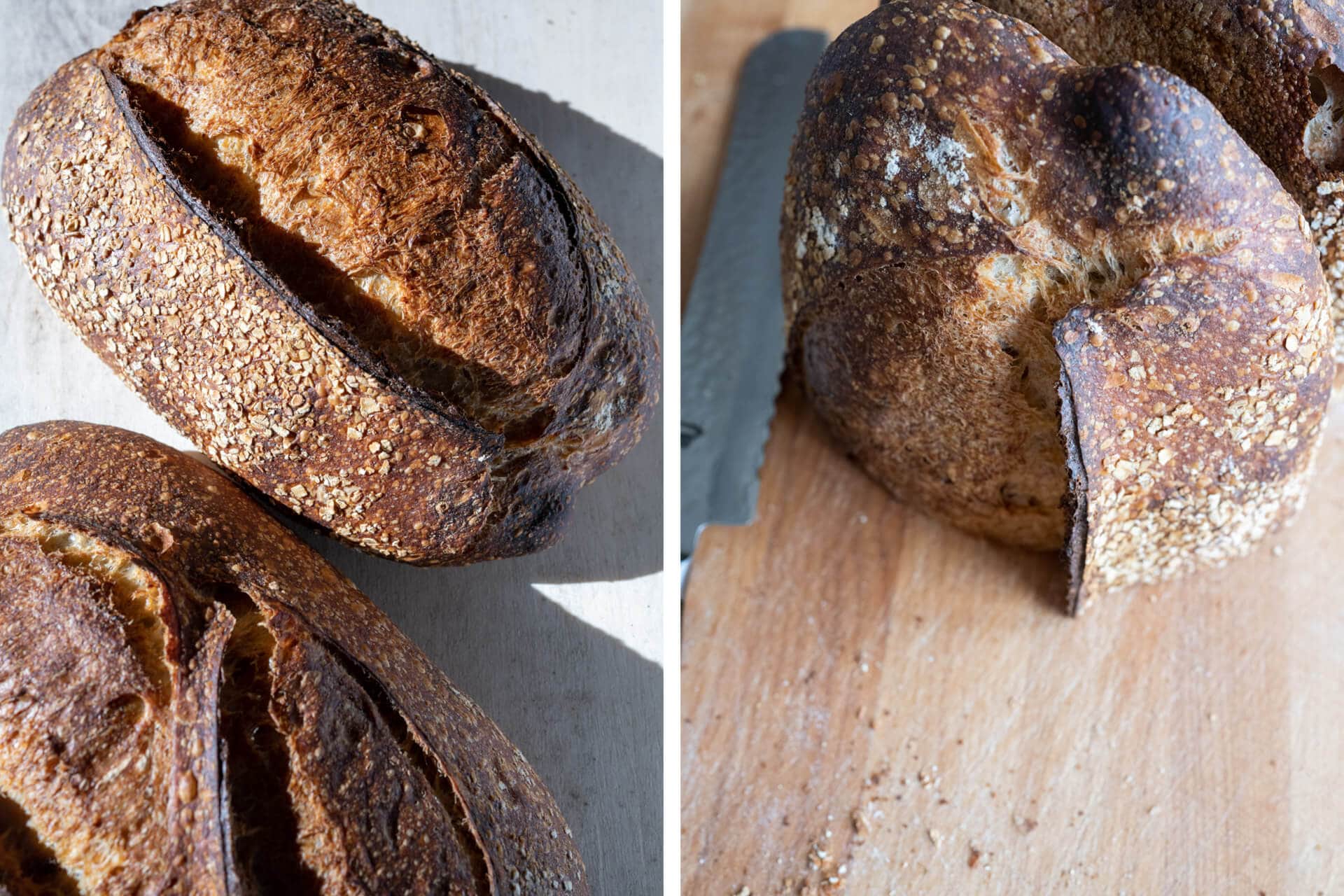
Once cool, I cut the loaf directly down the middle creating two halves (as seen above, right). This way, after slicing from the middle, I can turn the halves so the crumb faces the cutting board. This completely surrounds the interior with the (relatively) thick crust, keeping it from drying out excessively. The crust is a natural bag of sorts, keeping moisture in and dryness out.
I can typically keep my bread like this for a day or two (remember, it’s very dry here) on my cutting board, which I move to a breadbox.
Note that if you live in a very high-humidity environment, you may not be able to keep your sliced bread on the counter for as long; you might have to move it to the refrigerator to prevent molding.
Use a breadbox
This is as simple as it gets: keep your cooled loaves, cut or uncut, in a bread box, and let the box do its job. I like this svelte stainless steel breadbox (seen below) which is well-made and has lasted for years in my kitchen.
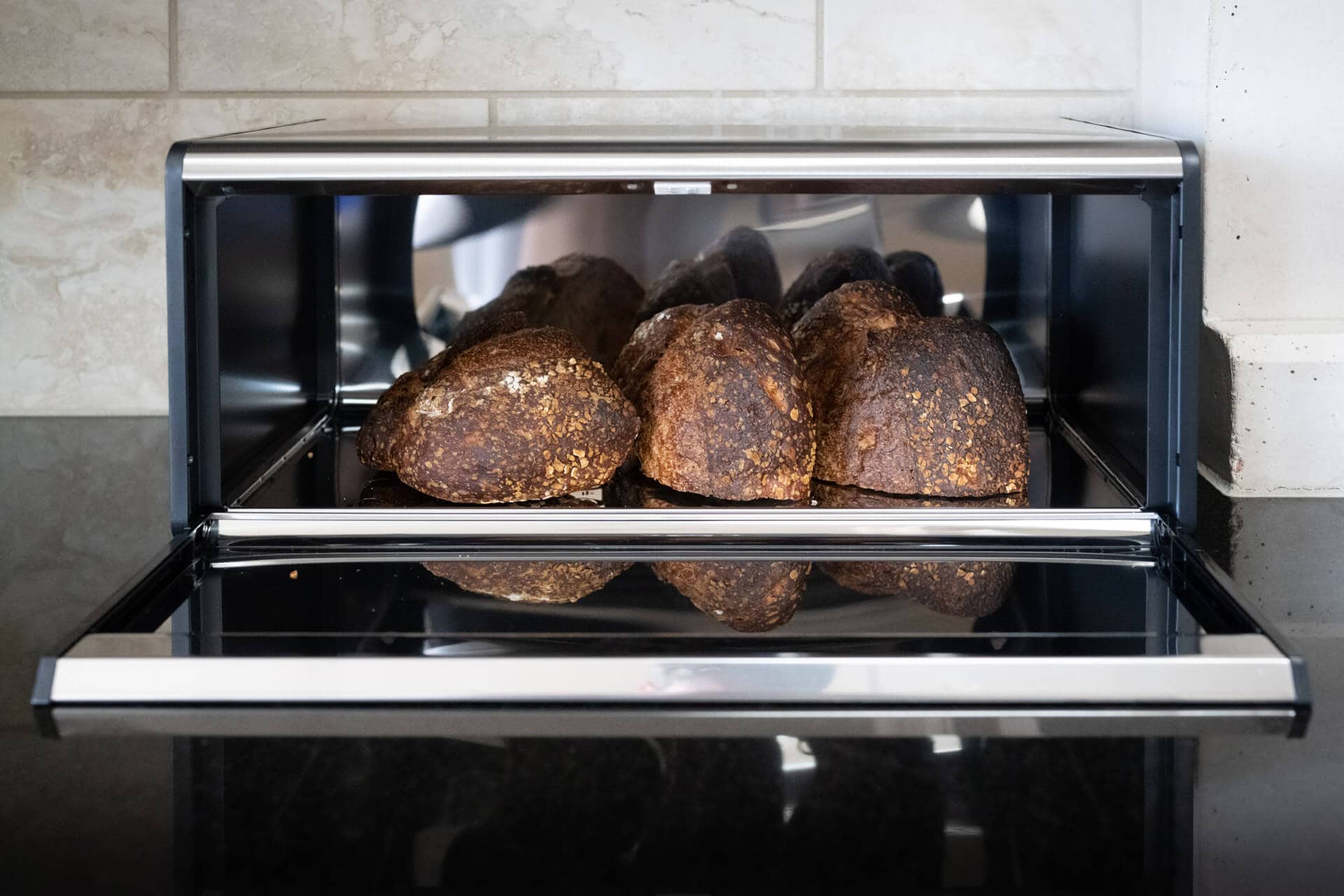
I like that it’s rather large (H: 7.3″ x W: 18.2″ x D: 9.8″), and I can easily store 2-3 whole loaves of bread in there at a time. And because I bake so often at home, I almost always have at least one loaf of bread in the box, ready to be sliced and used straight away.
Use reusable wrap like Bee’s Wrap
Another option is to use a reusable wrap like this bread-sized Bee’s Wrap. This is one of my favorite ways to wrap up longer loaves (like demi-baguettes), and the wrap works extremely well at keeping loaves soft but not too soft.
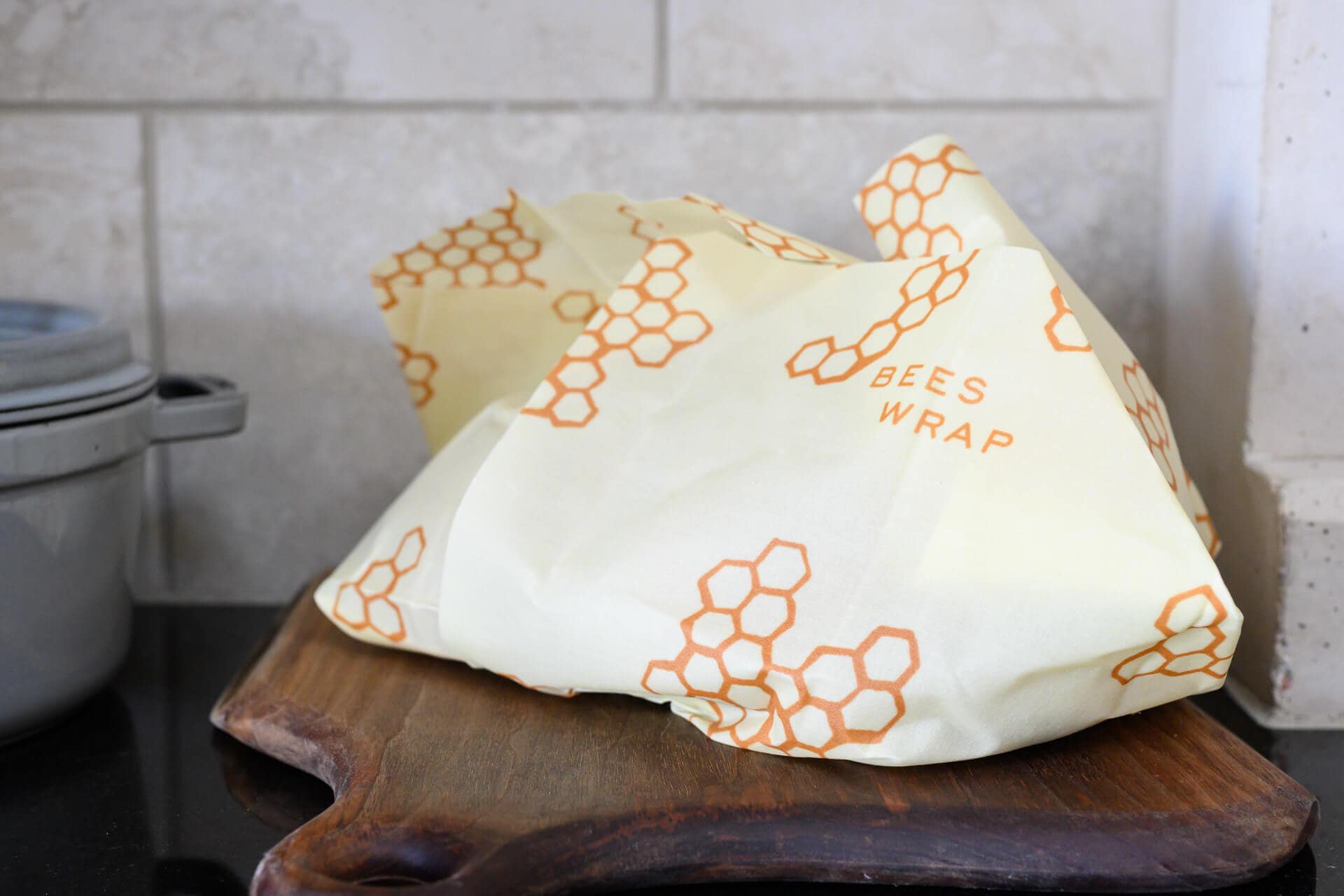
Simply place your bread in the wrap and cover it tightly. The beeswax-lined wrap will deform and wrap around all the nooks and crannies of your loaf as the warmth of your hands molds it to fit.
Paper bags, kitchen towels, and plastic bags
Plain paper bags and kitchen towels also work very well to keep the bread from drying excessively. And while many sources say never to use a plastic bag, sometimes it might be necessary, especially if your climate demands it. In the dead of winter here in New Mexico, humidity levels drop so low my lower-hydration sourdough bread almost has to be placed in a sealed plastic bag to retain some semblance of a soft texture. In this rare case, a sealed plastic bag is necessary and works well.
Don’t place bread in the refrigerator
Finally, and this is very important, don’t store bread in the refrigerator. It might seem counterintuitive since the refrigerator is seen as a food-preserver, but placing your homebaked loaf of bread in the refrigerator will cause it to be stale faster than if it’s kept at room temperature.
The practice: freeze bread for long-term storage
For long-term storage, a freezer is a handy option. The retrogradation process can be mostly halted by subjecting bread to very low temperatures, preventing moisture migration out of starches and their subsequent recrystallization. This means a cooled loaf can be frozen whole or sliced completely, and then the slices are frozen independently (my preference).
First, let’s look at freezing slices.
Freezing Slices
In practice, freezing individual slices of bread is a great way to get the best of both worlds: conveniently sliced bread that can be reheated at a moment’s notice that also keeps for a very long time in the freezer (I’ve done a month or so, but this could probably go longer). When reheated, the bread comes out like freshly baked bread that’s perfectly toasted.
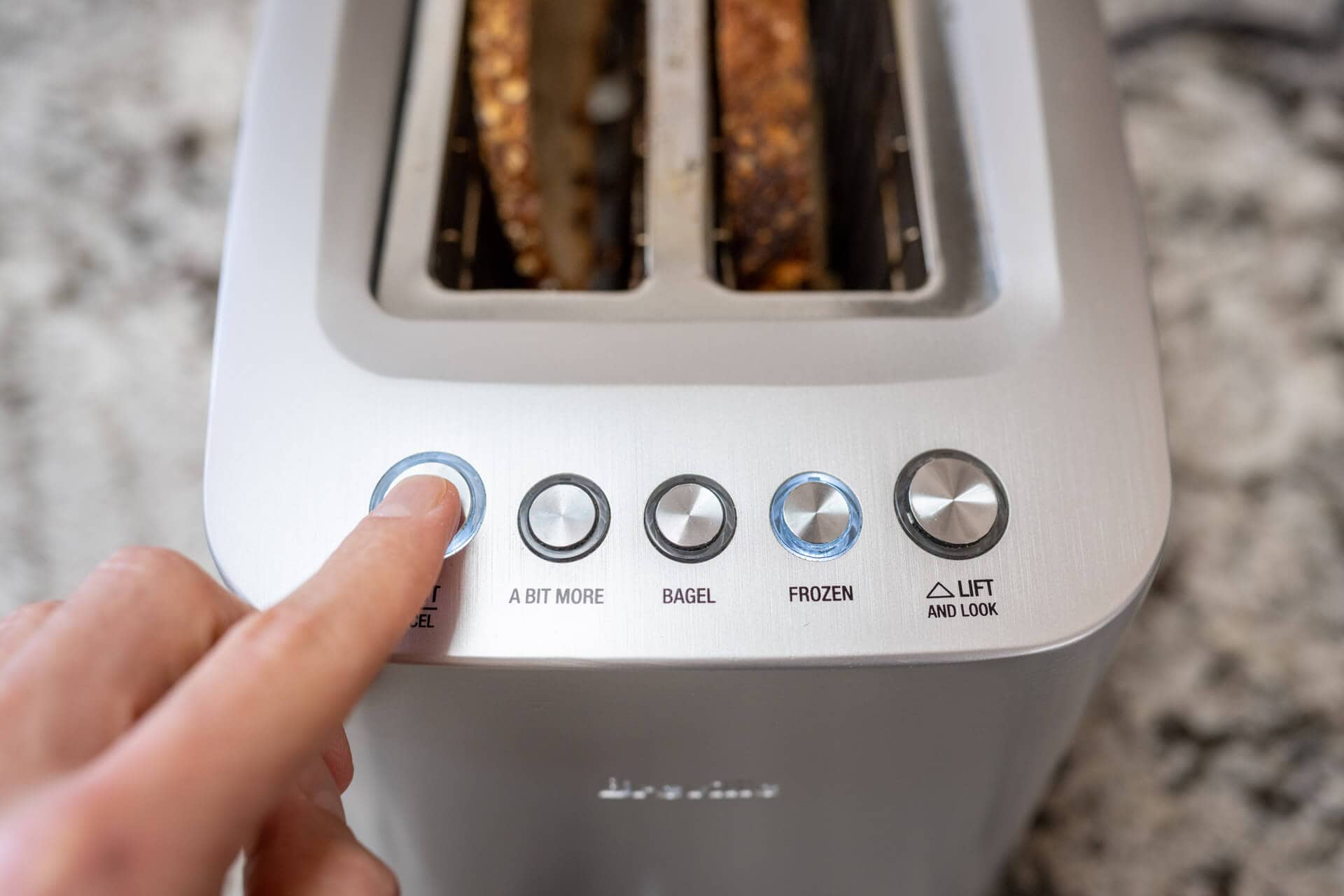
Years ago, when I first started baking bread, I searched for the perfect toaster. After going through a few, I found the Breville Smart Toaster, which is the best toaster I’ve found: not only does it take extra long slices (like the ones from sourdough boules or batards), but it has a frozen function that works perfectly to reheat a frozen slice of bread to just the right amount. It’s expensive for a toaster, but the amount of bread I go through in my kitchen justifies the expense.
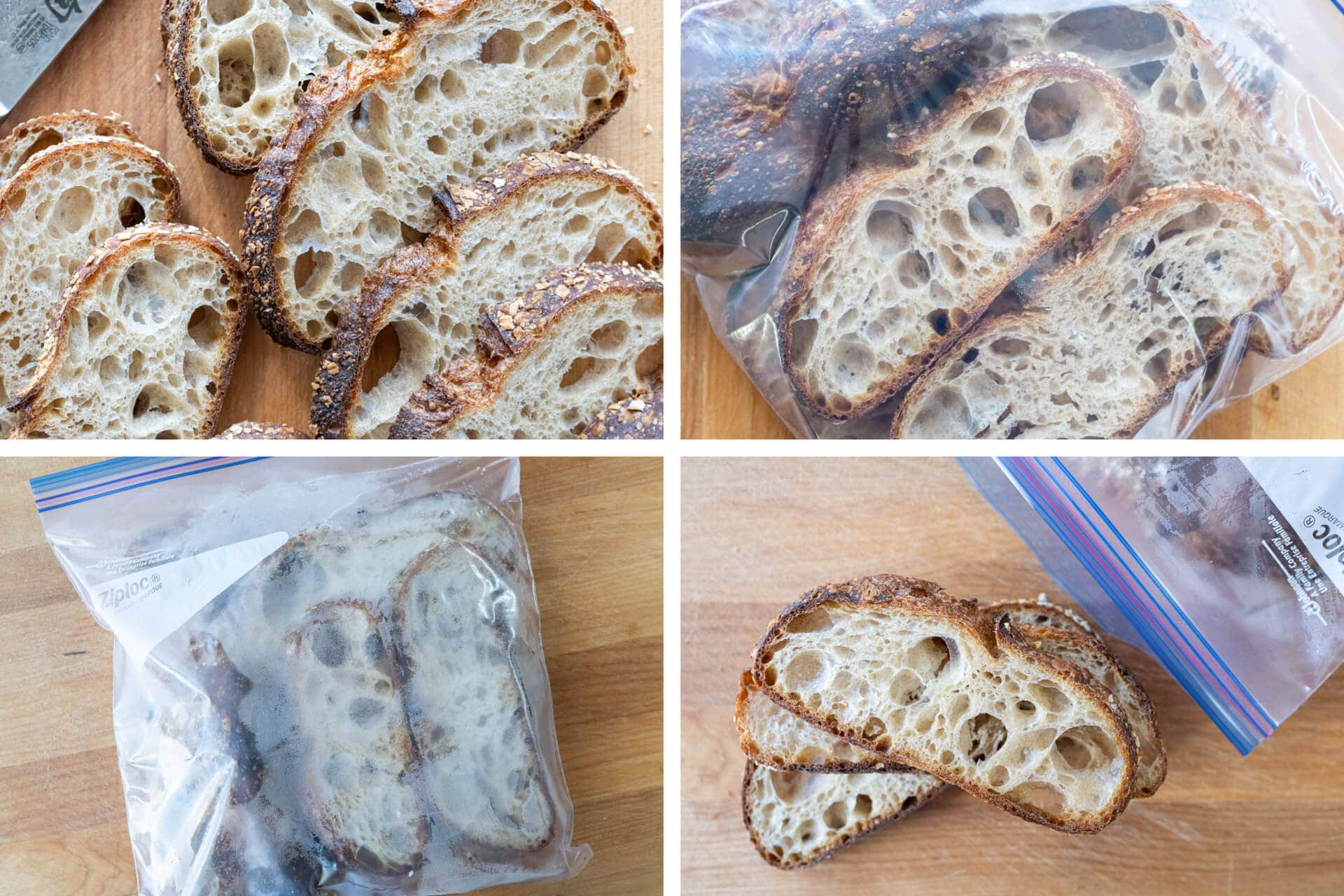
The process is simple: once your loaf of bread is cooled thoroughly, slice it completely from end to end. Then place the pieces in a freezer Ziploc bag, one on top of the other, in an alternating pattern (place a layer on the bottom from side to side, then place slices on top of the bottom layer turned 90°) and press out as much air as possible. Then, place the bag in the freezer until the slices are frozen. At this point, take one or two slices out and reheat them in the toaster to your liking. The plastic freezer bag can be used many times without discarding.
Freezing whole loaves
This method uses a little more material to work, but it’s a great option if you want an entire loaf of bread for some use in the future. A good example might be if you bake two loaves at one time, plan to eat one this coming week, but want the second loaf for the week or two after.
Once the baked bread is fully cool, wrap it in plastic. Then, take the wrapped loaf and put it into a freezer Ziplock bag. Press out as much air as possible, then stick the bag in the freezer. When you want to eat the bread, take it out to defrost in the fridge for a few days or on the counter overnight. Once it thaws completely, store it on the counter via one of the methods described above.
What next?
I’d love to hear your best way to store bread and keep your sourdough fresh. I know here in my kitchen, with the various options for storing and using bread, there’s hardly ever a loaf wasted—and I bake a lot of bread!
For other practical baking guides, see how to store a sourdough starter (for short and long term) and my guide to how to store flour to keep it fresh.
If you’re looking for a recipe to start baking sourdough (and freezing!), check out my simple weekday bread—a delicious bread that couldn’t be easier.
Happy baking!


190 Comments
How do you reheat your soft dinner rolls?
I put them on a baking sheet and bake very low heat for a few mins!
Hi Maurizo…
I like baking breads & cookies to send to my niece who is in an assister liveing facility due to a stroke.
Problem is baked goods i send her mold rather quickly, something about the quality of the air in her appartment.
I’m wondering if vacuum packing breads & cookies in single or double size portions for her to freeze and take out as needed would work.
Do you have any experiance with vacuum packing breads?
Thanks, Hall
Hi Hall, I work as a rehab therapist in a skilled nursing facility and honestly, although it’s very nice of you to bake goods for your family, I always see my patients have their baked goods just sitting in their rooms for days untouched. I would suggest only bringing your family member like 1-2 cookies at one time. Bringing anything more is going to be an absolute waste. Most often that specific population tend to not have much of an appetite due to medications they take and the priority is going to be eating the nutritious meals the facility supplies over treats. They even have a hard time just eating a basic nutritious meal. Your family will appreciate your kind gesture but even with a small quantity.
Unfortunately, I don’t have any experience vacuum packing! I’d imagine it would help, though.
If you freeze the bread slices or other items first (loosely in plastic), you can then vac-pack them without squashing them. Thawing during transport and subsequent re-freezing shouldn’t affect the quality significantly (if transport is fairly quick).
Hi Maurizio…
I use a Güde Bread knife (Barrel Oak – E430/21 with a blade length of 8.25 inches). It is knife made in Solingen, Germany. It is hand-forged from one piece of chrome-vanadium-molybdenum knife steel with a hardness of approx. 57-58 HRc (Rockwell). The edge is rather straight and I have been using it for more than ten (10) years to cut normal whole wheat bread. Can I use this bread knife to cut Sourdough bread. Please let me know.
Cheerio !
S. Radhakrishnan (Ranjit) / Divya Raheja
Chennai, India
That sounds like a fantastic knife!
A former roommate shared this tip with me, and I’ll pass it along. The best, and for me now the only, way to store sourdough bread to keep it fresh and soft is to double wrap it. First, wrap the bread in a paper bag. Second, place the paper bag into a plastic bag. Et voile. I reuse both, but the plastic bags last me much longer–a paper bag can only be used a couple times before it begins to come apart.
That’s a fantastic method. The paper helps absorb moisture and is porous, while the plastic keeps just enough locked in.
Hi Maurizio, just reread this article on bread storage first read a year ago and again realised how helpful it is particularly the science. My method first used bymy wife is to make a small cap of aluminium foil to cover the cut end of the bread and to store on a covered bread board. Works well for bread consumed in 3-4 days which is about as long as a cut loaf lasts. If the second loaf looks like being too long in waiting it goes off to a neighbour, friend or most likely my daughter. I like to have an excuse to bake again so giving away one loaf hastens that opportunity. Cheers
Hi Maurizio! Just for fun, I sewed a doubled lined bag, linen in the inside, cotton on the outside. A small cutting board fits inside where I place the cut side of my bread on. Seems to keep the bread fresh for about 4 days before it starts to harden. By then there’s only a very small piece left.
Does it hurt the bread, when freezing slices, to be in a frost free freezer, where the temperature fluctuates as it defrosts itself, or is it better to keep it in a freezer (that needs manual defrosting) where the temp is always steady at 0 degrees?
Thanx for your great wisdom.
Hi Maurizio! I’m a beginner but have already learned so much from you. I was wondering about freezing dough. What I’d like to do is freeze a loaf after it is formed and instead of placing in the refrigerator for it’s cold-proof. What would be the process to thaw and bake it when we’re ready?
Hey, Susan! Sorry for the incredibly late reply. I let the loaf fully cool, then double wrap in plastic and freeze. Let thaw overnight in the fridge (maybe 2 days), then warm in the oven.
She was actually enquiring about freezing dough, not baked bread.
All really good points, Amanda. You live in basically the opposite climate from mere where humidity is around 30%. I hve the opposite problem: if I leave my bread anywhere uncovered, it’ll be a rock in no time.
I’ve been using micro.perforated plastic bread bags for about 6 months now with very good results and longevity of bread life. Ordinarily I eschew plastic wherever possible but I reuse them enough times that I believe they are acceptable
That’s a really good suggestion, Phil. And I’m sure you can use them over and over.
I feel like my loaves dry out so quickly here in Arizona, no matter what I do. Cut side down, definitely never refrigerated. I can usually get 3-4 days, but never a week. One exception recently was the seeded pan loaf, that seemed to stay soft longer. Probably due to the tangzhong. I need to start slicing and freezing by day 3 or 4.
Yup, that is a problem here. In your case, a plastic bag is probably best.
Great information! I usually bake 2 boules each week and always slice and freeze one loaf. Works beautifully for my teen grandson’s packed lunch. I just make the sandwiches with the frozen bread slices; place in a sandwich bag and by lunch time all is ready for eats!
Fantastic, Joyce!
Hi thanks for all your brilliant information, not only this article.
When you defrost whole loaves do you unwrap them or leave them wrapped?
Karen in Johannesburg South Africa
Also high altitude so that information is especially valuable to me
You’re very welcome, Karen! Sorry for the delay. When I defrost them, I leave them wrapped to thaw 🙂
I found that your tip to not cut the bread fir 12-24 hours not only improves flavor but reduces gumminess and prolongs the life of the loaf for counter storage. My mixed dough weighs approximately 800g, I use a 1.5 quart Pyrex and linen towel for the final cold rest and store the bake bread in the linen on the parchment it was baked on, on the counter, after the bread completely cools. First cut is 12-24 hours later and then the cut side is placed face down on the same parchment and wrap it in the linen and into a zip bag big enough to hold the loaf. I don’t zip the bag but fold it under. This works for up to a week and both the linen and parchment seems to play a roll in removing excess moisture in the bread but also prevents mold during humid days. The bread always feels fresh and the flavor improves. After 7 days I move any bread left to the fridge but still wrapped in the linen and parchment (this is rare but it happens). Only once when I didn’t use the linen wrap did the bread get moldy during the first week.
Yes, letting the bread rest completely before cutting really brings out the full flavor and texture of bread! Love that storage method, too, Faw!
For thinner loaves, i.e. baguettes, I wrap them in foil then in plastic wrap before freezing. When I’m ready to use one I leave it in the foil and put it in a 450 F oven for 10 minutes. Open the foil, turn off the oven and let rest until the internal temp is between 120 – 150. At this point it is ready to serve hot and fresh.
That’s brilliant, Steve!
I have a Pyrex glass baking sheet as a base and a 3 litre large Pyrex bowl over the top – only suitable for boules of course, but it works for me.
That’s a great method! Glass is a wonderful insulator.
This is great. Thank you. When defrosting a whole loaf from the freezer overnight, do you leave it wrapped in the plastic & ziploc, or take it out of the bag/plastic wrap?
I usually leave it in the bag!
Hi, Maurizio, I just moved from New Mexico, where I’ve been baking all my life, to a very humid part of Wisconsin. I have always used a bread box but here I find that the bread often molds by day 4 or 5. I’ve been putting the bread in the fridge on day 3. This has worked so far, and I really don’t notice a huge difference in the bread. But then we mostly toast it. I have to say it’s like living in opposite land, where everything that worked for me in Santa Fe
is doomed for failure here.
Hah, yes that sounds like a very different environment! As you’ve found, do what you gotta do to make it last, in a humid env. a fridge would help pull some of that excess moisture out and keep things fresh once it gets a bit on the older side!
Once the bread is completely cool, I wrap it in a cotton tea towel and then place the towel-wrapped bread in a plastic bag that is slightly open to the air. I think the towel and small bit of air circulation helps keep excess moisture from building in the plastic bag. My mom taught me this (she eats toasted bread every morning) and it works beautifully to keep the bread soft and delicious for at least a week.
P.s. I live in Northern California (Los Gatos)
Yes, that’s a great approach! Sometimes I do something similar, and with some breads here (mostly those with lower hydration), I have to use a plastic bag!
I always freeze my loaves by using wax paper in between each slice. That way they don’t stick to each other and I can toast just the amount I need. I always recycle the pieces of wax paper by keeping them in the freezer when not being used. That way they don’t get moldy.
Fantastic, yes that’s a great way to keep them from sticking!
And here’s a tip for slicing a boule (whether for freezing or not): https://www.youtube.com/watch?v=xu8KixgDRVI
I also recommend waiting till the slices are frozen in the ziplock bag *before* squeezing the air out. The slices are less likely to stick together and don’t get compressed. (I also use a straw to suck the air out from one corner, pinching the bag as I withdraw the straw and finishing the zip as soon as the straw is out.)
Great points there!!
I’m surprised you recommend refrigerating the frozen loaf. I thought refridg is the death of crusty breads! I wrap fresh bread either whole or half in foil then ziploc. Thaw at room temp, or, remove the foil and place on oven rack at 350F for 20-30 minutes. It comes out like fresh baked with a crisp crust. It can even be sliced slightly warm without getting gummy interior.
Yes, it’s definitely not ideal, but it’s a good way to not waste bread!!
My microwave works great as a breadbox. I don’t use it that much to heat up food. After a few days I slice it up, toss it in a ziploc and freeze it.
Perfect, Jib!
Thank you Maurizio for addressing this issue! I learned something new today. I live in SW Florida (semi tropics) and it’s really hard keeping my bread crusty. I was on the verge of buying the bread box when I started reading these comments! Here’s a tip I would like to share that I learned awhile ago when reheating Italian bread in the oven, to always spray it good with water or run it quick under the faucet and then place on wire rack in the oven as this will create steam and crust the bread up beautifully. I have employed this trick to my sourdough baguettes and they come out great! Question, any idea why when making baguettes from regular yeast my bread stays crispy but when I use my sourdough starter it always gets soft? This is baffling to say the least. Thank you for all your teachings!
That’s a fantastic suggestion, Barbara! It kind of mimics many of the steam toasters you now see on the market. Hmm, hard to say why there’s a difference there. Usually, sourdough bread stays fresher for longer due to the longer fermentation time and byproducts.
I have a warming drawer. Could it be used as a bread box?
I’d give it a try, but only when turned off 🙂 It’s sealed up for sure, so it should hold moisture in nicely, but it might hold in too much. Worth a test!
I find paper bag or cloth in the ziploc bag helps keep the moisture levels balanced at room temperature or frozen
Yes, I’ll also sometimes add in a dry paper towel for the same reason!
I live in the tropical climate of Jamaica and have the opposite issue than most folks. My breads come out of the oven crispy and beautiful but the crust turns soft and rubbery when cooled. The crust is hard to cut through without squishing the crumb. It’s very frustrating, even though it still tastes amazing. Any thoughts on better storage ideas? Thanks in advance!
Ahh, yes you have the opposite issue I have here in the super-dry climate I live in. Unfortunately, I don’t know of a solution for that sort of climate. My guess is toasting slices or a quick blast in the oven (broiler) will be the only option to crisp things up! I would definitely not leave the bread in a bread box, you want to try and keep it drier and that will hold moisture inside. Maybe a paper bag on the counter is the best solution, it should help absorb some of the moisture!
Hi Maurizio, I might have the same problem here . Living in the Canary islands with hot temp all year round my sourdough breads come out of the oven really crispy with a good crust but sometimes after they are cooled even after several hours with my kitchen window open ,the crust turns a bit gummy. Not always but its rather irritating. I always thought that cooling for a longer period would make the crust crispier in a warm climate but maybe there are other reasons. Do you have any suggestion?
Yes, in a humid environment it’ll be tough to keep that crust crisp as the bread eventually sits. I’m not sure I have a solution for this other than to recommend toasting slices and keeping the bread somewhere excessive moisture cannot build up (i.e., not in a sealed box).
Hello, your site has been an inspiration to me. Because of you, my breads have been good enough to swap with my neighbors for treats and services and sometime even sell.
My Question is…once a bread has been baked, how many days is still fresh enough to give/sell to another and still be fresh?
I’ve given folks day old uncut loaves and they seem fine with that. What’s the limit?
Super glad to hear that, Arnie! I don’t think there’s any single answer to your question. It also really depends on the bread you’re making. For instance, a 100% rye sourdough can last weeks or more and still be delicious (in fact, it gets better as it ages, in my experience). For a hearth style loaf you’ll see often here, I usually gift it the day I bake it if I can, but the next day works just as well. The 3rd day you’ll start to see effects of staling perhaps, but toasted the bread will still be wonderful. In the end, it’s totally up to you and the expectation those receiving the bread have!
Thanks soooo much for your response!
It gives me the info I need.
Today’s my first day using lava rocks and baking stone instead of the combo oven. This will allow me to back two at once.
With the warmer weather in NY I’m having issues in getting the rise in my breads that I’m used to.
Any suggestions?
Thanks again
Arnie
Usually when warmer weather rolls in we tend to slightly over proof our bread. Be sure the dough hits the final dough temperature you’re after (I specify this for all my recipes) and keep an eye on it during bulk fermentation! You might want to cut it short.
Thanks so much.
I made a contribution thru your website. wish it could be more. You’ve earned it even without your private responses.
Be well..Arnie
Thank you so much, Arnie! I really appreciate that. Happy baking and be well!
Hiya Maurizio, I sent you a contribution about a month ago…but according to my bank…it doesn’t look like it went thru. It was for $25. Could you check and see if you got it?
Hey, Arnie! Thank you, I appreciate that. But you’re right, I do not see the transaction in PayPal (if that’s how you contributed).
I’ll resend…I’ve been swapping and selling bread and you’ve help make that happen.
you can read about me at:
https://www.riverdalepress.com/stories/fostering-community-by-bartering-some-sourdough,73889?fbclid=IwAR1mu9aSUlF5ExVd_9l942HmB2BntOzT_2N78y0sEi3dPBj0XfCP6rS9pmI
my instagram is : https://www.instagram.com/breadbakerofriverdale/
I received it this time! Wow, so great to hear about your bread baking in your community. Just fantastic, Arnie!
Hello, long time fan, first time poster! Quick question, you said in this article that the fats in the dough slow down how quickly a loaf goes stale. Is it possible to add extra fats to a sourdough loaf to keep it fresh for longer? Thanks in advance!
Hey, Lucas! This is a great question. Some additions, notably sugar, will help act as a dough preserver in a way, keeping it fresher for longer. In my experience, oil can help with this as well, it keeps the crumb more moist for a little longer. But there is a point of demising returns where too much oil (or butter) tends to make the loaf soggy and too soft. So yes, in my experience, a little fat can help nudge out the time a loaf stays soft and pliable.
Before reading this post I would store my freshly baked sourdough in the fridge. It was a pain to slice and was always cold. Thanks to you I now store it properly in wax paper at room temperature. My bread is soft and stays fresh longer. My husband is happier with its taste now too. Thank you for sharing this wonderful lifelong tip, it makes such a huge difference.
Do you plan to write an article on flour and grain storage? Would be happy to read your technique on proper storage.
Right on, so happy my tips have helped! That’s definitely something I’m going to cover soon!
I just finished making your starter and have 2 loaves of the everyday sourdough proofing in the frig yo bake tomorrow! My question is about using the bread box. Are the halves placed cut side down? Thank you for all the great information!
Awesome, Eileen! I still do place the halves cut-side-down inside the bread box. This way, they don’t collapse if they’re a tall loaf. Happy baking!
Glad to hear that! Sorry for the delay. Yes, that can work. You can either par-bake the goods (bake them like 75% of the way) or freeze the dough in shape, then take out to thaw in the fridge, bake when thawed. Many have reported success with the latter!
I’d love to hear more about how a bread box helps keep bread fresh. What is the science behind it? And since we eat a mix of store bought and homemade bread, do both go into the bread box? Does store bread come out of the plastic? I have so many questions!
Hey, Sharon! It simply locks in some of the moisture in the box, keeping the crust and crumb soft (you’ll have less migration of moisture out of the bread). The thing about a bread box, though, is the humidity inside can’t be too high or it’ll result in overly soft bread. Most are really good at keeping in just enough moisture to keep bread from going stale.
I think it also depends on your climate. It’s very dry here and the box I have linked in the post does a great job of keeping it just right. If you lived in a very humid climate, you might not even need a box!
Hi, great articles! When storing bread in a breadbox, do you find it makes the crust soft after half a day?
See my reply to @sharonzell:disqus above! It does make the crust a little soft, but for me, that’s a good thing. My goal is to always avoid bread that turns into a rock here in my dry climate!
I am new here, we have a bakery shop and desire to bake our breads fresh to order. however we bake most of the breads in the morning. How can we store the bread from morning baked to after some hours and then rebate it again for a few moments so the customer will get the bread totally fresh as if it was baked for his order?
If it were me, I would not reheat the bread! Once baked, that loaf should stay great all day as-is 🙂
What is the best way to package sourdough bread for shipping. Would it stay fresh if I put it in a paper bag?
Yes, I’d do paper bag depending on how far you’re shipping!