


I often say to bake great sourdough bread, you need a strong sourdough starter. Our bubbling culture of beneficial bacteria and wild yeasts have the burden of leavening and flavoring our bread dough. If our starter is sluggish because it’s been in the refrigerator for too long or has been neglected on the counter, it can negatively impact the entire fermentation process. This might mean underproofed or lackluster bread.
To bake great sourdough bread, you need a strong starter.
So I set out to help Brød & Taylor design a small home unit that will make starter maintenance much simpler. And we did just that—the Sourdough Home takes the guesswork out of keeping your starter strong, healthy, and ready for baking when you are.
In my experience, the typical issues home bakers encounter revolve around their sourdough starter. Usually, it’s a starter that wasn’t properly cared for or it wasn’t used at the right time. These root causes can result in a dough that was underproofed, and believe me, I’ve been there!
So, we designed the Sourdough Home to heat and cool to keep your sourdough starter at precisely the right temperature to suit your baking schedule.
A quick disclosure: I helped B&T design the Sourdough Home, all the way from the initial design sketches to testing final prototypes, and I’m working with them on its promotion and will be financially compensated.
Real Quick: Why Do I Love the Sourdough Home?
- It lets me keep my starter at the perfect temperature to suit my baking schedule.
- When it’s cold outside, it heats for strong fermentation and more flavor.
- When it’s warm outside, it cools to slow fermentation.
- The interior is incredibly easy to clean. If something spills, just wipe it with a cloth.
- It uses low power, is quiet, and is small enough to stash anywhere in the kitchen.
- It takes the guesswork out of sourdough starter maintenance.
Ultimately, because I can dial in the temperature of my starter to precisely what I want to maximize bacteria and yeast activity and have my starter ripe when I want.
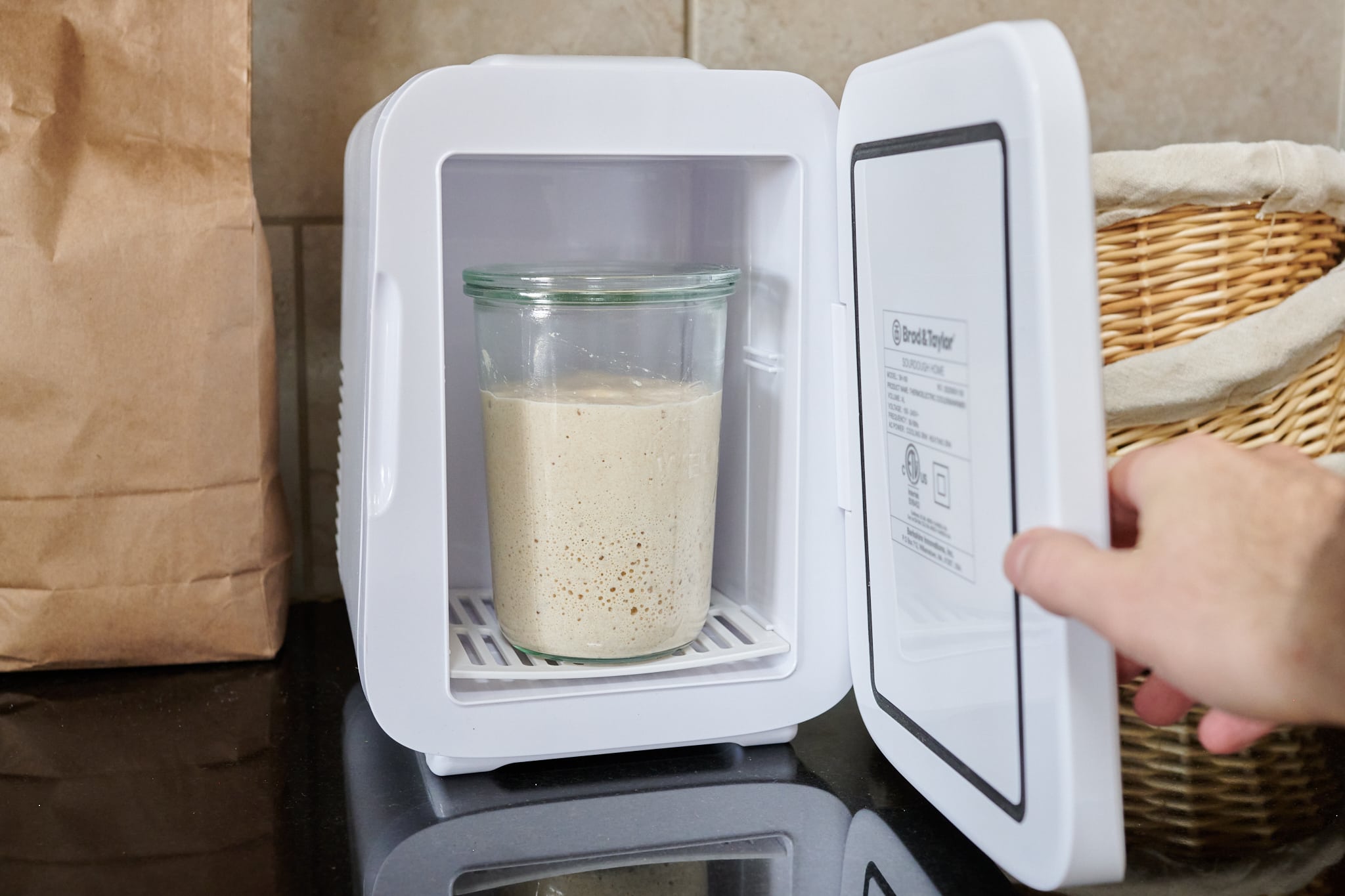
What is the Sourdough Home?
The Sourdough Home is a small appliance designed to hold a sourdough starter at a precise temperature. The unit can heat and cool and be set to any temperature between 41 to 122°F (5 to 50°C). This lets you control your starter’s ripening schedule and adjust the balance of yeast and bacteria to change the flavor, aroma, and texture of your sourdough bread.
Why is the Sourdough Home Useful?
You all know how I’m a stickler for paying attention to temperatures during the entire bread-making process, and for good reason. Temperature is incredibly important because it’s the driving force behind fermentation. If the temperature your starter is kept at is too cool, it will take a long time to ripen and is usually used in an under-ripe state. And conversely, if the temperature your starter is kept at is too warm, it will ripen too quickly and become overly acidic.
You can use the Sourdough Home to keep your sourdough starter at whatever temperature you need to ensure it’s ready to use when you want.

Sourdough Home Specs
Since the Sourdough Home is a small unit, I like to keep it inside my pantry. Similarly, it can also fit just about anywhere on your kitchen counter without taking up much space. It has a small fan inside that runs quietly, similar in sound to a small computer fan running idle.
The Sourdough Home is designed to be just large enough to fit your sourdough starter, but you can comfortably fit a variety of other jars inside if you’re into other types of fermentation (more on this below).
Outside dimensions
| Height | Width | Depth |
|---|---|---|
| 11-inches (28 cm) | 8-inches (23cm) | 10-inches (25cm) |
Inside dimensions
| Height | Width | Depth |
|---|---|---|
| 7 1/2-inches (19cm) | 5 1/8-inches (13cm) | 5 1/2-inches (14cm) |
What Can Fit Inside The Sourdough Home?
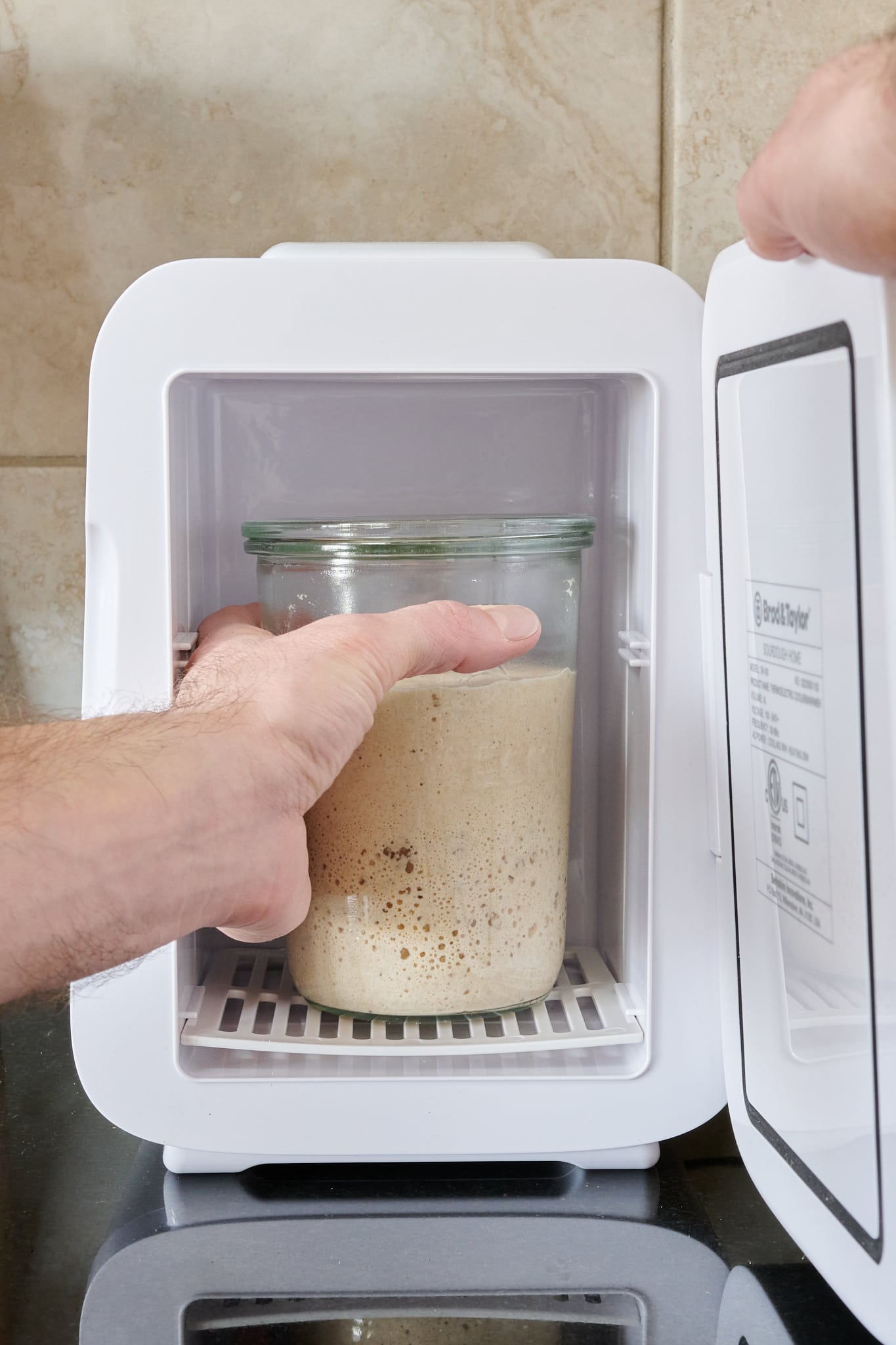
You can fit a single 1-liter (1-quart) jar inside or use the provided shelf to fit two smaller jars. As you can see below, there’s plenty of room to keep my favorite 3/4-liter sourdough starter jar inside. If you use smaller jars, say a 1/2-liter Weck jar, you can fit that on the bottom, insert the shelf, and place a smaller jar on top (two 1/2-liter Weck jars will not fit).
How to Use The Sourdough Home
Using it really is as simple as set-and-forget.
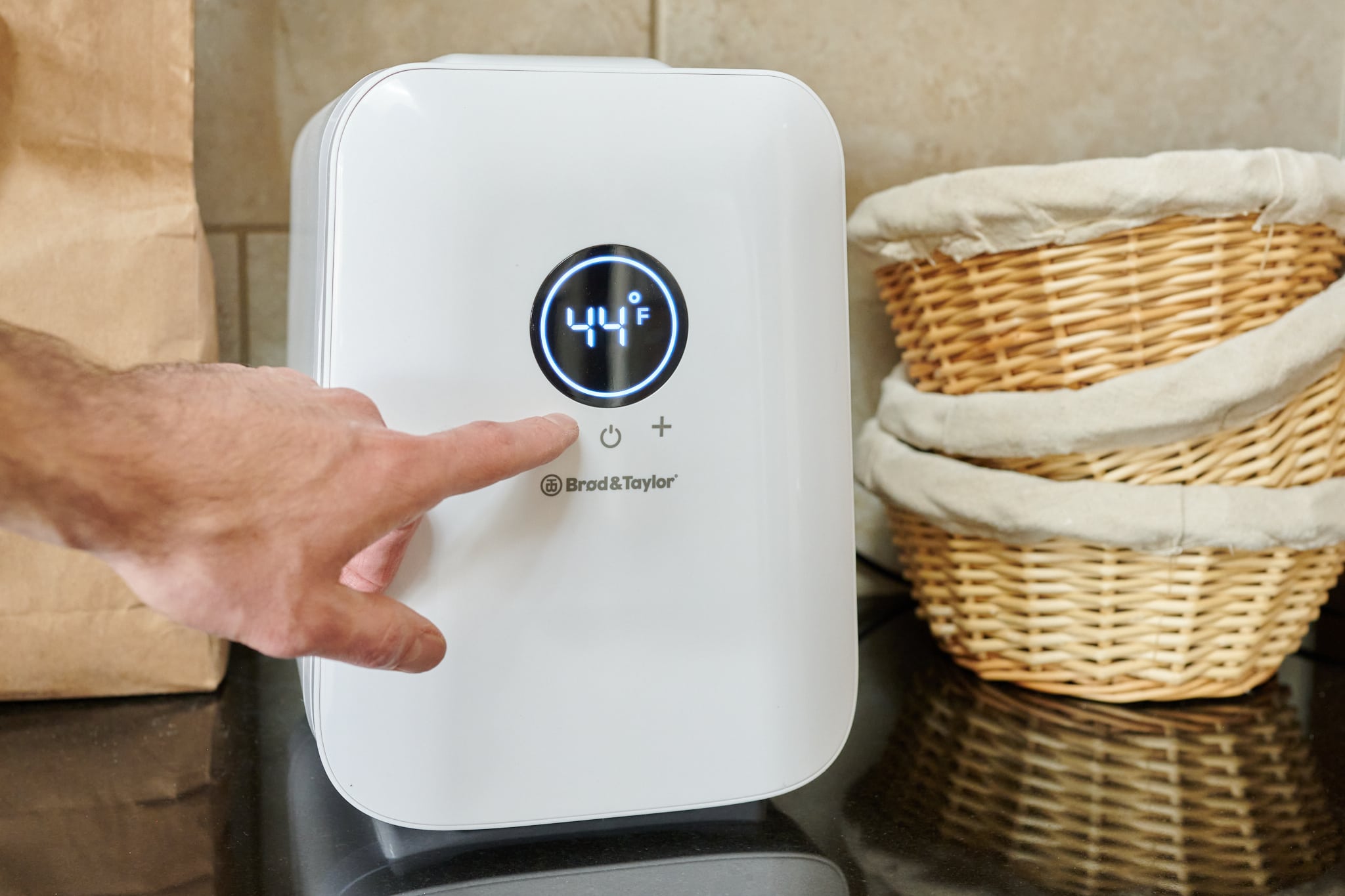
Setting the temperature is as simple as you might think: press the “+” or “-” buttons to change the inside temperature to whatever you desire. I set the temperature to 78°F (25°C) to keep my starter warm and ready for feeding every 12 hours, consistent with how I feed my sourdough starter. Using it really is as simple as set-and-forget.
If you want to feed your starter less, you can keep the same ratio of ingredients and reduce its maintenance temperature.
How Can I Feed My Starter Once a Week?
Many home bakers prefer baking only on the weekend. This can mean many sourdough starter feedings during the week to keep it healthy and active. Or, you can keep your starter in the refrigerator and take it out a day or two before using it. However, the cold temperatures of a refrigerator (usually around 38°F/3°C) result in a sluggish starter that needs a few feedings to regain full strength.
Instead of keeping your starter at super cold refrigerator temperatures, the Sourdough Home can be set to 44-48°F (6-8°C), which is cold but not too cold. This will slow fermentation in your starter, so you need only one feeding a week, but keep it warm and active enough to be ready for weekend baking without the need to feed it beforehand.
Of course, this highly depends on your sourdough starter’s makeup, so adjust as necessary to achieve the feeding schedule you’re after. For instance, you can play with 10%, 20%, or more (in baker’s percentages) starter carryover at each feeding and see how long it takes to ripen. Additionally, your starter may benefit from one room-temperature feeding before mixing it into bread dough, or making a levain.
Read how I feed my starter once every five days in my Sourdough Home user guide.
How to use the Sourdough Home to Make a Levain
You can use the Sourdough Home to provide the right conditions for your levain for a particular bake. Since a levain is the same thing as a starter, set the temperature control to whatever a recipe says and let it ripen for however long the recipe indicates. While this is happening, I’ll set my starter to the side to wait its turn to go back into the Sourdough Home once the levain is removed.
For instance, with my Beginner’s Sourdough Bread recipe, mix together the levain ingredients (flour, water, and ripe sourdough starter), set the Sourdough Home to 75°F (23°C), and slide in your jar. Then, return in 5 to 6 hours to find a perfect ripe levain ready for use.
Should I Still Buy the Folding Dough Proofer?
I do plan to use both the Sourdough Home and the Folding Dough proofer in my baking. The Sourdough Home and the Folding Dough Proofer are complementary tools used at different parts of the sourdough bread-making process. You use the Sourdough Home to keep your starter or levain at precisely the right temperature by heating and cooling, whereas you use the Folding Dough Proofer to keep larger batches of dough warm for strong fermentation.
See my guide to using the dough proofer for more on how I use it →

What Else Can I Use the Sourdough Home For?
Since the Sourdough Home can heat and cool, it can be used for other culinary purposes besides sourdough bread. You can use it for:
- Panettone: Maintain your pasta madre (lievito made) for panettone at the perfect cool temperature.
- Kombucha: Keep your SCOBY happy and fermenting lively, even in the winter.
- Yogurt: Use the Sourdough Home to keep your yogurt culture at the right temperature and ready to use.
Really, any type of culture can benefit from being kept inside the Sourdough Home at the optimal temperature for its type of fermentation.
How Does the Sourdough Home Heat and Cool?
The Sourdough Home is built around a Peltier module (thermoelectric module) that can both cool and heat. When an electric current is passed through the module, a plate will heat. If the current is reversed, the plate will cool. There are several advantages to using this technology, including energy efficiency, high precision temperature control (+/- 1°C), it’s compact, noiseless (except for the fan to help cool the heatsink), and vibration-free.
Watch Me Use the Sourdough Home
In the video below, you can watch me use the Sourdough Home and discuss why it’s so helpful for starter maintenance and, ultimately, for baking a fantastic loaf of bread.
Sourdough Home FAQs
How do I change the Sourdough Home to Celsius or Fahrenheit?
Press and hold the “+” and “-” buttons simultaneously until the display changes from Fahrenheit to Celsius.
Is the Sourdough Home loud?
The unit has a small fan inside, and I’d say it’s about as loud as a quiet computer fan.
Does the Sourdough Home use a lot of power?
Brød & Taylor lists the unit as low power, and it uses a max 30W of power when actively heating or cooling. Once the unit reaches the desired temperature, it will cycle on and off to keep the interior at the set temperature, which means it isn’t always cooling or heating. By comparison, the minimum power usage of a TV set-top box is between 50 to 200 watts. Ultimately, the amount of power it uses will be dependent on the ambient temperature around the unit (i.e., if it’s very cold outside and you want to heat, it will use more energy to reach the desired temperature).
What is the bump on the top of the Sourdough Home?
It’s a handle for carrying the unit around!
Does the display stay lit up all the time?
Yes, but it dims significantly after a short time when no buttons are pressed.
What’s Next?
To see how I use the Sourdough Home to feed my starter less often (2, 3, and even 5 days!), see my guide to using the Sourdough Home.
If you’d like to look at more of the best tools for making sourdough bread at home, see my best baking tools roundup.
💬 Have any questions about the Sourdough Home? Let me know in the comments below!


110 Comments
Hi Maurizio,
I got mine 2 weeks ago and I love how much easier my sourdough baking routine is now.
Only one feeding after getting it out and it’s bubbly and ready to go, when I kept it in the fridge sometimes it took 2-3 refreshments for it to double or so.
Also I use it to speed up the activation, once fed I set the temp to 78F and put it back in, it doubles up in half the time compared to putting it in my oven with the light on.
I’m so happy that I found this cute and useful appliance here on your blog.
Thanks
So glad it’s working well for you, Laura! Yes, it just makes things almost too easy… Happy baking 🙂
Hi Maurizio, this is such a great product! I have been waiting for something like this for a long time in tropical Singapore. I really hope there will be a bigger version coming up too, for proofing dough!
So happy this can help you out there! Having the ability to cool is a game changer.
How do you know when the SDH has reached your temperature that you set on it?
Good question. It happens rather gradually depending on how large of an item you have inside, and the temperature of that item. I would say it’s not as big of a concern though if you set it to your desired temp early before placing your starter inside. The larger the delta between the temp you want inside and the temp outside, the longer it will take, though. But it shouldn’t take long, it’s a small space!
Hi Maurizio,
I have a question about using my new Sourdough Home (SH).
I cooled the SH down to 45°F. I fed the starter with the coldest tap water I had (53°F), flour temp was 68°F and carry over starter temp was 68° F. After stirring to combine the final temp of the fed starter (1:5:5 feeding ratio) was 66°F.
The starter has not increased in volume as much as when I keep in my B&T Proofer but it did double over time. It has stayed at the same height for some time and not fallen. It has been in the SH for 3 days and 15 hours.
My question. How do I know when I have reached starter peak and it is time to feed again. Normally I look for doming of the starter and a 2-3X height gain before it starts to fall. The cold mass just seems to act a bit different.
Thanks in advance for your help.
I was going to order one this morning but NOT AVAILABLE IN CANADA UNTIL MARCH! Do you have an in haha, when can I get one? Heidi from Pigeon Lake, Alberta.
Magically the Brot & Taylor Canada site had availability so I have one on order now. Can’t wait to receive it and also thanks so much for working with them to create such a cool device.
Hope you love it, Heidi!
I have had it now for 3 weeks and it makes all the difference. I used to store my starter in the fridge and I didn’t think it was sluggish because it made amazing loaves but … with the Sourdough Home my breads are perfectly sour and rise like in your pictures! A great product.
I grabbed one and got it yesterday, when using it with my digital thermometer with my starter it tends to be off by almost 5 degrees.Has anyone observed this or maybe have you seen this Maurizio?
Hey, Jon! No, I have not seen it off by this much. The most I’ve measured here has been 2°F/1°C. What conditions are you using it in, is it warm or cold where you are? Also, a good test is to put a jar of water inside, set the temp, then measure *the water temp* in 12 hours (just to ensure stability).
Thanks Maurizio right now its a nice 70f – I’ll do the water test!
Hello Maurizio, I live in Mauritius. Does it come with a European plug & a Celsius temperature?
Safinaz
B&T will make an European version available in May, it will have the necessary connection there. They have an EU website you can order from when available!
I’m a little confused about how you’re saying the Home should be used.
I’m used to having a smallish starter in the frig and feeding it once a week The total weight is about 100 grams (20 g “old” starter; 40 g water, 40 g flour). Then on baking day I use a certain amount of the the starter to get a levain going with a feeding. The total weight of the bake day levain depends on the recipe but is usually around 200-220 grams.
With the Home are you saying that I should follow the same routine (more or less) but just keep the 100 g starter in the Home for the week at around the 45 degree mark? OR that I should keep a large levain (220+ grams) in the Home all week and that it would be all ready to go on bake day w/out having the growth process?
I hope I’ve explained my confusion and would love your advice. Thanks.
Hey, David! I find my starter works best when I take it out at least 2 days before using it to bake, giving it 2-4 feedings, then using it to make a levain. With the Sourdough Home (SDH), I can keep it at a cool temperature, but not as cold at the home fridge (38F). So somewhere in the mid 40’s will keep my starter active enough to require less feedings to get “ramped up” again ready for baking. I almost always still make a levain.
I’m still working on a guide to temperatures, feedings, and exactly how I’m using the SDH at various schedules. Hope to have that up here in the next several weeks!
Thanks. I have purchased the Home and am looking forward to your promised guide on use, temperatures, etc. Appreciate the response.
Hi Maurizio, will this product work with just an adapter in Singapore?
That I don’t know, please email B&T, they will have an answer for you there!
Will the guides that you are developing be available free of charge, at least to those of us who have purchased the Sourdough Home
They will be available free to all, as is all my content here 🙂
I just spent part of a week trying to hack a countertop starter warmer. I abandoned the idea after I added up the cost of a temperature regulator and seedling mat (also, the cables were too long and messy). It turns out you had already invented it, plus it cools as well. Sourdough home, albeit a bit pricey, is in shipment to me, so thanks.
Hey Rick! I’ve done the same thing over the years… That way works, but it does take a bit of work to build the unit, and even then, it’s not perfect. You’re going to love this 🙂
I use a larger glass jar because I make 4 loaves at a time and need more starter. What are the interior dimensions of this? Would it hold a glass jar that’s 6″ in diameter and about 6″ tall? Thanks!
Hey, David! I have the interior dimensions listed above in the post.
Got your email and I just ordered this today, can’t wait to try it out!! I only have time to bake bread twice per month on week ends. Battling with keeping my starter strong and healthy when half of its life is lived in my fridge has been a challenge, resulting in inconsistent results.
I’m looking forward to training my starter to be fed once per week at a slightly warmer temp than my fridge, with the last feed becoming a levain build–and saving money on all the discard that I can’t use up!
Thanks for coming up with such a cool tool that fills a need for home bakers!
I think you’re really going to love using this, Angela! I’ll have some sample schedules and guides coming soon, but you’ve already got the idea 🙂 That last levain build should help get it perfectly up to speed for mixing right into a batch of bread dough.
Maurizio,
Did you test this product for summer heat? I live in the high desert with extremely hot summers, 100F+ for weeks on end. I’ve struggled with the sourdough baking process in general during that season, I just can’t get the timing down right. Do you have any information about its cooling in those conditions?
ETA: I don’t use a lot of AC so my kitchen is over 80F FOR SURE in summer. 🙂
I would imagine it’s ok at 80F, but I would reach out to B&T, they are very responsive. I haven’t personally tested it in extreme conditions (yet, it get hot here too!) 🙂
Can’t wait for you to develop and discuss the chart of temperatures for the different feeding schedules. I’m a weekend baker and feel like I’m wasting so much by feeding daily. I want to feed the once a week but also understand when to raise the the temp after feeding to fully ripen my levain and have it ready to use. Loving the cookbook!
I hear you. Working on this!
Thanks so much for getting my cookbook as well!
In your disclosure you were vague in specifying whether you receive financial compensation for the design and promotion. You were on the way there but didn’t quite reach that destination. Ethics.
Hi Jo,
Your comment is misplaced.
I have followed Maurizio for going on four years. He has shared his knowledge and experience with all of us and has done so with a sense of humility and kindness.
His statement regarding this product was clear and in my opinion very ethical. He stated clearly that he worked on product development and promotion. I would hope that he might benefit financially but I really don’t care. I have ordered the Sourdough Home and look forward to a new tool in my baking collection.
Thanks Bruce, I appreciate that!
Very well stated Bruce – you beat me to the punch! Maurizio was very upfront about his involvement – no need to disclose ANY details to anyone of his personal financial arrangement with B&T. And, it is very ethical to benefit financially if he brought the idea to them &/or participated in design, engineering, testing, etc…I hope it happens. Looks very useful to those of us living in temp-challenged environs (SW WY, 6900′ elevation).
Ahh, sorry to hear it came across that way, Jo. I tried to make it clear without going into too much detail. I’ve just made the disclosure more upfront! Believe me, I pride myself on my ethics.
Why be an ass. He should recieve financial compensation the guy is a kind, baking genius.
I’m on day 3 with mine. It’s a game changer. My kitchen room temperatures in the winter range from 58 to 74, depending on wood heat and sun. I’ve thought I’d used every trick in the book to reduce temperature variation and find the sweet spot consistently – but baby blankets never occurred to me. With the Home, starter maintenance and levain temps are off my list of worries. Thanks, B&D and Maurizio! The Home just became a can’t-live-without.
So glad you’re liking it, David!
I pre- ordered it and it arrived about 3 days ago. It’s very convenient, and I like its smaller size. I have their proofer and that has been wonderful. The only thing that I can say negative ( but easy to adjust) is the inside temperature is 3 degrees lower than the setting. Even after 6 hours of testing with a Thermapen ( instant read thermometer ) and a fridge thermometer ( same maker). But like I stated , it’s an easy fix. Looking forward to your upcoming guide. Thanks for your tips.
So glad you’re liking it Sue! I’ve seen mine vary by 1°C here and there, too. But for the most part, it’s very accurate. I set it one degree higher than I need so far!
I also have been keeping my starter in the refrigerator and I feed it once a week. I find that using a combination of white bread flour and rye flour will ferment perfectly in the one week timeframe, so I have ready to use ripe starter each time I bake each weekend. Then I feed it and put it back in the fridge until the next week. It’s so simple, and there’s no need to discard.
Right on!
I think this is genius. I was going to buy the folding proofing box but I will likely wait now for the heating & cooling version. For those of us who live in variable climates (warm-hot in summer and cool-cold in winter), we need to be able to cool the ambient temperature in the summer. If the B& T Home unit can do both, so too should the Proofing Box, no?
It gets harder since the proofer is so much larger. The technology used to cool this SDH likely won’t work at that scale…
Thanks for the super quick response, Maurizio. Keep up the great work.
also-your cookbook is amazing. The best Englsh muffins ever and the Rustico bread is family favorite.
Two of my fav recipes. Thank you!!
love mine! Got it last week and already my starter looks more active.
awesome to hear that, Betsy!
Ordered mine this morning as soon as I got you email newsletter announcing it. Can’t wait!
You’re going to love it 🙂
Where is this attractive tool made?
You know, I’m not positive. I need to ask B&T!
Wow, what a useful invention! Will look for it when it comes to Canada…just wondering – I can’t quite tell whether it uses a cord and needs to be plugged into an outlet or not? I thought I saw a cord in the video but not the pics, and you mentioned keeping it in your pantry.
Ordered! This is going to be a game changer in the summertime. Can’t wait to see your feeding guide.
I hope you love it, it’s made things so much easier here!!
Ok! Now make one a little bigger to retard dough at better temperatures! Warm for 4, cool for 12, warm again if needed. As an example.
The folding proofer does a great job of warming, been using that for years! Cooling… It’s a little harder 🙂
This is genius! I already use the B&T prover to warm my starter to 78 degrees the day before baking but struggle in the Summer to keep it cool without wanting to put it in the fridge. This solves that problem!
It’s the perfect complement to the proofer 🙂
You’re going to love it, Jeffrey!
Hello Maurizio!
This is super helpful. Is there a way to ship if outside the US?
I am not sure. If you’re able to put in your address at their ship page it should work! I know they are getting units in the EU near end of March or so.
Hi, Maurizio! I’ve been waiting for your review not realizing your role here. So, just to be clear, I could keep it at a temperature that would mean just one feeding so that I could bake on a moment’s notice (+12 hours)?
Yeah I helped design it! Yes, you can keep it cool, but not cold, which will help it be ready for baking with less feedings. I’m working on a guide to using it with various schedules.
I noticed that you do not use the rubber seal or clamps on your Weck jars, Is there a particular reason for this?
Not available on any of your European sites?
I believe they will be getting some soon!
Great–thanks!
Knowing the bread community’s enthusiasm for this type of thing, I ordered mine immediately before they sell out in the States, too. I look forward to giving a better life to my starter (and to reading more about timings and temperatures on this incredible site). Thank you for helping make this, Maurizio!
Thanks so much, Bryan! I really do think you’re going to love it, I know I have 🙂
Arrgh! Sold out in Canada. 🙁
They’ll be getting more I’m sure of it!