


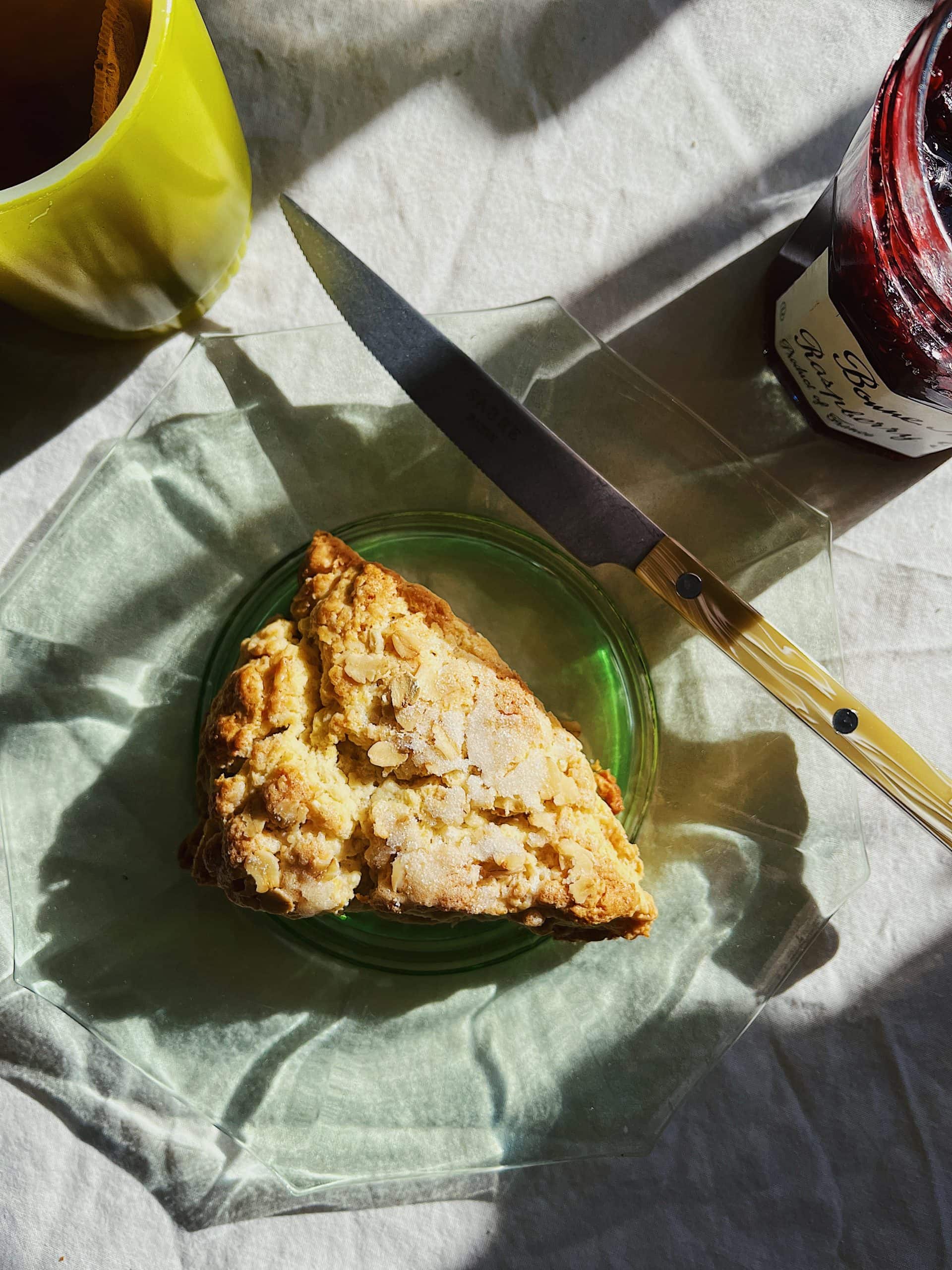
A freshly-baked scone is a truly special breakfast. My preference is a butter- and cream-based wedge that’s tender and crumbly, pillowy-light, and barely sweet. These sourdough starter discard scones are moist enough to be enjoyed on their own, sans spread, but aren’t overly rich or sweet when spread with butter and jam. This is achieved by keeping the ingredients list (and flavors) simple. And of course, as their name suggests, there is one tangy addition to this scone dough: a full cup of sourdough starter discard.
To make a successful sourdough starter discard scone recipe, we’ll reduce some—but not all—of the water and flour that appears in such a recipe. After playing around with removing different amounts of the various water-contributing ingredients (cream, egg, and butter), it was clear that, like any other sourdough recipe, a successful starter discard recipe is not the result of using as much of the ingredient as possible. Starter discard truly shines in a recipe when just enough is added to lend a subtle tang.
Use Unfed Discard Straight from the Refrigerator
These scones get their lift from plenty of baking powder, aka a chemical leavener, so they don’t need ripe, extra-active sourdough starter. Therefore, unfed sourdough starter discard straight from the refrigerator (from your sourdough starter discard cache) will work perfectly in this recipe.
To Remove Excess Water, Use Egg Yolk and Less Dairy
Sourdough starter discard is fermented flour and water in equal parts by weight. In order to include starter discard in a dough, some plain flour and water needed to be omitted. Flour is easy enough of course; but water is tricker, as scone recipes don’t tend to include pure water, so we have to look for it within other wet ingredients.
Some scone recipes do not call for egg, while others say the main difference between a biscuit and a scone is in fact eggs’ addition. Because I was looking to remove water from the dough to add in the starter discard, and eggs have quite a bit of water, I naturally formulated the recipe around the use of one whole egg. Removing one large egg’s 35-gram white (about 90% water) meant I could add 70 grams of starter discard, or 35 grams each of water and flour, so naturally I went for it, leaving the yolk to contribute fat to the dough.
To remove more water from the recipe, I looked at other dairy often included in scones, specifically butter and milk products, which have varying degrees of water content. While most scone recipes that call for butter also incorporate milk or buttermilk (like our einkorn pumpkin scones), some are made entirely with cream and no butter. I personally find that both butter and cream bring the most valuable textures and flavors to a scone: Butter for craggy-crisp edges and flaky layers, cream for a rich flavor and extra-tender interior.
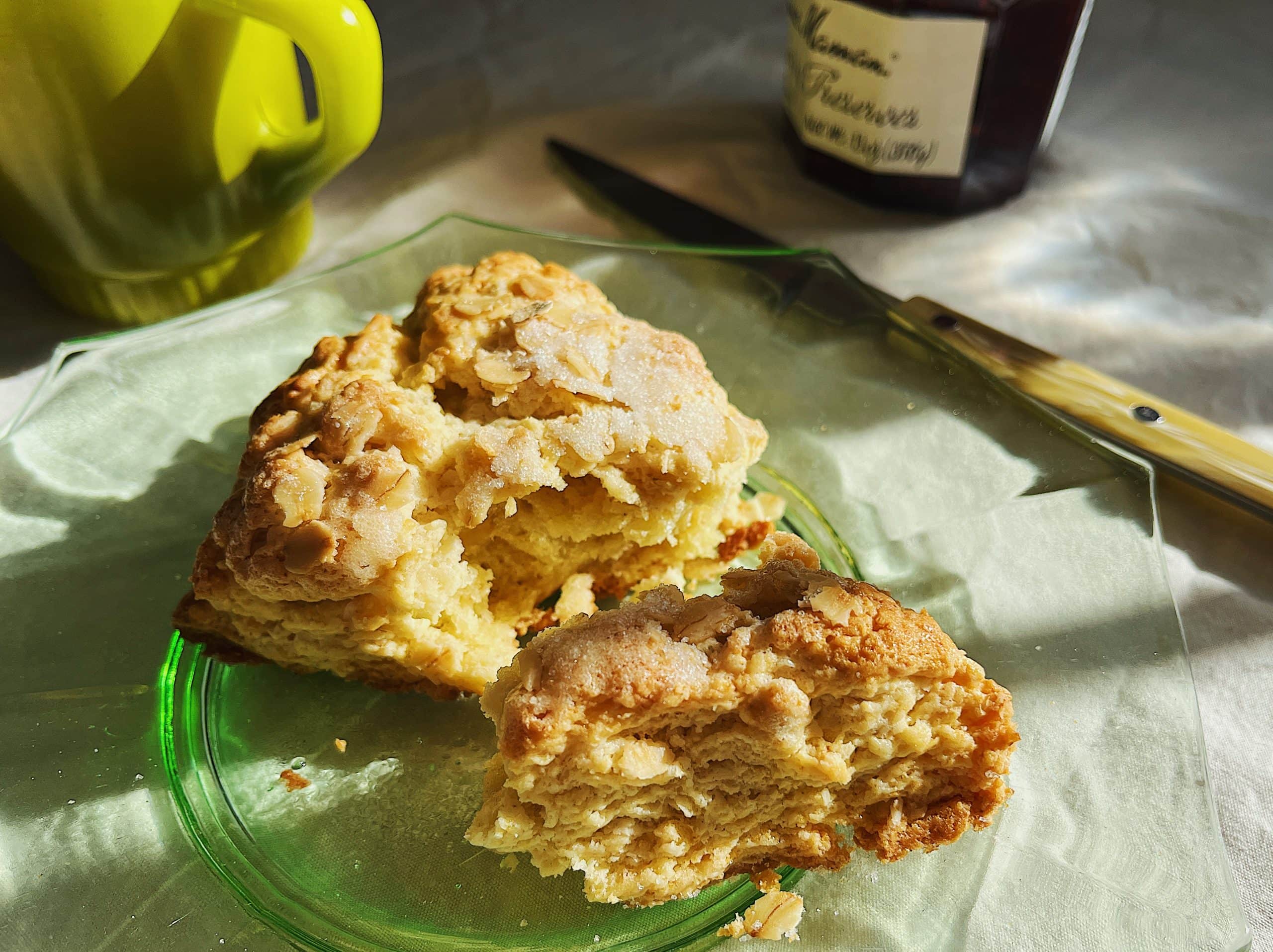
Because scones come out as pillowy as possible when using very cold ingredients, especially fat, and the best way to remove water from butter is by melting it (as demonstrated in this starter discard sugar cookie recipe), I opted not to remove any water from the butter. Could I have removed water from the butter via melting (essentially making clarified butter), re-chilled it, and then used it in the dough? Sure, but that would’ve added quite a bit to the recipe time, and I simply didn’t want to do that to any hungry bakers. After a few tests with cream as the additional dairy, it was clear that as the cream was significantly reduced, the scones lost some of the richness that makes a cream scone so desirable. Additionally, these minimal-cream scones had quite a bit more tang. I landed on “removing” some, but not all, of the cream, adding up to another 150 grams of sourdough starter discard.
That’s a total of 220 grams, or 1 cup of sourdough starter discard.
Why Use Grated Butter?
For flaky, tender scones, you need small pockets of cold butter. The butter slowly melts in the oven for tenderness, and generates steam to help with rise. While you could cut in butter with your fingers or a pastry blender as you might do in pie dough, grating butter on a box grater creates perfectly sized pieces that you’ll simply toss into the dough to disperse, no cutting needed.
How to Freeze Sourdough Scones (Baked or Unbaked)
If you have lots of starter discard in the refrigerator that you want to use up, make two (or more!) batches of scones and freeze them, baked or unbaked. Scones taste best when baked fresh from raw dough, but reheated frozen scones are nothing to turn up your nose at.
When it comes to baking frozen raw scones or reheating frozen scones, the quality will start to degrade (barely) after 1 month, and more noticeably after 2 months, so I don’t recommend keeping either for more than 2 months.
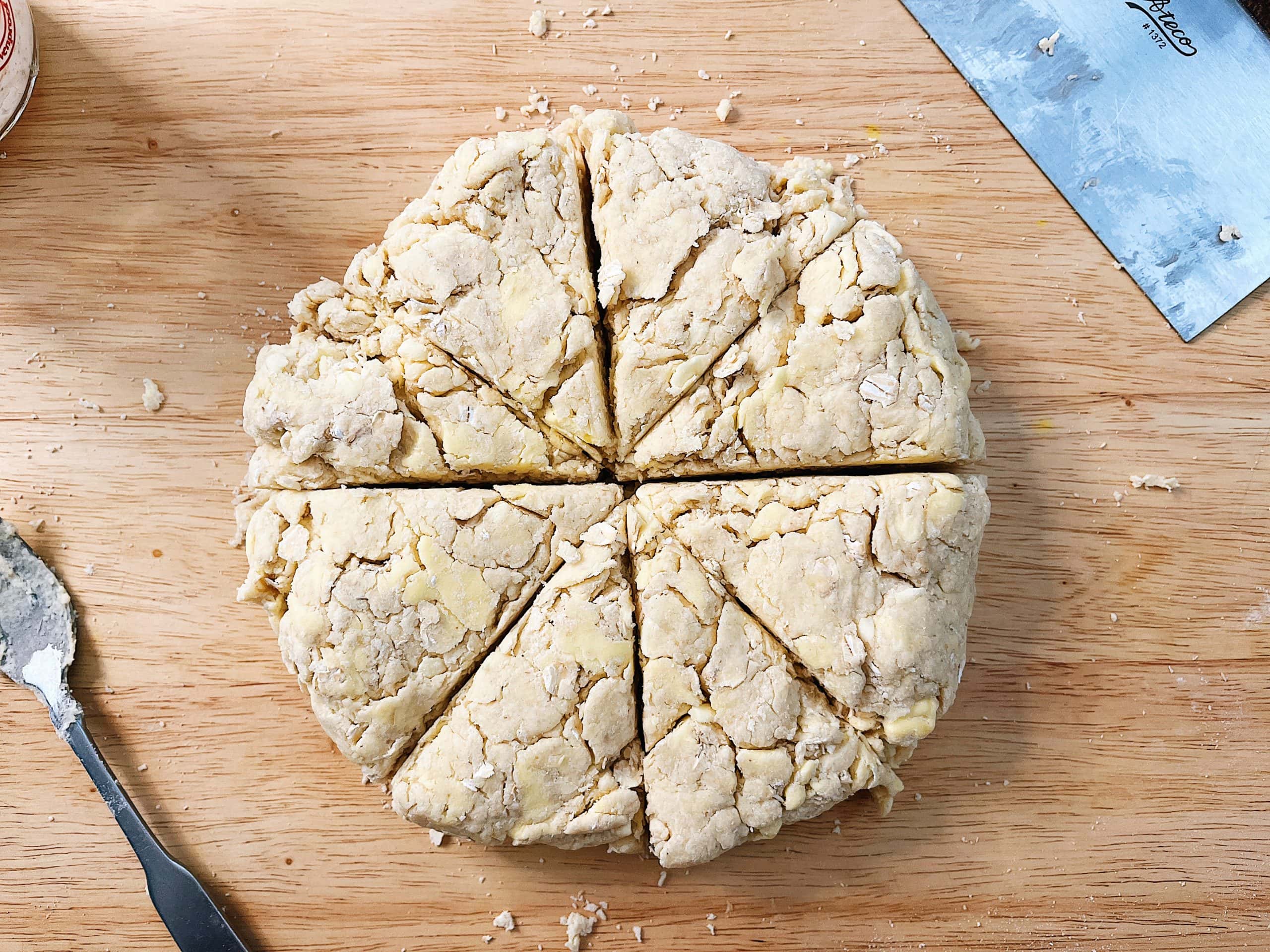
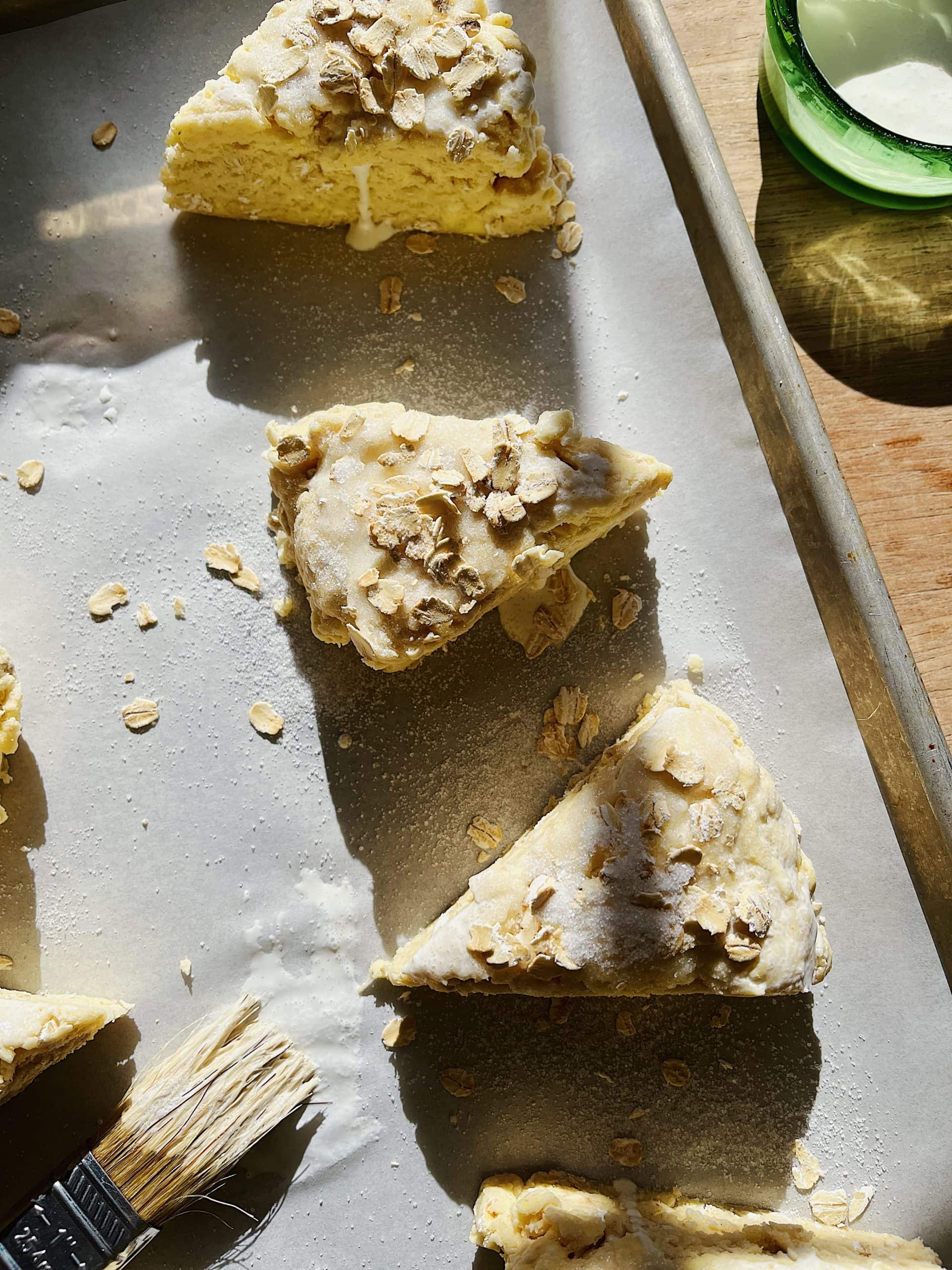
For freezing unbaked scones: After cutting the scone wedges, place on a parchment-lined sheet pan (you can freeze more than one batch per tray, just ensure there’s at least ¼-inch of space between each scone) and freeze until solid, about 2 hours. Wrap each scone in plastic wrap, then place the scones in a large freezer-safe container or bag. Store in the freezer for up to 2 months. When you’re ready to bake, place up to 8 frozen scones on a parchment-lined sheet pan, brush with additional cream and sprinkle with oats and sugar per the recipe, then bake at 375ºF (190ºC) for 30 to 40 minutes.
For freezing baked scones: Let the scones cool completely, then wrap each scone in plastic wrap. Place in a large freezer-safe container or bag. Store the scones in the freezer for up to 2 months. When you want to reheat, place however many scones you’d like on a sheet pan (no need to line it or worry about spacing them evenly as they won’t stick, and have already expanded during the bake). Defrost at room temperature for 1-2 hours or overnight in the refrigerator. Reheat defrosted scones in a 350ºF (177ºC) oven until warmed through, about 10 minutes.

Sourdough Starter Discard Scones
- Prep Time: 45 minutes
- Cook Time: 27 minutes
- Total Time: 1 hour 12 minutes
- Yield: 8 scones
- Category: Breakfast, Brunch, Snack, Dessert
- Cuisine: American
Description
Tender cream scones come together with kitchen staples—including your sourdough starter.
Ingredients
- 140 grams (10 tablespoons) unsalted butter, cold
- 114 grams (½ cup) heavy cream, cold from the refrigerator, plus more for brushing
- 220 grams (1 cup) sourdough starter discard (100% hydration, unfed, preferably cold)
- 14 grams (1 large) egg yolk, cold from the refrigerator
- 257 grams (2 cups plus 1 tablespoon) all-purpose flour
- 67 grams (⅓ cup) granulated sugar, plus 25 grams (2 tablespoons) for topping
- 37 grams (¼ cup) rolled oats, plus 19 grams (2 tablespoons) for topping
- 16 grams (4 teaspoons) baking powder
- 2 grams (½ teaspoon Diamond Crystal or ¼ teaspoon Morton) kosher salt
Instructions
-
Use the large holes of a box grater to grate the butter. Transfer to a small bowl and place in the freezer until it goes into the dough.
-
In a medium bowl, whisk together the heavy cream, the discard, and egg yolk until smooth. Place in the refrigerator until it goes into the dough.
-
Line a sheet pan with parchment paper.
-
In a large bowl use a fork to combine the flour, 67 grams (⅓ cup) sugar, 37 grams (¼ cup) oats, baking powder, and salt. Use the fork to toss the grated butter to coat in the flour mixture (no need to work in the butter any more than this), then stir in the cream mixture until just combined. Knead the dough in the bowl a few times to bring it together.
-
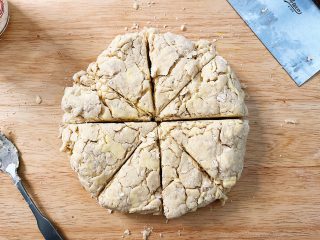
Dump the dough onto a work surface and pat it together to form a roughly 2-inch tall disk. Cut the disk into 8 wedges. Arrange the wedges evenly on the prepared sheet pan. Freeze the scones until firm, about 30 minutes or up to 8 hours. If not baking after 8 hours, wrap the scones in plastic wrap, then place in a freezer-safe bag. Freeze for up to 2 months.
-
When you’re ready to bake, preheat the oven to 375ºF (190ºC) with a rack positioned in the center. Brush each scone with a bit more cream, then sprinkle with 19 grams (2 tablespoons) oats, then 25 grams (2 tablespoons) sugar.
-
Bake until the scones are puffed and deeply golden, 22 to 27 minutes (if baking scones that have been frozen for more than 8 hours, they may need an additional 5 or so minutes.) Let cool on the sheet pan for 5 minutes before devouring, or cool completely.
-
Store in an airtight container at room temperature for up to 2 days; or wrap individually in plastic wrap and a freezer-safe bag and freeze for up to 2 months. Reheat room temperature scones in a 350ºF (177ºC) oven until warmed through, about 10 minutes; defrost frozen, baked scones for 1 hour at room temperature or overnight in the refrigerator first, then warm through.

Notes
Add up to 1 cup fresh, frozen, or dried fruit (use small fruit like blueberries or raisins; chop anything larger into ½-inch pieces), candied ginger, or chocolate chips to the batter after adding the cream mixture.
Replace up to 50% of the all-purpose flour with whole wheat flour.
Sourdough Starter Discard Scones FAQ
Can I use a ripe sourdough starter discard?
While the use of chemical leavener in the recipe eliminates the need for a ripe, recently fed sourdough starter, you can use it if that’s what you have. Chilled ingredients, including starter discard, help achieve a tender, flaky texture, but as the scones get a 30-minute freeze before baking, you should have no trouble if using room temperature starter discard.
Can I reduce or increase the sourdough starter discard amount in this recipe?
So you only have ½ cup of sourdough starter discard, but you really want to make these scones. Well, you’re in luck! Just increase the cream and flour ratios a bit: with 110 grams (½ cup) starter discard, you’ll need 170 grams (¾ cup) heavy cream and 313 grams (2 ½ cups) all-purpose flour. The scones will be slightly more rich, and slightly less tangy—no problem in my book.
Technically speaking, you could probably replace all the cream in this scone recipe with the liquid in sourdough starter discard. With so much less milkfat, the resulting scones would lose a lot of richness, and taste quite tangy, bordering on savory. Is that a bad thing? Not necessarily! Just something to keep in mind. All of which is to say: Feel free to play around with the ratio, keeping in mind that as you add starter discard by removing cream, you’ll need to reduce an equal weight of flour from the recipe.
Can I add fruit or other flavorings to these scones?
Yes! Add up to 1 cup fresh, frozen, or dried fruit (use small fruit like blueberries or raisins; chop anything larger into ½-inch pieces), candied ginger, or chocolate chips. Add them to the batter after the cream mixture.
You can also add flavor via spices or citrus zest. Try 1 gram (½ teaspoon) ground cinnamon or cardamom, mixed in along with the dry ingredients. Or use up to 12 grams (2 tablespoons) of grapefruit, lemon, or orange zest: Make the most of the flavor by adding it to a small bowl with the sugar, then rubbing the mixture together with your fingers until the sugar is slightly moistened, then follow the recipe as written.
Can I make these scones with whole wheat flour?
Yes! Whole wheat flour adds a slightly nutty flavor and heartier texture to scones. While replacing all of the all-purpose flour with whole wheat can result in a denser scone, you can swap in up to 50% whole wheat flour.
Can I skip the 30-minute freeze before baking scones?
Don’t skip it! Freezing the scones helps immensely with rise: Chilled butter melts more slowly, which causes the scones to bake up tall and flaky, and the gluten in the flour has some time to relax, keeping the scones tender.
What’s Next
For more ways to put your sourdough starter discard to use, see our starter discard recipes, or get right to work on a tangy lemon and poppyseed loaf.


82 Comments
I followed the directions very carefully and let me say….Slap these things right on my thighs because that's where they are going to end up!! Gosh these are so good! The crispiness is delightful with the soft, flaky center—to die for! I did make these into cranberry orange scones with a cinnamon sugar sprinkle on top. I added a bit more salt than called for because the 2 g did not seem like enough. Glad I did.
Cannot wait to try different varieties!
Hi from New Zealand Maurizio, thank you so much for all your fabulous recipes! Do you think it would be possible to add cheese to these scones – if so quantity? (say 1& 1/2 cups of grated tasty cheese) without altering other ingreds? Nicki
Yeah absolutely. I'd start with 1 cup of grated cheese (anything gratable!).
Hi everyone! I’m Jordan and I was wondering if anyone had an idea to why my scones are turning out really dense (I think that’s the right word)? Also, by “the big holes on the box grater” does she mean the circle shaped holes or the three long holes on the side?
I do the circle holes. Are you over working the dough? It should literally just come together (and still be a little crumbly)!
I tried the recipe with the metric amounts listed on the recipe card and it turned out really terrible. The texture was great but it tasted like straight baking powder…not sure where it went wrong because it seems everyone else in the comments had no problem
Hey Kiki! Have you tried measuring by volume instead? 4 teaspoons. I weigh on a scale, but I'm just curious. Also, you could try using baking soda instead (there are enough acidic ingredients in here for soda to work!).
I have to admit that I was skeptical about this recipe. I thought there was too much liquid and discard. But it’s the best sourdough scone recipe I’ve ever tried! I made I few adjustments. I actually roasted oats with flaxseeds and sesame seeds in the pan then soaked the mixture in milk. I used milk instead of cream and 113 gm of butter (as a dietitian I am always trying to reduce fat) . I used a whole egg (more convenient for me) and a cup of chopped dried apricots. I used 1 tablespoon of baking powder and 1 teaspoon of salt.
Glad you liked these! Love the idea of roasting the oats.
Thank you for you comments, I too have to reduce my fat intake, lower cholesterol. I’ll definitely give they a go.
This looks SO exceptional that I have to ask: do you think there might be a non-dairy substitute for the heavy cream? I have an allergy and find good vegan butter is a strong 1:1 butter replacement, and oat milk does the trick for regular milk, but cream is tougher. What do you think? Could coconut cream fit the bill perhaps?
I think a full fat milk alternative would work well!
As soon as I saw this recipe on the newsletter I wanted to try it because I just LOVE scones.
I even have one batch cooling off to take to my in-laws right now 😀
And also I love the fact that it utilizes A LOT of discard which is always great 🙂
Highly recommended for anyone to try it! I already know it by heart.
Here's the alternatives I've tried that worked for me:
– Less sugar, for a bit more savory treat (around 30g. total)
– No oats
– Crushed oats instead of rolled (not sure how its called in English exactly)
– Sweet cream instead of heavy just because most of the times I'm baking cakes and such and that's what I have at home.
Simply put – a beautiful, delicious and easy to make recipe. Thank you!
Love these swaps, Dimana!
Hi there. How can I make these without the last? What adjustments or substitutions would it need? Thank you.
Without the Oats*
You totally can – I tried it already a few times 😀
I tried this recipe with some hesitation (it sounded like a LOT of discard), but scones came out wonderfully. I used cane sugar for the topping, as I like its taste better. Thanks! and greetings from Milano https://uploads.disquscdn.com/images/6fd99fe226c77296a55a51b38e25687a0b6a1bdd4b21863ce5bee6dacdda0997.jpg
Gosh these came out PERFECT!
When adding in fruit, do I add it in with the cream mixture and mix with the cream and flour? Or after the cream and flour has been mixed?
I did 1 cup of frozen blueberries and found it somewhat difficult to mix it into the dough after it had been mixed, so it made me think that I was supposed to mix it all together at the same time.
I add fruit in with the cream mixture so it is easier to blend with the dry ingredients!
Yes, with the liquid mixture!
I made two batches: one using a cup of frozen blueberries and one using a cup of chocolate chips. The result was incredible. This is an easy recipe that produces magnificent results. The scones are light and flaky and impossible to
Resist.
I do wonder if I would need to adjust the sugar if I were to make these into a savoury scone using scallions and cheese…
Id reduce sugar by 30g. Glad you liked these Philip!
Ugh, I’m so bummed. The first time I made this recipe, we absolutely loved them but I thought they maybe had just a touch too much leavener – just the faintest hint of metallic aftertaste. This time I cut down to 3 teaspoons leavener to see what would happen except I accidentally used baking soda instead of baking powder 🙁 Third time’s the charm!
LMK how it goes, Lauren!
Try using baking powder without aluminum. I believe clabber girl is aluminum free.
These came out great. I’m trying to keep refined sugar to a minimum. Thoughts on trying to sub out some of the sugar with honey?
You can absolutely do that 🙂
This worked great! I tried it with a cranberry, orange zest mix with 50% whole wheat flour, and they were huge hit! My honey was a little crystalized so I gave it a brief zap in the microwave. That thinned it and made it easier to mix and I think I’d recommend that either way, but it really takes just a few seconds in the microwave.
These are some of the best scones I've made over the years, and I've made a lot! The crumb is very light and tender. The outside crust is nice and crispy. I omitted the egg yolk and oats and would do that again. I had to sub light cream for the heavy but it didn't seem to affect the texture. For a flavour boost I added cardamom, orange zest and toasted walnuts. Delicious!
Oooh love those adds Sadie! Glad you liked these, I love 'em 🙂
That’s my question….can 1/2&1/2 cream be subbed for the heavy cream?…OR what about for half the liquid, use 1/2&1/2 cream and the other half, use whole buttermilk. Will that provide enough milk fat? Your thoughts?!
I was wondering if buttermilk could be a substitute for the cream and if I could make these a savory scone with chopped ham and cheese?
Yes to both!
I did and they were super yummy! Thank you!
These were absolutely incredible what a fantastic recipe thank you so much! I added chocolate chips and accidentally used half and half they still turned out great!
Yumm, great add with choc chips!
If I mixed all the wet ingredients 10 days ago, covered and stored in fridge but never got around to finishing, is it safe to still use? All the ingredients are within their expiration date. Wasn’t sure if the sourdough discard already being included would make a difference.
Hmm. That's a long time, Brenda. I mean, I bet you it's safe, but I might start over just to be sure everything turns out okay!
Thanks Maurizio for sharing the recipe 💗🤗
It's Rebecca's creation and such a good one! Enjoy 🙂
I made these sourdough discard scones this morning and we had them with blueberry jam I made last evening. WOW! These are SO tender and delicious! Next time I make shortcake (Peach, or strawberry) I I am going to use this recipe and cut out the dough in rounds. Thank you for yet another way to use discard.
So glad you liked them, Linda!
Outstanding! I'm about to make my third batch of these! Truly EXCELLENT!!!
Happy you liked these scones, Carren. I'm making them again this weekend 🙂
Hello!! The Perfect Loaf has been my go-to book and site for all my sourdough needs!
I was thinking of making savory scones with green onion and cheese. Would you keep the same amount of sugar or use less? Thank you!
I would personally use less sugar. That sounds delicious by the way.
I just made these scones this morning 5/19/24, best scones I’ve ever made, I put blueberries and almonds in mine and made a goat cheese spread to go with them. For sure this is my ” Go to ” scones recipe.
Right on, Michael! Really love those mods, too. I just made these for Mother’s Day and they were a hit (again). Enjoy and thanks for the comments!
Made these this week, added a cup of semi-sweet chocolate chips, and must say, absolutely amazing. 🙂 Thank you so much!
Oooh, delicious. I haven’t tried adding chocolate… yet!
Just made these and was worried the dough was super sticky…but they baked up nice and fluffy!! not too sweet! loved that they used a full cup of discard.
So happy they worked for you, Janice. These are such a great way to use discard, in fact, I’m making them tomorrow for Mother’s Day!
Can Einkorn flour be substituted for AP flour?
Yes, I think that would work super well for these (I generally swap einkorn for AP, though not always 100%).
Hi,
Can I use self raising flour instead of the all purpose flour ?
Hey Derek! No, I would use just plain AP for these!
This is my new favorite discard recipe using cold discard from the refrigerator. I made them in my stand mixer and cut the butter very quickly into a very small cubes by hand. I added one cup of a combo of dried orange peel and cranberries, and added 1/2 teaspoon of cardamom. I scooped them out (13 scones) and baked them for 24 minutes – perfection!
Oh, I LOVE the idea of using candied orange peel. Im going to add that to my batch this weekend 🙂
These turned out fantastic! Thank you so much for all your recipes!
So glad you liked them, Lita. Rebecca really nailed this recipe!
These were so good! I used oat milk instead of cream. And I left in the freezer overnight (probably 9 or 10 hours) and they baked great the next morning- just needed a little more time in the oven.
So glad to hear these worked well for ya, Penn!
Just wondering if there’s any wiggle room in this direction – Freeze the scones until firm…up to 8 hours. Specifically would the scones still work out if I made the dough the evening before and froze until baking the next morning? Thanks.
Yes, absolutely!
Thanks, Rebecca, for this tasty, quick and easy recipe! Made a batch today (by weight), substituted milk/yogurt for the cream and they turned out beautifully! Grated butter in a food processor – which worked – but next time I might chill the work bowl and attachment first to keep the butter from sticking.
I planned to add in blueberries but omitted because I wasn’t sure if they go in when the “cream” ingredients are added or after dough is stirred together. Maybe a line in the directions to call this step out, “If adding fruit, stir in now,” would help clarify for other novice bakers? 🙂
Great suggestion, will add this!
Made these today and they came out delicious and so pretty! Perfect topped with honey or jam. Made them with ingredients by weight, and my dough was a touch dry and not quite coming together- I did add another splash of water and I was worried this might make them tough with the extra mixing but they came out a lovely texture even so. They are quite rich, so i think I will make smaller scones next time. I may also work the butter into the flour next time as I found grating the butter to be messy (I used frozen butter).
Great comments there, Steph. The dough was a touch dry for me, too, but I added a splash of cream to better suit my flour. Cutting the butter in with a pastry blend is fair game 🙂 Enjoy!
Can these scones be made with buttermilk instead of heavy cream?
I was out of cream and only had buttermilk in the house; they turned out terrific. Possibly not as rich as the original because the buttermilk has less fat, but I thought they were terrific. The buttermilk added a bit of zing.
Yup, absolutely. Just like @disqus_pnIzF5KUjQ:disqus said. You could even use regular full fat milk—they’d just be a tad less rich.
I love sourdough scones as a special treat. Usually use einkorn flour, blueberries, and lemon zest.
Havent yet tried these with einkorn, but that’s a great idea. I’ve also been keen to try with white sonora pastry flour!
I like to do a long cold ferment to help boost digestion that sourdough offers. Should I do that instead of the 30 min freeze?
That’s an interesting idea, Jaime. I haven’t tried it with these so I don’t know how it’ll affect the dough. But even letting the dough rest in the fridge should encourage some fermentation, and might be a good middle ground between the recipe as-is and letting some fermentation happen.
Whatever you try, please report back on how this works for ya!
Fantastic!! My favorite scored ever. Family devoured them!
So happy to hear that, David!