


Understanding and working in baker’s percentages, also known as baker’s math, is a key skill for the home and professional baker alike.
If you’ve ever wanted to scale up or down a bread recipe, baker’s percentages and this page will help you. If you’ve ever wanted to understand all those percentages and prefermented flour labels in my posts and bread books, this post will help you do that, too. This introduction to baker’s percentages is a place to dig into that not-so-scary math behind baking formulas.
What Are Baker’s Percentages?
Baker’s percentages, also known as baker’s math or formula percentage, allow a baker to quickly scale up and down recipes, read formulas (recipes), and immediately understand the type of bread it represents and a way to add and remove ingredients without affecting the entire recipe.
Why Use Baker’s Percentages?
The cornerstone of using baker’s percentages is that we weigh each ingredient for accuracy (you are weighing, right?), and their weight is related to the total flour weight in a recipe. This means the water, salt, preferment, nuts—everything—is a percentage of the total flour weight.
And because we keep flour at the center of everything, it gives us a starting place from which to compare everything. Instead of ingredients as percentages with respect to everything else, they’re with respect to flour only. In this way, when we see a dough hydration of 80%, we instinctively know it will likely be a pretty wet dough[footnote]Ok, I know hydration is very respective of the flour you’re using. Still, generally, 80% hydration is considered moderately high by most standards.[/footnote].
With baker’s percentages, you can:
- quickly scale up and down a recipe
- assess a recipe immediately and determine what the end bread might be like when baked (further, it helps us spot gross errors at the formula-creation level)
- communicate with other bakers in a standard format to quickly share formulas
- add, remove, or change ingredient percentages without affecting the entire formula
First, let’s go through a simple calculation to set the stage. A nice stage. A gentle stage. A stage where math is our friend.
The First Thing To Know About Baker’s Percentages
Perhaps the most confusing part about baker’s percentages can be removed by understanding this single statement:
If you sum all the percentages for all the ingredients in a formula, it will be OVER 100%.
Typically, when dealing with percentages in other areas of life, all the items add up and neatly sum to 100%, or the percentages describe the portion of a whole (e.g., 50% of the pizza is cheese).
With baker’s percentages, however, percentages are used to serve as a reference point relative to the main ingredient: flour (which is always 100% of the recipe). This lets us quickly see how much of an ingredient is in the recipe relative to the flour.
Let’s look at how you can calculate the percentage of an ingredient now that we know flour is always pegged to 100%.
Calculating The Baker’s Percentage of a Single Ingredient
Here is how you calculate the baker’s percentage for any single ingredient in a bread formula:

And that’s it! If you want to know what the hydration of a recipe is (i.e., the baker’s percentage of the water), just take the total weight of the water, divide it by the total weight of the flour, and multiply it by 100. That’ll give you the hydration percentage. And you can do this with any ingredient in the recipe: mix-ins, butter, sugar, oil, etc.
Next, let’s work through an example.

My Spreadsheets Do All The Calculations For Me
While learning baker’s percentages and math is incredibly useful, I rely on my spreadsheets to do all the work. TPL Members have access to my baking spreadsheet suite, making creating and editing bread formulas much easier. In other words, the spreadsheets do all the heavy lifting.
A Baker’s Percentage Example
Now that we know how to calculate the baker’s percentage for a single ingredient, we apply this to all the ingredients in a recipe to fill out the total formula.
Let’s use my Simple Weekend Sourdough Bread as an example to work through. Below is a table you’ll typically see here called the Total Formula table; it shows the total weight for each ingredient and its corresponding baker’s percentage.
In the table below, you’ll see some typical percentages: the flour adds up to 100% (high protein bread flour at 80% and whole wheat flour at 20%), there’s water (usually 60% – 100%), some measure of salt (typically 1.8% – 2.3%), and some preferment percentage. For weights, I don’t often include sub-gram weights (I round everything up) since most home bakers do not have scales that measure to this precision, and it’s not necessary. I included those here, though, so the numbers work out precisely.
Total Formula
| Weight | Ingredient | Baker’s Percentage |
|---|---|---|
| 805.8g | High protein bread flour, malted | 80.00% |
| 201.5g | Whole wheat flour | 20.00% |
| 765.5g | Water | 76.00% |
| 19.1g | Salt | 1.90% |
| 8.1g | Sourdough starter | 0.80% |
A few important things to note:
- if you add all the flour percentages, you’ll get 100% (80% + 20%)—and this is always true with baker’s percentages: the total flour always adds up to 100%
- if you add all the percentages, you’ll get more than 100%[footnote]This is because all the ingredients are with respect to the flour weight—a single ingredient—rather than with respect to the weight of all the ingredients.[/footnote]
In addition to the total formula we also sometimes have a preferment such as a levain. Let’s look at that table.
Levain (Preferment)

Many bakes here rely on a dedicated preferment, or what’s typically called a levain (leaven) when working with sourdough. A levain is an off-shoot of your sourdough starter, and the difference is clear: the sourdough starter is the ongoing culture maintained indefinitely, whereas a levain ceases to exist once it’s mixed in with your dough (and eventually is baked in the oven).
| Weight | Ingredient | Baker’s Percentage |
|---|---|---|
| 40.3g | High protein bread flour, malted | 50% |
| 40.3g | Whole wheat flour | 50% |
| 80.6g | Water | 100% |
| 8.1g | Mature sourdough starter | 10% |
Just like the Total Formula table above, each ingredient is listed with its corresponding weight and baker’s percentage. In this case, the baker’s percentage of each ingredient is derived from the total flour in the preferment, 80.6g. For example, for the hydration (and baker’s percentage) of this levain, we have:

If you need to calculate how to make a specific sourdough starter or levain for a recipe, use my handy starter and levain calculator to do all this math for you!
How to Scale Up or Down a Sourdough Bread Recipe
Another handy reason to get comfortable with baker’s percentages is it becomes extremely easy to scale a recipe up or down (adjust the yield). I learned this method from Jeffrey Hamelman in his Professional Baker’s course (and this is also in his highly recommended book, BREAD). Note that this method works for any unit of weight in the formula: pounds, grams, or kilograms.
Steps to scale a formula:
- Sum all the percentages in the original formula
- Divide new desired total yield (the total weight you want) by the sum of percentages
- Round up the result and multiply it by each ingredient’s percentage to get the new weight of that ingredient
That’s it! Let’s work through an example. My Simple Weekday Sourdough recipe makes two 900g loaves, a total yield of 1,800g. Let’s say we wanted to make three loaves for a total yield of 2,700g.
| Weight | Ingredient | Baker’s Percentage |
|---|---|---|
| 805.8g | High protein bread flour, malted | 80.00% |
| 201.5g | Whole wheat flour | 20.00% |
| 765.5g | Water | 76.00% |
| 19.1g | Salt | 1.90% |
| 8.1g | Sourdough starter | 0.80% |
1. Sum all the percentages in the formula

2. Divide the new desired total yield by the sum of percentages

3. Round up the result and multiply it by percentages
| New Weight | Ingredient | Baker’s Percentage |
|---|---|---|
| 15.11 x 80 = 1208.8g | High protein bread flour, malted | 80.00% |
| 15.11 x 20 = 302.2g | Whole wheat flour | 20.00% |
| 15.11 x 76 = 1148.4g | Water | 76.00% |
| 15.11 x 1.9 = 28.7g | Salt | 1.90% |
| 15.11 x 0.8 = 12.1g | Sourdough starter | 0.80% |
There you have it, my Simple Weekday Sourdough recipe scaled up to make three 900g loaves for a total yield of 2,700g. Notice it adds up to a bit more than 2,700g. That’s because we rounded up the formula conversion factor—as Jeffrey says, it’s better to have a little more dough than not enough.
Also, notice the percentages of each ingredient remain the same. We’re scaling everything up proportionally to the new desired yield—thank you, baker’s percentages!
How To Bake Only a Single Loaf of Bread (Even if The Recipe Makes Two)
A bread formula (recipe) for a loaf of bread can be doubled to make four loaves or halved to only make a single loaf. To make only a single loaf, halve all the ingredients in the recipe, even the levain.
Let’s look at an example and continue with my Simple Weekday Sourdough and halve the recipe to make a single 900-gram loaf. All you do is take every ingredient and divide the weight of that ingredient by 2—including the levain build. The percentages will all stay the same, but the weights will be cut in half. So the total formula table will now be:
| Weight | Ingredient | Baker’s Percentage |
|---|---|---|
| 402.9g | High protein bread flour, malted | 80.00% |
| 100.7g | Whole wheat flour | 20.00% |
| 382.8g | Water | 76.00% |
| 9.6g | Salt | 1.90% |
| 4.0g | Sourdough starter | 0.80% |
To double a recipe, do the reverse: take the weight of each ingredient and multiply it by 2. Again, the percentages will remain the same but the total yield will now be 3,600g.
How to Modify a Bread Formula
Next, let’s say we wanted to add some walnuts to the Simple Weekday recipe. Where would we begin? We might instinctively say 15% would be a good amount: not too much, but just enough to get the flavor across[footnote]Your feeling for these percentages will develop with your ever-increased baking experience.[/footnote]. And the beautiful thing about baker’s percentages is we can add the 15% walnuts to the recipe, and all the other ingredient percentages will remain the same. If we kept our final yield at 1,800g, their weights would decrease, but their percentages will stay the same.
And this is important: because we’re keeping the percentages the same, their relative effect on the dough will remain the same.
Now let’s look at the result. This is the ingredient list before:
| Weight | Ingredient | Baker’s Percentage |
|---|---|---|
| 805.8g | High protein bread flour, malted | 80.00% |
| 201.5g | Whole wheat flour | 20.00% |
| 765.5g | Water | 76.00% |
| 19.1g | Salt | 1.90% |
| 8.1g | Sourdough starter | 0.80% |
| – | – | – |
And this is the ingredient list after adding in the walnuts (last row):
| Weight | Ingredient | Baker’s Percentage |
|---|---|---|
| 743.4g | High protein bread flour, malted | 80.00% |
| 185.9g | Whole wheat flour | 20.00% |
| 706.2g | Water | 76.00% |
| 17.7g | Salt | 1.90% |
| 7.4g | Sourdough starter | 0.80% |
| 139.4 | Walnuts, shelled and toasted | 15% |
After adding 15% walnuts to the formula at right, the weights of all the other ingredients went down proportionally, but their percentages remained the same. This means the ingredients’ weights went down by the same amount across the board, giving “room” to add the walnuts to the recipe and still maintain a yield of 1,800g.
Baker’s percentages let us focus on a single ingredient and not worry about how it affects others in the formula.
Imagine for a minute what would happen if we added some walnuts to the recipe but didn’t have baker’s percentages. We’d have to blindly guess their weight and add the walnuts, this would mean our total yield would increase and we’d have an increased dough weight in the end — perhaps our dough wouldn’t fit in our desired proofing baskets or we wouldn’t be able to fit it in our oven.
With baker’s percentages, we can add any percentage of walnuts we desire, and the ratio of other ingredients will remain constant. This lets us focus on just the ingredient we’re increasing (or decreasing) and let the rest of the ingredients still play their role.
Use Spreadsheets To Do All The Work
Understanding baker’s percentages and math is highly valuable, but I depend on my spreadsheets to handle the calculations. Join the baking community here—The Baker’s Corner—and access my baking spreadsheets, which simplify creating and adjusting bread formulas. Essentially, the spreadsheets take care of the hard work and let you focus on baking!
How To Calculate The Prefermented Flour Percentage
Another common term is the prefermented flour (PFF) percentage. This is the percentage of flour that’s fermented ahead of time before the main dough is mixed. This percentage can vary widely depending on the recipe (and whether you’re using only sourdough, instant yeast, a mixture), all the way down to 1%, and up to 50% — and even outside those extents.
Continuing with my Simple Weekday Sourdough example from above, that recipe has a prefermented flour percentage of 8.00% (listed in the Vitals table). This means that 8% of the total flour in the recipe is in the preferment (levain); let’s see how:
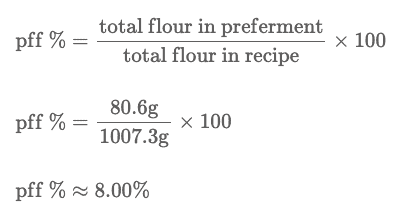
Over time, this percentage will begin to convey something instinctively to you, much like the hydration percentage. You’ll see 5% or 10% or 25% and think, ok, that’s a recipe’s low, medium, or high PFF percentage. Based on this intuitive assessment, you’ll need to pay attention and make a larger sourdough starter to build the levain (if high PFF), or perhaps start with the assumption that the dough will move very slowly for a long fermentation time (if low PFF).
Why Don’t You Include the Sourdough Starter In The Calculations?
This is an important point and something I’ve struggled with here at The Perfect Loaf (and in my baking in general) for years: should I include the sourdough starter flour and water in my overall calculations? For a formula to be wholly correct and account for all flour and water, the flour and water in the starter should be included. However, I typically do not include them for clarity and ease of use. Instead, I treat the starter as a single, cohesive unit.
I see this as a tradeoff between complete correctness and clarity. For example, if I included my starter in my formulas here, you’d always see rye flour as an ingredient (because it’s in a tiny percentage of my sourdough starter feeds). Including that bit of flour would be the correct thing, but it means strange percentages for all the other ingredients, which will lead to questions and confusion.
In the end—and maybe just for now!—I’ve settled on not including the starter flour and water in my calculations. This is because, in many of my formulas, my starter is included in such a small percentage that the impact of that flour and water on the total formula is minimal.
If you’re a TPL Member, you’ll notice in my baking spreadsheets that I offer the option to include your sourdough starter in the calculations for a dough formula if you wish to be 100% correct.
Explaining The Perfect Loaf Bread Tables and Charts
I know there are many tables on this website, but I think it is the most concise and clear way to convey a bread formula. Here at The Perfect Loaf, I like to split up a bread formula into four tables: Vitals, Total Formula, Levain Build, and Dough Mix.
The Vitals table (see right) is a roll-up of all the important aspects of a recipe:
- the total dough weight (how much the recipe makes)
- the prefermented flour percentage (the amount of preferment in the recipe with respect to the total flour in the recipe, more on this below)
- the hydration percentage (the amount of water in the recipe with respect to the total flour in the recipe)
- the yield (how many loaves, buns, rolls, etc., the recipe makes).
Simple Weekday Sourdough Vitals
| Total Dough Weight | 1,800 grams |
| Pre-fermented Flour | 8.00% |
| Hydration | 76.00% |
| Yield | 2 x 900g loaves |
The Total Formula table (see earlier in this post) is a snapshot of the entire formula, taking the levain into account: the total flour required, the total liquid, total fats, total sugars, and so on. In addition, the TF table also shows the baker’s percentages for everything so you can get a sense of the recipe outright (as I discussed at the beginning of this post).
The Levain Build table (see earlier in this post) is what you need to mix to make the levain—the off-shoot of your sourdough starter (see my post here on the differences between a sourdough starter and levain) for a single bake—for the recipe. The levain is usually some percentage of sourdough starter, some flour, and some water that’s made some number of hours before the rest of the recipe begins.
Finally, the Dough Mix table is what you need when you get to your counter and start combining ingredients. This table doesn’t have baker’s percentages because, at this point, you just need the weights of everything to know what to add to your mixing bowl.
Why Are the Ingredient Weights Here Rarely Round Numbers?
You might have already figured out the answer to this by now, but it’s worth stating: almost every one of the recipes you see here will have strange ingredient weights that aren’t usually round numbers. For example, in the Simple Weekend recipe used above the high protein bread flour is 805.8g, not 800g. Why?
When making a formula, I work on the overall baker’s percentages. So, I might say to myself, “I want this recipe to have 80% bread flour, 20% whole wheat flour, 76% water, …” Forming an image of the end loaf in my mind through numbers. And this goes back to that instinctual feel for percentages and how they will eventually translate into bread dough.
In essence, I know for me a 76% hydration dough is low to moderate hydration, and it’s also a manageable dough for many. Finally, when I use those percentages and set the total dough yield to be 1,800g (to make two beautiful boules), the math spits out the actual weights I need for each ingredient to satisfy the percentage concerning the total yield. And because I’m focusing on working in percentages (usually round), the actual weights can be whatever the math says they should be—and generally not round.
What’s Next?
And there you have it, my (hopefully clear and not too scary) introduction to baker’s percentages. If things are still unclear, or I’ve missed something here, please comment below, and I’ll get back to you with an explanation. I’d also love to hear if you have any tricks or suggestions on how you work in baker’s percentages (besides just using a spreadsheet!)—there’s always more to learn and, dare I say, more fun!
If you’re looking for more technical aspects of baking, check out my post on dough temperature and its importance in baking.
Happy baking!

138 Comments
Hello there, this is very useful. Can you explain where I would include ingredients like flaxmeal and oats in the calculation? Are they included in the flour or are they ‘others’?
Hey, Deborah. They are not included in the flour, they’d be others, mix-ins, or inclusions.
Hi Maurizio. Thank you . For a self taught baker like me the information here is invaluable. My question is , for a hot and humid climate (32C) what would be the ideal percentage of Levan such that the bread does not get too acidic. Fermentation happens quickly . At times I keep the dough in the refrigerator for bulk fermentation cause keeping the aircon on the whole day is ….. Thank you.
Hey there! It’s really hard to say, it depends on other factors as well (hydration, flour, etc.). At those warm temps, I’d expect to have to drop things significantly, likely single-digits. You might also want to consider switching to a stiff starter and/or levain which I find can work a little more effectively in warm conditions.
So, the flour in the sourdough is not counted to the total flour? And the water in the sourdough not counted toward the hydration?
I typically do not count the sourdough starter. I’ve noticed many other bakers do not either. For me, my starter is usually a small overall percentage in the dough (the levain, which is counted is much larger by comparison) so I omit that from the calculations. If you wanted to be super accurate, you could certainly factor your starter in!
Can you please explain when loaves are referred to as 500g/1 kg/1 pound etc? Is that number the total weigh or just the flour measurement? I am trying to purchase new bannetons and they mention dough weight.
For baskets, that will be the total dough weight (all the stuff in the mix: water, flour, salt, etc.) to fit in the basket.
Hello! Thank you for being a resource I’m baking the loaf below but the leavain percentage seems extremely high to me. Would I use all of the levain when mixing it with the other ingredients? I’m used to using starter directly not premixing a levain.
For the levain/sponge
22 g sourdough starter
105 g all purpose flour (approx ¾ cup) plain flour
105 ml water lukewarm
To make loaf
230 g bread flour
115 g wholewheat flour
210 ml water lukewarm
8 g salt
That is a high levain percentage (about 67%), but it depends on the recipe and formula you’re using, maybe that’s the intention (although I’ve never personally baked with that high of a preferment percentage). If it were me, I’d drop it down to 20% or so, so only use about 70g of the levain.
Hi Maurizio,
In you’re Sourdough recipe where you use the Starter directly ,it says Mature Starter ( 100 hydration )
My starter is as follows, discard all but 75 gram. Add 100 g flour, 115 water . So to achieve 100 percent hydration, I would only add 100 g water for its feed ??
Also doe mature mean, the starter has been refreshed and at its optimum to be used ?
Thanks for all your writings.
Nic
That’s right, 100% hydration is the same amount of water as flour. But use whatever you have, if your starter has 115% hydration that’s just fine, too. When I say mature I mean “ripe,” when it’s fully fermented and you’d normally give it a refreshment.
Hi Maurizio,
Can you please share what the perfect range is for Levain PH to give a good rise but not yield in a very sour bread?
Cheers
Maziar
Since I don’t use a pH meter I can’t say, I instead go by aroma, look, feel!
Hey!
I just was reading this as I made an avocado loaf today where I used 250g of avocado for 500g of flour in total. I also used 200g of water.
My end result was quite dense, though I managed to get some rise and air pockets in the final dough.
My main question here, is how do I calculate something like blended avocado? Should I factor that it will be partially liquid, or account for it to be an additional solid?
I played it rather low on the hydration at only 40%, thinking the avocado mash would substitute and raise it to maybe a 55-60%. The dough ended being really quite slack and reminded me a lot of when I make 65% hydration.
Any advice is extremely appreciated!
Whoa, that’s an interesting approach. Honestly, I’m not quite sure. I’d see the avocado as a mix-in (inclusion) instead of a flour, liquid.
Hello ,
Thanks for the information.
Id like to ask a question so if I want to use all purpose flour instead of the bread flour here in the basic recipe. How does the percentages change? Do I keep everything the same except for the water?
Moving to my second question which is ; if I want to reduce the amount of water , do I I have to change anything else in the recipe? Also while building the levain?
Thank you
That’s right, if you want to substitute out AP for bread flour, all will be the same. I find with most bread flour (higher protein than AP, around 12-13%), the dough needs a little added water. I’ll add that water during mixing, a small splash at a time.
If you want to reduce the overall hydration properly and change the percentage of water, yes, you’ll have to adjust the weights of all the other ingredients. However, if it’s a small adjustment during mixing (to adjust “by feel,” as I usually say), it’s fine to just adjust in the kitchen. I do like to take notes of the adjustment, and if it’s significant, go back and modify the formula (so I don’t forget next time!).
Hello! Thank you
So I made this recipe today , Ill be baking it tomorrow and let you know:))
I have a couple of other questions if you can help me out with please .
1. So I followed the recipe as is , but regarding the levain , First can I make a levain that will be ready in less than 10 hours , if yes then what should I do different?
Second, is the starter percentage 0.008%? I wasn’t sure of it and if I want to make as the previous question so what should be the percentage of my starter now?
Third, can I just change the percentage of water and then keep everything the same ? For example
All purpose flour 80%
Ww flour 20%
Water 70%
salt 1.8%
Starter ( Im not sure how much as I mentioned above ) .
Lastly, lets say I want to add walnuts , I read and understood how to change the amounts of other things in the recipe but the levain is always not clear for me. I always don’t know how much to put .
I hope its okay to ask all these questions:)
Thank you again
To make a faster levain, use more of your ripe sourdough starter (i.e. increase the seed percentage). For something like a 5 hour levain at warm temperature, I usually use 50% sourdough starter as the seed.
The starter percentage can be low to make a levain, but .008% seems very, very low!
I’d suggest you setup a spreadsheet to do all of these calculations. I’m working on getting my spreadsheet uploaded here for everyone to use!
Hi Maurizio, thanks for your sharing. It really inspires me. I have some questions, hopefully you will reply it, thank you very much.
, 1. I always use 20% levain in my baker percentage. But still got too acidic For me. If I lower the levain, in my baker percentage, it will be more acid?
2. If I use more levain, said 30%, what the effect for my loaf? I used to maintain the yield, if I didnt mistake your lesson, so, The other ingredients still have same percentage.
3. Can I use baker percentage to my brioche recipe?
You’re welcome, Melina.
1. Reducing the levain might help, but there are many factors that go into the ending flavor of your bread! I’d say a quick thing to try would be to be sure and refresh your starter often to keep acidity low, use it before it becomes excessively ripe, and keep your dough on the cooler side.
2. Using more levain will speed up the fermentation timeline. But yes, if you want to increase the quantity of one ingredient, you have to adjust the quantity for the others. This is why baker’s percentages are so helpful, you can adjust the percentage of one ingredient (in a spreadsheet, helps!) and everything else stays in line.
3. Yes, you can use baker’s percentages in any recipe.
I wan to add some add ins to my dough. But I think I dont need to maintain the same yield. So, do I have to adjust my bake4 percentages, due to this add ins.
Adding other ingredients do need to be accounted for in the formula if you want to maintain the same total yield (the total weight of the dough in the end). Alternatively, you could just add them in and you’ll end up with some excess when you go to divide.
I’m very curious as to why you only use 8% levain in your recipe? Thats is the lowest I’ve seen.
It’s all relative to the overall formula: the flour used, temperatures, the duration for bulk and proof, etc. In some recipes I use a low levain to build more acidity in the dough over time (the starting pH of the dough will be higher, allowing bacteria to “work” for longer, producing more acidity—flavor). But there’s other ways to do this as well, it’s just an approach I sometimes take. I’ve also seen lower than 8% 🙂
Hi Maurice, thanks for your excellent website! I’m just reading this thread as I was curious to know why some of your recipes use a levain of 1:1:1 and some 1:2:2. Looking through your recipes it looks like the ones that perhaps use more whole grains (spelt/rye etc) have the 1:1:1 levain. Is this something to do with the whole grains being more ‘active’?? Sorry if it’s a silly question! 😆 thanks, Nicky
I adjust the ratios there more because of scheduling–the higher the seed, the faster the levain ripens. It does also have some implications on the resulting flavor in the bread as higher seed means a faster pH drop and less bacterial activity. Not a silly question!
Thank you!
I bought a flour which says it would needs 40% increase is the yeast what does that mean? And to make matters more complex – I am using Levain for sourdough
I have never seen or heard of this. Is it saying the leavening agent needs a 40% increase? Over what?
Hi once I scale down the recipe and arrive at new figures for the flour do I deduct the Flour amount gone into starter for the dough mix ?im trying to scale down ur babka recipe
Hey there sorry for the delay! I don’t usually take the starter into account unless it’s the only preferment.
Ciao Maurizio! Could you address the modification of the formula with 15% walnuts above in more detail. The math doesn’t seem to work out. I see that 15% of the total weight of flour (743.4g + 185.9g = 929.3g X 0.15 = 139.8g), but the remaining weights in grams are a little off. Some are 7.7% of the total weight of flour, while others are 7.3% (salt) and 8.6% (starter). I would greatly appreciate a bit more clarification. Grazie!
Please disregard as I see someone clever figured this out below!
Ok, good. Sorry for the delay anyway, missed this message!
Got it….except…while making the Levain, does the flour used in that process come from the total weight of flour in the recipe or is it in addition to the recipe? I’m excited to try this.
For every recipe you see here at my site, the flour used in the levain is counted for in the Total Formula. The total formula flour and water = dough mix flour and water + levain mix flour and water. Have fun!
Hello maurizio, I did not understand one thing, how do you determine the quantity of water and flour for your preference? Let me explain how you determine that on 8.1 of yeast there are 80.6 of water and flour thanks
Liborio — I usually start with the flour percentages I’m looking for in a formula. What I want for flavor, texture, nutrition. From there, I’ll set the hydration based on the style of bread I’m after and the flour used: usually whole grains need more water, if the bread is mostly white flour, then it can be lower.
Can you please explain why you don’t put into the calculation the amount of water and flour that the starter is made of?
If hydration percentage is sought te starter does have water in it
Thanks
Yes, you’re right. I’ve found this is not typically done, however, likely because the starter is a small amount in the end and I also think many bakers keep their starter at the same hydration as their levain. For me, since my starter is so small going into many of my recipes, I leave this out. Great question!
Hello sir. Is it mandatory to adjust to the original dough weight when using add ins? I have been adding jalapeno and cheese to the recipe I follow but I haven’t adjusted percentages. I’m new to this and have just started getting into that portion of baking.
Thanks
That’s right, when you add new ingredients you do have to adjust all the other ingredient weights (to make “room” for the new additions) if you want to keep the total yield the same.
Hi .will you please explain how to scale down weight of each ingredient when extra ingredient added to get same percentages as previous.For example when walnut added actual 15percent of 1800 gms yield is 270 but final recipe showing 139 gms with reduced weight of every other ingredient. I am not able to figure out.
Thank you for all of your wonderful information! I am terrible at math. So my question is how do I figure out the weight/grams if I have percentages and total weight of a loaf? For example a recipe says that the loaf is 600g: 89% Flour, 11% Starter, 75% Water and 18% Salt. So, what is the weight/g of flour? Is it 534g? I think if I can get the weight of the flour then I should be able to calculate the rest with the information you gave. I REALLY appreciate your help!
You’re very welcome, Beverly! You take the total yield and multiply it by the percentage of each to get that ingredient’s weight. For example, 600g * .89 = 545g of flour. Hope that helps!
You are the best. Thank you!!
Hello.. i was just reading your article. For this part, if we have figured out the flour is 545gr, then the starter is 11% x 545gr? Water is 75% x 545gr? and salt is 18% x 545gr? Pls confirm my understanding is correct?
I’ve only recently started making sourdough and am not aiming to become a master or anything. I just want to make healthy, good tasting food for my family. I’ve made a few loaves that have tasted good but am struggling with too wet dough. Since moving across country last year, I’m still figuring out how altitude & low humidity affects things. I’d think the low humidity would result in dryer dough but 4 of my 5 loaves have been basically un-shapeable. We live in Albuquerque in the West Mesa area so just over 5000ft. How do you make adjustments to recipes to account for altitude & humidity (or know if need to make adjustments)?
Hey, Betsy! I too live in ABQ, in the NE. And while altitude and climate do make a different, hydration really is subjective to the flour you’re using. Having high or low water isn’t important, the important thing is hydrating the flour appropriately for what you’re after. So if the flour you’re using feels too wet, weak, and slack, drop the water until it feels right. Many of the recipes here you’ll find I call for reserving some portion of the mixing water — this is done to help mitigate over hydration. If the dough feels too sloppy after mixing omit that reserved water — if it still is too wet at that point add a little flour to firm things up and reduce the water next time from the get-go.
Generally, I measure out all the water in its own container apart from the flour. Then I add the flour in stages to ensure I don’t over hydrate the dough.
Hope that helps!
How come you don’t include the flour in the mature starter itself? if you’re making a Levain with 80 g of flour, 40 g of 100% hydration mature starter, and 80 g of water, shouldn’t you include the hypothetically 20 g of flour and water in that starter since that changes the hydration levels of the entire recipe. This would also affect the PFF percentage also right?
the only reason I suggest this is because what if instead of Levain being made, I just use a larger amount of mature starter and I still want to calculate hydration levels. shouldn’t I include the flour and water in this large amount of starter in my final baking percentages?
This is a good point and generally, at least in my experience, most bakers overlook the flour & water in the starter that’s added to the levain. Usually this is a small percentage of the overall recipe and won’t have much of an impact later down the line. To be complete, though, you could certainly add those in and take the calculation further — I usually don’t do this 🙂
I got here because of our current global situation i’m stuck at home and wanted to try the idea of sourdough.
But i don’t have a kitchen scale.
Please excuse me as i ramble here, but it’s related to baker’s percentages.
Because of the current situation – it’s complicated – i can’t exactly get a kitchen scale on short notice.
So i built a crude equilibrium balance having one arm with a fixed hanging point, and the other arm having a sliding hanging point with 10 equally spaced marks out to the same distance as the fixed distance on the first side.
This is where the baker’s percentages become unbelievably simple and obvious…
If i am looking to make a 75% hydration mixture, i take a random quantity of flour that looks about right, and i simply hang the flour from between the 7 and 8 marks (for 75%) as the reference and then weigh out water on the other side until the balance rests even. Bingo – 75% hydration, no thinking or calculating. And this works for all ingredients (or it would if my crude scale was better).
Anyway, I’m sure this is where the method comes from because 200 years ago nobody had a digital scale but such a balance is simple and really easy to use if everything is based off the weight of the flour as 100%. It’s a cool way of doing it.
One need to think of Flour as the “base weight” against which all other things are measured as a percentage of that base weight.
So by definition flour must be 100%.
If your flour and water hang evenly, wouldn’t that be 100% hydration, not 75%?
How to adapt a recipe that has all the weights but no Bakers” Percent?
You can calculate the percents based on the flour weight. For example, if your recipes calls for 500g of flour and 300g of water, you do (“ingredient weight” / “flour weight”) * 100 = Ingredient %, so in my example, that would be (300/500) * 100 = 60%. You can do this for each ingredient to get its percentage.
You can go a step further and get the true percentage of each ingredient in the dough. If we know our dough weighs 1800g, we can divide the weight of an ingredient by the total weight of the dough. In my example, we can find the water’s true percentage in the dough by doing (300 / 1800) * 100 = 16.67% (rounded). Doing this for each ingredient should equal 100%.
Hope that all makes sense.
Exactly as Scopes said!
I have a smaller oval Dutch oven and a 10” oval banneton which can hold up to 750 g of dough. This is just over 40% of your beginner sourdough recipe, so would I just use 40% of the listed amounts in the Levain / Dough mix? Is that a weird thing to do? Haha.
When I finally read the “Intro to Baker’s percentages” article I had a difficult time figuring how to calculate the reduced amounts, in the final recipe, when the 15% walnuts were added. When I added all the percentages (including the 15% for the walnuts) I came up with 193.7. I then divided this into 1800 grams and got 9.293. If I took that number times 80%, for example, I got 743.4 grams of bread flour. As it turns out, the 9.293 figure is pretty important.
Thank you. That explanation was great.
Great explanation, indeed. Exactly what I was looking for 🙂 Thanks!
Oh man, brilliant, thank you. There was a big leap we had to make reading that section and I definitely didn’t make it. Thank you for filling in the details here!
H Maurizioi, first of all i’d like to thank you to take the time to make such an excellent baking blog. Congrats!
Here goes my question.
1.- How Can i do the math to calculate the percentage of flour and water in my sourdough starter.
ie. If i make a levain with:
– Flour 50%
– Water 50%
– Mature sourdough starter 10%
* How much of that water is absorbed by the flour, y how much water keeps free in the mix?
* How that free water impacts over the whole hydratation final formula?
2.- …and how does it impact in the percentage of flour and water of the whole formula?
Flour is always 100% – the other stuff i’ll leave to someone else.
So your Levain mixture would be:
– Flour 100% (by weight)
– Water 100% (by weight)
– Starter 20% (by weight)
Think of flour as the “base weight” against which all other things are measured. So, in this case…
Flour is 100% of base weight,
Water is 100% of base weight,
Starter in 20% of base weight.
Hi Maurizio! Quick questions / comments:
(1) How would I scale up / down the levain in a similar fashion for your recipes? Is there an easier way besides solving for x in the formula `pff = x / total flour` after computing the new total flour?
(2) I love this scaling up / down method. Small suggestion: have you considered adding the “total” percentage to the total formula at the bottom in your recipes? Obviously a small thing but every little thing helps when baking 🙂
HI Maurizio I am new to sourdough been practicing it weekly to get to learn the art of the sourdough bake. Can it be said that it that high hydration is more difficult to handle the dough and high hydration is again dependent on the type of flour used in the recipe also on its manageability?
“More difficult to handle” is very subjective, as is the numerical value of the water in the dough as well. For instance, a dough with high rye percentage might be stiff at 70% hydration, whereas a dough with all white flour at that hydration might be perfectly slack and supple. Yes, all relative!
Thanks for the clarification. I got some idea now on different type of flours behave differently with the same water weight. Just one more query on what is the diff in using a starter that is ripe directly with the flour/water as compared to preparing a levain overnight. This confuses me as I cant see the reason for this unless it affects the final bake. Can you help?
Thank you for this explanation of bakers percentagebut I do have a question. How does the hydration percentage relate to the final loaf? You state that a 75% hydration results is a low to moderate rate and a manageable dough. But how does the final loaf compare to one with a 100% or 50% hydration rate? I usually make a no-knead bread with a 75% hydration and the loaf is so slack it doesn’t rise much – it more spreads out. I am in Denver at over 5000 feet above sea level, if that makes a difference. Thank you for any help you can provide.
A valid question but unfortunately just the statement “my dough is 75% hydration” doesn’t convey much information to a baker unless they have more of the picture, including: flour used in the mix, mixing process, bulk process, proof, etc. Why? Because a dough that’s 100% whole grain will feel extremely different at 75% hydration than a dough with 100% high gluten white flour at 75% hydration. So while I say a dough at 75% is low-moderate hydration, I’m mostly speaking to the recipe examples in this post: a mostly-white dough with about 20% whole grain flour.
But even then, all flours require some measure of adjustment when it comes to hydration. As I always say here, the hydration number is very subjective to the flour on hand! Sometimes a white flour is extremely slack and weak at 75% hydration (a good example would be using pastry flour!) and other times it’s the opposite.
Hope that makes sense!
I’ll admit I haven’t read the full article yet but I want to clarify some inconsequential minutiae 🙂 .
Is it more correct to represent the levain in the bakers math as it’s components or as it’s whole in the “starter” category?
E.g. you show starter as 0.8% as it’s only 8.1 grams of the levain and 8.1 grams of 1000.7 grams of total flour (including that in the levain).
In my personal calculator I count the levain as the starter and thus calculate the starter % as total levain weight / flour weight (what I add in the autolyze).
So in this case 8.1 grams of starter goes into a 169.3 gram levain which is added to the dough/autolyze, in this case which contains 926.7 grams of flour (1000.7 grams – 80.6 grams of flour from levain). 169.3 grams levain / 926.7 grams flour in starter = 18.3% levain/starter.
Am I crazy that I always calculated it this way?
A very good point, and I’ve seen it done several ways. To be complete I should really list the levain in that first table as I always break it out into its own category (as you usually see here at the site in my “Levain Build” tables) and in it’s own set of columns in the table.
So what you’re doing is absolutely correct. It’s the percentage of the levain in the final mix and many bakers communicate with that percentage just as they would with the prefermented flour percentage. In fact, if you’ve read the first Tartine baking book he doesn’t mention PFF at all and just calls things “levain percentage,” it’s just the percentage of the levain in that final mix. And in this same way, you’d not see my “starter” row show up there at all, it’s all in the levain.
The reason I have starter in the Total Formula (as I call it) table is because it tells the baker they will need X amount of starter for this bake. Just as the rest of the table tells them how much total flour they’ll need, water, etc., I do this so they can make sure they have enough starter on hand to make the levain that’s yet to come.
The starter, levain percentage, and prefermented flour percentages are all linked and traceable through the formula, it just depends on how you want to use that info and where to show it. If I was super complete here this table would be much larger, but I like to split it up for digestabilibty and to keep relevant info where it’s needed in the process, chronologically.
Hope that makes sense, and in the end, we’re both right! Actually, there’s really no right way to any of this, it’s mostly convention and keeping things consistent 🙂
Absolutely that makes sense and I think I follow your logic. Specifying the initial seed amount required makes a lot sense, especially for those that keep very small starters so they can quickly know if they’re prepared or not in addition to total flour/water/salt needed.
Although one downside is it is not immediately available to compare your recipes to many others without doing some math first to calculate the traditional “sourdough %”. For example in this recipe: https://slimlife.fit/best-sourdough-recipe/%3C/a%3E%3C/p%3E
The pre-fermented flour is specified (6.4%) but the levain as a % of the flour (or what I often see as the sourdough % in baker’s math) is not. In this case we need to remove the levain flour amount from the total flour amount to find the base recipe flour amount then divide the levain size by that to find the traditional sourdough %. To show the math:
Total flour 937 grams (843 malted + 93 whole wheat) – levain flour 60 grams (30 malted + 30 whole wheat) = 877 grams base flour amount.
Levain size 150 grams (30 malted + 30 whole wheat + 60 water + 30 seed) / 877 grams base flour amount = .171 = 17.1%.
Again, it’s super minor thing but the more bakers I follow the more often I like to compare recipes and methods hence why I was trying to calculate this. By sharing I hope any error in my reasoning will be pointed out.
Correction: by “sourdough %” I mean “starter %” or “levain %”.
Yes, you’re right about that. Typically you’ll see either PFF or Levain %. There’s actually quite a bit of confusion around all of this, and if you tell people who aren’t familiar with your formulas what your PFF is, they might think it’s the Levain %, or vice versa.
In my posts I try to distill down to just what a baker needs in the kitchen, I’d love to include everything but then you have a rather large table with many columns that quickly makes most people’s eyes glaze over… The balance is hard to find!
Another issue I just realized with this is scaling the Total Formula is nice and clean, but then you also have to scale the Levain table separately, which is very cumbersome. So if someone wanted to scale up one of my formulas, they have to do both tables separately. I need to think about how to solve that issue and include the information here. I know, I know, having a Levain % row would solve this 🙂
😀
Hey Maurizio, I can’t thank you enough for this blog. Began my SD journey about a week before quarantine (lucky timing in that a neighbor offered me starter and I decided it was a good time to finally jump in…amazingly I got flour before the run on it began!), and it has been so helpful to have your blog to keep referencing. I have checked others out and while there are some other nice resources, I guess the science/math nerd in me appreciates your clarity and detail with which you have shared your processes with us. I have told others that your blog is definitely the one to get started with!!
Anyway, I wanted to tell you also that this article was extremely helpful with my understanding of how baker’s percentages work. The only feedback I would give you is that I might put your walnuts/recipe modification example AFTER your scaling paragraph. The math nerd in me was REALLY SUPER STUCK on the walnuts section, and it was only as I gave up in frustration and continued reading that I suddenly understood how you derived your new formula! LOL!!!!
Thanks again for everything, this blog is the bomb. My loaves have been great pretty much from the start because of you!!! (Also super happy for your referencing Central Milling – I’m in Sonoma County where they have a facility down the road from me and I have been able to get great flour!)
Glad I could help! Great suggestion, I’ve moved the walnut modification example after scaling and doubling/halving a recipe 🙂
It’s really great to hear your bakes have gone well. Over the years I’ve tried to find a balance here with just enough information to help increase baking consistency, but not too much to overwhelm… It’s easy to go too far one way or the other!
You’re very lucky. I’ve been using CM flour for years and the shipping is quite high, as you can imagine. Worth it! Have fun and happy baking.
Thanks Sarah for your comment. It made me realise how the walnuts section was calculated. 🙂
Why do some recipes refer to the salt amount as a percent of the non-fermented flour? Thank you for this article. It’s very helpful!
I’m not sure, I’ve never seen the salt taken out of the overall calculations. I’ve always learned, and read pretty much everywhere, all ingredients are with respect to the total flour in the recipe. Happy to help!
Total flour would actually mean including the flour contained in the levain!
Great description Maurizio! I love the new look of the site, I hope you and the family are well. I just started an Airtable base for this exact purpose. It not only does the math, but also keeps a record of the bake. I’m still fine tuning and tweaking. I found my spreadsheets were overflowing. Are you using a separate app for tracking what you bake?
Thank you, Shawn! And likewise, I hope all is well with you — we’re doing fine, but it’s definitely taking adjustment. I have a set of spreadsheets I use currently, but I’m working on something more comprehensive I hope to share with everyone here later this year 🙂 You’re right, it can get overwhelming. I am currently using spreadsheets combined with Apple Notes and it works pretty well, but still clunky.
Good to hear. Indeed there is definitely room for a good app that we can use with Bakers Guild percentages. Hope you can develop something cool this year, it’ll sell well!