



Hey there, new baker! My name is Maurizio, and I’m the baker here; welcome.
This new baker, start here page has a rollup of resources that’ll help you get baking sourdough bread quickly in your home kitchen. It begins with creating a sourdough starter from scratch (just flour and water!), your first sourdough bread, a few guides, and some of my favorite (and reader’s favorite) recipes.
Sourdough can be intimidating for new bakers, but it doesn’t have to be. With a few essential basics, you’ll be baking crusty and healthy loaves of bread in short order. And if you get stuck? I’m almost always lurking around here, answering questions and providing help—leave a comment, and I’ll get back to you.
Step 1. Create Your Sourdough Starter

A sourdough starter is the most important aspect of baking sourdough bread at home, and without it, you’d have flour and water mixed. It takes a little care to keep it alive, but it’ll reward you with countless loaves of bread, pizza, and more.
It takes about 5-7 days to get a starter going from scratch, using only flour and water. But, of course, if you have a friend who is a sourdough baker, you can always ask if they’ll give you a bit of theirs to get going. If not:
Check out my guide to creating a sourdough starter from scratch →

Step 2. Review the Baking Process
While your sourdough starter is starting up, review my eight steps to making sourdough bread. In this beginner’s guide, you can see a high-level view of each step of the bread-making process with detailed explanations of each step.
Read the Beginner’s Guide to Sourdough Bread →
Step 3. Bake Your First Loaf of Bread

Here. We. Go!
Once your sourdough starter consistently shows the same signs of fermentation each day, it should be strong enough to bake a loaf of bread. I have two recipes here that are great introductions to baking sourdough at home.
Most Detailed Recipe: Bake my Beginner’s Sourdough Bread Recipe →
If you want a more condensed recipe that gets straight to baking, have a look at my simple weekday sourdough bread:
Easiest: Bake my Easy No-knead Sourdough Bread →
Step 4. Review More Baking Guides
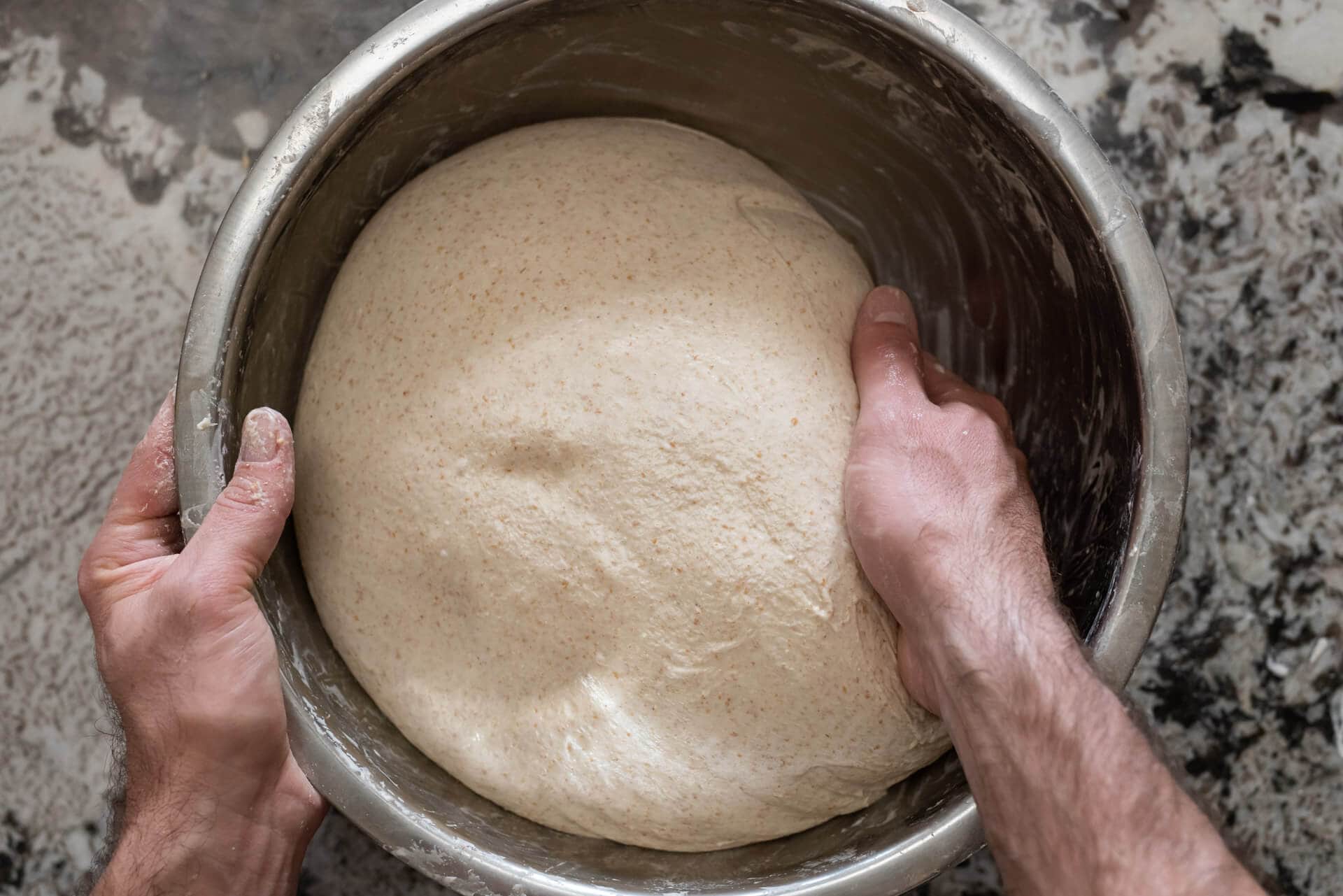
Once you have that loaf of bread crackling on the counter as it cools, review more of my baking guides to increase baking consistency and confidence. These guides have in-depth tips on maintaining a sourdough starter (with video walkthrough), creating baking schedules around your busy work week, working with baker’s percentages (baker’s math) to scale up and down recipes, and numerous guides to shaping bread dough.
My Guides Page is a great place to bookmark and return to from time to time to review the basics and expand your baking toolset:
Explore my baking guides page →
Step 5. Use Your Sourdough Starter For Other Things

Because a sourdough starter requires fresh flour and water each day (or less if you’re keeping it in the fridge), we tend to have sourdough starter discard—don’t throw it away! Instead, I like to save up the discard in a container in the fridge during the week, then use this to make sourdough pancakes, sourdough waffles, and sourdough banana bread.
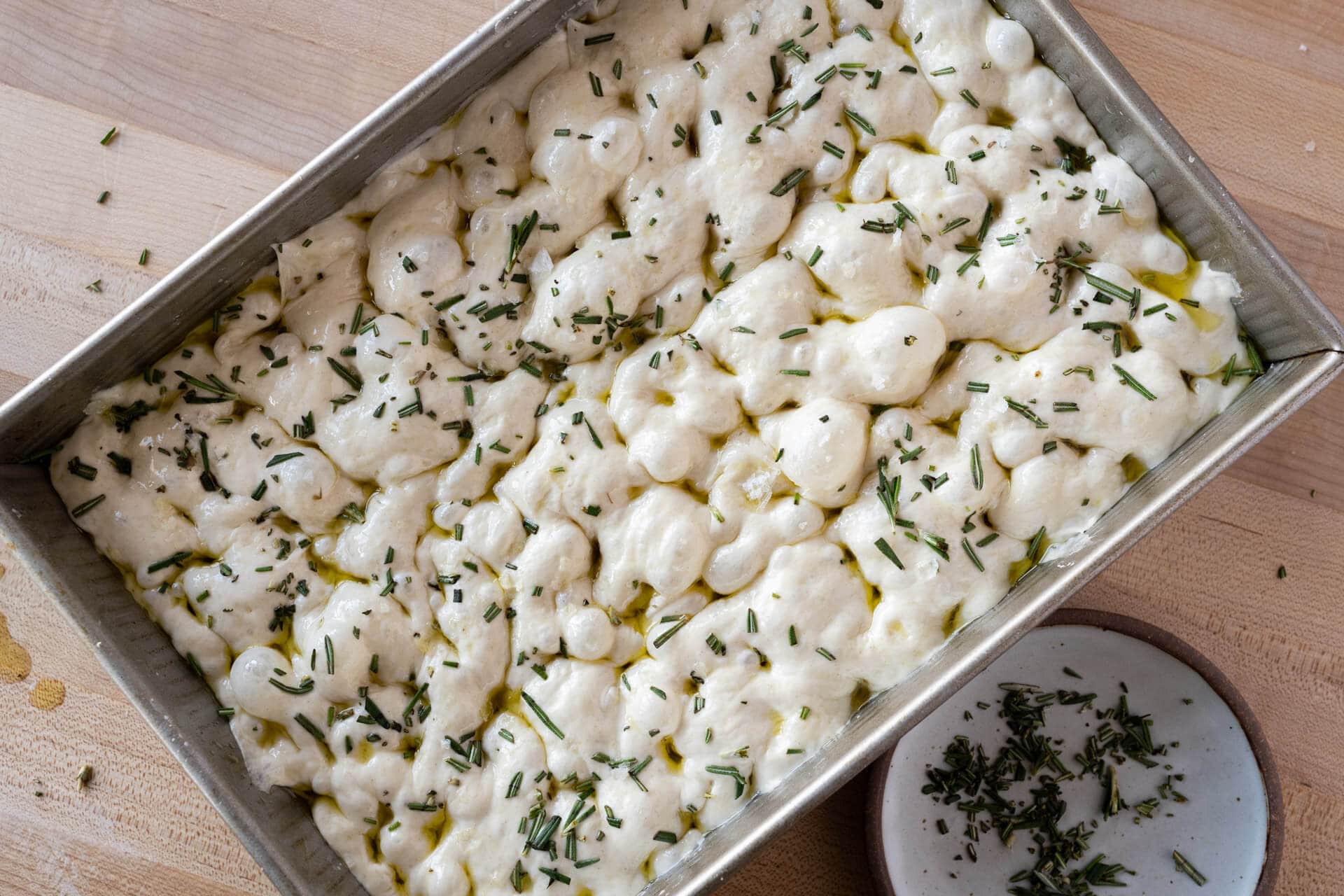
I’m also a huge fan of focaccia. This is one of the most-baked items in my kitchen, and my recipe couldn’t be easier. Use all of your sourdough starter discard one morning, and you’ll have fresh sourdough focaccia for dinner (and it’s an amazing canvas for any veggies in season!).
See my collection of sourdough starter discard recipes →
Step 6. Upgrade Your Baking Tools

One of the challenges of baking at home is consistency. It can be hard to bake consistently great loaves when the environment—our hectic home kitchens!—is always changing. I’ve collected my tried-and-true tools in one place, and they’ll help you make the bread easier and more repeatable in your home kitchen.
My top 3 recommended tools (read: if you’re going to buy anything, get these):
- A simple kitchen scale to accurately measure ingredients
- An instant-read thermometer to quickly and accurately measure dough temperature
- A foldable dough proofer to keep your dough warm and fermentation activity high
Explore all my favorite baking tools →
Step 7. My Top 10 Favorite Sourdough Recipes
- A Simple Weekday Sourdough Bread
- My Best Sourdough Bread Recipe
- Spelt, Rye, and Whole Wheat Sourdough Bread (50% whole grain)
- Fifty-fifty Whole Wheat Sourdough (50% whole grain)
- Sourdough Pizza
- Pain de Mie (super soft sandwich bread)
- A Simple Focaccia
- Whole Grain Spelt Pan Loaf
- Super Soft Sourdough Rolls
- Sourdough Cinnamon Rolls
Step 8. Join The 2500+ Member Community and Come Chat

Want to take your baking to the next level or get help with an issue you’re running into? Join the community here at The Perfect Loaf and get:
- Remove all ads from the website
- Instantly download my recipe archive and baking spreadsheets, plus other baking tools
- Join our private community to share photos, talk baking tips, tricks, and get help (I’m chatting there daily!)
- Access exclusive tool and flour discounts
- First access to live baking events
- And more!
Check out the baking community and membership →
Step 9. Experiment, Have Fun, and Happy Baking
One last note: don’t be afraid to experiment and have fun—after all, what’s the worst that can happen? No matter what comes out of your oven in almost every case, it’s perfectly edible and delicious. Some of my most significant baking improvements came from accidents that turned into opportunities for me to learn and grow as a baker.
Happy baking!

367 Comments
Again (this time from the new challah recipe e-mail) I spotted the tip about using the oven lights to help with bulk fermentation. It's a good idea but do put a disclaimer (or several) somewhere about watching that temperature with a remote digital thermometer. The twin lights in my upper/smaller oven will boost the temperature from 64°F to 130° in about 3 hours. That's a mistake I won't make again!
Yes, very very good point here Michael!
Hi!
I recently started following your sourdough starter recipe. From days 2 through 4 I had consistent fermentation activity with my starter being about double the size the next morning. On day 4 I refreshed 12 hours after my morning feeding as suggested, but it looked like my starter had only gone through half of the fermentation process (it had grown by about half). Since then, I have had very little activity. Should I go back to only feeding once a day, or continue the 12 hour feedings?
Hey there, Josh! Yes, I talk about that a bit on the starter creation page. It's normal to see a dip in activity, but if it's persisting, switch back to 1x feeding a day. Keep it warm and stick with it, it will come around 🙂
Hi Maurizio. I purchased your book via kindle and I am enjoying it. It inspired me to start making my own starter following your method. I Had a flase rise after day1 to 3 then quiet phase started. Now on Day 10, bubbles on side sometimes on top but not significant rise. Doing 20g starter, 30g rye, 60g APF & 100g water. Placed it in proofing box with 78F temp, feeding twice. However, it turns a bit runny when I'm about to refresh. Any advice suggestion how to make it stronger? Thank you!!!
It's actually sounding fine, Claire. No need to focus on how much it rises and how many bubbles you see, just that you're seeing these consistent signs each day—that's what's important. It sounds like youre doing all the right things here. Keep with the feeding schedule.
Thank you for getting my book!
Not 60g APF but 70g APF.
Use also S.Pellegrino water. works great for me.
Hi Maurizio, I'm a seasoned baker of about 30 plus years, is there a way to use 1/2 yeast and 1/2 sour starter when making your demi baguettes? My husband doesnt appreciate full sour flavor in bread. I try not to cold ferment when making my boules, but I was wondering if you've ever played with the ratio Ive stated. Thanks for any help in this journey.
Rosalie
You could just add a pinch of yeast to the recipe when making it, but also feel free to reduce the starter/levain in that case by 50%.
hello I just purchased your flour blend. Can I use that for the beginning of my starter?ty
Yes, you certainly can!
getting ready to bake my first loaf from my first ever starter! I have a proofing mat that I’ve never used. I see your notes say to do bulk fermentation at 75f for 3.5 hours on the simple weekday sourdough bread, but I am wondering at what temperature I should set the proofing mat, since ambient air will be cooler. I’m going to have the dough in a Pyrex bowl covered in plastic wrap…should I set the mat to 80f?
I'd recommend putting a cooling rack on top of the mat just to be sure it doesn't get too hot when in direct contact with your starter. I'd set it to maybe 74F and take your starter's temp after 6 hours or so to see where it's at. Bump it up if needed.
I just got your book for Christmas and followed your steps with my pre-existing starter for my first loaf. I want to transition my starter to have rye in it like your recipe. Right now mine is only white flour. How would I start mixing in the rye with the starter I already have active?
Just add it in at the next feeding in whatever ratio you'd like! You can use the ratios I like (I talk about them here on my post how I feed my starter ), or adjust to what works for you!
Hi !
I just receive your book and I started to reed it and I am already enjoying it, being my self a scientific. But I am French canadien and I am a little confuse with a note in page 302: " Using Ripe Sourdough Starter instead of a Levain"… I looked up ripe sourdough and in french it is a levain at his top form, ready for use. So I don't understand what levain is in English and I couldn't find that in the dictionary. So could you please clarify that for me ?
Oh! In your book you stated that you enjoy a loaf with thin crust, but the loaf on the photo of the book cover are very dark and I tough that it would be the opposite, but it must be tasty !!!
Thank You
Jean-Michel
Thanks so much for getting my cookbook! Check out the "Levain" section in the cookbook, I talk about the word and how I use it in the book. Essentially, it's a small off-shoot of your sourdough starter (which you feed and maintain every day). That little off-shoot is used completely in a single bake. You can generally use your sourdough starter in place of the levain if you feed it regularly and it's healthy.
Here's some more info about what a levain is (vs a sourdough starter).
Hope that helps!
How. Long after removing starter from refrigerator can it be fed?
I usually let it warm up for a few hours then feed it!
Just joined as a member but have been using your website for a couple weeks. I have two starters now (Rick and Morty) and have made two loaves from each. Beginners luck or just a lot of reading, but all the loaves came out beautiful and tasted great. I'm using a dutch oven and the middle bottom on all four loaves is a little over done. I've used wax paper and one of those silicone mats. Still the same issue. Looking for ideas.
Thank you so much Maurizio,
Jeff
Hey Jeff! Sorry for the late reply and thanks so much for joining, it's great to have you here. A Dutch oven can often do this, the key is to either preheat the DO for less time, or take the loaf out for the last 5-10 mins in the bake to just bake directly on the rack. This always helps me!
how do I join the discusion
You just have!
I am a new member! My friend shared some of her sourdough starter with me over a month ago and I have been baking almost 3 days a week. She suggested first thing to buy The Perfect Loaf. Well, I did and have found every recipe I have tried delicious. I have made about 5 or 6 loaves of Sourdough Rounds, Kalamata Olive and Rosemary Batard, The Weekend Cinnamon Rolls (my husband just finished off the last two this morning), Discard Scones with dried cranberries and half with blueberry/lemon zest. This morning I made Jalapeno and Cheddar Batard (great with a smear of cream cheese}. Now I have been asked to make Sourdough with Garlic Cloves.
When making the loaves with garlic, should they be roasted before adding them to the dough?
Hey there, Debbie, welcome! Really happy to hear you're enjoying my cookbook, thanks so much for getting it 🙂 Yes, I would absolutely roast the garlic (or confit) before adding it to the dough. Know that garlic can sometimes interfere with fermentation, so if the dough needs longer in bulk fermentation, give it a bit more. Let me know how it goes!
Hello all! I hope everyone is enjoying the holiday season. I’ve run into a problem lately that I just can’t seem to beat. My loaves come out gummy. Ive gone back back to Mauricio’s beginners sourdough dough loaf but I’ve had no success. Suggestions please! Thank You!
Hey, Bill. If the hydration is too high for your dough it can lead to an overly wet or gummy interior. If the dough feels "soupy" or very "slack" then try pulling back the water percentage by 5% and see if that helps.
Make sure to bake your loaves completely. The interior should register around 204-206°F (95-96°C) or higher.
If your loaf is under proofed then this will typically lead to a gummy or "wet" textured interior. Make sure your starter and levain are very vigorous and strong when you use them. This is very important! From there, make sure to bulk ferment your dough fully (use the images you see in my posts to guide you on what the dough should look/feel like). You want the dough to be alive and aerated before you divide and shape.
From there, a full and complete proof is also very important.
A few ideas there for you, let me know how the next attempt goes!
Mario,
Question about the new baking steel and cover you're promoting. Important question to me is, is there an improvement over the other baking vessels you've used? You emphasize the convenience factor but you do not note any improvement in results…or I missed that?
Hey Rob, I do talk about it in the post: https://slimlife.fit/introducing-baking-sourdough-bread-with-the-baking-shell/%3C/a%3E
I mention you get the same results!
Oops. I meant Maurizio! Apologies.
Do you have a list of all of your favorite ingredients?
I actually don't. What are you looking for here Desiree? Like a list of flour, nuts, seeds, etc?
This is a great idea!
Hey, I am planning to bake the 50-50 loaf from your book today. My issue is – my max oven temperature is around 410, and it goes back to 400 as soon as I open the oven door, which is needed for the baking process. The color comes out very pale and I broil it to brown it from top because if I bake it longer, the bottom gets burned.
I think because of this I get gummy interior as well? The internal temperature was around 211 so the bread was not undercooked. I have baked before but this is my second loaf with this oven.
Do you have a baking stone or baking steel? What you could do is put that in the oven, preheat to 410F, then turn on broil for 5 to 10 minutes to get a bit more heat into that stone (if you have an IR gun, take the temp and see if you can get it to around 450 or 475).
Means a ton to hear that, Darryl. Thank you! ❤️
HI first time using one of your Rx for Pain de Mie Sandwich Bread. I do not have a KitchenAid Mixer but I do have an Ankarsrum Mixer a I user the roller rather than the hook . I followed the recipe as written and ended up with a batter rather than a dough. I have had to add more flour so far twice it now has some body to it. My question is what did I do wrong in the first place?
Thank you for any help.
You can absolutely use an Ank mixer for that dough, Eric. I would say reduce the liquid in the recipe to help your dough firm up.
I only want to make one loaf, can I half the simple sourdough recipe?
Yes, divide all the ingredients in half.
Love, Love, Love everything you do. I recently discovered your website, while searching for sourdough bread recipes. I am an experienced baker, but not sourdough. I bought your book, joined, your group, went out and spent lots of money on miscellaneous equipment, so I’m ready to go. Can you tell me what size oval banetton I should buy for a cocotte which is 9” long, and for a cocotte which is round with a 10” diameter.
Thanks so much for joining and the kind words, Annick! Great to have you here. For 9", I would go with 11" baskets (there should be some linked on the baking tools page .
Keep me posted how your baking is going and have fun!
Thanks so much for the quick reply.
Maurizio, can you recommend a source for unmilled wheat?
Thanks!
I like to buy whole berries from a variety of sources, depending on where you are. Camas, Central Milling, Barton Springs, Hayden Flour Mills—they all have options for whole berries. Here's a few more listed at the bottom of my fresh milling guide:
https://slimlife.fit/how-to-freshly-mill-flour-at-home-for-baking/%3C/a%3E%3C/p%3E
Hi Maurizio, I am really enjoying your website and all the sourdough information and tools. I do have a couple of questions……
In your recipe for Beginner Sourdough, you direct to make the levain at 8am with ripe sourdough starter. But when I feed my starter, it is at its peak activity/rise, 5 hours after feeding. So I would have to feed it at 3am, not realistic! How do I slow the peak activity down? Or is it OK to use the starter, even when it has started to “shrink” down again? At what point is the starter “ripe to bake with”? Or should I just use starter and not bother with the levain? And if so, how much starter?
I also am finding when baking (in a dutch oven), that I get good “oven spring” but my finished crust is really hard, very difficult to cut, even with a good bread knife. How can I fix that?
Hi Spike, I'm no expert, but reducing the ratio of leftover starter when feeding can slow down the rise. What ratio are you feeding your starter at? If it's 1:1:1, leftover:flour:water, try 1:2:2 or 2:3:3. Temperature also plays a huge role in activity. Is your starter kept in a very warm place? And if your starter has begun to shrink down, don't worry, there's definitely a window of activity where the starter is useful. Some folks recommend a strength test of dropping a little blob of starter in a cup of water, and if it floats, that means there's enough gas and the microbes haven't yet broken down too much gluten (that is, the starter is structurally strong), but definitely search online if you're curious.
What exactly do you mean by your finished crust being really hard? Inedibly hard? You might try reducing the amount of time the loaf is baked uncovered (I'm assuming you're starting the bake in a closed dutch oven for maximal spring and finishing with the lid off for browning). Also, the crust of a loaf of bread is as hard as it will ever be when fresh out the oven. If you leave the loaf to sit the crust will take on some moisture and become chewier.
Super glad to help. You can slow the ripening of your starter by leaving less in the jar when you feed it. If you're leaving 20g in there and it ripens in 6 hours, leave 10g and see if that'll get you to 12.
As for the crust, I have some tips, here: https://slimlife.fit/how-to-bake-bread-in-a-dutch-oven/%3C/a%3E%3C/p%3E
Hope this helps!
Thanks so much!!!
Hi Maurizio, I love your blog, it is always helpful for my baking projects. I got a question for you though, and it is about my starter. When it seems ready it has little bubbles, and then my dough comes with somewhat small air bubbles as well. I would like it with bigger ones like the pictures of your dough. This makes me believe that my starter is not that strong? can be that the issue? For the rest of steps I follow every single one as you say, respecting the temperatures and all… Many thanks in advance!!
Thanks Anabella, appreciate that! Unfortunately there isn’t a single thing that leads to a more open interior in a baked loaf of bread. First, the flour used is very important, it needs to be strong enough (protein) and have the proper gluten properties to trap the gasses produced during fermentation. For example, no matter how hard you try with rye flour, the gluten properties in the grain just won’t lead to an open interior.
From there, a very strong and well-fed starter is important — it all begins there. Fermentation in general is so critical, it’s worth spending some time really stepping back to look at how your starter is performing and how well-fermented your dough is during bulk fermentation and the final proof. Without strong fermentation your loaf will never rise to its full potential.
Sufficient dough strength through mixing, and also organically through fermentation, is also important. Think of your dough as a balloon: you want it strong enough to trap gasses and expand in the oven, but not so strong that it won’t relax and expand out. Finding this sweet spot takes some practice.
A full and complete bulk is also very important. Cutting bulk fermentation short before the dough is sufficiently fermented will hinder the development in final proof.
I also find that, and this depends on the dough you’re working with, a very gentle preshape and shape are key to maintaining an open interior. If you’re rough with the dough during these times the delicate interior will quickly break down and become more dense. That said, the dough does still need enough strength through shaping to hold its shape during baking.
Sorry for the long winded answer but really all of these things are important! Each part plays into the next and overall what we’re searching for as bakers is balance. Balance between the extremes in each phase of the process.
I am so new to bread baking that I’m not even sure about the pan size. I was hoping maybe you could help me? I have a recipe for sourdough bread that was developed for an 8.5×4.8×4.5 Pullman pan. My Pullman pan is 9x4x4. Will this recipe work in my pan and fill it so the loaf comes out square?
Thank you
Hey Barb. Check out my guide to pan loaves, here, it has a bunch of pan options with subs!
https://slimlife.fit/guides/shaping-a-pan-loaf/%3C/a%3E%3C/p%3E
Hi! I just started this journey yesterday! Thank you for the detailed guides. What day can I start using the discard? Would it be day 7 or 8? I created the starter yesterday, Sunday, so would next Sunday be day 7 and can I use it then? Thanks everyone for any info!
Once your starter is reliably rising and falling each day it's good to use discard!
Hi Maurizio- love reading your guides and videos. I can’t seem to get my dough strong – it stays very loose even though I do strong stretch and folds. I tried doing the slap and folds tonight and it just became soup. Would love your help…
I would try reducing the hydration of the dough to firm it up a bit, this will make it easier to handle, too.
Have just bought the book. Can the recipes be halved as I won’t need to make such large loaves or more than one at a time
Thanks for picking up my cookbook, Anita! Yes, just divide all the ingredients in half to make one loaf. Have fun 🙂
I have been wanting to try baking Olive Bread again. I have done it twice. The first time was good and the second was a little disappointing. That’s why I wanted to try your Olive Bread recipe- Tartine or Sourdough..
My question is – if you use Walnut Oil in the Cranberry Walnut Bread recipe why not use the same amount of Olive Oil in the Olive Bread recipe? I have searched You Tube for Olive Bread recipes and can’t seem to find any that include Olive Oil.
What are your thoughts please.
Thank you
Hey there! I think I answered you this in email, but here it is again (after thinking more about it a bit, too): you can absolutely use OO in that bread! It doesn’t bring a ton of “olive-y” flavor, but you will get some fruitiness and spicy notes, depending on the variety you use, but most importantly, these oils bring softness and a little richness to the dough.
Yes you did. Thank you!!!
My question has to do with not just sourdough but non-sourdough, no-knead recipes as well. What do we need to be doing differently when moving from Southern California sea level to mountain-high Colorado Springs. My friend is having a terrible time with his breads (non-SD fr now). He is sprouting and milling his own wheat. His loaves are coming out sunken, gooey and gross. They look way over-roofed from the photos he sends but I’m not sure how he should proceed. We may be heading that way ourselves so I need to know what I’lll need to do for successful loaves. Thank you!
Fresh milled flour behaves differently than shelf flour. It still contains a TON of active enzymes. These enzymes make the flour extra slack and weak – sounds in line with your gooey and gross description? I’d recommend reading the autolyse page on this website 🙂
I think my guide to baking at high altitude will help you!
I have a steam, convection, bake oven at home. Can this be used to bake sourdough bread?? The auto program buttons have a couple of spots for bread baking and even some for proofing. Have you had any experience with this?? Thank you
My oven doesn’t have these options, but yes, by all means use them if they work for you! I’d love to have a steam function on my oven 🙂
just joined and have a couple of questions. I have a double oven both of which have a bread proofing function that maintains a temperature of about 110 degrees F. Will this work to wake up a starter from refrigeration? Second, how to modify the starter recipe to accommodate a whole wheat starter if possible. Thanks
Hey Doug! Welcome. Unfortunately, 110F is super hot; I wouldn’t put your starter in there! For a whole wheat starter, just swap out the flour, expect that it’ll ripen a little faster, and it might need a bit more water if you want to keep the same consistency (not mandatory).
Does the pH of water used make a difference in bread success? We have well water that is at about 8.1. No chlorine, just a bit alkaline. Thank you.
I honestly don’t think it will be significant enough to impact things. As long as your water is safe for drinking, it can be used no problem.
In your book the 100% Whole Wheat levain seems off — it is so dry. Is there a mistake in the ingredients? I am not having a good result when baking this recipe.
It’s supposed to be dry and stiff, but it should soften! If it’s too dry, and too stiff, add more water until it’s workable.
I note that most of your recipes call for 11.5% all purpose flour. Can King Arthur Organic Bread Flour be substituted for the all purpose flour?
KA BF is higher protein at about 12.7%. If you want to do this swap, your dough will generally need more water to be properly hydrated—but it’s possible. Instead, and if you have it, I would use KA all-purpose flour.
I’ve had 3 of my best sourdough bakes following your “best” method, with 90% Cairnspring Glacier Peak and home-milled 10% rouge de Bordeaux. Phenomenal taste, oven spring, open crumb. I’m curious why your loaves are 900g each vs. Tartine’s 1000g each. I use Sassafras ceramic bakers and they can easily accommodate 1000g loaves.
Amazing, so glad to hear that, Rob! They make incredible flour.