


I’m often asked whether mixing dough by hand or with a mechanical mixer (like the Ooni Halo Pro Spiral Mixer) is better. My answer is always the same: You can make great bread and pizza either way. The important thing is to develop the dough sufficiently for the best texture and rise, regardless of your mixing method.
The word “sufficiently” is hard to quantify for every dough because it depends on what you’re mixing and the process (but I’ll talk about what to look for later in this post). In my baking here, this means strengthening the dough until medium development. The dough will be smooth and elastic but not pass the windowpane test (full development). Instead of mixing that far, I rely on stretches and folds in bulk fermentation to fine-tune dough strength.
You can achieve medium or even full development when mixing by hand; I did so for many years before I owned a mixer. But it’s also very easy to achieve this using a mechanical mixer with no downside: in my experience, mixing by hand doesn’t necessarily make for better bread.
Today, I’m going to discuss how I’ve been using a new mixer here for many months: the Ooni Halo Pro Spiral Mixer. I’ll explain what I like about it, who I think would benefit from it, who might not, and how I use it to make a few different doughs.
Full disclosure: Ooni sent me this mixer because I’ve been working with them on its promotion, but I only agreed to this after vetting its capability (as you know, I only recommend the products I genuinely use and love). I was not paid to create this post; I’ve been asked so much about the Halo Pro that I thought I’d put together this guide.
Real Quick: Do I Recommend the Ooni Halo Pro Mixer?
As a bread baker and pizza maker who typically bakes in smaller quantities, I can say this Ooni Halo Pro spiral mixer is fantastic. I wholeheartedly recommend it for the home setting.
Over the past few months, I’ve thrown countless doughs at this thing to assess its effectiveness, and it’s handled everything from a 55% hydration pizza dough up to an 85% hydration bread dough. The top controls for adjusting the mixing speed and setting timers are intuitive and helpful, and the tilt head, removable bowl, breaker bar, and mixing hook are easy to clean.
All in all, this is a fantastic mixer for the home, and it is the perfect combination of compact size, mixing capacity, and price.
Let’s take a step back to first look at what makes this mixer special.
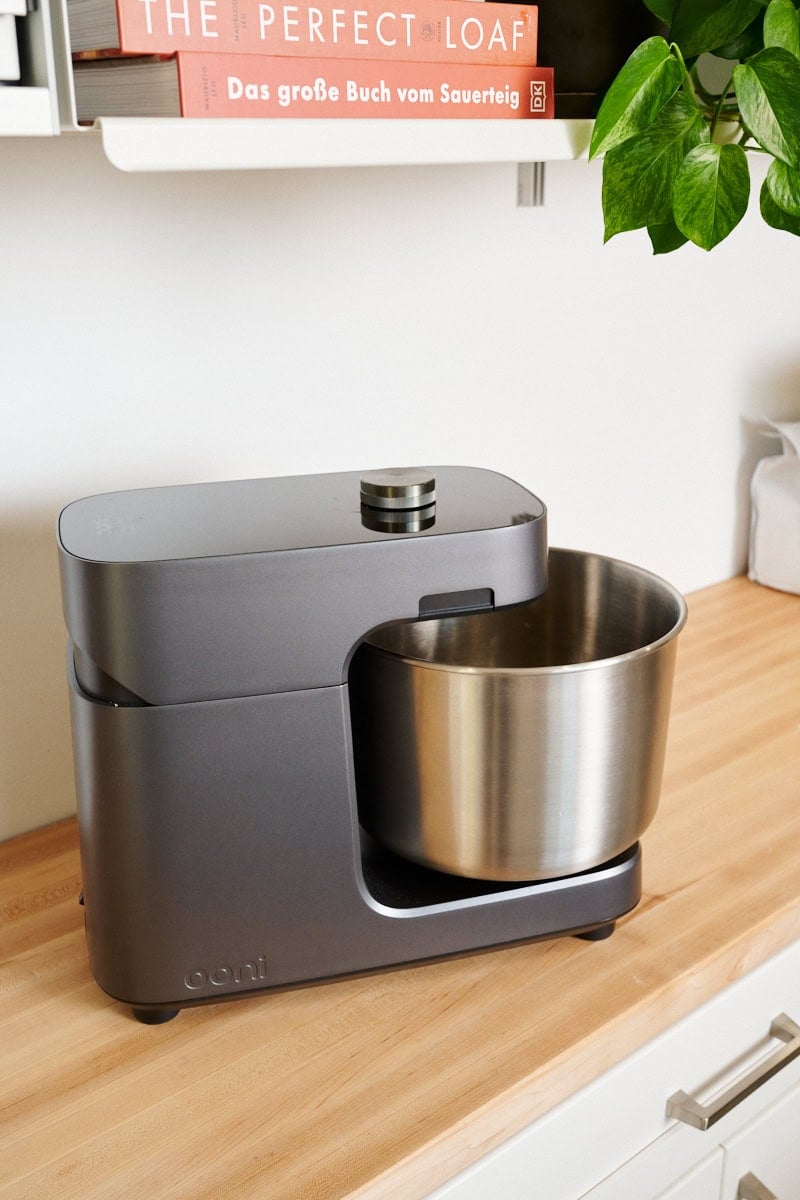
What is a Spiral Dough Mixer?
A spiral mixer has a fixed hook that spins while the bowl rotates. This design is incredibly efficient at quickly strengthening your dough and incorporates air to help aerate it, achieving an open crumb and light-textured final product. Spiral mixers often have a breaker bar in the middle of the bowl, which scrapes the hook as it rotates to prevent dough from climbing up the hook, thereby reducing effectiveness.
The Ooni Halo Pro is a spiral mixer with a breaker bar and rotating bowl. It’s a little different than others because the bowl, hook, and breaker bar are removable. This makes it really easy to clean in the sink and allows for swapping in and out other attachments to mix other types of doughs and batters (like cookies and cakes).
More on this in a moment.
Spiral Mixer versus Planetary
Below, you can listen to me talk about the features of a spiral vs. a planetary, what each is good for, and why I love a spiral mixer.
What is a Breaker Bar, and Why is it Useful When Mixing Bread Dough?
A breaker bar is a straight metal piece extending into the mixer’s bowl. In the Halo Pro, this bar attaches to the tilting head and moves up and down with the head. When the head is locked in the down position, the breaker bar sits very close to the rotating spiral hook, removing dough from the hook during mixing. This ensures the dough is mixed and strengthened evenly as a new portion is continuously stretched and folded.
This means you don’t have to stop the mixer to scrape down the hook. Less babysitting allows you to do other tasks while your spiral mixer mixes the dough evenly and effectively.
Design, Build Quality, and Construction
When I first received the Halo Pro, I was smitten by its design. If you’re familiar with Ooni products, like their Koda and Karu outdoor pizza ovens, you’ll immediately love the mixer. It’s matte black with clean lines and minimal controls. The mixer is heavy but not excessively so, making it easy to move around the kitchen if needed. The heft means it’ll stay put when mixing even low-hydration doughs—no KitchenAid “walking on the counter” for this thing.
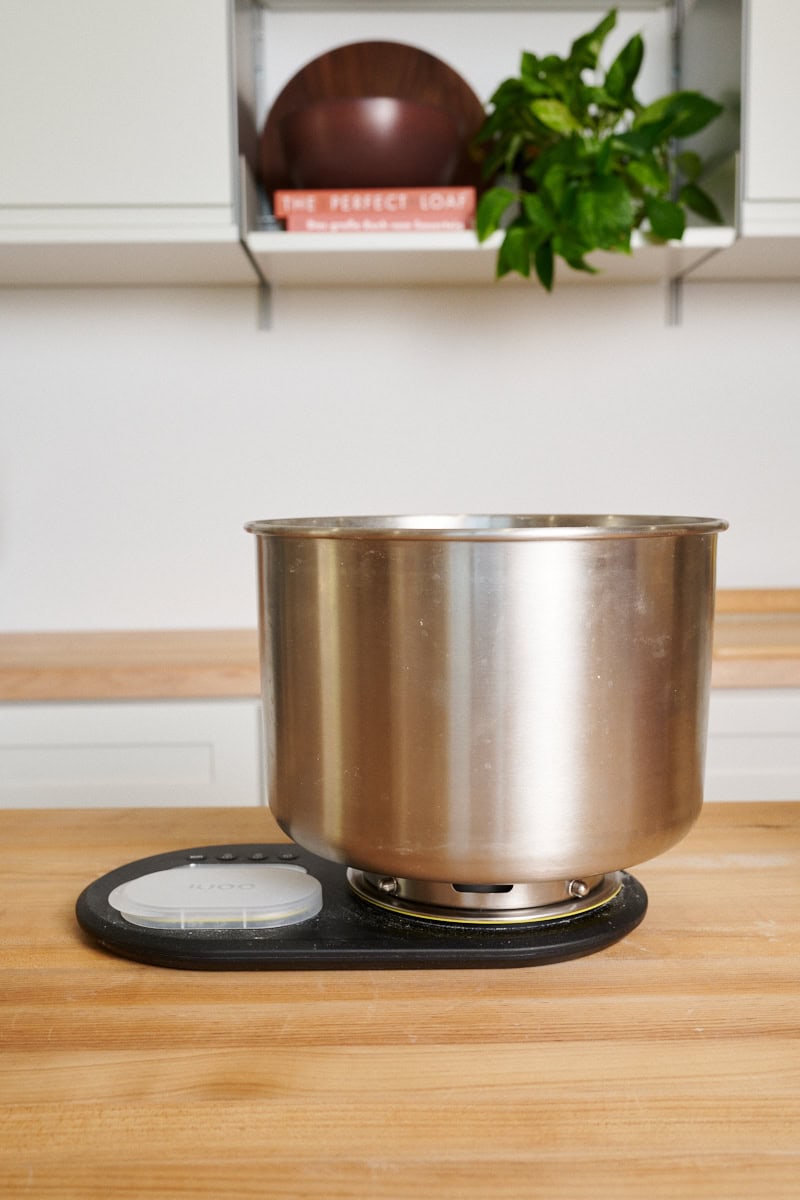
You can tell everything about the mixer was thoroughly thought out, from the rubber feet to keep it stuck to the work surface to the tapered back that feels solid yet unobtrusive. Even the mixing bowl fits perfectly on the Ooni multi-platform scale, making it easy to weigh ingredients right into the bowl.
At first, I was slightly turned off that the base connector on the mixer was plastic instead of metal. My concern was that the metal bowl might get loose over time or even break the plastic dock, but I have seen zero evidence of either thing happening. The plastic is incredibly tough, and the design is well thought out—no tiny bits that could break; the bowl sits and locks in solidly.
Ooni Halo Pro Spiral Mixer Specifications
Here are some high-level specifications for:
- Spiral mixer with tilt head and removable bowl, breaker bar, and dough hook (plus other mixing attachments)
- ~5kg dough capacity, bowl capacity of 7 liters
- 110V (650W), made for home use
- Turn dial speed control with integrated timer
- LED lights that illuminate the interior of the mixing bowl
- 14.5 kg (32 lbs) total weight
- This is a compact mixer that can easily fit on a home kitchen counter
Mixing Bowl Capacity
| Dough weight | Notes |
|---|---|
| Minimum | 1 kg of dough (anything lower than this, and I typically mix by hand anyway) |
| Maximum | 5 kg of dough |

How Do I Use The Ooni Halo Pro Mixer?
I almost always read the manual for whatever I buy, but with the Halo Pro, there’s no need. It’s all so intuitive; Ooni did a fantastic job thinking through the controls. There are minimal buttons to clean and no space for flour to fall into; it’s just one large dial and touch buttons. I love the design of the controls.
Turning On and Inserting Attachments
Flip the switch on the back of the machine to turn it on, and two LEDs illuminate the interior of the mixing bowl, making it easy to watch the dough as it mixes and strengthens. It’s incredible how these lights improve the mixing process—seeing the dough clearly to assess its level of strengthening during mixing is a game changer. I’ve worked with other mixers with LEDs, like Sunmix (more coming soon on these larger mixers!), and once you use them, it’s hard to go back.
To insert the dough hook, turn it counterclockwise to lock it in place. The breaker bar is first inserted, then a metal collar is screwed down around it to secure. Both are easy and quick. An optional splash guard can then be slid on the tilt head to keep hands out and ingredients in while mixing. I often omit this cover if it’s just me in the kitchen.
Let’s look at how to lock in the bowl, use the tilt head, and the controls.
A tip: If you’re having trouble inserting the breaker bar, rub the top with a small amount of vegetable oil to help (you may need to repeat this periodically).

Locking and Unlocking the Removable Mixing Bowl
The stainless steel bowl locks into the mixer’s base with a twist and a click. Once locked in, the motor can turn the bowl while the mixer runs.
Lock and Unlock The Tilting Mixer Head
Unlocking the tilting head is easy with two flanking switches (great for lefties like me!) on the head. Press one or both, and the head tilts up with a satisfying and smooth motion.
Control the Mixing Speed With The Dial
The speed and timer controls are on the top of the tilting head. Turning the single large dial controls the motor’s RPMs, while pressing it in starts and stops the mixer (and timer when selected). Two touch buttons toggle between mix controls and timer controls. Pressing one selects that mode, and the turn dial then controls that function.
For example, pressing the timer button and then turning the dial will allow you to increase or decrease the timer duration. Press the dial in to start the timer.
Change The Display From Percentage to RPM and Mute Sounds
I recently discovered that if you long-press on the mixing function, the display will change its speed display from percentage (of total speed) to RPMs (revolutions per minute). This can be helpful if you’re used to another mixer and are first using the Halo Pro; you can get your speeds to match your previous mixing workflow.
| Percentage Setting | Revolutions Per Minute (Approximate) |
|---|---|
| 15% | 90 |
| 20% | 100 |
| 25% | 120 |
| 30% | 130 to 140 |
| 35% | 150 to 160 |
Similarly, a long-press to the timer button mutes the mixer’s beeps.
How I Use the Halo Pro to Mix Bread Dough
For a typical bread dough, this is where I start with mixing. The duration for each step is ultimately dependent on the dough you’re mixing (the flour and hydration).
- Initial incorporation: 1 minute at 15% mixing speed (“speed one”, 90-100 RPM)
- Initial strengthening: 3 minutes at 25% (“speed two”, 120 RPM) mixing speed
- Rest (optional): 5-10 minutes
- Final strengthening: 3-5 minutes at 25% mixing speed (higher hydration doughs may need longer)
The initial mixing phase combines ingredients and ensures even distribution throughout the dough. The rest period helps the dough unify and become slightly firm, though it isn’t always required. Significant gluten development occurs during the second mixing phase. Most doughs typically take between one and three minutes, though highly hydrated doughs or those needing more elasticity may require additional mixing time.
Again, the duration of each step will change depending on the dough you’re mixing. Usually, with increased hydration, I’ll also hold back some mixing water to “bassinage” that water during the second strengthening phase.
Does Using an Autolyse Reduce Mixing Time?
If a recipe still calls for using the autolyse technique, I’ll mix the flour and water in the spiral mixer and let it sit for the duration, covered. After the autolyse time, you’ll notice the dough will be smoother, and you can often reduce the total mixing time. This reduced mixing time is one of the many reasons we do an autolyse.
Calculating Water Temperature for a Spiral Mixer
Spiral mixers run warm, and water temperature is the simplest lever you have for landing your final dough where you want it.
Start with the magic number, for me, usually around 78°F (usually your desired dough temperature, DDT) and multiply it by 3. Then, using an instant-read thermometer, measure your air temp and flour temp. Subtract both from that number, along with a friction factor (around 35-40°F for a spiral mixer, closer to 40 for longer mixes), and what’s left is your water temperature.
The formula:
(DDT × 3) − Air Temp − Flour Temp − Friction Factor = Water Temp
If you’d rather skip the math, my water temperature calculator will do it for you. Or, to keep things really simple, just make sure your water is ice-cold.
How I Use the Halo Pro to Mix Pizza Dough
When mixing pizza dough, my process is similar to that for bread dough, though it is typically lower in hydration and requires less mixing time. Also, I usually add olive oil at the end of mixing if the recipe calls for it.
- Initial incorporation: 1 minute at 20% mixing speed
- Initial strengthening: 2 minutes at 30% mixing speed
- Rest (optional): 5-10 minutes
- Final strengthening: 2-4 minutes at 30% mixing speed
- Add enrichments: 1 minute at 20% mixing speed to pour in olive oil slowly
I used the Halo Pro exclusively when testing a wide range of pizza doughs—from stiff Chicago Tavern-style to higher-hydration rustic doughs with whole-grain flour—for my cookbook, The Perfect Pizza.
What Am I Looking For In a Fully Mixed Dough?
Whether I’m making sourdough bread or pizza, I want the dough to look and feel sufficiently developed by the end of mixing. Since I know I will give the dough at least one set of stretches and folds in bulk fermentation, I stop short of full (intensive) development—the dough should not pass a windowpane test.
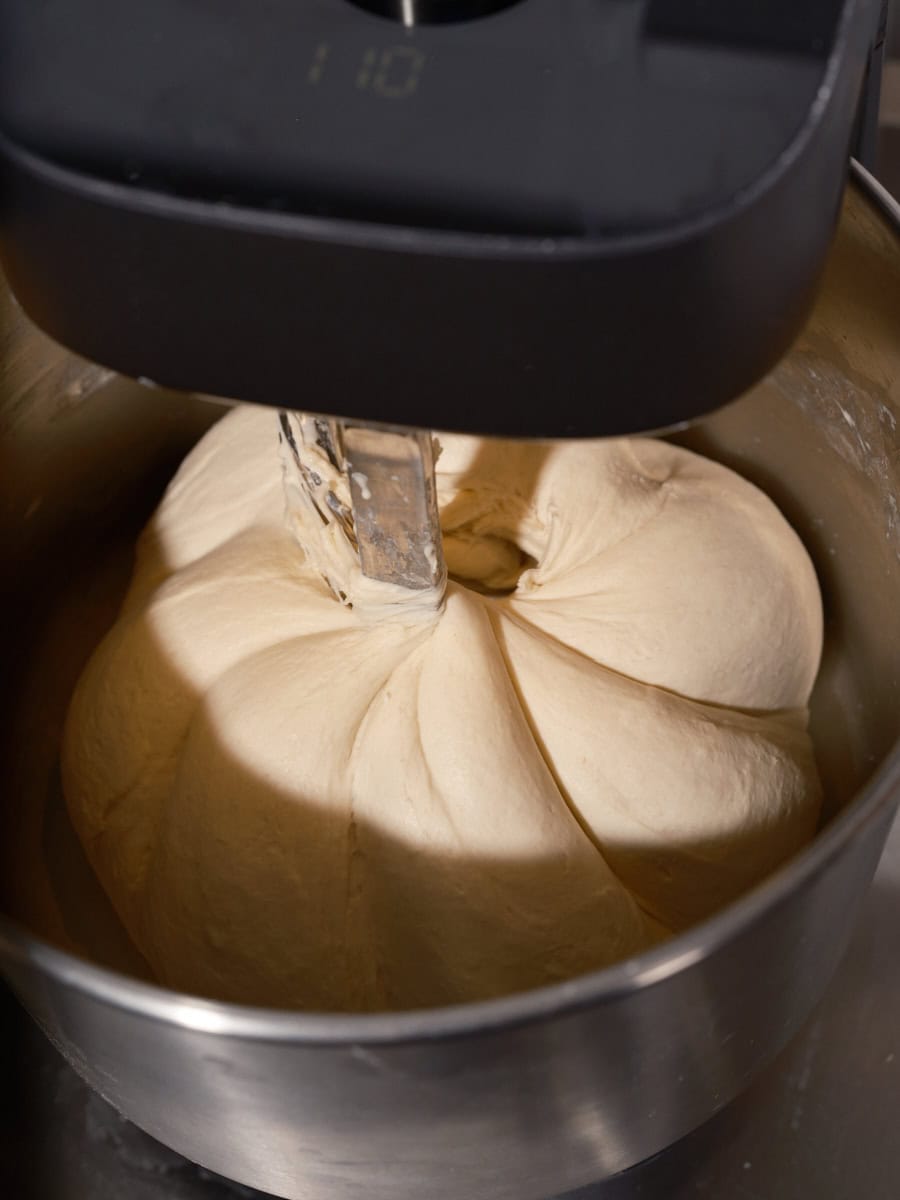
But I want to start seeing defined edges and even a pumpkin shape.
Dough and the Pumpkin Shape
When mixed and strengthened enough, bakers and pizza makers who use a spiral mixer often describe their dough as having a pumpkin shape.
This pumpkin shape is indicative of a well-mixed dough:
- defined edges between smooth sections of dough
- elastic and holding itself together
- when tugged, it will offer resistance
The way the dough rotates around the breaker bar when mixing creates this shape. Below, you can see it nearing the end of the first mixing phase. The dough is starting to pumpkin in the mixing bowl, but it’s still shaggy and not quite strong enough (it needs about three more minutes of mixing).
How Come My Dough Never Makes a Pumpkin Shape?
One telltale sign that a batch under 1,000g isn’t mixing efficiently is that the dough never forms a proper pumpkin shape. To work around this, you may need to occasionally—and carefully—use a spatula to guide the dough toward the hook and breaker bar while the machine is running, keeping it in contact with the hook as much as possible.
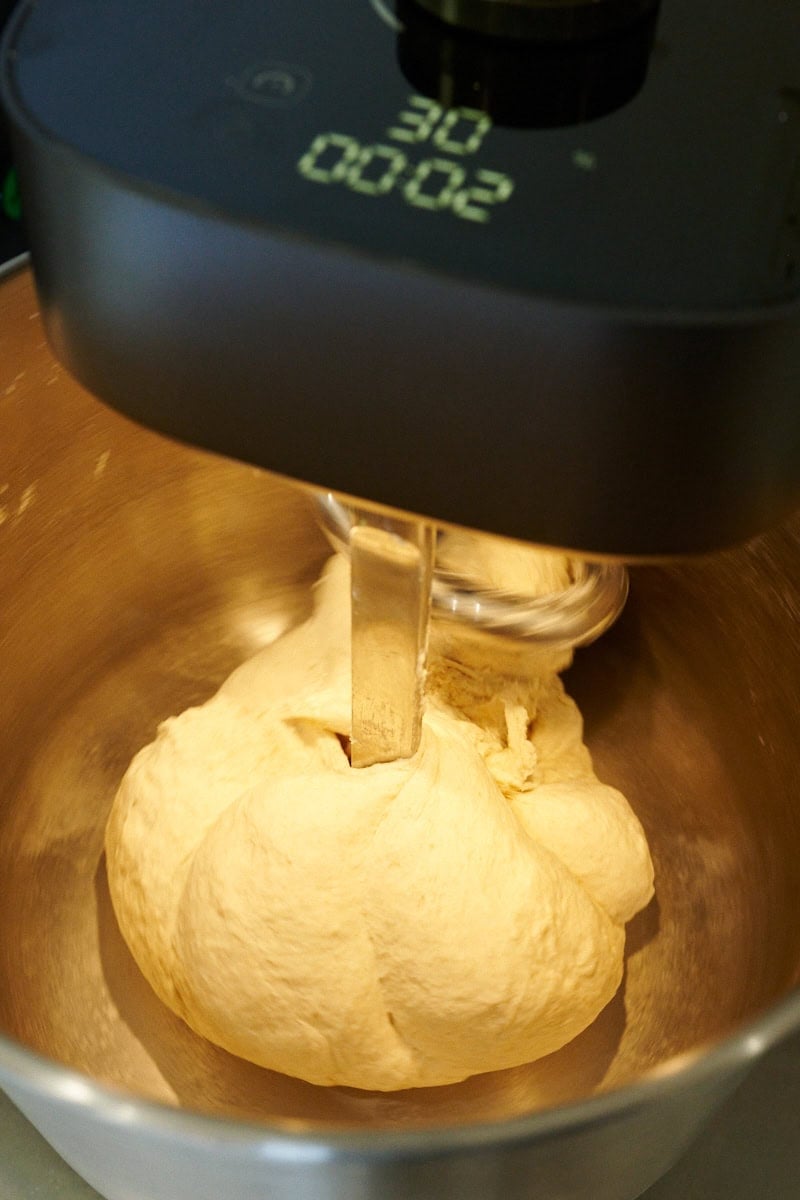
Smaller batches are also prone to climbing up the hook, simply because there isn’t enough dough mass for gravity to keep things anchored at the bottom of the bowl. If that happens, stop the machine and, with wet hands, push the dough off the hook completely before resuming. If it keeps climbing, take it as a signal: the dough is strong enough, and it’s probably time to call it done.
Cleaning the Halo Pro
After mixing, I remove the bowl and scrape the dough into my bulk fermentation container using my favorite silicone scraper. I do my best to remove every bit of dough from the bowl.
Next, I remove the breaker bar and dough hook and place them in the mixing bowl and sink to finish washing off any remaining dough with the damp cloth. The ability to remove the bowl and attachments makes cleaning incredibly easy. If there are any stuck-on bits, soaking the bowl and attachments in warm water with a bit of soap quickly loosens them.
Other Attachments and Mixing
The Ooni Halo Pro also comes with a flexible beater and a geared whisk for making other products such as cakes, cookies, and biscuits. I haven’t used these other attachments because I primarily use the Halo Pro for bread and pizza dough.
Who Isn’t The Halo Pro Spiral Mixer For?
I think the Halo Pro is perfect for the home baker and pizza maker, but I’m not sure I’d use it for heavy production in a bakery. The mixer wasn’t really designed for that use, anyway. I’d recommend getting a Famag or Sunmix with a larger motor and more capacity for that setting.
I haven’t tried going below 55% hydration with the Halo Pro, and I probably wouldn’t buy this mixer to mix many batches of bagel or pretzel dough (unless you’re making crispy, higher-hydration bagels, which I’ve done in the Halo). Though I think it could handle a batch of these here and there, those types of doughs are better suited for larger mixers with heavy-duty motors geared for stiff doughs. Or, they’re easy to mix by hand, too.
Conclusion
I think the biggest testament to this mixer is that I now turn to it by default when mixing smaller batches of dough, whether that’s bread, pizza, or any enriched dough.
Before, I’d consider mixing small batches by hand, kneading with the slap and fold technique, or scaling things up to use my larger Famag mixer. But more and more, I find I’m settling in at 1 to 2kg and using the Ooni Halo Pro Spiral Mixer.
It has all the functions I’m looking for when making smaller batches of dough. It’s a capable mixer that can handle doughs at varying hydrations with ease. The sleek design, premium build quality, and intuitive controls mean it’ll be a mixer I’ll use for many years.
Watch Me Use The Halo Pro
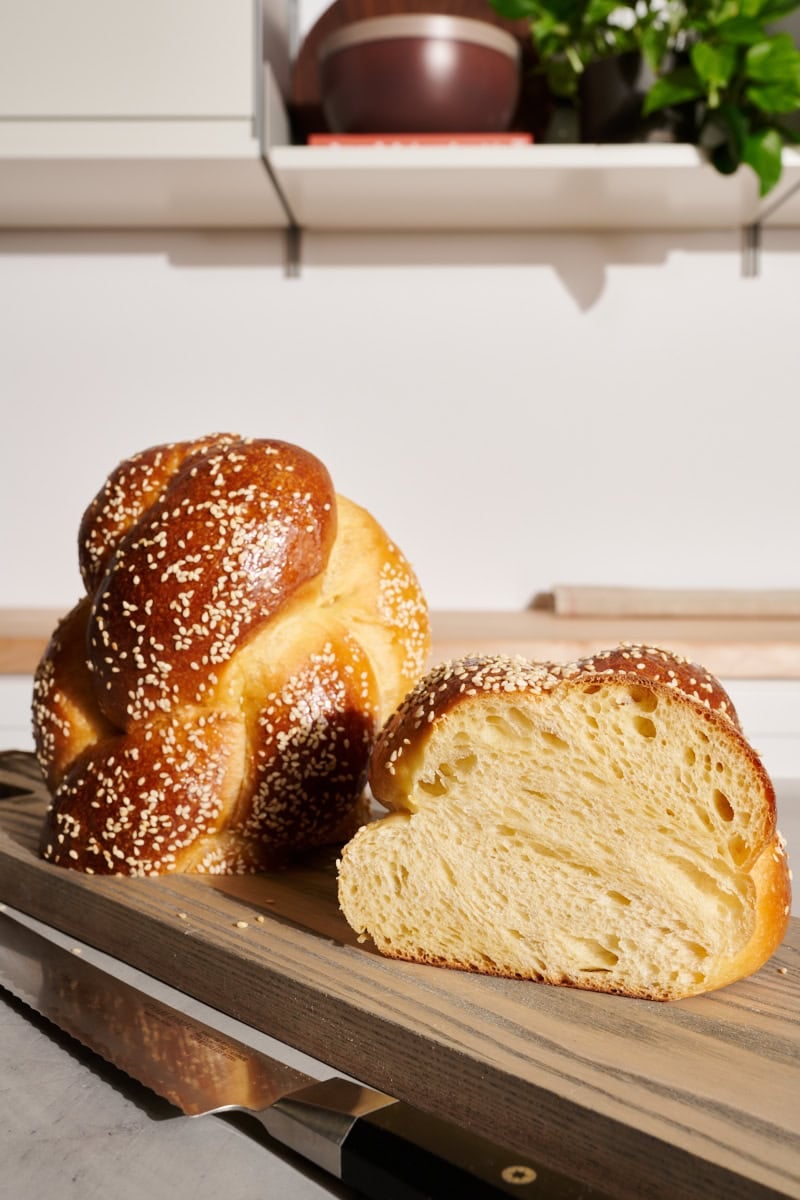
I’ve been using it with so many doughs lately, but two come to mind immediately. First, I used the Halo Pro in testing to develop my sourdough challah recipe (be sure to check out the YouTube video where I do a walkthrough).
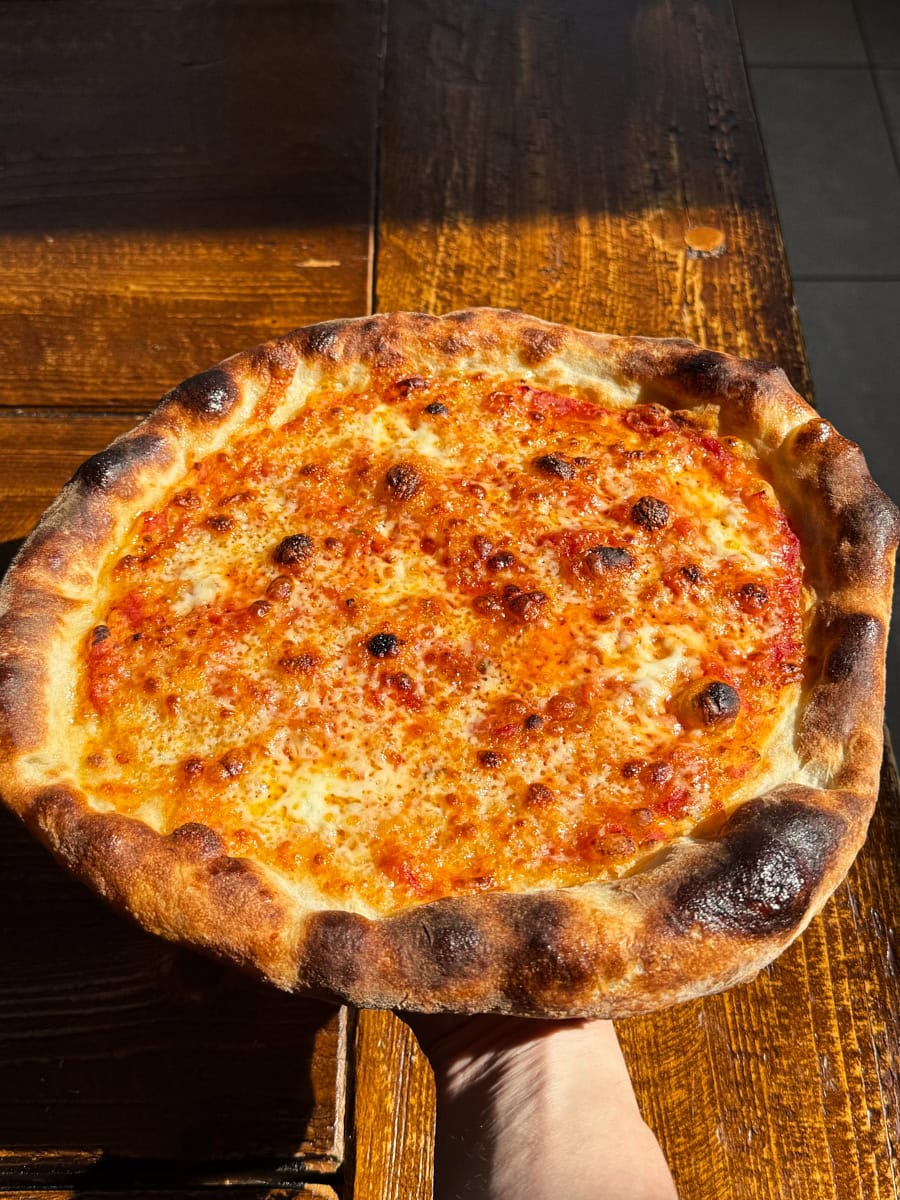
But also, sourdough pizza. Check out this incredible home oven pizza:
The dough is based on my Sourdough Pizza Dough Recipe and cooked up incredibly well in my home oven on a baking steel. Mixing the dough in the spiral was remarkably easy, and due to the effective strengthening of the dough, I achieved a significant rise with the coveted eggshell texture.
Halo Mixer FAQs
If I mix bread dough in a mixer, can I do fewer sets of stretches and folds in bulk fermentation?
Yes, if you mix and strengthen the dough more during the initial mixing phase, you don’t need to perform as many sets of stretch-and-folds during bulk fermentation.
Does the Ooni Halo Pro mixer heat up the dough during mixing?
As with any mixer, yes, it can. I’ve found that mixing at speeds exceeding 130 RPM for more than 4 minutes requires cooler water to offset the heat generated.
What’s Next?
For more posts about baking equipment, including mixers, ovens, and more, check out the best baking tools for any baker.
👋🏼 Have any questions about the Halo Pro? Drop them in the comments below!


85 Comments
Hello! How many loaves can you mix at a time in this mixer?
It depends on the loaf weight, you could easily do around 6x900g loaves.
Hi Maurizio,
Thanks for the sourdough advice on your site. I wonder if you have learned new processes for working with the Ooni Halo mixer you could share. I have been following your reconmendations for mixing percentage speeds and time for incorporation, rest, and strengthen times. I even returned to a Back to Basics recipe that reminded me to add the starter and water first and then add the flour and salt. Since the Halo doesn't like to add liquid after the inital mixing I tried adding hte salt in with the inital flour mix and hoped for the best. However, still I find that my bread is a lower hydration (otherwise I have a sloppy mess that never comes together – it did that the first time and had to slap and fold the batch for close to 20 minutes to bring it together). And that even at he lower hydration I am at least doubling the recomended mixing times in order for the dough to have any sort of strength. The mixer gives it a pumpkin shape but there is no strength in the dough. Today's batch I finally pulled out of the bowel after 8 minutes mixing at 40% speed after a 10 minute rest and went into slap and folds for 5 minutes to strenthen it to a point where I could work with it in fermentation. Just wondering if with the Halo there is a better way or recipe modifications that I should keep in mind in order to have a strengthen and elastic dough ready for fermentaiton after the mixing step? Thanks for any ideas you have used to achieve that ends.
This seems like a great replacement for my KitchenAid when the time comes! As always, I appreciate your in-depth and honest reviews. You said that you wouldn't use this mixer to mix many batches of stiff dough, like bagels, but do you think it would be able to handle a single batch at a given time? I make a batch of your bagels about once every ten days, and I actually do use my decade-old KitchenAid, even though I know it's not recommended! Are such doughs not recommended by Ooni to be made in this mixer, or were you just saying that you think that too many batches of a stiff dough all at once would strain the mixer?
Happy to help Rachel! I feel like it will handle my bagel dough, but I haven't tested yet. I'm going to do this very soon! But if you're using a KitchenAid, I feel like the Ooni should handle it no problem. The issue is the breaker bar, which might have trouble with a very stiff dough—but! You can always remove the breaker bar if needed.
Would you use this mixer for other baking tasks such as cakes, meringues, frosting, cookies….?
I have limited counter space and would like to avoid having a mixer only for bread/pizza.
Thank you,
Lynn
Hey Lynn! That's the goal of this mixer, it includes other attachments like beaters and paddles. I personally haven't used it for that purpose yet, I've mostly been using it for bread. But it was designed to be multi-purpose in this way!
I have used the halo for all but meringues… I did see a video showing how long it took for a meringue in the Halo vs other mixers and honestly if I were making a meringue I would probably pull out the hand mixer. Cookies and cakes, bread and pizza dough all came out well and I do not use large quantities. Except for pizza dough and an occasional bread, I am usually well under the minimum suggested by Halo. Cookies might be 250-375g flour and my breads range from 375-750 with most closer to 500g flour. All have been great!!
I usually autolyse my water, flour and salt for about 2 hours (by hand). I then add the starter and hand mix for about 10 minutes (3-4 minute intervals across a half hour). I then stretch and fold about 6-7 times over the next few hours.
If I were to buy the Ooni, should I mix the water, flour and salt in the bowl and leave to autolyse, then add the starter and mix?
Thanks in advance,
Lisa
Hey Lisa—yes exactly, that's how I do it here! Just be sure to cover the dough in the mixing bowl if it's resting for long periods to ensure it doesn't dry out.
I only use your “My Best Sourdough Recipe”. Could this mixer make it so I am not doing the 3 15 minute stretch and folds, and the 3 30 minute stretch and folds. I have degenerative disc disease and have a great fear of not being able to make this bread much longer. If this mixer could give me more baking years, I would be very happy!
Yes, you'll reduce the number of stretches and folds if you mix the dough to a greater degree in this mixer! After mixing in here, I'll drop it down to 2-3 sets (usually 1-2).
Hi Maurizio, thank you for your comprehensive review. Based on your use of the mixer, could I check with you whether the 5kg max dough limit only applies to lower hydration dough, e.g. 55065%, or could it also apply to 80-85% doughs? Appreciate your advice on this, thank you!
I feel like the mixer should be able to handle this, yes. I haven't done a 5kg batch at 50% hydro, though. But I have done smaller batches at this hydration level just fine.
Can the Ooni be used to mix a stiff sourdough pasta dough? I use a KA, but it struggles & feels like it might wear out. Thanks
I've mixed 50% hydro doughs in here just fine, but if it gets too stiff it might have trouble for extended periods.
I always appreciate your share of knowledge about anything related to sourdough. Thank you very much Maurizio. I followed your guide above on how to make sourdough using Ooni Pro Halo. So, If I hold 10% of the water to add it later, do I add this after the initial strengthening? or after 5-10 min rest? Also when do I add the salt?
I see you have Challah recipe using OOni mixer, how about sourdough? It would really help for someone like me to see it from start to finish.
Once again, thank you in advance.
Happy to help, Igusti! Add that reserved (bassinage) water after the rest period. I add the salt after the rest period usually, too. So it's: initial mixing, rest, salt, final mixing while adding reserved water.
I'll work on a larger loaf recipe/video with the Ooni!
Were you able to create this? I just received the Ooni and I'd love to create some soughdough with a video to watch! Pleeeaassse!
Thank you very much indeed! As always, I really appreciate your respond 🙂
Also looking forward to your larger batch recipe using Ooni.
Hi. with Halo can you do all the mixing and strengthening the dough enough to just go to bulk fermentation and not do any stretch and fold or coil fold and go directly to shaping after. This is the kind of mixer they have in a bakery bigger of course and I am sure with the huge amount of dough they produce they don't do any stretch and fold. Please let me know. I bake sourdough bread twice a week and less manipulation with my hand would be great, even if I do enjoy making bread by hand it would be nice to do it with the mixer. I am starting to have osteoarthritis in both hands so I guess it will come a time I wont be able to mix bread by hand. I love all your video on you tube you are a very good teacher it is very pleasant to view your video. thanks in advance
You can certainly mix far enough to eliminate stretches and folds, yes. I often dont, though, because I prefer doing at least one set. I talk about this more, here . Appreciate the kind words, Jocelyne!
I just received a Ooni Halo Pro as a gift. I haven’t a complete sourdough bread recipe. Would you be willing to share yours
This is a great one: https://slimlife.fit/beginners-sourdough-bread/%3C/a%3E%3C/p%3E
How would you do that recipe in the Halo? I’ve tried twice and failed miserably.
Maurizio,
While I make allot of sourdough loves and baguettes that would work well with this spiral mixer, I was concerned with your note reference low hydration doughs like bagels, Jewish Rye and Pumpernickel, which I make allot of. I currently have a Wolf planetary mixer(paid $1000 for it) which handles those doughs like a champ, but when making sourdough, I only use it for initial mixing. Would the Ooni spiral mixer be a good addition?
Lisa
The problem with mixers is you end up having several, not just one (I'd be ashamed if you looked into my kitchen!!). I would say keep the Wolf for those doughs, then add the Ooni for higher hydration doughs or anything else. You might find the Ooni can mix those doughs through testing, it depends on the hydration and your recipe. In that case, you could consider selling the Wold down the line. I do like having two mixers though… Oh, I have mixed relatively low hydration doughs in this Ooni and it has done really well with them, too!
I have had my ankarsrum in a cupboard for years and decided that I would like to a loaf of Tartine country bread. Any guidance would be appreciated
Hey David—if I'm honest, I've never been a fan of the Ank mixer (which is why you havent really seen me talk about it here). I don't have enough experience with it to offer advice!
I'm curious. Why aren't you a fan of the Ankarsrum? I don't have either an Ooni or a Ankarsrum, but I would interested to know why you prefer one & not the other. My kitchen is quite small with minimal counter space. If I can ever afford either it needs to be a workhorse for both bread & cake (and Swiss meringue buttercream). I can't accommodate or afford two machines. Thanks for any guidance.
I've found the framework in your book for determining water temperature based on desired dough temperature very helpful. Part of that includes a friction factor relating to the mixing process. Have you observed a measurable friction factor for the Halo for unenriched sourdoughs or other popular recipes of yours?
Sorry for the delay and great Q! I have not yet figured out the friction factor, but I will say the Ooni can quickly heat up a dough if you mix for 4+ minutes. In the summer here, I've been mixing with 100% water from the fridge to offset this. I'll try to calculate this soon and update the post.
Many thanks.
https://myteana.ru/forums/index.php?autocom=gallery&req=si&img=6721
https://vitz.ru/forums/index.php?autocom=gallery&req=si&img=4922
http://passo.su/forums/index.php?autocom=gallery&req=si&img=4271
https://honda-fit.ru/forums/index.php?autocom=gallery&req=si&img=7113
https://myteana.ru/forums/index.php?autocom=gallery&req=si&img=6827
https://hrv-club.ru/forums/index.php?autocom=gallery&req=si&img=7165
https://vitz.ru/forums/index.php?autocom=gallery&req=si&img=5106
https://mazda-demio.ru/forums/index.php?autocom=gallery&req=si&img=6256
https://mazda-demio.ru/forums/index.php?autocom=gallery&req=si&img=6406
https://vitz.ru/forums/index.php?autocom=gallery&req=si&img=4873
I was wondering how you mix your ingredients with the halo for sourdough loaves. For a 75% hydration loaf I’ve tried my initial mix with water and flour together, holding back a bit of water as well to add with my salt and I end up with hard compacted doughy flour on the bottom of the bowl and a lot of it not incorporated into the mix. Any pointers to avoid this? It makes a mess for clean up. Thanks!
I do something very similar. While the dough is mixing at the start, I'll slowly stream water in around the edge to help gets those bits incorporated. If there's any stuck, I'll use a spatula to quickly loosen.
Awesome https://is.gd/tpjNyL
Your timing and speed guidance for bread and pizza are really helpful. would you please also do it for brioche and panettone first and second dough? Much appreciated. thanks.
Yes, definitely going to be testing those in this mixer. I've extensively done enriched doughs and it works really well (see my Challah recipe for an example!).
https://vitz.ru/forums/index.php?autocom=gallery&req=si&img=4836
Not sure if your unit was an early prototype, but my Halo's base connector (dock) is metal, just with a rubber-like flat 'washer' to ensure a snug, quiet fit. That feasibly could wear, dry out or be replaceable.
I do have an early version. Will check this!
https://cr-v.su/forums/index.php?autocom=gallery&req=si&img=4017
Excited to start using mine… First time with a spiral mixer, what does it do to the bulk ferment time? For instance your recipe for best sourdough loaf, I imagine it's not the same amount of stretch and folds but still the same time for BF?
For pizza I will be room temp fermenting so whatever happens there happens lol.
You're right, Jamil. The more you mix and strengthen upfront, the fewer sets of stretches and folds in bulk fermentation!
This mixer seems to be very similar to the wonderful wilfa probaker, which looks almost the same and works by the same principle.
They do look similar, Carmen!
Does this affect your autolyse timing with many of your sourdough loaves?
Great question, Jake. What I do is still perform the autolyse (it's optional, but I still do it). I mix the flour and water in the Halo and let it sit for the auto time, covered. Then proceed with mixing. Usually if you do an autolyse, you can reduce the mixing time—adjust as necessary based on how the dough looks when mixing, but usually, it's a reduction in maybe 2-3 minutes.
will it cope with mixing panettone dough
That is high on the list to test very, very soon 🙂
maurizio, please do and give us the guidance. Thanks.
How heavy is this mixer?
I have it up in the specs section: 32lbs. I can easily move it around!