
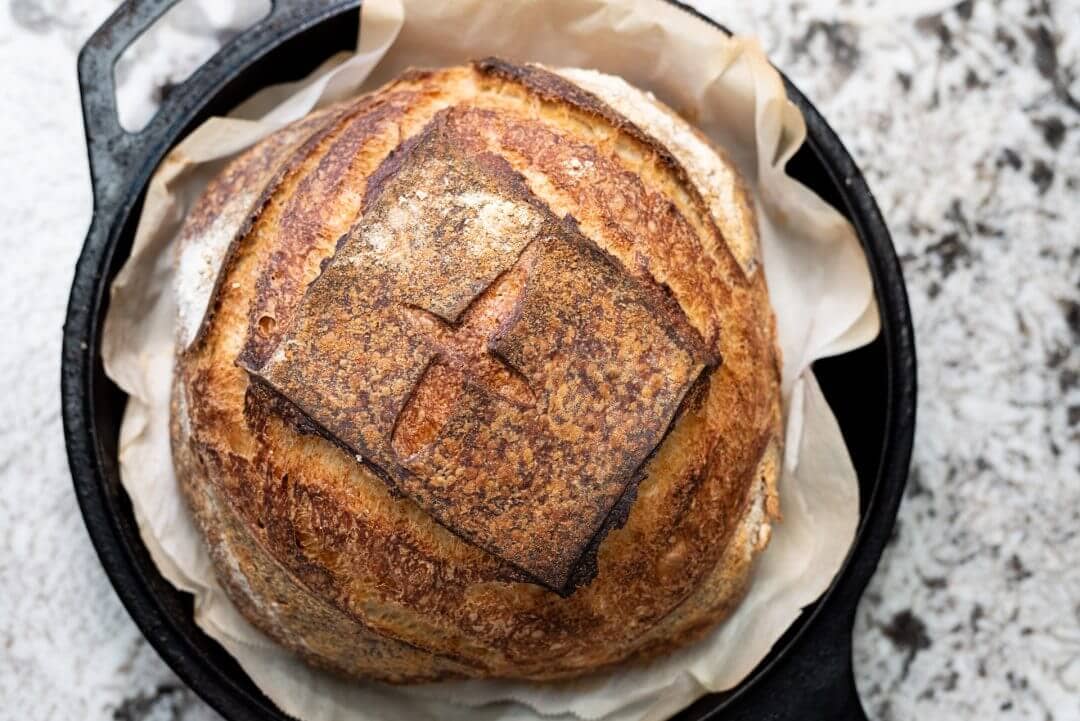
Learning how to bake bread in a Dutch oven is the first task many undertake when embarking on their bread-baking journey at home—myself included. Introducing steam in the home oven—a beneficial component in bread baking—can be a challenge, and a sealed pot makes this process simple and unassuming. During the initial stages of baking, steam is released from the dough into the sealed pot, where it is trapped and keeps the dough moist. This humid environment allows the bread to rise high and promotes a crispy and shiny crust.
In this comprehensive guide to baking bread in a Dutch oven, we’ll look at:
- Why using a Dutch oven (like this one, which is my favorite) to bake bread is a good idea (and what it does for your bread dough)
- The baking time and temperature necessary for baking in a Dutch oven
- How to avoid burning the bottom of your bread dough
- Links to my favorite (and high-quality) Dutch ovens
Real Quick: Why Bake Bread in a Dutch Oven?
A Dutch oven helps mimic the environment many professional bakers have in a bakery: a moisture-sealed chamber with intense, (mostly) even radiant heat. The Dutch oven’s thick cast-iron walls provide ample thermal mass, ensuring a temperature-stable baking environment. Additionally, the sealed interior traps steam, a beneficial component of baking bread. Moisture in the oven during the early part of baking allows your bread to rise fully, deepens the crust color, and finally adds a level of shine to the exterior.
Video: Watch Me Bake Bread in a Dutch Oven
Here’s a quick video showing how I use a Dutch oven in my kitchen to bake sourdough bread:
How To Bake Bread in a Dutch Oven, Step by Step
My method for baking bread dough in a Dutch oven:
- Preheat your home oven to 450°F (230°C) with a Dutch oven inside for 30 to 45 minutes
- Line a pizza peel, inverted baking sheet, or cutting board with parchment paper
- Turn out your proofed bread dough onto the parchment paper (trim the paper to fit, if necessary)
- Score your dough
- Slide the parchment paper with the dough into your preheated Dutch oven and return it to the oven
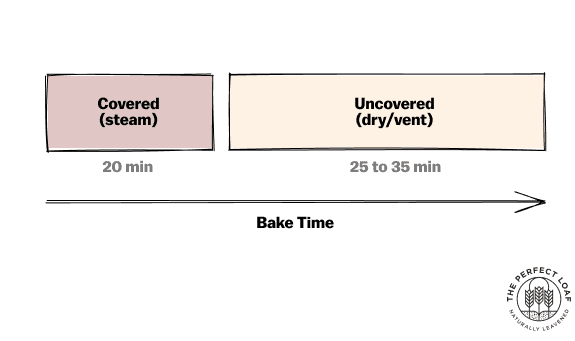
- Cover with the lid and bake for 20 minutes, covered
- After 20 minutes, remove the lid from the oven and continue baking per the recipe (typically 25 to 35 minutes)
When finished, a free-form loaf should have an internal temperature of around 206° to 208°F (96° to 97°C) when fully baked.
As with most things in baking, you might have to adjust the baking duration and oven temperature to suit your environment. See my guide to baking bread at high altitude if you’re a high altitude baker.
Should I Preheat a Dutch Oven When Baking Bread?
Yes, I always preheat my Dutch oven before baking bread dough inside. I’ve tested using a cold Dutch oven, and I don’t get the same oven spring or final loaf volume as when I bake bread dough in a preheated Dutch oven.
How To Remove Your Baked Loaf From a Dutch Oven
When your loaf is finished baking, use a pair of oven-safe gloves to carefully reach down into the pot to remove the bread. The crust will be fully hardened off by this time, so there’s no worry of collapse.
Additionally, if you baked your bread dough in the Dutch oven on a piece of parchment paper as I recommend here, you can lift the corners of the parchment to remove the baked loaf.
Why Bake Bread in a Dutch Oven (Or Any Sealed Pot)
A Dutch oven helps increase loaf volume
Without steam in the oven during the first part of baking (when oven spring occurs), the rapidly expanding dough quickly forms a hard crust on the exterior. This early crust formation limits optimal oven spring and reduces overall loaf volume, resulting in a squat, dense loaf.
Conversely, when you provide adequate steam, the exterior of the dough remains moist and supple, allowing it to expand and stretch further before starches gel and the crust hardens and sets.
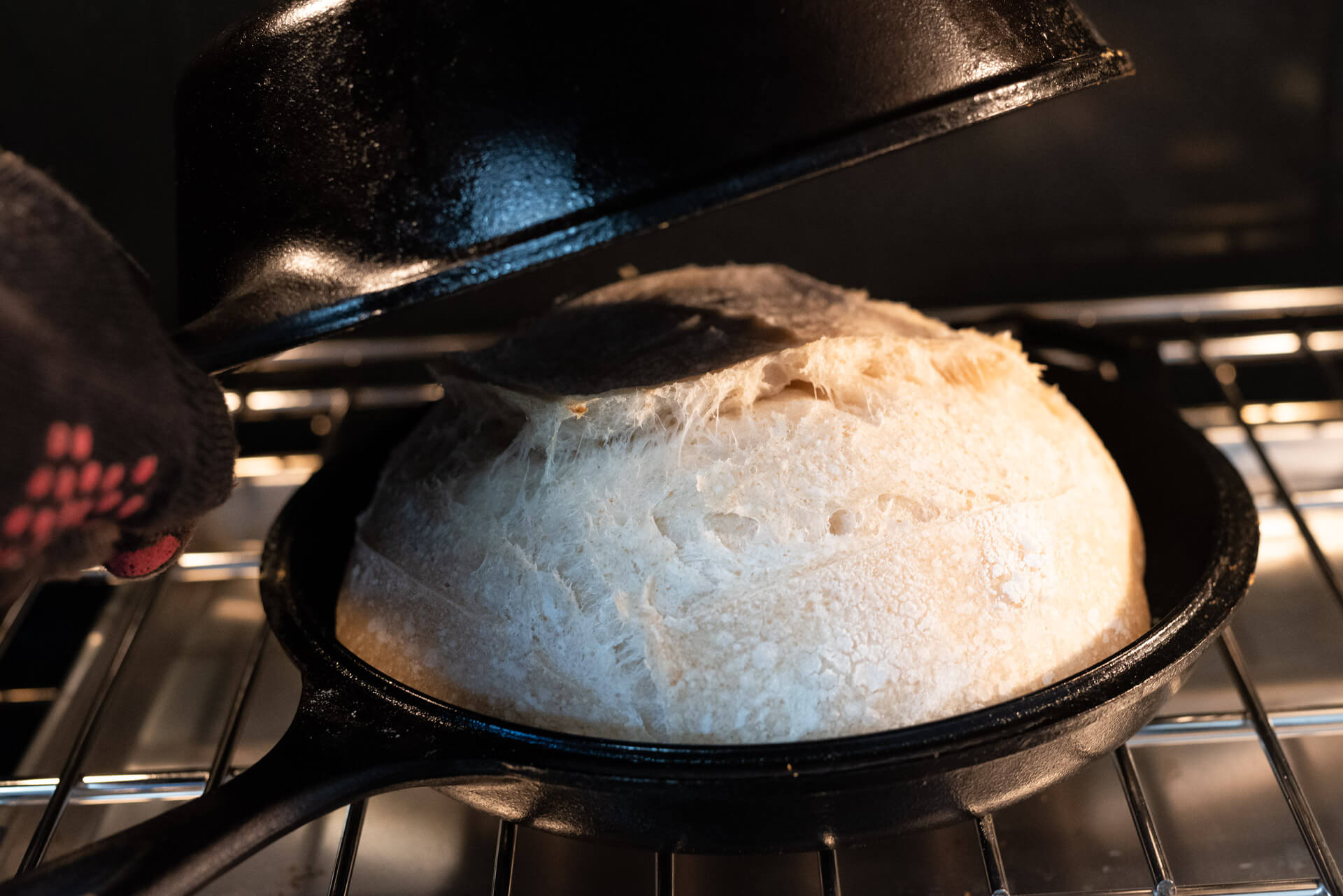
It doesn’t require much steam to provide benefit. When the pot is sealed during the first 20 minutes of baking, the moisture escaping from the dough provides the right environment to encourage optimal loaf volume.
Use a Dutch oven for a deeply colored and shiny bread crust
There’s little as elegant as a crust that’s well-colored with a gradient from almost-white to a deep mahogany—the contrast is striking. Add to this a subtle catch of light and shininess: your mouth starts watering even before the intoxicating aroma surrounds you.
As Jeffrey Hamelman states in his book BREAD, the reduced temperature on the exterior of the loaf allows the enzymatic activity to continue for longer. This activity, which has been happening throughout the entire fermentation process, continues to “unlock” sugars that contribute to crust color during baking.
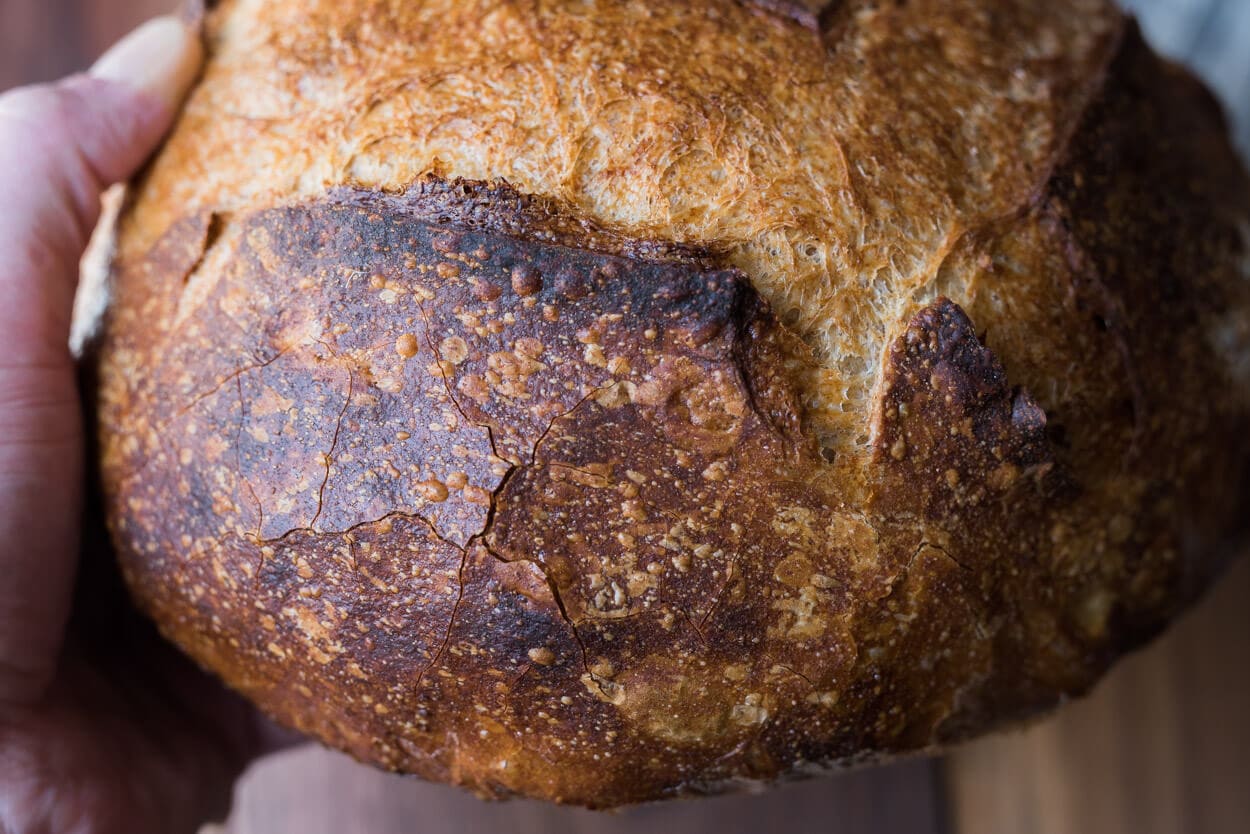
A well-steamed oven also promotes starch gelatinization: in the presence of heat, starch molecules on the exterior of the dough begin to absorb available moisture (hello, steam), start to swell, and eventually pop to form a thin liquid layer (starch gel). This layer finally bakes hard, forming a thin, crispy exterior with a subtle shine.
As we discussed earlier, steam in the Dutch oven’s closed environment settles on the outside of the dough, forming a thin layer that prevents the temperature from rising too quickly. This helps ensure the exterior of your loaf doesn’t darken before you finish baking the interior.
With all these benefits, baking in a sealed pot is a good idea. However, there are some issues with the method, the biggest being a thicker and possibly burned bottom crust. Let’s take a look at a few ways to help mitigate this issue.
How To Keep The Bottom of Your Bread From Burning
In my experience, baking in a Dutch oven typically produces a slightly darker bottom, even with the suggestions below. However, using one or more of these will significantly reduce this darkening.
My methods for ensuring the bottom of my loaf doesn’t burn when baking in a Dutch oven:
- Do not bake bread dough inside a Dutch oven on top of a baking stone
- Reduce the oven temperature during preheating
- Insulate the bottom of the Dutch oven with a baking sheet, baking stone, or even a single sheet of aluminum foil
- Add coarse cornmeal or wheat bran to the Dutch oven before adding your dough
- Use two pieces of parchment paper below the dough
- Remove the dough from the Dutch oven when it’s almost finished baking
Let’s look at each method to help prevent bread dough from burning.
1. Do not bake bread dough inside a Dutch oven on top of a baking stone
The first important thing is to ensure you are not baking with your Dutch oven on a baking stone, or even better, a Baking Steel. When the oven has finished preheating, the stone and the cast-iron pot will be far too hot, resulting in scorched or burned bread.
2. Reduce the oven temperature during preheating
The first approach is to modify your baking temperatures. If you find the bottom crust is burning or becoming too thick, reduce the preheat temperature. For example, some of my recipes here call for a 45-minute preheat at 450°F (230°C); you could reduce it to 425°F (218°C).
3. Insulate the Dutch oven with a baking sheet or stone
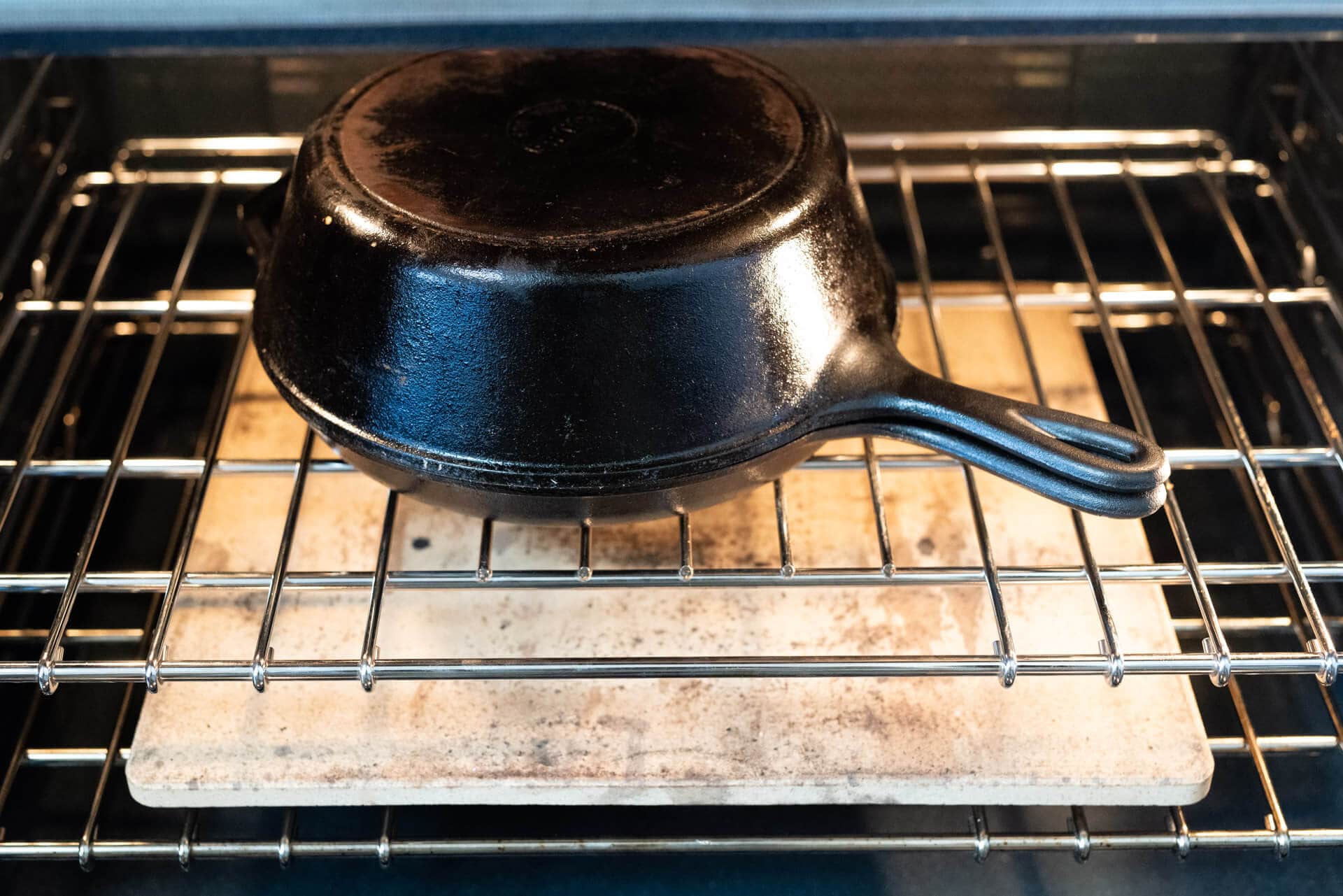
Most ovens have a bottom heating element that can provide far too much heat on the bottom of your dough, especially if you place the rack too close. An insulator, such as a baking sheet or stone, can provide enough thermal mass between the heating element and your dough. This will help insulate your dough when the heating element kicks on, which happens often.
Place a rack on the bottom of your oven, and then place another one or two rungs above that. Place your baking surface on the bottom rack. Then, use the rack above to hold your Dutch oven when baking.
Additionally, a thin aluminum baking sheet, or even a single layer of aluminum foil, placed underneath the Dutch oven will help reflect most of the infrared heat from the bottom of your home oven.
4. Use coarse cornmeal or wheat bran
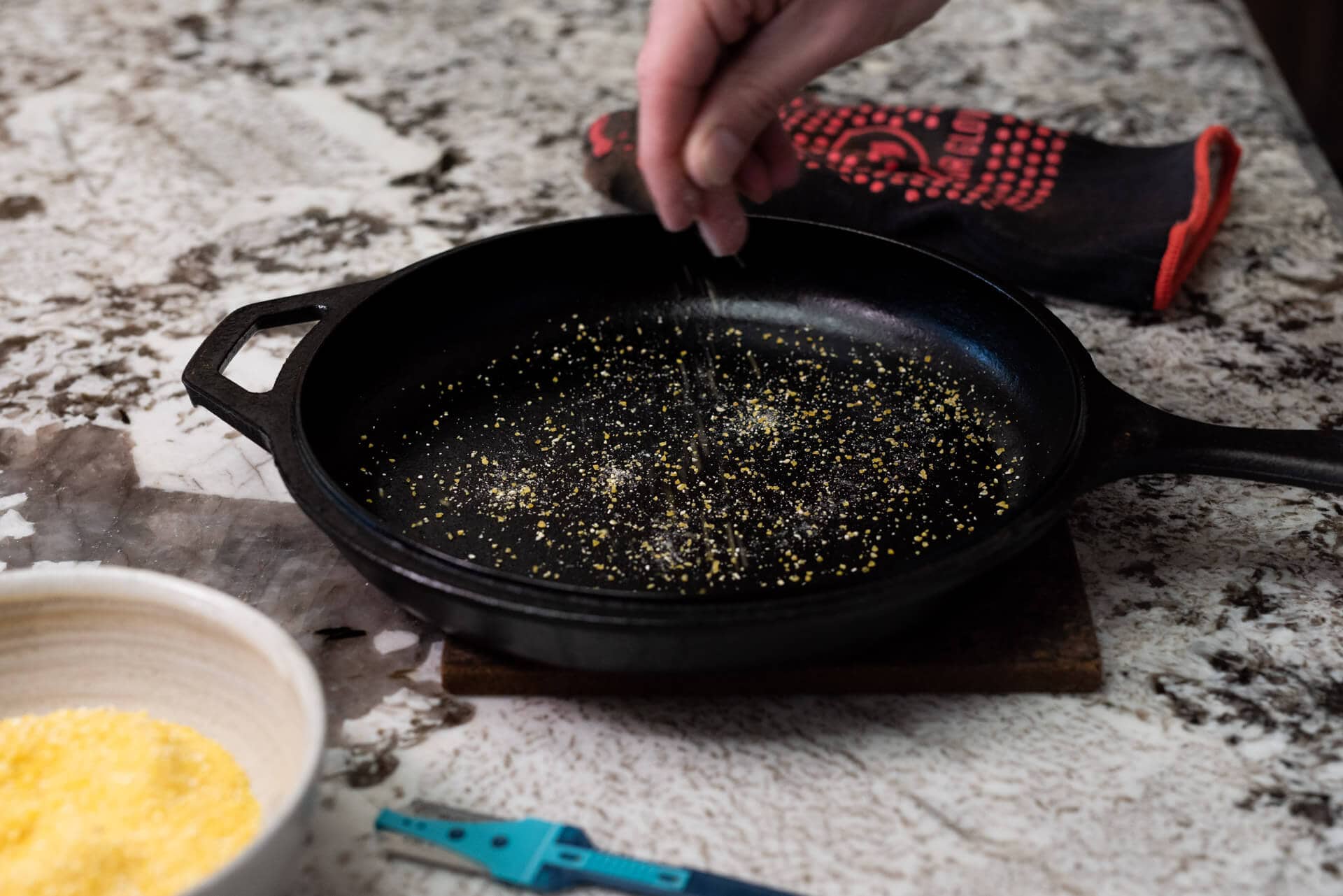
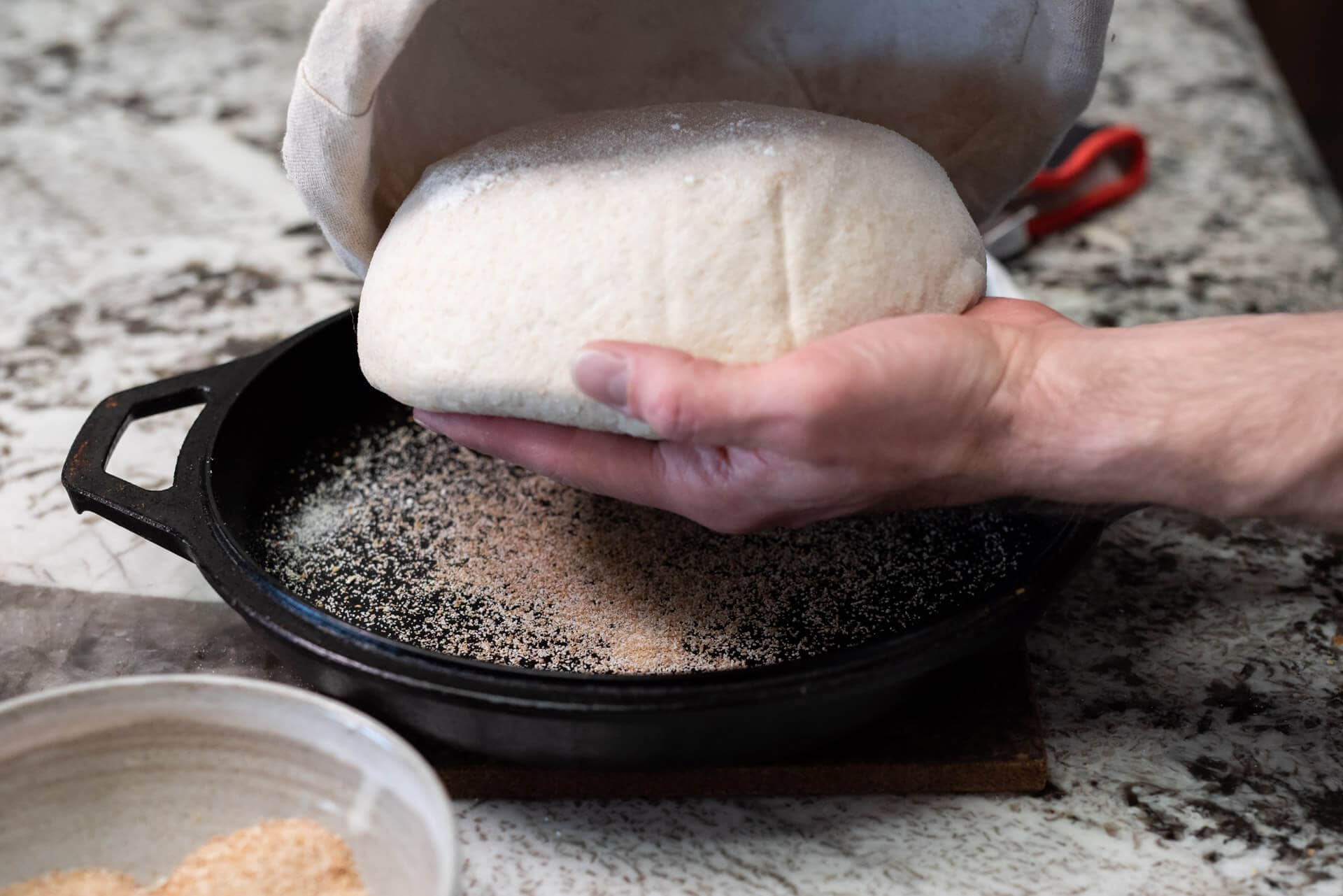
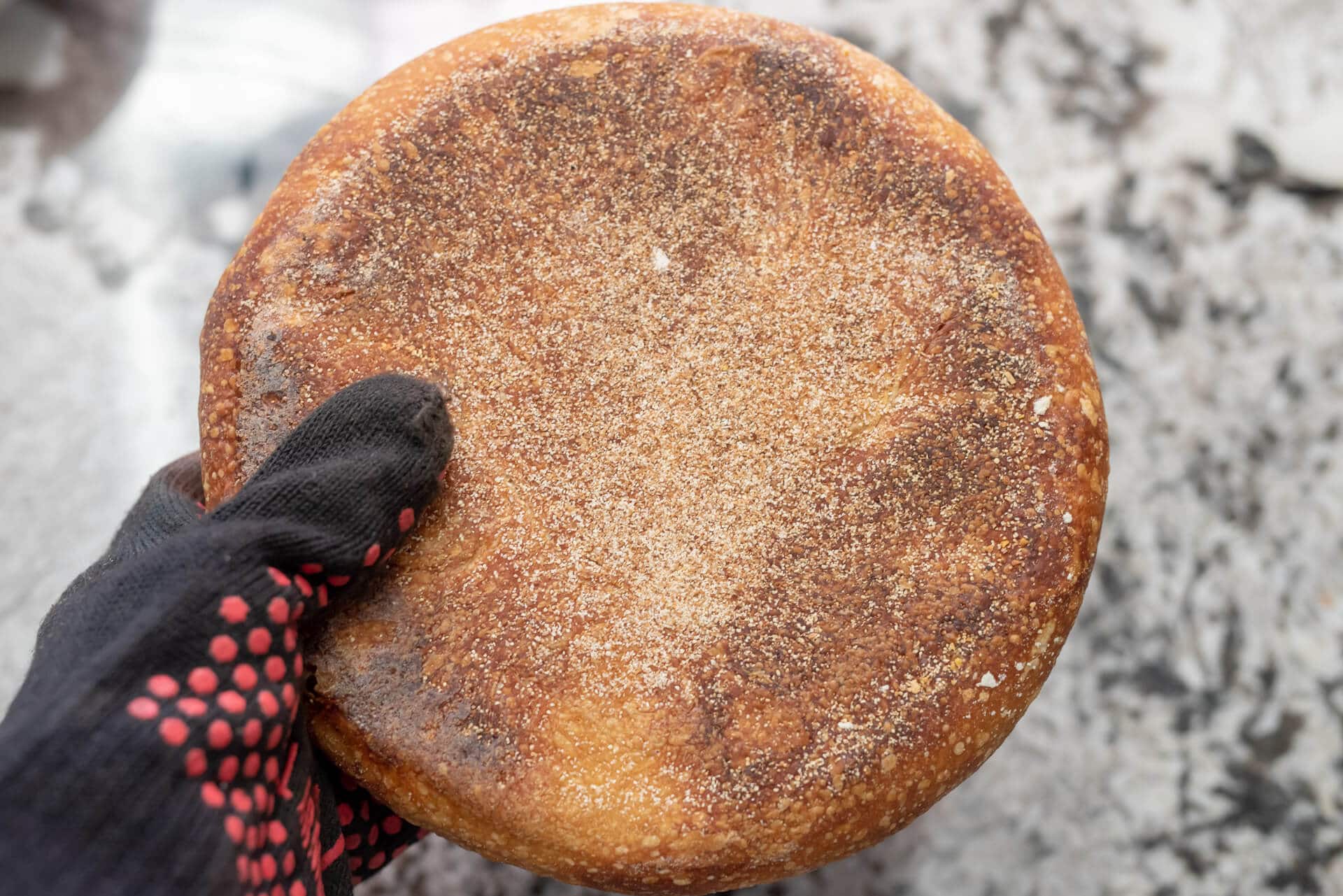
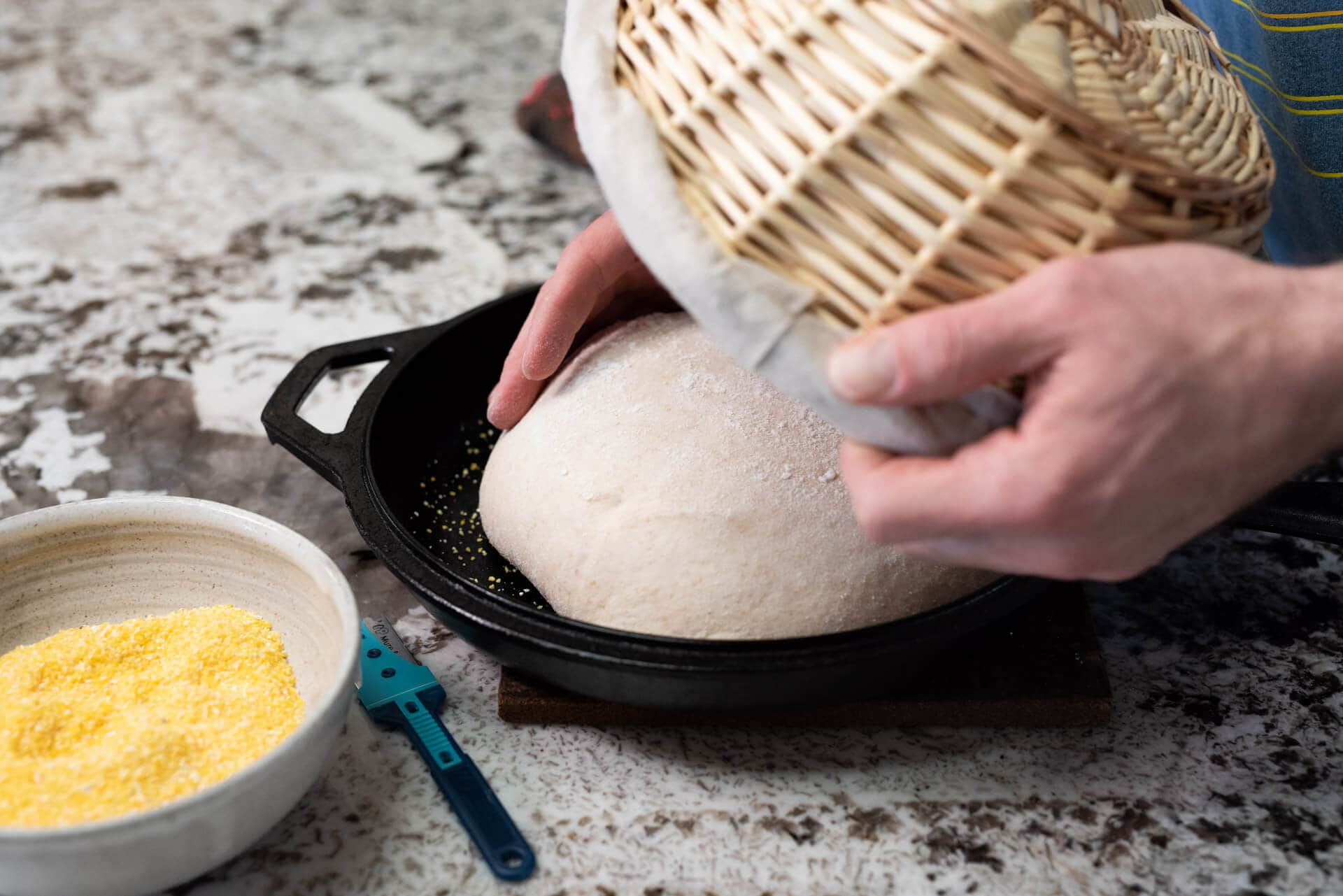
Coarsely ground corn (polenta or corn grits) works exceptionally well to provide a thin layer of insulation between your dough and the Dutch oven. This layer helps keep the dough from sticking to the cast iron while also lifting it to prevent burning.
Sprinkle a generous amount of coarse corn onto the preheated pan just before turning your dough onto it to score. Cover the pot with the deep end and center it over your baking stone insulator, as shown above.
If you frequently mill your own flour and have a sifting screen, save the wheat germ or bran you sift out. These coarse particles (which you can always add to the dough later) perform a similar function to the corn.
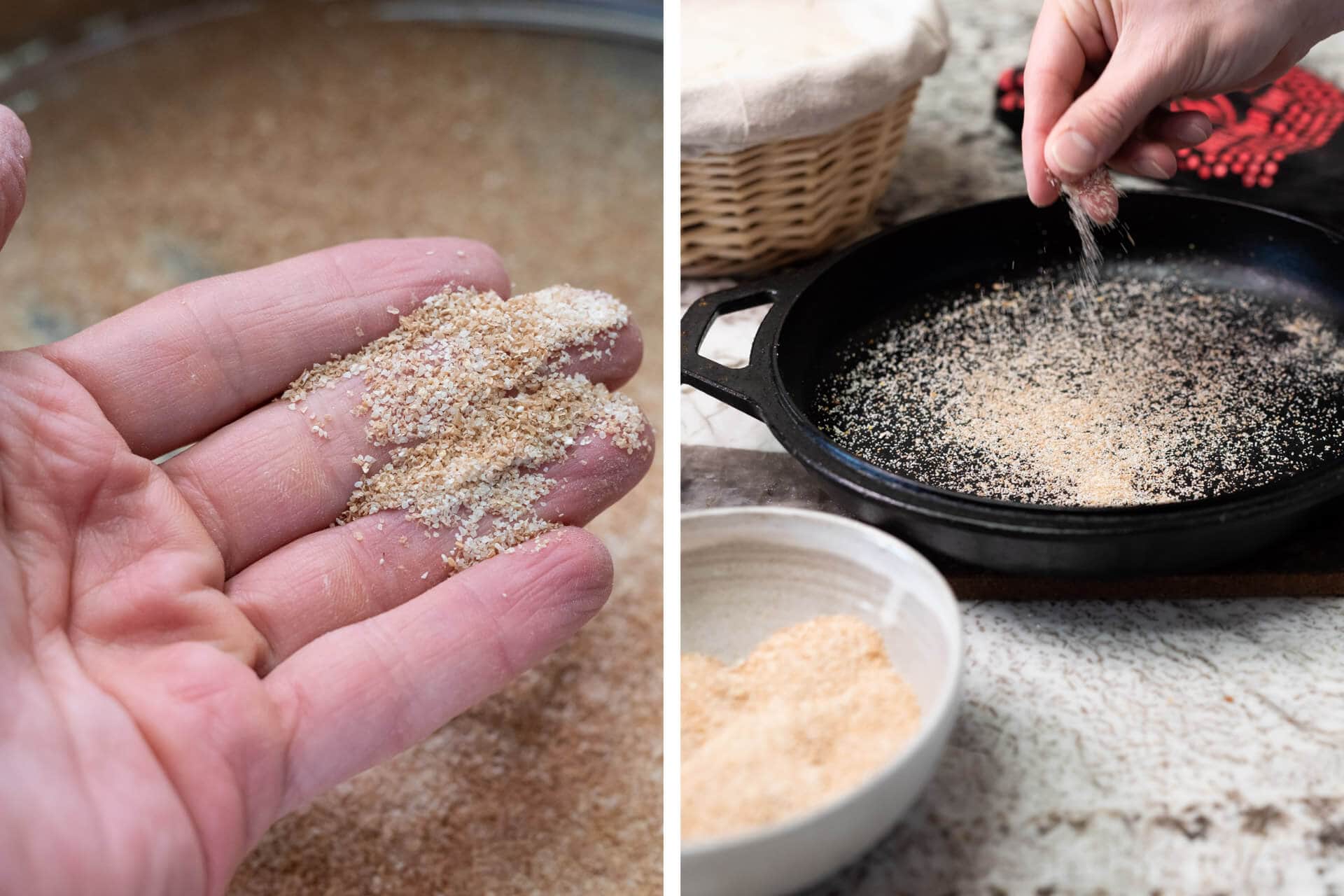
The image above shows the large germ/bran particles I’ve sifted out with my sifting screen. The fine, high-extraction flour falls through my screen into a bowl that I can add when mixing my bread dough. Then, I collect these larger bits to either add to the dough as porridge or use to coat the bottom as insulation.
Bake on two pieces of parchment paper to help prevent burning
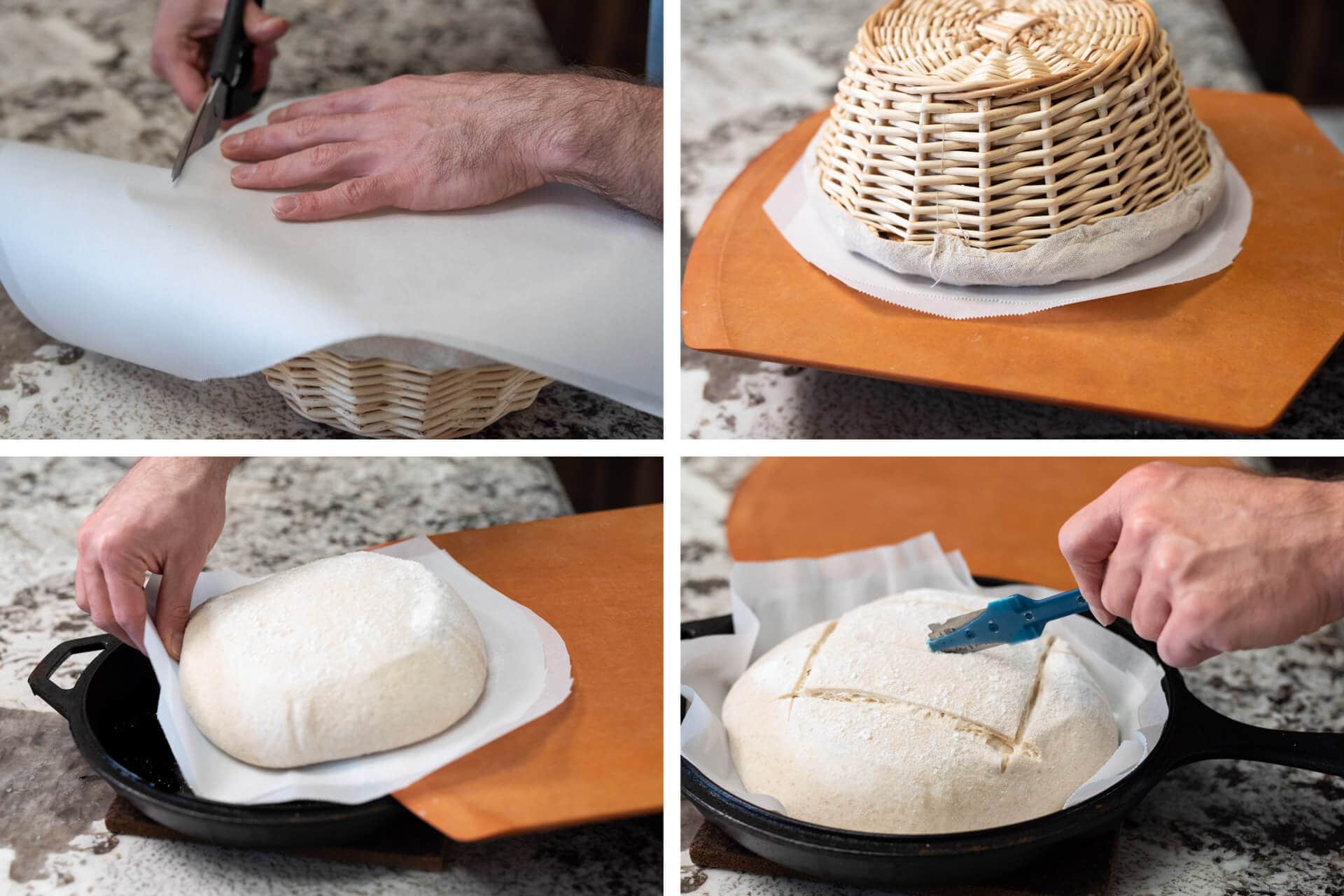
As you might have noticed in my Beginner’s Sourdough recipe, I typically use parchment paper (I love this natural, non-stick option) to help drag dough into the blisteringly hot Dutch oven. As I describe in that recipe post, lay a sheet of parchment paper over your proofing basket containing the dough, and cut it to fit. Invert the basket on a pizza peel, slide the parchment into the preheated Dutch oven, score the dough, and bake.
In this approach, you will follow the same process as before, except you’ll layer two pieces of parchment on top of each other to help further insulate the dough.
Additionally, you can sprinkle coarse corn (as discussed above) into the pan before you drag it into the parchment holding your dough. The corn will not stick to the dough, but it will help further insulate it and prevent burning.
To prevent burning, remove the dough from the Dutch oven when it’s almost done
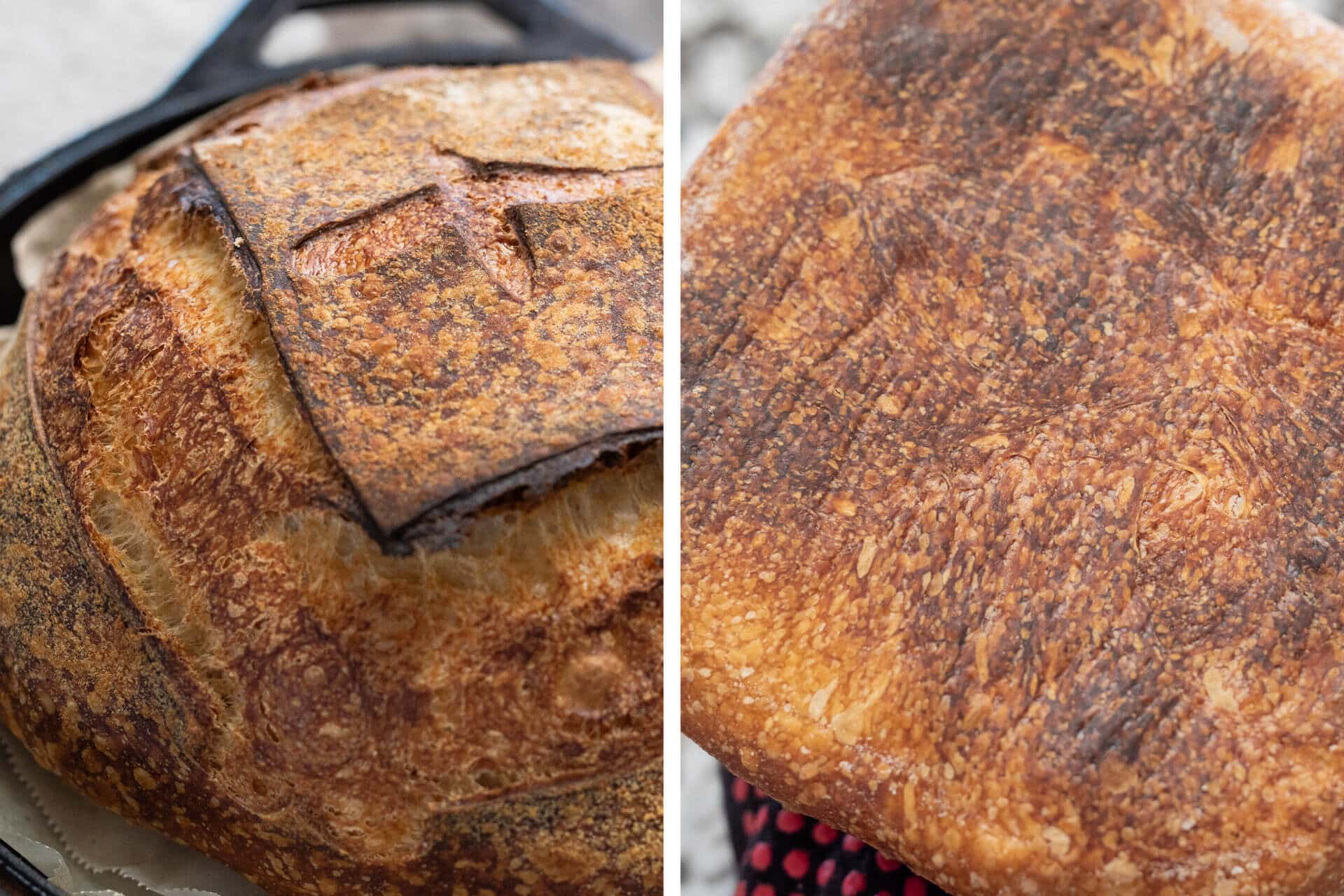
Another method to help prevent burning your bread dough in a Dutch oven is to remove it once the crust has set, about 30 minutes into baking. This means the dough has baked for 20 minutes with the lid on (and with steam), then uncovered and baked for another 10 minutes.
By this time, the crust should be a pale golden brown and sturdy enough to gently lift the dough from the Dutch oven to finish baking on the oven rack.
Additionally, remove both sides of the Dutch oven and the parchment paper at this time and continue baking until done.
Recommended Dutch Ovens and Combo Cookers
There are many types of Dutch ovens (lidded pots) and combo cookers out there, made from a range of materials, shapes, and sizes, and at varying quality levels. Any Dutch oven or combo cooker will work for baking bread if it’s oven-safe up to 450°F (230°C) and has a tight-fitting lid.
The following is a list of my favorite Dutch ovens for baking bread. I’ve used the following pots for years, and they’ve helped me make countless loaves of sourdough bread.
Note that some pots cannot be preheated empty, so check with the manufacturer if you are unsure.
3.2 Quart Lodge Combo Cooker
| Maximum dough weight | 900g |
| Material | Cast iron |
My favorite Dutch oven (or combo cooker, as Lodge calls it) is the Lodge 3.2-quart cast-iron combo cooker. I’ve been using the same combo cooker since I started baking bread many years ago, and it still looks new. It’ll likely last a lifetime.
This pot is extremely versatile, and I use it for a myriad of other kitchen tasks besides baking bread. I frequently use it to make the wonderful Tartine French toast and crispy-bottomed sourdough cinnamon rolls, and the deep end makes a mean roast chicken.
I’ve comfortably fit bread dough sizes from 500g to 900g in the pot. As with all cast iron, keep it seasoned.
The Dutch Oven Is Heavy. Is There A Lightweight Option?
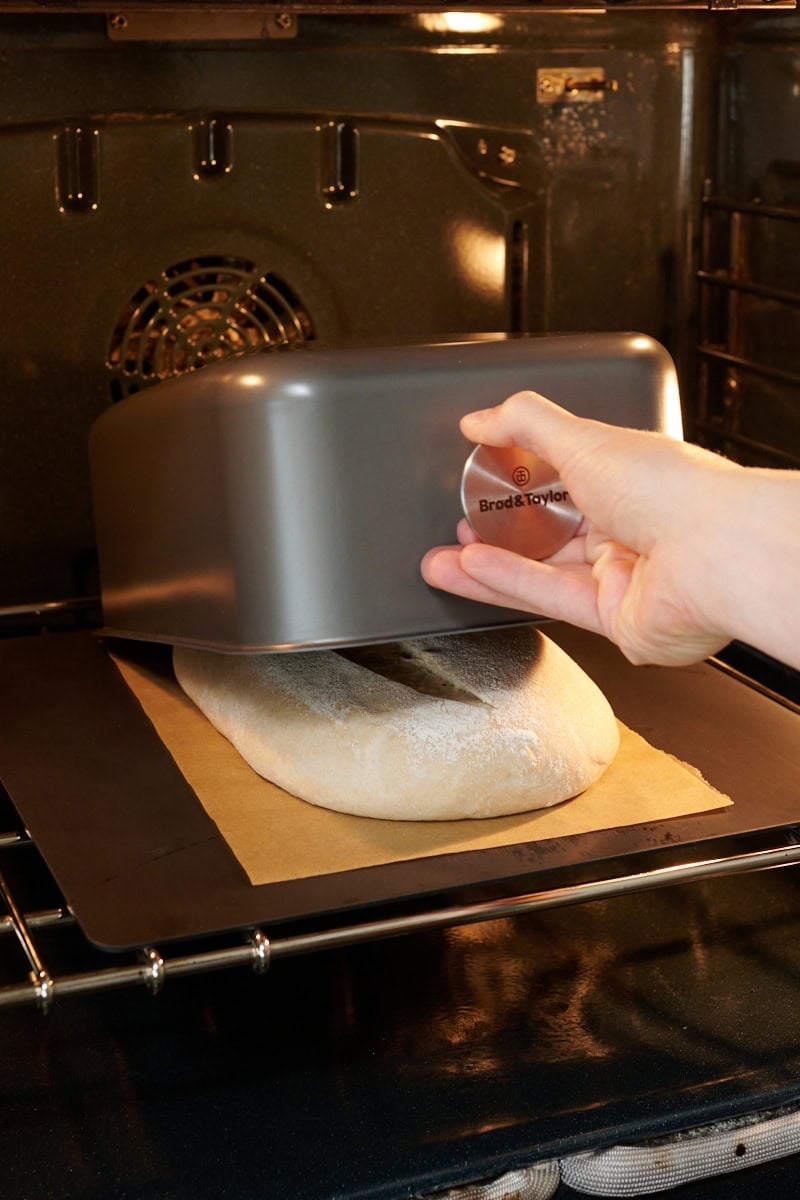
Instead of using a heavy pot to bake your sourdough bread, the new Baking Shell is a metal cover that traps steam and weighs just over 1 pound! If you struggle to move your Dutch oven in and out of the oven, the Baking Shell is perfect for you.
How Do You Bake Bread Without a Dutch Oven?
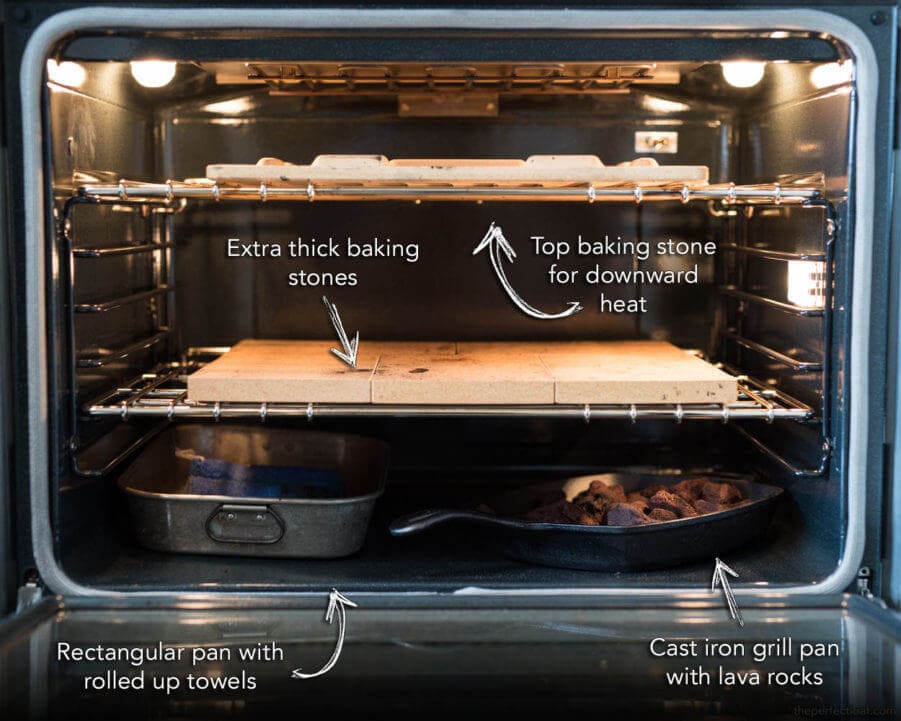
While using a Dutch oven to bake bread is straightforward, I still enjoy steaming my home oven and baking my sourdough bread directly on a baking surface. With this alternate method, it’s easy to bake two long bâtards (even up to 1.2 kg if your surface is large enough).
Ultimately, use whatever method is most comfortable for you and that you use often for the bread you bake. And if you’re like me, you might often switch between methods.
Baking Bread in a Dutch Oven FAQs
Do you oil a Dutch oven when baking bread?
No, no oil is necessary to bake bread in a Dutch oven.
What is the best size Dutch oven for bread?
I like to use a 4 or 5-quart Dutch oven or a 3.2-quart combo cooker for baking bread. These sizes are large enough to accommodate most bread recipes. If you have a larger Dutch oven, that will work just fine, too.
Should I preheat a Dutch oven when baking bread?
Yes, I always like to preheat the Dutch oven inside my home oven before baking bread. I find a preheated Dutch oven helps encourage maximum oven spring (the amount the dough rises in the oven) at the start of baking.
Can I reuse the parchment paper used to bake bread?
Yes, absolutely! I typically use the same square of parchment paper two to three times before needing a new one.
Why did my sourdough bread burn on the bottom?
It likely was baked for too long at too high a temperature. Reduce the bake time and temperature until it no longer burns. Use the suggestions in this guide post to help reduce burning on the bottom of your bread dough.
Do I have to season my Dutch oven?
Yes, I periodically season the Dutch oven I use to bake my bread—it is cast iron after all. I simply apply a thin layer of vegetable oil to the entire pot.
What’s Next?
And now that you’ve baked a loaf (or two), be sure to read my guide on how to store baked bread to ensure it stays fresh for as long as possible!
If you still have questions about the baking process or are looking for tips on scoring your dough before baking, see my full guide to baking sourdough bread.